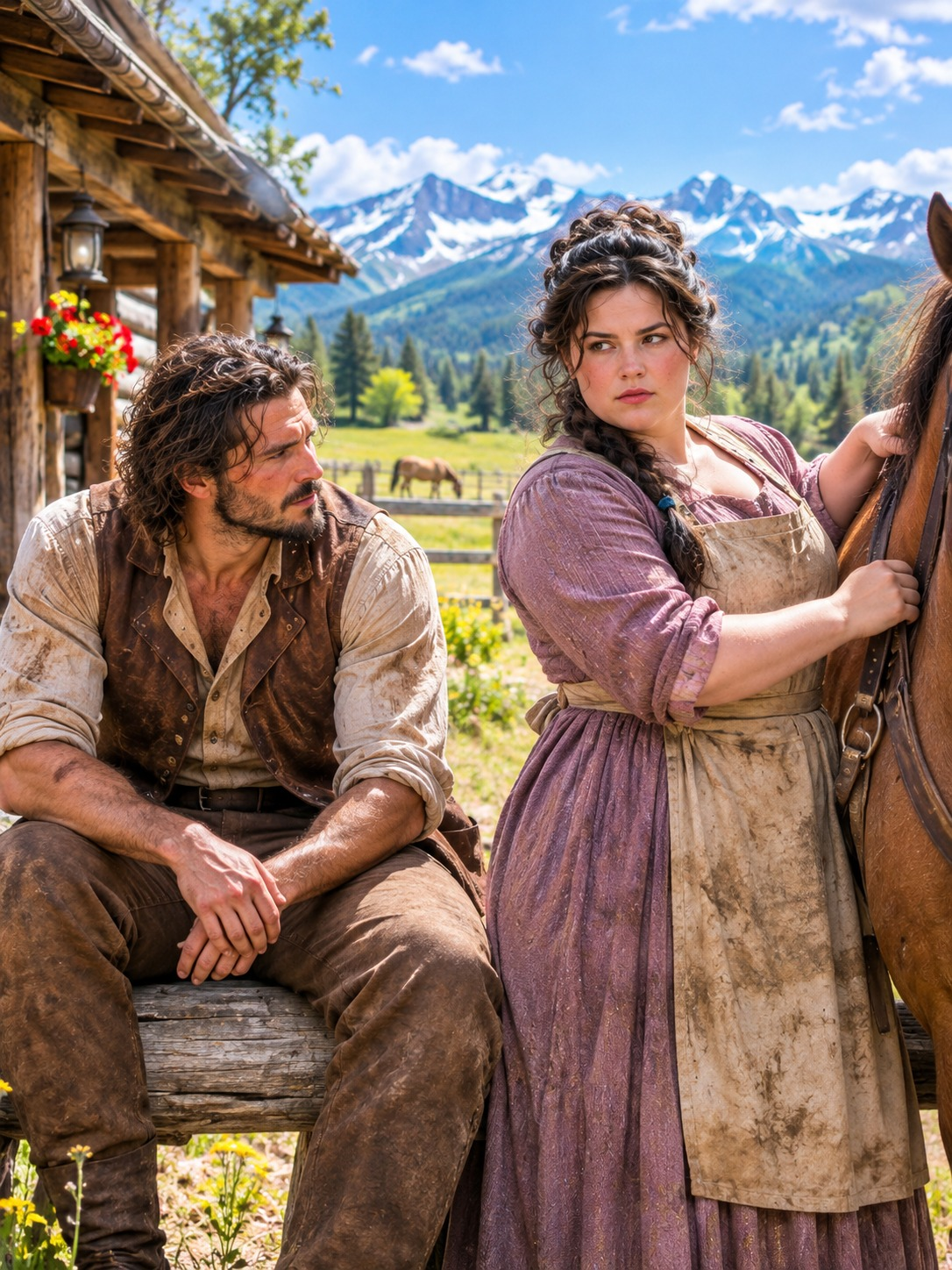
"You're not supposed to be here, Thomasine."
Thomasine froze.
The man stepped out from behind the old saddle rack.
It was Ss.
The oldest ranch hand on the Ashford property stood holding Eleanor's missing ledger against his chest.
His weathered face looked unusually pale.
Thomasine stared at the book.
Then she looked at the photograph attached to its first page.
A woman stood beside Eleanor Ashford.
She had dark hair, tired eyes, and a familiar smile.
Thomasine knew that face.
She had seen it in family photographs, in the small wooden box she had carried from Fort Macleod, and in the few memories she still held of her childhood.
It was her mother.
Lydia Old.
But there was something written beneath the photograph that made Thomasine's stomach tighten.
Lydia Old — Original Ranch Accounts, September 2019.
Her mother had died believing that her years of working in private households had been nothing more than ordinary employment.
She had never mentioned the Ashford ranch.
Not once.
"Where did you get that?" Thomasine asked.
Ss looked down at the ledger.
"I found it."
"That's not what I asked."
He looked toward the open barn door.
"Put your voice down."
Thomasine took one step closer.
"Why is my mother's photograph in a book belonging to this family?"
Ss tightened his grip.
"Because your mother worked here."
The words seemed to strike the air between them.
Thomasine shook her head.
"No."
"She did."
"That's impossible."
"Not according to Eleanor."
Thomasine looked at the photograph again.
Her mother was smiling.
Eleanor had one hand resting on Lydia's shoulder.
They looked comfortable together.
Not like an employer and an employee.
Like two women who had known each other for years.
Thomasine swallowed.
"How long?"
Ss hesitated.
"Almost three years."
"Why didn't she ever tell me?"
"Maybe she wanted to protect you."
Thomasine stared at him.
"From what?"
Ss did not answer.
Instead, he closed the ledger.
Then he said something that made her blood run cold.
"Your mother wasn't the first person to discover what Richard Voss was doing."
Crane heard Thomasine shout from the barn.
He was already halfway down the porch steps when Beck appeared from the equipment shed.
"What happened?"
"She's in the barn."
Beck looked toward the building.
Crane tightened his grip on his cane.
"Get over there."
Beck moved ahead.
Crane followed as quickly as his injured knee allowed.
Every step hurt.
His ribs protested with each breath.
But when he reached the barn entrance and saw Thomasine standing opposite Ss, he forgot about the pain.
The ledger was in Ss's hands.
"What are you doing with that?" Crane demanded.
Ss turned.
His expression changed.
"Crane."
"Give me the book."
Ss looked toward Thomasine.
Then back at his employer.
"There's something you need to understand."
"I've been trying to understand something for four years."
Crane stepped closer.
"Give me the ledger."
Ss hesitated.
Thomasine spoke quietly.
"He's holding my mother's photograph."
Crane looked at the open page.
His eyes settled on Lydia Old's face.
He glanced at Thomasine.
Then at Ss.
"What is this?"
Ss lowered the book.
"Her mother worked here."
Crane stared at him.
"Since when?"
"Before Eleanor died."
"Why wasn't I told?"
Ss looked away.
"Because Eleanor asked me not to tell you."
Crane's jaw tightened.
"Everybody seems to have been keeping secrets from me."
Nobody answered.
He looked at Thomasine.
"Did you know?"
She shook her head.
"Never."
Crane looked at the photograph again.
"Why would Eleanor have a picture of your mother?"
Thomasine's voice was unsteady now.
"I don't know."
Ss opened the ledger.
"Because Lydia helped her."
He turned several pages.
There were columns of numbers, dates, names, and handwritten notes.
Some entries had been marked in red.
Others had been crossed out.
"Your wife discovered that money was being taken from the ranch accounts," Ss explained. "Lydia was the one who helped her trace it."
Crane looked at the pages.
"How much?"
Ss pointed to a series of transactions.
"Over four years, somebody moved money through several accounts. Some of it went into a company registered under a different name."
Crane recognized the name immediately.
Ashford Land Holdings.
He looked up.
"Richard."
Ss nodded.
"Richard was involved. But he wasn't working alone."
Crane's eyes narrowed.
"Who else?"
Ss closed the ledger.
"That's what Eleanor was trying to find out."
Thomasine looked at him.
"And my mother?"
Ss looked directly at her.
"She found the original records."
Thomasine could barely hear the wind moving through the barn.
Her thoughts had become trapped around one question.
Why had her mother never told her?
She remembered Lydia as a hardworking woman who rarely complained.
She remembered her mother coming home late from private jobs, washing her hands, and sitting at the kitchen table with a cup of tea.
Sometimes she would stare at the wall for several minutes.
Thomasine had assumed she was tired.
Now those memories seemed different.
"Did my mother know Eleanor was afraid?" she asked.
Ss nodded.
"Yes."
"Did she know what Richard was doing?"
"She helped uncover it."
"Then why did she leave?"
Ss looked toward the barn entrance.
"Because Eleanor told her to."
Thomasine frowned.
"Why?"
"She believed somebody had started watching Lydia's house."
Thomasine felt a chill.
"Who?"
"I don't know."
"Did anybody threaten her?"
Ss looked at the ground.
"Not directly."
Thomasine's eyes narrowed.
"What does that mean?"
He hesitated.
Then he spoke.
"One evening, Lydia came here to meet Eleanor. When she returned home, somebody had gone through her belongings."
Thomasine stared at him.
"Did she report it?"
"No."
"Why not?"
"Because the next morning, she received a photograph of you."
Thomasine stopped breathing.
She remembered being sixteen.
A photograph had arrived in the mail showing her standing outside her school.
Her mother had taken it from the envelope and immediately burned it.
When Thomasine had asked who sent it, Lydia had told her it was probably a mistake.
She had never mentioned it again.
Thomasine looked at Ss.
"How do you know about that?"
"Your mother told Eleanor."
Thomasine pressed her fingers against her forehead.
"Why would somebody photograph me?"
Ss's expression became grim.
"Because they wanted Lydia to stop asking questions."
Crane looked toward the open barn door.
"Who knew about this?"
"Very few people."
"Name them."
Ss counted slowly.
"Eleanor. Lydia. Silas. Me."
He paused.
"And Richard."
Crane's face hardened.
"Then Richard knew about Thomasine before she arrived."
Ss nodded.
Thomasine turned toward the doorway.
The realization was beginning to take shape.
Her arrival at the ranch might not have been an accident.
She had answered an ordinary employment advertisement.
She had traveled from Fort Macleod expecting a difficult job and a remote house.
But someone had already placed her name in a ledger that had been hidden for years.
She looked at Crane.
"Did you know my mother?"
He shook his head.
"Not personally."
"Did Eleanor ever mention her?"
Crane looked troubled.
"She mentioned a woman named Lydia once. I thought she was talking about someone who helped with the accounts. I never connected the name to you."
Thomasine looked down.
Her mother had been part of this family's history.
And nobody had told her.
They carried the ledger back to the house.
Crane insisted on keeping it in his office.
Beck locked the door after them.
Thomasine remained near the kitchen table, staring at the photograph.
She could not stop thinking about the woman in the picture.
Her mother had stood beside Eleanor with a confidence Thomasine had rarely seen at home.
She looked younger.
Happier.
Almost relieved.
"What happened to her?" Crane asked.
Thomasine looked up.
"My mother?"
He nodded.
"How did she die?"
Thomasine took a breath.
"Three years ago. She became ill quite suddenly."
Crane's expression softened.
"I'm sorry."
"Thank you."
"Was it a long illness?"
"No. At first, we thought it was exhaustion. She kept saying she was tired. Then she started having trouble breathing."
Thomasine looked down at her hands.
"By the time we understood how serious it was, she was already in the hospital."
Crane remained silent.
"She died two weeks later."
Thomasine paused.
"I never knew she had been afraid of anybody."
Beck stood near the doorway.
Ss looked uncomfortable.
Then Thomasine asked the question nobody seemed prepared to answer.
"Did my mother die because of what she discovered?"
Ss looked up.
"No."
His answer came too quickly.
Thomasine noticed.
"How do you know?"
"She was sick."
"That doesn't answer my question."
Ss lowered his head.
"I don't know everything."
"Then tell me what you do know."
He looked toward Crane.
Crane nodded.
"Tell her."
Ss sighed.
"Before Lydia left the ranch, she gave Eleanor a second copy of the original accounts. She believed the first copy had been stolen."
"Where is the second copy?"
"I don't know."
Thomasine looked at the ledger.
"Is this the original?"
Ss shook his head.
"No. This is the working ledger."
"Then where is the other one?"
He hesitated.
"Eleanor said she had placed it somewhere nobody would think to look."
Crane leaned forward.
"Where?"
Ss shook his head again.
"She never told me."
Thomasine looked at the photograph.
There was something written beneath it that she had not noticed before.
A small handwritten number.
17.
She pointed toward it.
"What's that?"
Ss leaned closer.
His face changed.
"That's not a date."
Crane looked at him.
"What is it?"
Ss slowly turned the page.
"That's a storage reference."
The following morning, Thomasine woke before sunrise.
She had slept badly.
Every time she closed her eyes, she saw her mother's photograph.
She kept remembering the envelope that had arrived when she was sixteen.
The photograph of her outside school.
Her mother's frightened expression.
The sudden decision to move to another neighborhood.
At the time, Lydia had explained everything as ordinary family difficulties.
Now Thomasine wondered whether those explanations had been designed to keep her safe.
She dressed and went downstairs.
The kitchen was cold.
She lit the stove and prepared coffee.
Then she opened the wooden box she had brought from Fort Macleod.
Inside were several old photographs.
A picture of her mother standing beside a garden.
Another showing them together at a family picnic.
And one small envelope.
Thomasine had not opened it in years.
Her mother's handwriting appeared across the front.
For Thomasine, when she's ready.
She stared at it.
She had received the envelope shortly before Lydia died.
At the time, she had been too frightened to open it.
She had placed it in the box and told herself she would read it later.
Now she understood that later had become years.
She carefully opened the envelope.
Inside was a single sheet.
My darling girl,
There are things I should have told you about my past. I wanted to explain them when you were older, when I could be certain you would understand why I made certain choices.
I worked for a family in the foothills many years ago. I met a woman named Eleanor who became more than an employer to me.
She trusted me with something important.
I promised her I would keep it safe.
If anyone ever comes asking questions about the Ashford ranch, do not assume they are trying to help you.
And if you ever meet a man named Richard Voss, remember this: he knows what happened to the original ledger.
Thomasine read the final sentence twice.
Then she noticed something written at the bottom.
A separate line.
In darker ink.
If Eleanor is gone, find the woman called Margaret.
Thomasine sat down.
She looked at the envelope again.
The date was four years old.
Her mother had written it shortly before she died.
And she had never told Thomasine anything about Margaret.
At breakfast, Crane noticed that Thomasine was unusually quiet.
He sat at the table with his coffee.
His ribs were still painful, and his knee had begun swelling again.
But he was more concerned about the documents in his office.
"Did you sleep?"
"A little."
"Something wrong?"
Thomasine placed the letter beside his cup.
"I found this in my mother's belongings."
Crane read it.
His expression changed when he reached Richard's name.
Then he read the final line.
"Margaret."
He looked up.
"She mentioned Margaret too?"
Thomasine nodded.
"She told me to find her."
Crane leaned back.
"Then we need to find her."
"Silas said he knew her."
"Where is Silas?"
"Outside."
Crane called for Beck.
The foreman entered a moment later.
"Find Silas."
Beck nodded.
He returned several minutes later.
"He's gone."
Crane frowned.
"What do you mean, gone?"
"His room is empty."
"His truck?"
"Still here."
Crane looked toward the hallway.
"Where would he go without his truck?"
Beck shook his head.
"I don't know."
Thomasine looked at the kitchen window.
The morning was quiet.
Then she noticed something outside.
A small piece of white paper had been placed beneath the front door.
She walked over and picked it up.
There was no envelope.
Only a handwritten message.
STOP LOOKING FOR MARGARET.
Crane took the paper.
His expression hardened.
"Who brought this?"
Nobody answered.
He turned it over.
On the back was another sentence.
YOUR MOTHER SHOULD HAVE KEPT HER PROMISE.
Thomasine felt her hands go cold.
Crane looked at her.
"You're not leaving this house alone."
She nodded.
But her eyes remained on the note.
Someone knew about the letter.
Someone knew what Lydia had written.
And someone was still watching the ranch.
By noon, Beck had searched the barn, the equipment shed, the bunkhouse, and the paddock.
There was no sign of Silas.
His personal belongings were still in his room.
His coat was hanging behind the door.
His boots were missing.
Crane was furious.
"Find him."
Beck stood beside the desk.
"I've checked the property."
"Then check again."
"Crane, we need to be careful."
Crane looked at him.
"Careful? Somebody has been threatening my employee, stealing my wife's documents, and moving money out of my ranch. How much more careful do you want me to be?"
Beck said nothing.
Then Thomasine entered.
She was holding a small object.
It was a brass key.
"I found this beneath the kitchen cupboard."
Crane looked at it.
"Where?"
"Behind the loose panel where I found Margaret's note."
Beck took the key.
He examined it.
Then his expression changed.
"This belongs to the old storage room."
Crane frowned.
"What storage room?"
"The one behind the northern barn wall."
Crane stared at him.
"I thought that room had been sealed."
"It was."
"Why?"
Beck looked toward Thomasine.
"Because Eleanor asked us to keep it locked."
Crane stood as quickly as his injury allowed.
His face tightened.
"Get the truck."
Thomasine looked at him.
"What's inside?"
Crane shook his head.
"I don't know."
"Then why did Eleanor seal it?"
He looked at the key.
"Because she didn't want anyone finding what she left there."
They reached the old storage room shortly after one.
The entrance was hidden behind several weathered boards.
Beck removed them carefully.
A narrow wooden door appeared.
It had a small brass lock.
Thomasine held the key.
Crane looked at her.
"Are you sure?"
She nodded.
She inserted it.
The lock turned.
Beck pulled the door open.
Inside was a small room.
Dust covered the shelves.
An old wooden desk stood against the far wall.
There were boxes, rolled maps, and several sealed containers.
Thomasine stepped inside.
She noticed a photograph hanging above the desk.
It showed Eleanor.
Beside her stood Lydia.
And between them was a third woman.
Crane moved closer.
His face changed.
"Margaret."
Thomasine examined the photograph.
The woman looked to be in her late forties.
She wore a dark coat and had short blond hair.
A small silver brooch was pinned near her collar.
Beneath the photograph was a handwritten inscription.
The three of us knew the truth.
Crane looked toward the shelves.
"What truth?"
Thomasine opened the first box.
Inside were old account books.
The second contained several letters.
The third held a small cassette recorder.
Beck examined the desk.
"There are papers here."
Crane approached.
One document was folded inside a leather folder.
He opened it.
The first page contained a list of property transfers.
The second showed several payments.
The third was a legal declaration.
But the fourth page made him stop.
It carried a signature.
Eleanor Ashford.
Below it was another.
Lydia Old.
And beneath both signatures was a third name.
Margaret Hale.
Crane stared at the page.
"These are witness signatures."
Thomasine leaned closer.
"What was the document?"
He read the heading.
Then his face went pale.
It was a declaration concerning the original ownership of the northern parcel.
A parcel that Richard Voss had been trying to transfer.
A parcel that was worth far more than Crane had ever realized.
But the most disturbing part was the date.
The declaration had been signed one day before Eleanor died.
Crane looked at Thomasine.
"Your mother knew."
Thomasine nodded slowly.
"Yes."
Then she noticed something else.
A small envelope had been taped to the back of the document.
Her name was written on it.
Not her mother's.
Hers.
THOMASINE OLD.
She carefully removed it.
Inside was a photograph.
It showed Thomasine as a little girl, standing outside a house in Fort Macleod.
Her mother was beside her.
But behind them, partly hidden by a parked vehicle, stood Richard Voss.
Thomasine stared at the picture.
The photograph was dated fourteen years earlier.
Richard had known her long before she had ever applied for the ranch job.
And on the back, Eleanor had written one final sentence:
If Thomasine ever comes here, tell her who her father really was.
Crane looked at the words.
Then he slowly turned toward Thomasine.
Before he could speak, Beck's phone rang.
He answered.
Listened.
And suddenly dropped his hand.
"Crane."
The rancher looked at him.
"What?"
Beck swallowed.
"Dr. Angel just called."
"Is it Copper?"
"No."
Beck looked toward Thomasine.
"He says somebody has arrived at his clinic asking for her."
Thomasine's face went pale.
"Who?"
Beck looked down at the phone.
Then he repeated the name the caller had given.
"Her father."
And according to Dr. Angel, the man had been dead for twenty years.






Comments 0