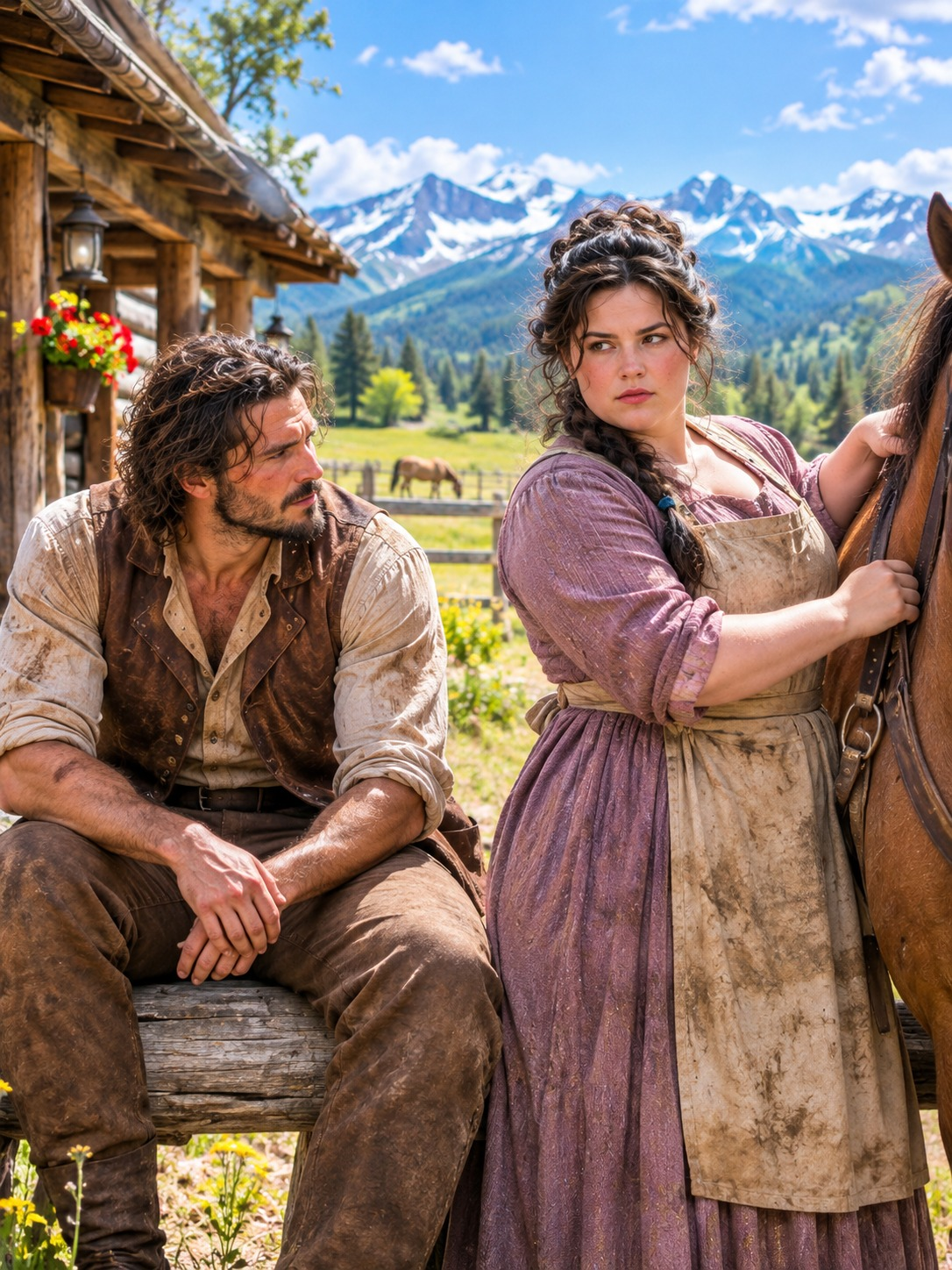
"Don't let him touch that horse!" a young ranch hand shouted.
Crane Ashford struggled to rise from the wooden bench, clutching his broken ribs.
But Thomasine Old had already noticed something nobody else had.
The horse wasn't afraid of her.
It was afraid of the pain.
And that changed everything.
Six weeks earlier, Crane Ashford would have considered the sight of himself sitting helplessly on his own porch an insult.
He had never been a man who waited for somebody else to solve his problems.
At forty-six, he had spent eleven years building a reputation as the toughest rancher in the Alberta foothills. His cattle were healthy, his fences were maintained, and his horses were better trained than most men in the surrounding settlements.
He knew every drainage ditch, every stretch of uneven ground, and every stubborn animal on his property.
He also knew exactly how much work could be accomplished before sunrise.
What he did not know was how to sit still.
Four broken ribs and a badly injured left knee had made certain of that.
The accident had happened during a routine inspection of the northern fence line. A section of shale above the drainage had collapsed after weeks of wet September weather.
There had been no warning.
One moment Crane had been riding Copper along the slope, thinking about the coming winter.
The next, the ground had disappeared beneath them.
Copper had scrambled upright.
Crane had not.
When Beck Prader finally found him, the evening light was disappearing behind the mountains.
His foreman had crouched beside him, one hand against Crane's shoulder.
"You're breathing," Beck had said.
"So far," Crane had answered.
It was the last joke Crane remembered making for several days.
Dr. Angel had arrived the following morning.
He examined Crane's ribs, checked his knee, and delivered a diagnosis that Crane immediately disliked.
"Four fractured ribs. Two of them are serious enough that I don't want you lifting anything heavier than a coffee cup."
Crane stared at him.
"And the knee?"
"Swollen joint. You need to keep your weight off it."
"For how long?"
"Six weeks. Minimum."
"I have two hundred and thirty head of cattle."
"Then somebody else will look after them."
"I have twelve horses."
"Somebody else can look after them too."
Crane's expression hardened.
The doctor closed his medical bag.
"Listen to me, Ashford. You can spend six weeks healing, or you can spend the next six months discovering what happens when you ignore an injury like this."
Crane said nothing.
Dr. Angel looked toward Beck.
"Make sure he follows my instructions."
Beck nodded.
Crane hated that part more than the diagnosis.
The first two weeks were miserable.
The third was worse.
He could watch the ranch through the front window, but he could not manage it himself.
Beck took over the cattle operations.
Yule handled the daily chores.
Ss, the oldest ranch hand, quietly covered the tasks that nobody remembered to assign.
They worked hard.
But Crane noticed every missed detail.
A gate left unsecured.
A water trough that needed cleaning.
A section of fencing that should have been repaired before the next snowfall.
He could see the work waiting to be done.
He simply could not get up and do it.
Then Copper began limping.
At first, Crane thought the horse was merely stiff from the accident.
Copper had walked away from the rockslide. He had stood afterward, accepted water, and allowed Beck to lead him back to the barn.
There had been no obvious sign of serious injury.
But by the second week, something had changed.
Copper stopped eating normally.
He began standing alone at the far end of the paddock.
By the third week, his right hind leg was carrying less weight.
Crane watched him every evening.
The horse that had carried him through eleven years of ranch work no longer came when he called.
That was the part Crane could not forgive himself for.
One afternoon, Beck found him standing at the kitchen window.
Crane had managed to get there using a wooden cane.
His face was pale from the effort.
"He's not getting better," Crane said.
Beck followed his gaze.
Copper stood near the far fence.
"No, sir."
"Have you called another veterinarian?"
"I called Dr. Angel yesterday."
"And?"
"He said he wants to examine him again."
"When?"
"Tomorrow, if the road holds."
Crane tightened his grip on the cane.
"That horse carried me down that mountain."
"I know."
"He could have left me there."
Beck looked at him.
"But he didn't."
Crane swallowed.
For a long moment, neither man spoke.
Then Beck unfolded a piece of paper.
"We have another problem."
Crane turned.
"What now?"
"The cook position."
"We don't have a cook."
"Exactly."
Beck placed the paper on the kitchen table.
Three women had answered the original advertisement.
The first had arrived, looked at the remote trail, and turned around without dismounting.
The second had sent a message saying she had heard about Crane Ashford and wasn't interested.
The third had stayed until noon, complained about the stove, and left.
Crane rubbed his forehead.
"Then find somebody else."
"That's what I've been trying to do."
"Advertise farther away."
"I did."
Beck hesitated.
"There's a woman in Fort Macleod. She worked in a hotel kitchen for eight months and has references from two private households."
Crane glanced at the letter.
"What's wrong with her?"
"Nothing that concerns her ability to cook."
"Then why are you hesitating?"
Beck took a breath.
"The hotel let her go because management didn't think she fit the image they wanted for the dining room."
Crane looked at him.
"What does that mean?"
Beck shifted his weight.
"She's a large woman."
Silence settled over the kitchen.
Crane looked down at the letter again.
"Can she cook?"
"Apparently very well."
"Can she manage a household?"
"Her references say she can."
"Then bring her up."
Beck nodded.
"She's coming Friday."
Crane returned his attention to the window.
"Fine."
He had no idea that Friday would become the day everything began to change.
Thomasine Old had learned a long time ago that people often made up their minds about her before she had even opened her mouth.
At thirty-nine, she had become very good at recognizing the moment.
It usually happened when she walked into a room.
A glance at her body.
A quick examination of her clothing.
A polite smile that never quite reached somebody's eyes.
At the hotel in Fort Macleod, the manager had called her into his office after eight months of excellent kitchen reports.
He had folded his hands over his desk.
"Thomasine, you've done wonderful work here."
She had waited.
"But we are changing the atmosphere of the dining room."
She had looked at him.
"What does that have to do with me?"
He had glanced toward the window.
"Corporate image."
She had understood.
There had been no argument.
She collected her belongings, thanked the kitchen staff, and left.
She had spent the next several weeks taking temporary household jobs while looking for something more permanent.
The advertisement for the Ashford ranch had caught her attention because of one particular sentence.
Remote location. Hard conditions. Difficult employer. Fair wages. Room and board.
Thomasine had read it twice.
Then she had laughed.
She had worked in kitchens where the ovens broke during dinner service, where supplies arrived late, and where angry customers expected miracles.
A difficult employer did not frighten her.
A remote ranch sounded better than another hotel manager explaining corporate image.
So she packed her belongings.
She brought two practical dresses, several work blouses, a pair of sturdy boots, her favorite kitchen knife, and a small wooden box containing the few personal things she had kept from her mother.
On Friday morning, she climbed into the passenger seat of Beck's old truck.
The drive took longer than she expected.
The road narrowed as they moved deeper into the foothills.
Mountains rose beyond the tree line.
Cattle grazed behind weathered fencing.
Eventually, the ranch house appeared.
It was a large but modest wooden structure with a wide porch, a steep roof, and a barn standing several yards behind it.
Thomasine looked through the window.
"That's beautiful."
Beck glanced at her.
"Wait until winter."
She smiled slightly.
"I've lived through Alberta winters."
"Not this far out."
"Then I'll learn."
Beck did not respond.
He turned the truck into the yard.
Before he could stop the engine, Thomasine noticed the horse.
A dark chestnut animal stood alone near the far fence.
Its head was lowered.
One hind leg was positioned awkwardly.
She watched him for several seconds.
"What's wrong with that horse?"
Beck followed her gaze.
"That's Copper."
"He's injured?"
"He's been limping."
"How long?"
"Almost three weeks."
Thomasine looked at the animal again.
"Has a veterinarian examined him?"
"He's scheduled to be examined again tomorrow."
She nodded.
She did not offer an opinion.
She had not been hired to diagnose horses.
But she knew the difference between an animal that was frightened and one that was hurting.
Copper looked like the second.
Beck opened his door.
"Come on. I'll introduce you to Crane."
Thomasine stepped out.
The mountain air was cool.
She adjusted her forest-green blouse beneath her charcoal-gray apron and straightened the skirt she had chosen for the journey.
Her copper-red hair was pinned loosely at the back of her head.
She lifted her bag from the truck.
Then she saw him.
Crane Ashford sat on the wooden bench beside the porch.
His dark work shirt was rolled to his elbows.
A weathered vest covered his shoulders.
His beard was neatly trimmed, and his expression suggested that he had already decided he disliked the interruption.
A wooden cane rested beside him.
His left knee was extended slightly.
One hand pressed against his right side.
He looked at Thomasine.
Then at her luggage.
Then back at her.
"You're the applicant?"
"Thomasine Old."
He did not stand.
"Crane Ashford."
"I know."
His eyes narrowed slightly.
"Beck tell you about the job?"
"He told me the position was for a cook and household manager."
"Anything else?"
"That the ranch is remote."
Crane studied her.
"Anything else?"
Thomasine understood the question.
She could see the judgment in his face.
She had seen it before.
"I heard the conditions are difficult," she said.
"They are."
"I heard the employer is difficult."
Beck looked down.
Crane's expression barely changed.
"And?"
Thomasine placed her bag beside the porch.
"I suppose I'll find out."
For the first time, Crane seemed uncertain what to say.
He looked toward Beck.
"Show her the kitchen."
Thomasine did not move immediately.
"Before that, may I ask something?"
Crane's jaw tightened.
"What?"
She glanced toward Copper.
"Why is that horse standing alone?"
Crane followed her gaze.
"He's injured."
"Have you tried moving him to a smaller enclosure?"
"He's got a paddock."
"That's not what I asked."
Beck's eyebrows lifted.
Crane slowly turned his attention back to her.
"You're here to cook."
"I know."
"Then perhaps we should start with the kitchen."
Thomasine nodded.
"Of course."
She picked up her bag.
But as she passed the porch, Copper shifted his weight.
A small movement.
Almost invisible.
Thomasine stopped.
The horse lifted his head.
She watched his right hind leg.
Then she looked at Crane.
"Does he let anyone touch that side?"
"Not lately."
"Has he been kicking?"
"No."
"Does he eat normally?"
Crane's expression changed.
"Why?"
"Because he looks uncomfortable."
"I know he's uncomfortable."
There was a sharpness in his voice.
Thomasine did not react.
She simply nodded.
"All right."
She continued toward the house.
Crane watched her go.
Beck waited until she was out of earshot.
"She seems capable."
Crane looked at him.
"She asks too many questions."
Beck almost smiled.
"That might be useful around here."
The kitchen was larger than Thomasine expected.
There was a cast-iron stove, a wide wooden counter, several cupboards, and a heavy farmhouse table.
Everything was clean enough, but the room had the neglected appearance of a place where nobody had been able to keep up with ordinary household work.
A stack of unopened flour sacks stood beside the pantry.
Two shelves needed repairing.
The refrigerator contained little more than milk, eggs, leftover potatoes, and several containers of food that had been prepared days earlier.
Thomasine put her bag down.
"How many people eat here?"
"Four regularly," Beck answered. "Sometimes five, depending on who comes through."
"Any dietary restrictions?"
"Not that I know of."
"Good."
She opened a cupboard.
Then another.
She examined the pantry.
"Who orders supplies?"
"Crane used to."
"Used to?"
"Since the accident, we've been making do."
Thomasine nodded.
She took a small notebook from her bag.
"All right. I'll need to make an inventory."
Beck looked relieved.
"That would help."
She wrote down the missing items.
Flour.
Coffee.
Fresh vegetables.
Canned tomatoes.
Cooking oil.
Meat for the coming week.
She was halfway through the list when a sharp noise came from outside.
A horse snorted.
Then somebody shouted.
"Get away from him!"
Thomasine immediately looked toward the window.
Yule was standing near Copper's paddock.
The young ranch hand had approached the horse with a bucket.
Copper had suddenly stepped sideways.
His injured leg shifted awkwardly.
Yule jumped back.
Crane appeared on the porch.
He was trying to rise from the bench.
His face tightened with pain.
Beck hurried toward him.
"Stay where you are."
"What's happening?"
"Copper moved."
"Get over there!"
Crane tried to put weight on his injured knee.
His cane slipped against the wooden boards.
Thomasine was already moving.
She stepped through the kitchen door and crossed the yard.
"Don't approach him from behind," she called.
Yule turned.
"Ma'am, stay back!"
Thomasine stopped several feet from the fence.
She looked at Copper.
His ears were pinned back.
His nostrils flared.
He was frightened.
But he was not trying to attack.
"Put the bucket down," she said.
Yule hesitated.
"Now."
He lowered it.
Thomasine watched the horse's breathing.
Then she turned slightly toward Beck.
"Can someone open the smaller gate?"
Beck looked at Crane.
Crane was gripping the porch railing.
"What are you doing?" he called.
Thomasine looked back at him.
"Trying to keep him from hurting himself."
"You don't know that horse."
"No," she answered. "But I can see he's in pain."
Crane fell silent.
Thomasine moved closer to the fence.
She did not reach for Copper.
She did not try to touch him.
She simply stood where he could see her.
Her voice softened.
"Easy, sweetheart."
Copper's ears moved.
She waited.
"Nobody's going to rush you."
The horse lowered his head slightly.
Thomasine remained still.
Behind her, Crane watched with an expression he could not quite explain.
For three weeks, Copper had refused to approach anyone.
But now the animal had taken one careful step toward the fence.
Then another.
Thomasine looked at Crane.
"I think he needs a proper examination. And until the veterinarian gets here, nobody should force him to move."
Crane stared at her.
He wanted to argue.
He wanted to tell her that he had owned the horse for years and knew more about him than she ever could.
But Copper had just taken another step toward her.
For the first time in weeks.
Crane said nothing.
Thomasine slowly turned back toward the horse.
Then Beck noticed something.
A dark leather strap was hanging loose beneath Copper's saddle blanket.
It had not been there the previous evening.
He frowned.
"Who put that on him?"
Yule looked toward the barn.
"I thought it belonged to the old tack."
Beck stepped closer.
Then his expression changed.
"Crane."
The rancher turned.
"What?"
Beck pointed toward the loose strap.
There was something attached to its underside.
A small metal tag.
Crane stared at it.
He recognized the mark immediately.
It was the old Ashford ranch brand.
But someone had scratched a number into the back.
A number that did not belong to any horse on his property.
And when Beck turned the tag over, he saw three words engraved beneath the dirt.
ASK ABOUT ELEANOR.
Thomasine looked from the tag to Crane.
For the first time since she had arrived, the rancher's expression was no longer merely suspicious.
He looked frightened.
And then he whispered a name nobody on the ranch had mentioned in years—
"Who put that on Copper?"






Comments 0