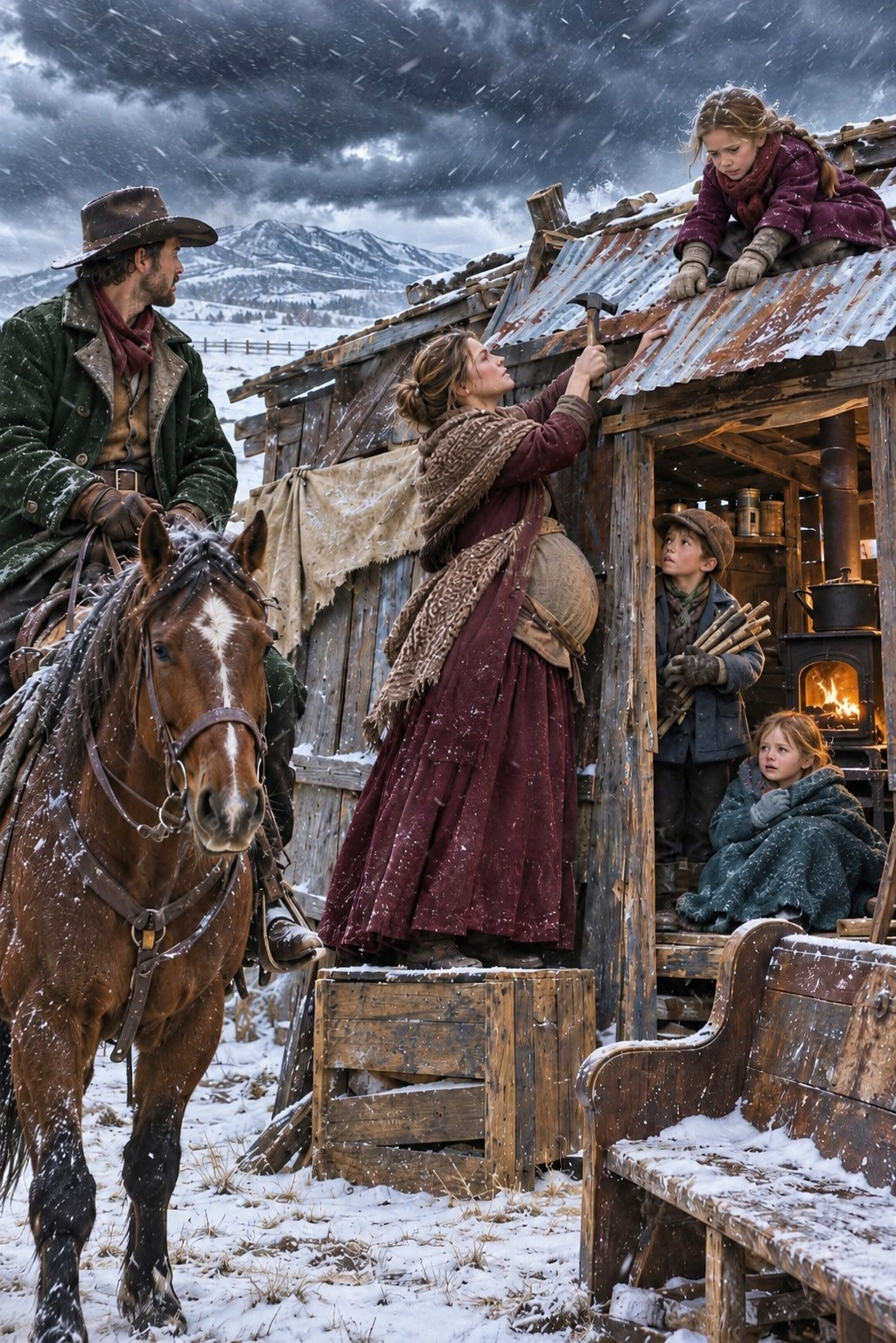
"Clara! Get down before the wind carries you away!"
Nora Bennett shouted as her eleven-year-old daughter struggled to hold a sheet of rusted tin against the collapsing roof.
When ranch owner Caleb Mercer arrived, he noticed a crooked stovepipe held together with wire and a strip of canvas.
Scratched into the metal were four uneven letters.
H-O-M-E.
Caleb suddenly understood that this was no ordinary abandoned shed.
The little girl was going to fall.
He could see it from thirty yards away, even through the snow that swept across the frozen Wyoming field.
Her boots had slipped twice against the rusted metal. One knee was wedged between two broken rafters, and her small hands clung to the edge of a roofing sheet that the wind kept trying to tear loose.
Below her, a heavily pregnant woman stood on an overturned wooden crate, reaching upward with a hammer.
"Clara, I mean it!"
"But Mama, you said the roof needed nailing!"
"I said the roof needed nailing, not my daughter!"
The girl tried to answer, but a violent gust stole the words from her mouth.
Caleb Mercer tightened his grip on the reins.
His black horse, Gideon, shifted uneasily beneath him.
The animal knew the weather was turning.
So did Caleb.
He had spent forty-three years beneath Wyoming skies, and he recognized the peculiar darkness gathering along the western mountains. It wasn't ordinary snowfall. The clouds had lowered into a thick, bruised wall, swallowing the ridgelines one by one.
By nightfall, the temperature would plunge.
By morning, anything without proper shelter might be buried.
And someone had put three children and a pregnant woman inside a building that should have collapsed years ago.
Caleb urged Gideon forward.
He had ridden past the old sheep shed a hundred times without stopping.
Twelve years earlier, it had belonged to a sheep farmer named Elias Crowley, who lost nearly his entire flock during a brutal winter. After Crowley abandoned the property, the roof caved in, the northern wall collapsed, and the place became little more than a heap of rotten timber.
Caleb remembered thinking that even coyotes wouldn't shelter there.
Yet now smoke rose from a crooked chimney.
Someone had rebuilt the northern wall with wagon boards.
Feed sacks covered the gaps between the planks.
A canvas sheet stretched across a broken window frame.
Pieces of discarded furniture had been used as structural supports.
And standing beneath the roof was a woman who looked as though she had spent every remaining ounce of strength keeping it from falling.
Caleb had never seen anything quite like it.
He slowed Gideon as he approached.
The woman turned sharply.
Her face was pale beneath strands of dark auburn hair that had escaped a loose braid. Wind had reddened her cheeks, and exhaustion showed around her eyes.
She wore a patched charcoal coat over a faded forest-green dress, its shape stretched tightly across her heavily pregnant belly.
But it wasn't her condition that made Caleb hesitate.
It was the way she looked at him.
Not with relief.
Not with gratitude.
With warning.
"Don't come any closer," she called.
Caleb stopped.
"Afternoon, ma'am."
"Depends on what you want."
"At the moment, I'd like to see that little girl get off the roof."
"She's getting down."
Clara looked between them.
"Mama, if I let go, the tin will fly away."
"Then let it fly," Caleb said.
Nora's eyes flashed.
"That tin is the only thing keeping snow off my children's beds."
Caleb looked at the roof again.
He understood her problem.
He also understood something she apparently refused to acknowledge.
The metal wasn't secured.
The nails were too short.
And the supporting beam beneath Clara's knee had already begun to split.
"Little miss," he called, "can you move toward the chimney?"
Clara nodded.
"Slowly. Keep your weight on the boards, not the tin."
Nora watched him with visible distrust.
Clara carefully shifted her knees.
The sheet of metal lifted.
Nora reached for it.
"Leave it!" Caleb shouted.
Too late.
The wind caught the loose edge.
The entire sheet rose with a metallic scream.
Clara lost her balance.
Nora dropped the hammer.
Caleb was already moving.
He swung down from Gideon's saddle and crossed the distance in three strides, catching the edge of the metal before it tore free.
The impact jolted his shoulder.
For a moment, the wind nearly pulled him off his feet.
"Get the girl down!" he ordered.
Nora climbed off the crate.
"Clara, come to me!"
The child scrambled toward the lower edge of the roof.
Nora caught her around the waist and lowered her into the snow.
Only then did Caleb release the metal.
It slammed against the rafters.
The sound echoed across the empty field.
Clara stumbled into her mother's arms.
Nora held her tightly.
For three seconds, she said nothing.
Then she pulled back and examined the girl's face.
"Are you hurt?"
"No, Mama."
"Your hands?"
Clara opened her mittens.
Her fingers were red.
Nora rubbed them between her own gloves.
"You are never climbing up there again."
"But—"
"Never."
Clara lowered her head.
Caleb stepped away from the roof.
"She's a brave girl."
Nora looked up.
"She's a child."
"Yes, ma'am."
"And children shouldn't have to be brave about things like this."
The words seemed to surprise her as soon as she spoke them.
Her expression hardened.
Caleb didn't answer.
He had learned long ago that people sometimes said the most revealing things when they believed nobody was listening.
A small boy appeared in the doorway.
He had curly reddish-brown hair, freckles, and a bundle of thin sticks tucked under one arm.
"Mama?"
Nora turned.
"What is it, Henry?"
"Rose is crying again."
Nora closed her eyes briefly.
"Did you put another log on the fire?"
"We don't have another log."
The boy lifted his bundle.
"Just these."
Caleb looked at the sticks.
Most were no thicker than his thumb.
They would burn for minutes, not hours.
Nora noticed him looking.
"We have enough."
Caleb said nothing.
Henry shifted his weight.
"She says her toes hurt."
Nora's expression changed.
Only slightly.
But Caleb saw it.
Fear.
Not for herself.
For the little girl inside.
"Tell Rose I'm coming," Nora said.
Henry disappeared through the doorway.
Clara started after him.
"Help your brother," Nora instructed.
The girl hesitated.
"What about the roof?"
"I'll manage."
Clara looked at Caleb.
Then at her mother.
Finally, she went inside.
Nora turned back toward the stranger.
"Now," she said, "who are you?"
"Caleb Mercer."
Recognition crossed her face.
Not relief.
Something closer to caution.
"The rancher?"
"That's right."
"From the north valley?"
"Two miles that way."
She followed the direction of his glance.
Then she looked back at him.
"I know who you are."
Caleb removed his hat.
"And you are?"
"Nora Bennett."
He had heard the name.
Everyone in Clearwater had.
The widow.
The woman who had arrived expecting to marry Amos Bell.
The woman who discovered that Bell had died three days before her stagecoach reached town.
The woman his grown son refused to admit into the family home.
The woman who stayed at Mrs. Whitcomb's boardinghouse until her money ran out.
The woman people whispered about at the general store.
Caleb had heard the stories.
He had never bothered to find out where she had gone.
Until now.
"Nora Bennett," he repeated.
Her chin lifted.
"If you've come to tell me I'm trespassing, you'll have to speak to the county. This land isn't being used."
"I didn't come to tell you anything."
"Then why are you here?"
Caleb glanced toward the chimney.
"Because I saw smoke where there shouldn't have been any."
Her mouth tightened.
"Well, now you've seen it."
He looked at the shelter.
The rebuilt wall leaned slightly outward.
A wooden church pew had been dismantled to reinforce the doorway.
Canvas covered a hole near the roofline.
Someone had hammered coffee tins flat and nailed them over smaller gaps.
It was desperate construction.
But it wasn't careless.
The supports were placed intelligently.
The weight of the patched roof had been distributed across the strongest remaining beams.
Even the crooked stovepipe had been positioned to draw smoke away from the sleeping area.
Caleb recognized skill when he saw it.
"Who built this?"
Nora stared at him.
"I did."
"All of it?"
"My children helped."
He examined the doorway again.
"That's a good brace."
She said nothing.
"The diagonal one. Keeps the wall from shifting."
"I know what it does."
Caleb almost smiled.
Almost.
"Then you know your chimney is leaning."
Nora followed his gaze.
The pipe swayed slightly in the wind.
"I know."
"If it falls against the canvas, it could start a fire."
"I know that too."
"May I straighten it?"
Her expression sharpened.
"Did I ask you to?"
"No, ma'am."
"Then why would you?"
Caleb considered the question.
He could have told her that the chimney was dangerous.
He could have explained that he had repaired enough ranch buildings to recognize a hazard.
He could have reminded her that she was eight months pregnant and standing in the middle of a winter storm.
But something in her eyes warned him against all three answers.
Instead, he said, "Because I have two good hands, and they're not doing much at the moment."
For the first time, Nora seemed uncertain how to respond.
She glanced at the chimney.
Then at the doorway.
Then back at Caleb.
"Only the chimney."
"Only the chimney."
"And don't move anything else."
"Understood."
Caleb set his hat on a dry piece of timber and approached the wall.
Up close, the condition of the shelter was worse than he had expected.
The wood was damp.
Several nails had been reused so many times that their heads were nearly flattened.
The stovepipe was secured with twisted wire.
He tested it gently.
It shifted.
A hard gust could send the entire assembly into the roof.
"Have you got any spare wire?" he asked.
Nora pointed toward a coffee tin beside the doorway.
Caleb opened it.
Inside were bent nails, short lengths of wire, two screws, and several broken hinges.
He picked through them carefully.
"You've saved everything."
"Everything that might be useful."
He selected the longest wire.
"That's sensible."
"Most people call it desperate."
"Most people don't know the difference."
Nora looked at him.
He kept working.
For several minutes, neither spoke.
The wind moved through the broken boards.
From inside came the soft voice of Clara comforting Rose.
Henry coughed.
Caleb tightened the wire around the stovepipe.
He had been a rancher for nearly twenty years.
He knew how much lumber it took to build a proper shelter.
He knew what a sound roof required.
And he knew that the woman standing beside him had accomplished something remarkable with almost nothing.
"Your husband was a carpenter?" he asked.
Nora went still.
"Who told you that?"
"Nobody. I can see the way you placed the braces."
She looked down at her hands.
"Thomas taught me."
"Thomas?"
"My husband."
Caleb nodded.
She stared at the roof.
"He used to say a house wasn't built from lumber."
"What was it built from?"
"People who refused to let it fall."
Her voice had changed.
It was quieter now.
Almost distant.
Caleb continued securing the pipe.
"Sounds like a good man."
"He was."
The answer came immediately.
Then silence.
Caleb knew better than to press.
He had buried his own share of memories.
Some wounds didn't heal because someone asked the right question.
They healed, if they healed at all, because time and kindness made them bearable.
He finished the repair and stepped back.
"That should hold for now."
Nora examined the chimney.
"You didn't have to do that."
"I asked permission."
"That's not what I meant."
"I know."
She looked toward the sky.
Snow had begun falling more heavily.
Caleb followed her gaze.
The western mountains were nearly invisible.
He had seen storms like this before.
One winter, he had lost thirty head of cattle in a single night.
Another year, two hired men had been trapped in a line shack for four days.
This storm carried the same warning.
He looked at the shelter.
"How much firewood do you have?"
"Enough."
"How much food?"
"Enough."
"Blankets?"
Nora's eyes hardened.
"Mr. Mercer, if you're planning to inventory my poverty, I suggest you do it somewhere else."
Caleb lowered his gaze.
"That wasn't my intention."
"Then what was?"
He thought of the little girl rubbing her frozen toes.
The boy carrying sticks.
Clara risking her life on the roof.
And Nora herself, standing straight despite the exhaustion written across her face.
"My ranch is two miles north," he said. "There's a warm kitchen, spare rooms, and plenty of food. You and the children could stay there until the storm passes."
"No."
He blinked.
"I haven't finished asking."
"You don't need to."
"Nora—"
"Mrs. Bennett."
He paused.
"Mrs. Bennett."
She folded her arms.
"I appreciate what you did for the chimney. And I appreciate you helping Clara. But my children and I aren't going anywhere."
"This building won't survive a serious blizzard."
"Then I'll make it stronger."
"With what?"
Her eyes flashed.
"Whatever I can find."
Caleb glanced at the coffee tin full of bent nails.
Then at the patched wall.
Then at the rusted roof.
He understood that arguing would accomplish nothing.
"You've done more with scraps than most men could manage with a lumberyard," he said.
Nora's expression shifted.
The compliment had caught her unprepared.
"But this storm doesn't care how capable you are."
She looked away.
For a moment, Caleb thought she might reconsider.
Then Henry appeared again.
"Mama?"
Nora turned immediately.
"What is it?"
"Rose wants you."
"I'll be there."
Henry looked at Caleb.
"Are you the man with the horse?"
"That's me."
"Is he friendly?"
"Usually."
"Does he have a name?"
"Gideon."
Henry glanced toward the black horse.
"That's a good name."
"He's a good horse."
The boy smiled faintly.
It was the first smile Caleb had seen since arriving.
Then Henry disappeared inside.
Nora watched him go.
"He's been asking for a horse since he could talk," she said.
Caleb nodded.
"Most boys do."
"He used to have a wooden one. His father made it."
"What happened to it?"
Her face closed.
"We couldn't bring everything."
Caleb felt something tighten in his chest.
He had heard that sentence before.
From families leaving failed homesteads.
From men who had lost their ranches.
From widows selling their last possessions.
We couldn't bring everything.
It usually meant they had already lost more than anyone knew.
He retrieved his hat.
"I should get moving."
Nora looked surprised.
"You're leaving?"
"You told me you didn't need a place to stay."
"I did."
"And I believe you."
She watched him approach Gideon.
"Mr. Mercer."
He turned.
"If you come back with a wagon expecting me to climb aboard because you think I'm helpless, you'll have wasted your afternoon."
Caleb rested one hand on the saddle.
"I believe that too."
"Then what are you bringing?"
He looked toward the damaged roof.
"Longer nails."
Nora stared at him.
For several seconds, she appeared to search his face for a hidden joke.
There wasn't one.
"Longer nails?" she repeated.
"Six-inch spikes, if I can find enough."
"That won't fix everything."
"No, ma'am."
"Not even close."
"I know."
He placed his boot in the stirrup.
"Then why bother?"
Caleb looked at the three small faces now visible in the doorway.
Clara stood behind Henry.
Rose peered out from beneath her blanket.
All three watched him.
He turned back to Nora.
"Because it's a start."
He mounted Gideon.
The horse shifted beneath him.
Caleb settled into the saddle and gathered the reins.
"I'll return before dark."
Nora didn't answer.
But she didn't tell him not to come.
That was enough.
Caleb turned north.
The wind struck him hard as he rode away.
He had traveled perhaps a quarter mile when he looked back.
The shed was almost hidden behind the blowing snow.
Nora was standing beside the doorway.
One hand rested on her pregnant belly.
The other held Clara close.
Caleb knew she was watching him leave.
He also knew she expected him to disappear.
Just like everyone else.
He urged Gideon into a faster pace.
By the time the ranch buildings appeared through the snow, Caleb had made up his mind.
He wasn't bringing a handful of nails.
He wasn't bringing a few blankets.
And he certainly wasn't returning to offer charity that Nora Bennett would refuse.
He was going to bring everything necessary to make that broken shelter safe.
Or build her a better one.
His foreman, Walter Price, came running from the barn as Caleb entered the yard.
"Storm's coming hard!" Walter shouted. "We need to get the livestock secured!"
"Already done on the south range?"
"Yes, sir."
"Good. Hitch the supply wagon."
Walter frowned.
"Now?"
"Now."
"What for?"
"Load boards. Tar paper. Nails. Blankets. Firewood. Flour. Salt pork. Everything we can spare."
Walter stared.
"Who needs all that?"
"The widow living in the old sheep shed."
The foreman's face changed.
He stopped moving.
"Mrs. Bennett?"
Caleb dismounted.
"You know her?"
Walter looked uncomfortable.
"Everybody knows she's out there."
Caleb turned slowly.
"Everybody?"
Walter shifted his weight.
"Well, folks figured she'd eventually come to her senses."
Caleb said nothing.
Walter cleared his throat.
"She's a stubborn woman, from what I hear."
"She's got three children."
"I know."
"And another coming."
"I heard."
"Then you also know they're freezing."
Walter looked toward the barn.
Caleb stepped closer.
"Did anybody go out there?"
The foreman hesitated.
"Caleb, it's complicated."
"What's complicated about children being cold?"
Walter swallowed.
"You don't understand what happened when she came to Clearwater."
"Then explain it."
Walter lowered his voice.
"There are people in town who don't want anyone helping Nora Bennett."
Caleb stared at him.
The wind howled between the ranch buildings.
"What people?"
Walter looked toward the house.
Then back at Caleb.
"Before you load that wagon, there's something you ought to know about Amos Bell's son."
Caleb's expression hardened.
"Go on."
Walter reached into his coat and pulled out a folded paper.
"I was told to give you this if you ever got involved."
Caleb looked at the paper.
Across the front, written in heavy black ink, were two words.
NORA BENNETT.
Walter held it out.
"Caleb, you need to read what's inside."
Caleb unfolded the paper.
And the first sentence made him stop breathing.






Comments 0