"Because the child she's holding isn't hers."
The words struck the little sheep shed like a gunshot.
Nora Bennett tightened her arms around her newborn daughter.
For one terrible moment, nobody moved.
Thomas stood beside the stove, his face white.
Clara pressed herself against Henry. Rose clutched the hem of her mother's blanket. Elijah stood near the table, holding his wooden horse against his chest.
Caleb Mercer slowly stepped between Nora and the door.
"Whoever you are," he said, "you'd better explain yourself."
The old man outside answered sharply.
"My name is Jonathan Bennett. Thomas is my son."
Thomas took a staggering step forward.
"Father?"
Caleb glanced at him.
"You recognize his voice?"
Thomas nodded.
"Yes."
Caleb kept his revolver ready.
"Then let him speak."
Jonathan Bennett struck the door with his cane.
"Open it!"
"Not until you tell me what you meant about the baby," Caleb replied.
A pause followed.
Then the old man said, "Harold Crane told me the child was taken from another woman. He said Nora Bennett had stolen her."
Nora stared at the door.
For a moment, she couldn't even feel the cold.
Then her expression changed.
"Stolen?"
She looked down at the tiny girl sleeping against her breast.
Her daughter.
The child she had carried through months of hunger and fear.
The baby she had delivered while a winter storm battered the roof.
Nora raised her head.
"Open the door, Caleb."
He turned.
"Nora—"
"Open it."
Her voice was quiet.
But there was no uncertainty in it.
Caleb studied her.
Then he nodded.
He lifted the latch.
The door swung inward.
An elderly man stood on the threshold, leaning heavily on a polished walking stick.
His silver hair was neatly combed beneath a black hat. His coat was expensive but travel-worn, and his cheeks were red from the cold.
Behind him stood Sheriff Daniel Hensley and two deputies.
The sheriff's expression was grim.
Jonathan Bennett stepped inside.
His eyes immediately found Thomas.
For a moment, the old man's anger disappeared.
"My son."
Thomas stared.
"Father."
Jonathan reached toward him.
Thomas stepped forward.
They embraced awkwardly, both trembling.
Caleb watched carefully.
The reunion appeared genuine.
But the old man's accusation still hung in the air.
Jonathan pulled back.
"They told me you were dead."
Thomas nodded.
"I know."
"They said you had been buried in Missouri."
"I know."
Jonathan's eyes filled.
"I should have come sooner."
Thomas swallowed.
"Yes."
The old man lowered his head.
Then Nora spoke.
"Mr. Bennett."
Jonathan turned.
She sat on the church pew, her newborn daughter wrapped securely in a clean blanket.
Her face was pale from childbirth.
But her eyes were steady.
"You said this baby isn't mine."
Jonathan hesitated.
"That's what I was told."
"By Harold Crane?"
"Yes."
Nora nodded.
"Then you were lied to."
Jonathan looked at the child.
Nora continued.
"I carried her for nine months. Dr. Nathaniel Hensley delivered her here. Martha Whitcomb helped. My children were beside me. Caleb was here."
She looked directly into Jonathan's eyes.
"This is my daughter."
The old man's expression changed.
He glanced toward Nathaniel.
The doctor stepped forward.
"I can confirm every word."
Jonathan looked toward the sheriff.
Hensley nodded.
"Crane's accusation is false."
Silence.
Jonathan slowly removed his hat.
For a moment, he looked much older.
"Then I've made a terrible mistake."
Nora didn't answer.
The old man stepped closer.
"I came here because I believed a child had been taken from her mother."
Nora held the baby tighter.
"And you were prepared to take her from me."
Jonathan lowered his eyes.
"Yes."
"Without asking me a single question."
He swallowed.
"Yes."
Nora looked at him for a long moment.
Then she said, "That is how men like Harold Crane have hurt so many families. They tell a lie about a mother, and someone with power believes it."
Jonathan closed his eyes.
The words struck him harder than any accusation Caleb could have made.
At last, he whispered, "You're right."
Nora looked down at her daughter.
"Then help us make certain it never happens again."
Jonathan raised his head.
"I will."
Caleb studied the old man.
"Crane sent you here to take the baby."
Jonathan nodded.
"He sent a message claiming Nora had kidnapped a newborn from a woman in Cheyenne."
"And you believed him?"
Jonathan's expression darkened.
"I had reason to think Crane was dishonest. I didn't know how much."
Thomas stepped forward.
"Father, Crane has been stealing children for years."
Jonathan stared.
"What?"
Thomas looked toward the metal chest resting beside the stove.
"We found the records."
Caleb opened it.
Inside were ledgers, deeds, letters, and lists.
The original documents from beneath the Clearwater freight warehouse.
He lifted a thick ledger.
"These are the families Crane destroyed."
Jonathan stared at the pages.
Caleb continued.
"Forged mortgages. False accusations of neglect. Children removed from their parents and sent away."
The old man's face drained of color.
Thomas stepped beside him.
"Daniel helped him."
Jonathan closed his eyes.
"My own son."
Thomas nodded.
"Yes."
For several seconds, Jonathan said nothing.
Then he looked toward the sheriff.
"Where is Daniel?"
Hensley answered.
"We're searching for him."
Jonathan's expression hardened.
"Then I will help you find him."
Caleb closed the ledger.
"First, there's something else we need to settle."
He looked toward Thomas.
"The inheritance."
Jonathan's face changed.
Thomas nodded.
"Father, you need to tell Nora the truth."
The old man looked toward the baby.
Then toward Elijah.
His expression softened.
"Yes."
He sat beside the table.
For a moment, he seemed uncertain where to begin.
Then he spoke.
"Many years ago, I purchased land north of Clearwater. Twenty thousand acres."
Caleb nodded.
"We know."
Jonathan continued.
"I intended to divide it fairly among my descendants. But when Daniel began making reckless debts, I changed the terms."
Thomas looked down.
Jonathan sighed.
"The deed gave temporary control of the property to a trustee until a qualifying descendant could inherit."
Nora frowned.
"What made a child qualify?"
"Birth in Wyoming Territory, recognition by the family, and a properly recorded claim."
Caleb looked toward the newborn.
"Then Nora's daughter qualifies."
Jonathan nodded.
"Yes."
He looked toward Elijah.
"And so does this boy."
Elijah froze.
"Me?"
Jonathan smiled gently.
"Yes, son."
The boy looked toward Nora.
She reached for his hand.
Jonathan continued.
"But Crane concealed the most important part of the deed."
Caleb frowned.
"What part?"
"The land was never intended to belong entirely to one child."
Thomas raised his head.
Jonathan looked at them.
"The qualifying children are beneficiaries of a family trust. The land is to be managed for their welfare, not sold by whoever happens to control their guardianship."
Silence.
Caleb slowly understood.
"Then Crane couldn't legally claim the land simply by taking the baby."
Jonathan shook his head.
"No."
"He would still need control of the trust."
"Exactly."
Thomas closed his eyes.
"That's why he forged the mortgage."
Jonathan nodded.
"And why he wanted the children declared abandoned or unfit for their mother's care."
Nora felt a cold sensation move through her.
Crane hadn't merely wanted her daughter.
He had wanted the power to decide her future.
Caleb looked toward the ledger.
"And Daniel?"
Jonathan's expression darkened.
"Daniel was named as an alternate trustee only if the legitimate beneficiaries had no suitable guardian."
Thomas stared.
"So he needed Nora removed."
Jonathan nodded.
"And he needed me declared dead."
Caleb frowned.
"Did he try?"
The old man gave a bitter smile.
"Three times."
He explained that Daniel had forged notices claiming Jonathan had died abroad. Jonathan had spent months tracing those false records, unaware that Thomas was being held prisoner.
When he finally discovered the Wyoming transactions, Crane intercepted his letters and sent him a forged message about Nora's newborn.
"I came here expecting to rescue a child," Jonathan said quietly.
He looked at Nora.
"Instead, I nearly helped steal one."
Nora studied him.
Then she nodded toward the metal chest.
"Now you can help us protect all of them."
Jonathan straightened.
"Yes."
The sheriff stepped forward.
"We'll need sworn statements from everyone involved."
Caleb looked at him.
"And we'll need an honest lawman to take them."
Hensley accepted the accusation without protest.
"You're right."
He removed his hat.
"I signed Margaret Mercer's false death report twelve years ago. I knew Crane had ordered it, and I was afraid to challenge him."
Margaret sat beside Samuel.
Her husband held her hand.
The sheriff looked toward them.
"I can't undo that."
Samuel's expression remained hard.
"No."
Hensley nodded.
"But I can tell the truth now, surrender my office, and face whatever punishment follows."
Caleb watched him.
For the first time, the sheriff sounded like a man who understood that regret was not the same as making amends.
Jonathan looked toward the door.
"Then we should begin immediately."
A sudden commotion rose outside.
Hooves struck the frozen ground.
A man shouted.
Caleb reached for his revolver.
But the sheriff raised a hand.
"My deputies."
The door opened.
A young deputy stepped inside.
"Sheriff, we've found them."
Hensley turned.
"Who?"
"Crane and Daniel Bennett."
Thomas stood.
"Where?"
The deputy swallowed.
"At the north crossing. They were trying to leave the territory."
Caleb stepped forward.
"Are they in custody?"
The deputy nodded.
"Both of them."
For a moment, nobody spoke.
Then the young man added, "They had a wagon full of documents. And money."
Jonathan rose slowly.
"Bring them to Clearwater."
The sheriff nodded.
"Under guard."
Caleb looked toward Nora.
Her eyes filled with tears.
Not because everything was suddenly easy.
But because, for the first time, the men who had terrorized her family were no longer free to do as they pleased.
She looked down at her daughter.
Then whispered, "You're safe."
The baby stirred.
Nora kissed her forehead.
"All of you."
By the following morning, the news had spread across Clearwater.
Harold Crane and Daniel Bennett had been arrested.
Arthur Voss remained in custody.
The original land records had been recovered.
And the missing families' names were finally being made public.
People gathered outside the courthouse before sunrise.
Some came because they had lost land.
Others came because they had lost children.
A few came simply because they wanted to see whether the powerful men who had ruled Clearwater for years would finally answer for what they had done.
Caleb stood beside Jonathan Bennett as the sheriff delivered the prisoners to the territorial marshal.
Crane looked furious.
Daniel looked frightened.
Neither man spoke when the marshal read the charges.
Fraud.
Kidnapping.
Conspiracy.
Forgery.
Attempted murder.
And offenses connected to the disappearance of children across territorial lines.
The evidence filled three wooden boxes.
Witnesses had already begun giving statements.
Martha Whitcomb confessed to transferring money through her boardinghouse.
Walter Price provided the altered ranch accounts.
Isaac Reed, who had finally admitted that he had used the dead Benjamin Bennett's name to conceal his own involvement in the old land office fire, surrendered himself and agreed to testify.
He had not been innocent.
But he had preserved records that would help identify the stolen children.
The marshal promised that his cooperation would be considered when his own crimes were judged.
Dr. Elias Hensley, the physician who had signed Amos Bell's questionable death certificate, was questioned separately. His records showed that he had certified the death from information supplied by Edwin Bell without conducting a proper examination.
Edwin was arrested that afternoon.
Under questioning, he admitted helping Crane isolate Nora and forge Amos Bell's courtship letters. He also confessed that his father had discovered the fraud and threatened to expose it.
Amos had died after being given a poisoned drink.
The evidence linked Edwin and Crane to the killing.
Caleb listened to the confession in silence.
He remembered the old man he had never met.
Amos Bell had tried to help Nora before she ever reached Clearwater.
And he had paid for it with his life.
At the courthouse, the marshal also received the documents concerning Thomas's supposed death.
The Missouri doctor who had signed the certificate had been paid to declare him dead after Crane's men removed him from the sickroom.
Thomas had been drugged and transported west.
His coffin had contained stones and scrap timber.
Nora's grief had been real.
The death had not.
Daniel Bennett had known everything.
When confronted with Thomas, he could not meet his brother's eyes.
Thomas stood before him.
For a long moment, he said nothing.
Then he asked quietly, "Why?"
Daniel looked away.
Thomas's voice broke.
"We were brothers."
Daniel swallowed.
"You always had everything."
Thomas stared.
"What?"
"Father trusted you. Nora loved you. Everyone thought you were the good one."
Thomas shook his head.
"You had a family too."
Daniel laughed bitterly.
"I had debts."
"You had choices."
Daniel's expression hardened.
Thomas stepped closer.
"You could have asked me for help."
Daniel looked at him.
Then lowered his eyes.
For the first time, he seemed to have no answer.
Thomas turned away.
There was nothing left to say.
Three days later, Caleb brought Nora and her children to the Mercer ranch.
The journey was slow.
Nathaniel had insisted that Nora rest as much as possible after the difficult birth.
She rode in a wagon lined with blankets.
Her newborn daughter slept in a padded basket beside her.
Clara sat close to her mother.
Henry and Rose watched the passing hills.
Elijah rode beside Walter, holding his wooden horse.
Thomas traveled in the second wagon with Margaret and Samuel.
He was still weak from his imprisonment.
His reunion with Nora had been joyful, painful, and bewildering all at once.
They had spent hours talking.
Sometimes they cried.
Sometimes they sat in silence.
Thomas had apologized again and again for allowing Nora to believe he was dead.
Nora had listened.
She had also told him things he needed to hear.
She told him about the hunger.
The nights she had lain awake wondering whether the children would survive.
The humiliation of being turned away from the boardinghouse.
The fear of giving birth without a proper home.
Thomas had not defended himself.
He had listened.
And when she finished, he had said, "I should have trusted you enough to tell you the truth."
Nora had nodded.
"Yes."
Neither pretended that one conversation could erase the past.
But they were willing to begin again.
At the ranch, Maria Alvarez waited on the porch.
When she saw the wagons, she hurried down the steps.
"Finally!"
Caleb smiled.
"Good morning, Maria."
She ignored him.
She went straight to Nora.
"Oh, you poor dear."
Nora laughed weakly.
"I'm all right."
Maria looked at the baby.
Her eyes filled with tears.
"And this little angel?"
Nora smiled.
"She's doing well."
Maria pressed a hand against her heart.
"Then come inside before you all freeze."
The ranch house was warm.
A fire burned in the great stone fireplace.
Fresh bread rested on the kitchen table.
Blankets had been laid across the beds.
And upstairs, Maria had prepared a small nursery.
Nora stopped in the doorway.
She stared at the cradle.
It was made of polished pine.
Its sides were carefully carved with tiny flowers.
Henry hurried forward.
"Mr. Caleb made it!"
Caleb looked embarrassed.
"Henry helped."
The boy nodded proudly.
"I sanded the wood."
Nora touched the cradle.
For a moment, she couldn't speak.
Then she looked at Caleb.
"It's beautiful."
He smiled.
"I thought she should have something of her own."
Nora's eyes filled.
"Thank you."
Caleb nodded.
"You're welcome."
Thomas stepped into the room.
He examined the cradle.
Then looked at Caleb.
"That's fine work."
Caleb smiled faintly.
"Your son has a good eye."
Thomas looked toward Henry.
The boy beamed.
For the first time, Thomas seemed able to imagine that the months he had lost might not have taken everything from his family.
The weeks that followed brought changes to Clearwater.
The territorial authorities appointed a new sheriff.
A judge reviewed the fraudulent mortgages.
Families began recovering their homes.
The money stolen from the Mercer ranch was traced through the boardinghouse accounts, and a substantial portion was returned.
Jonathan Bennett placed the Wyoming property under a properly administered trust.
Nora and Thomas were recognized as guardians of their newborn daughter's interest.
Elijah's claim was preserved while his parentage and guardianship were reviewed.
No child would be taken merely because someone claimed to own the land attached to the child's name.
That was written plainly into the court order.
For Caleb, the most important news came from Cheyenne.
Sarah Carter had been found alive.
She had been confined to a hospital under a false name after refusing to surrender Elijah.
When investigators showed her the boy's photograph, she began to cry.
A week later, she arrived at the ranch.
Elijah saw her from the porch.
For a moment, he stood perfectly still.
Then the wooden horse slipped from his hands.
"Mama?"
Sarah dropped her bag.
"Elijah!"
The boy ran.
She fell to her knees and caught him.
They held each other in the snow.
Nora watched from the doorway.
Tears streamed down her cheeks.
Elijah had spent so long believing his mother had abandoned him.
Now he knew the truth.
She had never stopped looking for him.
Sarah later confirmed that Daniel Bennett was Elijah's father, but she refused his claim to guardianship. With the evidence of Daniel's crimes before the court, Elijah remained safely in her care.
Jonathan ensured that the boy's inheritance rights would be protected.
When Sarah and Elijah left the ranch for their new home, Henry gave Elijah a second wooden horse.
"This one's for your mama," he explained.
Elijah smiled.
Then he hugged him.
"Thank you."
Nora watched them go.
Another family had been restored.
And this time, nobody had to lose a child for it to happen.
Winter slowly loosened its grip on Wyoming.
The snow began to melt along the southern hills.
The creek ran freely again.
The cattle moved toward the lower pasture.
And the old sheep shed, once the only shelter Nora could find, stood empty beneath the cottonwoods.
One afternoon, Caleb rode there alone.
He dismounted beside the fence.
The little building looked different in the sunlight.
Its roof was patched.
Its chimney stood straight.
The door hung securely on its hinges.
He remembered the first day he had found Nora.
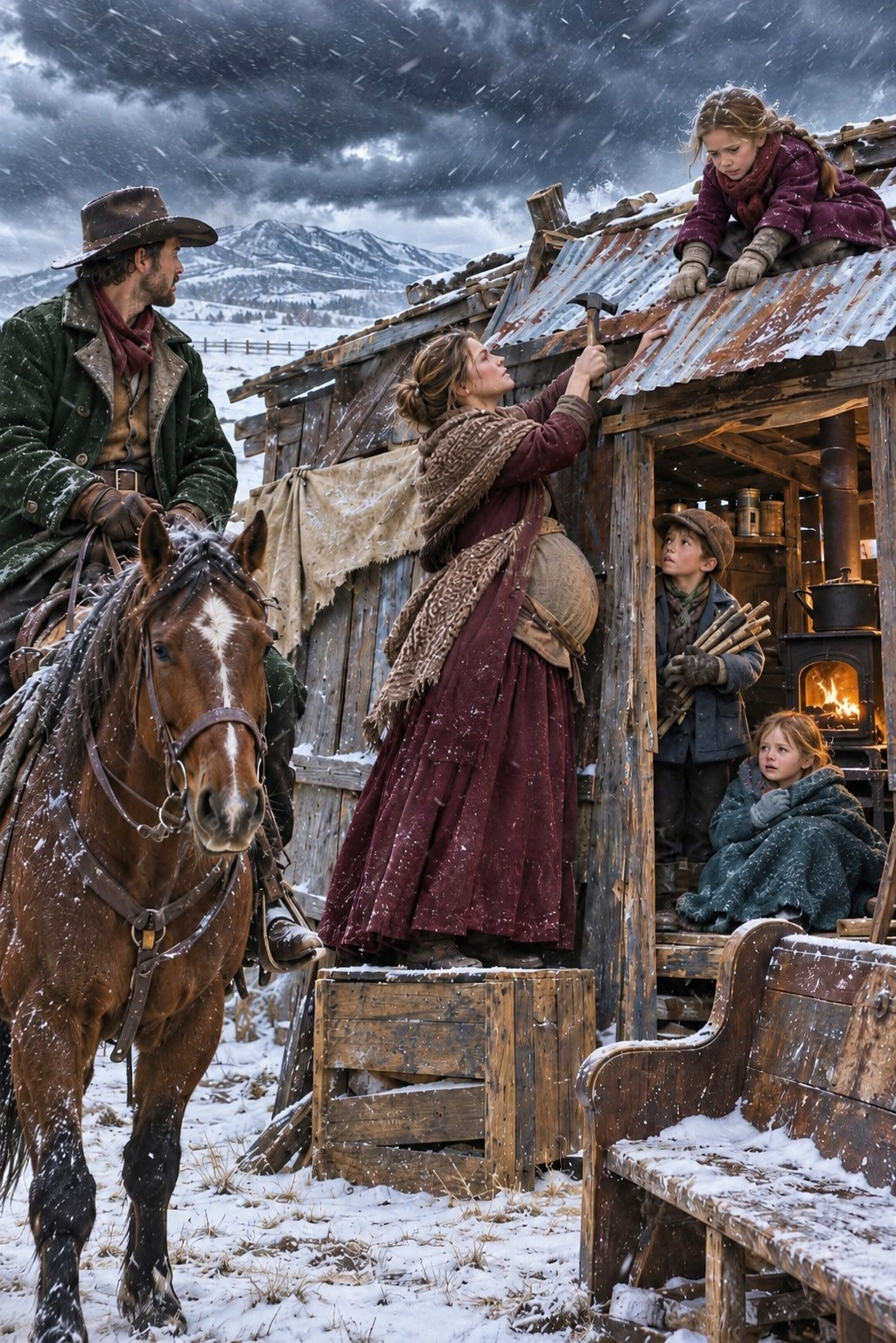
Clara on the roof.
Henry holding scraps of wood.
Rose shivering beside the stove.
Nora standing in the doorway, proud and exhausted, refusing to be treated as helpless.
He remembered his promise.
I'll come back with longer nails.
He smiled faintly.
A horse approached behind him.
Caleb turned.
Nora sat in a small wagon, with Thomas beside her.
The children were bundled together in the back.
The baby slept against Nora's chest.
Caleb walked toward them.
"What brings you out here?"
Nora smiled.
"We wanted to see it."
Caleb looked toward the shed.
"There's not much to see."
Clara jumped down.
"Yes, there is."
She hurried toward the door.
Henry followed.
Rose climbed carefully from the wagon.
Thomas helped Nora down.
For a moment, they stood together.
Then Nora stepped inside.
The room was quiet.
Sunlight entered through the little window.
The stove was cold.
The walls still bore marks where she had fitted mismatched boards together.
She touched one of them.
Thomas stood beside her.
"You built all this?"
Nora nodded.
"With the children."
He looked around.
His eyes filled.
"I wish I'd been here."
Nora turned toward him.
"So do I."
Thomas swallowed.
Then he took her hand.
"I can't give you those months back."
She nodded.
"I know."
"But I can spend the rest of my life making certain you never face anything like that alone again."
Nora studied him.
For a long moment, she said nothing.
Then she squeezed his hand.
"Then start by trusting me."
Thomas smiled through his tears.
"I will."
Caleb stood near the doorway.
He watched them.
A strange sadness moved through him.
He had never regretted helping Nora.
Not once.
But somewhere between the first nail he had driven into her roof and the night her daughter was born, he had allowed himself to imagine a different future.
A future with laughter in his quiet house.
Children running across his porch.
Nora beside the fire.
He had never spoken of it.
And now he knew he never would.
Thomas was alive.
Nora's family had been restored.
That was the ending Caleb had fought for.
He turned toward the door.
But Nora called his name.
"Caleb."
He stopped.
She stepped toward him.
"There's something I want to show you."
She pointed toward the chimney.
The children gathered around.
Carved into the wood were four uneven letters.
H-O-M-E
Henry grinned.
"We made that."
Rose nodded.
"Mama said it was a home because we were together."
Caleb smiled.
"She was right."
Nora looked at him.
"But you helped us believe it could become more."
Caleb lowered his eyes.
"I only brought lumber."
She shook her head.
"You came back."
He looked up.
Nora smiled.
"When everyone else turned away, you came back."
For a moment, Caleb couldn't speak.
Then Thomas stepped beside her.
He held out his hand.
"Caleb."
The rancher took it.
Thomas's grip was firm.
"I owe you more than I can ever repay."
Caleb shook his head.
"You don't owe me anything."
Thomas smiled.
"Then let me call you my friend."
Caleb felt his throat tighten.
He nodded.
"I'd like that."
They stood together in the little shed.
A widow who was no longer a widow.
A husband returned from the dead.
Four children who had survived the winter.
And the cowboy whose promise had helped keep them alive.
By late spring, the old sheep shed had a new purpose.
Jonathan Bennett donated the land surrounding it to Clearwater.
With help from Caleb, Thomas, Walter, and several townspeople, the building was expanded into a small refuge for families in need.
It had a proper roof.
A wide fireplace.
Two sleeping rooms.
A kitchen.
And a sturdy front door that could be opened from the inside without asking anyone's permission.
Above the entrance hung a wooden sign.
BENNETT HOUSE
Beneath it, in smaller letters, Thomas had carved:
NO FAMILY TURNED AWAY
Nora insisted that the refuge offer more than food and blankets.
There would be help finding work.
Help reading legal papers.
Help contacting relatives.
And no child would be separated from a parent simply because the family was poor.
Martha Whitcomb volunteered to cook there after completing the restitution and community service ordered by the court.
Nora did not pretend their past had disappeared.
But she allowed Martha the chance to do something better with her future.
Walter helped keep the accounts.
This time, every payment was recorded openly.
Caleb checked them himself.
And Margaret Mercer, reunited with Samuel after twelve lost years, helped teach reading and writing to the children who came through the refuge.
Her husband often sat beside the fireplace, telling stories of the old territory.
Sometimes Caleb listened from the doorway.
He had spent much of his life believing his parents were gone.
Now he heard their voices again.
He never stopped being grateful for that.
On the first warm Sunday of June, Clearwater gathered for the dedication of Bennett House.
The sky was clear.
Wildflowers grew along the creek.
Children ran between the cottonwood trees.
Maria had baked three honey cakes.
Henry proudly displayed a collection of wooden horses he had carved with Thomas and Caleb.
Clara helped organize the younger children.
Rose wore a lavender ribbon in her golden curls.
And Nora stood beneath the new sign, holding her daughter.
The baby was healthy.
Her cheeks were round.
Her eyes were bright.
She had learned to smile whenever Henry made silly faces.
Thomas stood beside Nora.
He looked stronger now.
His beard was neatly trimmed.
His hands had returned to their familiar work.
He had opened a carpentry shop in Clearwater, using a portion of the restored Bennett funds to purchase tools and timber.
Their family had moved into a small house near the edge of town.
It wasn't grand.
But it had a garden.
A workshop.
Enough bedrooms.
And a porch where Nora could sit in the evening and watch the children play.
The property belonged to Nora and Thomas together, with the children's inheritance protected separately.
For the first time in months, Nora could look toward the future without fear.
Caleb approached carrying a small wooden box.
Nora smiled.
"What's that?"
He looked toward the baby.
"A present."
Thomas laughed.
"You've already given us enough."
Caleb shrugged.
"One more won't hurt."
He opened the box.
Inside lay a tiny wooden horse.
Its mane was carefully carved.
Its legs were sturdy.
And beneath its belly, Caleb had engraved a name.
HOPE
Nora stared.
Then she looked at him.
"You remembered."
Caleb smiled.
"Of course."
Hope.
The name Nora had chosen for her daughter.
The name that had come to her during the darkest night of the winter.
She lifted the little horse.
Her eyes filled.
"It's beautiful."
Caleb nodded.
"Henry helped with the sanding."
The boy grinned from beside the porch.
Nora laughed.
"Of course he did."
She looked down at her daughter.
"Look, Hope. Your first horse."
The baby reached toward it.
Everyone laughed.
Caleb smiled.
Then he stepped back.
For a moment, he watched the family.
Thomas holding Rose.
Clara helping Henry.
Nora smiling at the baby.
The sight no longer hurt as sharply as it once had.
He had learned something during the long months since he first found them.
A promise did not have to end in possession.
Love did not always mean becoming the person someone chose to spend a lifetime beside.
Sometimes it meant standing close enough to help.
And stepping aside when the people you cared about finally found their way home.
Nora looked toward him.
"Caleb."
He turned.
She held out her free hand.
He took it.
"Thank you," she whispered.
He smiled.
"You've said that before."
"I know."
"Then you don't have to say it again."
Nora shook her head.
"I want to."
She looked toward Bennett House.
Then toward her children.
"You didn't save us because you thought we were helpless."
Caleb nodded.
"No."
"You saw what we had built."
He smiled.
"I did."
"And you believed we deserved the chance to keep building."
Caleb looked at her.
"Yes."
Nora squeezed his hand.
"That's something I'll never forget."
For a moment, they stood quietly.
Then Thomas called from the porch.
"Caleb! Come help me with this table."
Caleb laughed.
"Coming."
He released Nora's hand.
Then turned toward the house.
The children ran ahead.
Maria called for everyone to wash their hands before eating.
Walter carried another bench into the yard.
Margaret and Samuel sat beneath the cottonwoods, their fingers intertwined.
Jonathan Bennett stood beside the new sign, smiling as he watched families enter a place built to welcome them.
And Nora followed slowly, with Hope sleeping peacefully in her arms.
Before stepping inside, she paused.
She looked back toward the little building she had once made from scraps.
She remembered the first night.
The wind.
The cold.
The fear that her children might not survive until morning.
She remembered standing beside the unfinished roof, wondering whether anyone in the world would care if they disappeared.
Then she remembered a lone cowboy riding out of the snow.
A man who had looked at her crooked walls and patched chimney and seen something worth protecting.
He had not offered to take over her life.
He had offered to help her build it.
Nora smiled.
Inside Bennett House, laughter filled the rooms.
Clara called for her mother.
Henry asked Caleb whether they could make another wooden horse.
Rose insisted that Hope needed a slice of honey cake, even though the baby was far too young to eat it.
Thomas stood in the doorway, waiting for Nora.
He held out his hand.
She took it.
Together, they stepped inside.
The door remained open behind them.
Above it, the words Thomas had carved caught the afternoon sunlight.
NO FAMILY TURNED AWAY
And beneath the roof that had once sheltered a desperate mother and her children, there was warmth enough for everyone.






Comments 0