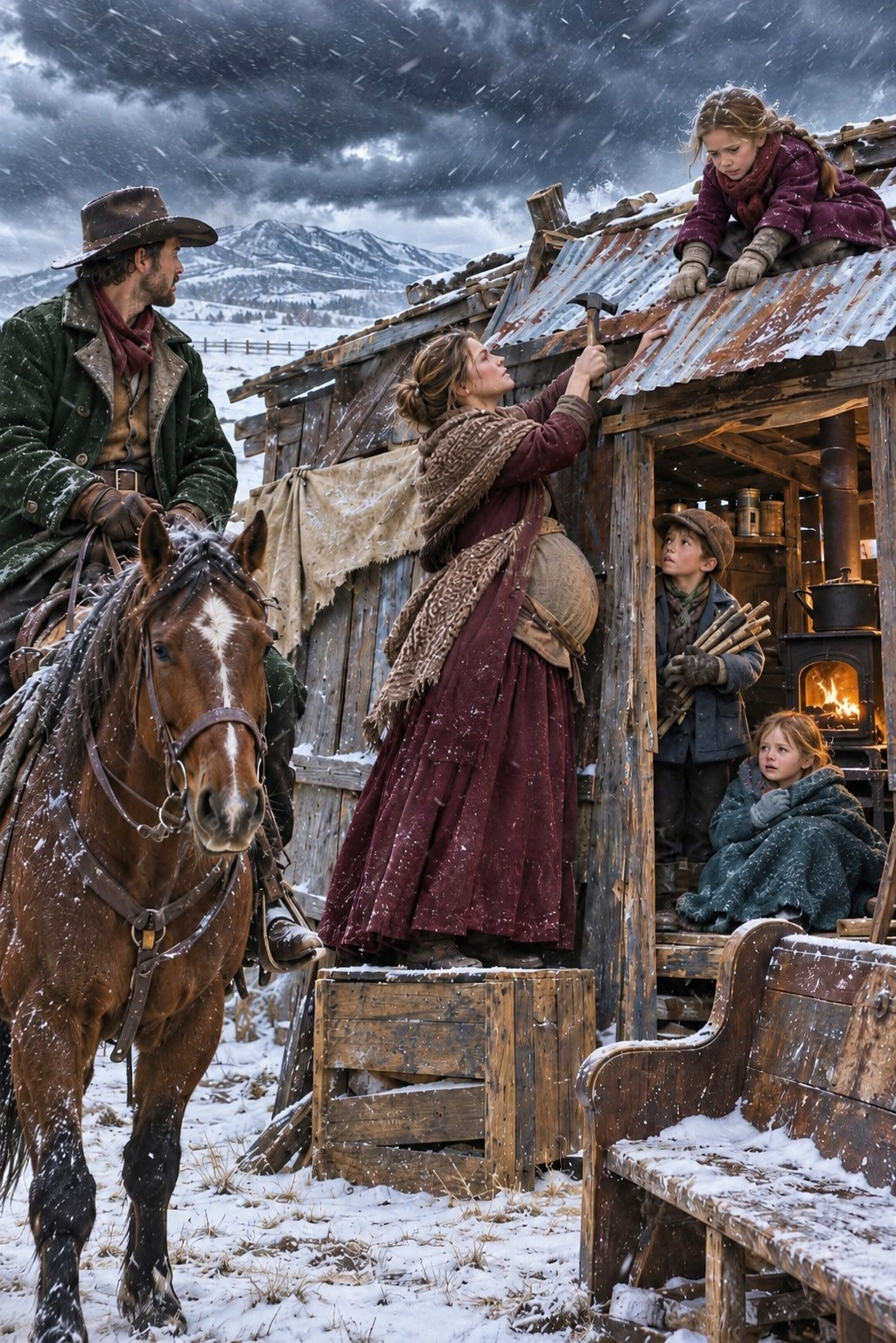
Caleb Mercer read the first sentence twice.
Then he looked at his foreman.
"Who gave you this?"
Walter Price didn't answer.
The paper trembled slightly in Caleb's gloved hand, though whether from the wind or the anger rising inside him, he couldn't have said.
Across the top, beneath Nora Bennett's name, someone had written:
NO EMPLOYMENT, SHELTER, CREDIT, OR ASSISTANCE IS TO BE EXTENDED TO THIS WOMAN WITHOUT PRIOR AUTHORIZATION.
Caleb slowly raised his eyes.
"Authorization from whom?"
Walter looked toward the ranch house.
"Caleb—"
"From whom, Walter?"
"Edwin Bell."
The name hung between them.
Caleb knew Edwin Bell.
Everyone in Clearwater did.
He was the grown son of Amos Bell, the widowed homesteader Nora had traveled west to marry. Since his father's death, Edwin had taken possession of the Bell property and begun conducting himself as though half the county belonged to him.
He had money.
He had friends.
And he had the particular kind of confidence that came from believing nobody would ever challenge him.
Caleb looked back at the paper.
Beneath the warning was a list of establishments.
Whitcomb Boardinghouse.
Harlan's General Store.
Clearwater Livery.
Three other businesses.
Beside each name was a small mark.
A check.
A confirmation.
Caleb felt something cold settle in his stomach.
"This isn't a warning," he said.
Walter remained silent.
"It's a list."
"Yes."
"Of people who agreed to turn her away."
Walter swallowed.
"That's what it looks like."
Caleb stepped closer.
"How long have you had this?"
"Three weeks."
"Three weeks?"
"I didn't know what to make of it."
Caleb stared at him.
"You knew she was living in that shed."
"Everybody knew."
"You knew she had children."
"Yes."
"And you kept this in your coat for three weeks?"
Walter's face reddened.
"Edwin said there were legal matters involved. He claimed the woman was trying to take property that didn't belong to her."
Caleb looked down at the paper again.
"Does this look like a legal document to you?"
"No."
"Then why did you believe him?"
Walter opened his mouth.
Nothing came out.
The wind struck the barn doors hard enough to make them rattle.
Caleb folded the paper carefully.
"Where did you get it?"
"Edwin handed copies around town. He came here himself because he thought Mrs. Bennett might ask you for work."
"And what did you tell him?"
"I told him we weren't hiring."
Caleb's expression didn't change.
But Walter took a step backward.
"Did you promise not to help her?"
"No."
"Did you sign anything?"
"No, sir."
"Then why did you keep it?"
Walter looked ashamed.
"Because he told me there'd be trouble if you got involved."
Caleb slipped the paper into his coat.
"Then I suppose trouble has finally arrived."
He walked toward the barn.
Walter hurried after him.
"Caleb, wait."
"Get the wagon."
"There's something else."
Caleb stopped.
Walter hesitated.
"Edwin wasn't only worried about the property."
"What else?"
"He said Mrs. Bennett had something belonging to his father."
Caleb turned.
"What?"
"I don't know. He wouldn't say."
"Then why mention it?"
"Because he seemed frightened."
Caleb studied him.
"Edwin Bell?"
Walter nodded.
"He was angry when he came here. But when he asked whether we'd seen the widow, his hands were shaking."
Caleb considered that.
Edwin Bell was not a man easily frightened.
At least, not by anything ordinary.
"Did he threaten her?"
"I don't know."
"Did he threaten the children?"
Walter looked away.
Caleb felt his jaw tighten.
"Answer me."
"He said if she didn't leave the territory, she'd regret staying."
For several seconds, Caleb said nothing.
Then he opened the barn door.
"Load the wagon."
Walter followed.
"Caleb, there's a storm coming."
"I noticed."
"The north trail will be nearly impassable by dark."
"Then we'd better move quickly."
"What if Edwin comes looking for trouble?"
Caleb turned to face him.
"Then he'll find me."
Walter stared.
He had worked for Caleb Mercer for eleven years.
He had seen the rancher face stampeding cattle, armed rustlers, and winters that killed livestock by the hundreds.
But he had rarely seen that expression.
It wasn't rage.
Rage burned hot and fast.
This was something quieter.
Something Walter had learned to respect.
Caleb had made a decision.
And once he made one, moving him was about as easy as moving a mountain.
"How many boards?" Walter asked.
"Enough to reinforce the north wall and replace the worst of the roof."
"That'll take half our winter stock."
"Then use half."
"Tar paper?"
"Every roll in the supply room."
"Blankets?"
"Six."
"Firewood?"
"As much as the wagon can carry."
Walter shook his head.
"You're planning to rebuild that shed."
"I'm planning to keep four people alive."
"Five," Walter corrected quietly.
Caleb stopped.
Walter glanced toward his own stomach.
"The baby."
For the first time since reading the paper, Caleb's expression softened.
"Five," he agreed.
They worked without another word.
Within twenty minutes, the ranch yard became a scene of hurried preparation.
Two hired hands carried lumber from the storage shed.
Walter brought out a heavy box of six-inch spikes.
Caleb inspected the wagon wheels, checked the harness, and added an extra coil of rope.
The horses would have to pull a considerable load across frozen ground.
He knew the journey would be difficult.
He also knew they were running out of daylight.
At the ranch house, Maria Alvarez appeared on the porch.
She had managed Caleb's kitchen for nearly eight years and possessed the rare ability to tell when something was wrong simply by watching how he walked.
"Caleb Mercer," she called, "why are my men carrying half the lumberyard into your wagon?"
"Because I asked them to."
"That explains nothing."
He approached the porch.
Maria folded her arms.
She was a sturdy woman in her late fifties, with silver threaded through her dark hair and a manner that frightened even the toughest ranch hands.
"Who are we helping?" she asked.
"Nora Bennett."
Maria's face changed immediately.
"The widow?"
"Yes."
"The one with the children?"
"Yes."
Maria looked toward the wagon.
Then toward the western sky.
"Good Lord."
Caleb waited.
"How bad is it?" she asked.
"Worse than you've heard."
Maria's eyes narrowed.
"How much food?"
"A week's worth."
"That isn't enough."
Caleb blinked.
"It isn't?"
"Not for three growing children and a woman carrying another one."
She turned toward the kitchen.
"I'll pack for two weeks."
"Maria—"
"And don't argue with me."
The door slammed behind her.
Walter, who had overheard the exchange, almost smiled.
"Well," he muttered, "there goes the pantry."
Caleb looked toward the wagon.
"Good."
Inside the kitchen, Maria moved with determined efficiency.
She packed flour, dried beans, salt pork, potatoes, onions, coffee, sugar, and several jars of preserved fruit.
Then she added two loaves of fresh bread.
After a moment's thought, she wrapped a small honey cake in clean cloth.
She knew little about Nora Bennett.
But she knew what hunger did to children.
And she knew that a little sweetness could sometimes remind them that the world still held kindness.
As she worked, Caleb entered the kitchen.
"Maria."
She didn't turn.
"Don't tell me to pack less."
"I wasn't going to."
"Then what?"
He placed Edwin Bell's paper on the table.
"Have you seen this?"
Maria wiped her hands and unfolded it.
She read slowly.
Her expression darkened.
"Where did you get this?"
"Walter."
She read the names again.
Then she set the paper down.
"Mrs. Whitcomb signed this?"
"Apparently."
Maria shook her head.
"That woman sits in church every Sunday talking about Christian charity."
Caleb said nothing.
Maria tapped the paper.
"And Harlan. He refused credit to a mother with three children?"
"Looks that way."
She looked up.
"Do you know why?"
"Edwin Bell told them to."
"That's not a reason."
"No."
"That's cowardice."
Caleb folded the paper.
Maria studied his face.
"You're angry."
"Yes."
"Good."
He looked surprised.
She returned to packing.
"Anger isn't always a sin, Caleb. Sometimes it's what reminds a decent man that something is terribly wrong."
He leaned against the table.
"I offered her a place here."
"And?"
"She refused."
Maria nodded as though she had expected that answer.
"Of course she did."
"Of course?"
"A woman who's had every door shut in her face isn't going to walk through the next one just because a stranger holds it open."
Caleb considered her words.
"Then what should I do?"
Maria tied the food sack.
"Stop trying to take her somewhere."
He frowned.
"Meaning?"
"Help her stand where she already is."
Caleb looked toward the window.
Outside, Walter was securing the final load.
"That's the plan."
Maria placed the honey cake on top of the supplies.
"Then make sure she understands it."
Back at the sheep shed, Nora Bennett was trying not to look toward the north.
She had promised herself she wouldn't.
Caleb Mercer had ridden away nearly an hour earlier.
He had said he would return.
So had other people.
A merchant in Nebraska had promised to hold her belongings until she could pay the storage fee.
He sold them after six days.
A man outside Cheyenne had promised her husband work when Thomas was still alive.
The job disappeared when they arrived.
Mrs. Whitcomb had promised Nora she could remain at the boardinghouse until she found employment.
Two mornings later, her belongings were placed on the porch.
Promises were easy.
Keeping them was another matter.
Nora pulled the blanket tighter around Rose.
The little girl sat beside the stove, her small feet tucked beneath her.
"Are you warm now, sweetheart?"
Rose nodded.
But her lips still looked pale.
Nora touched her forehead.
No fever.
Thank God.
Henry sat on the floor, carefully breaking sticks into smaller pieces.
"Don't use them all," Nora warned gently.
"I'm making them last."
"I know."
Clara stood near the doorway.
She had been watching the trail for almost twenty minutes.
"He's coming back," she said.
Nora didn't look up.
"Who?"
"The cowboy."
"Clara."
"He said he would."
"People say many things."
Clara turned.
"He helped me."
"Yes."
"And he fixed the chimney."
"Yes."
"Then why wouldn't he come back?"
Nora had no answer that an eleven-year-old should have to hear.
Because some people helped only when others were watching.
Because kindness sometimes came with conditions.
Because a woman without money or a husband could be treated as though her dignity were a luxury she could no longer afford.
Instead, Nora said, "We have work to do."
Clara lowered her eyes.
"Yes, Mama."
Nora regretted the sharpness in her voice.
She reached for her daughter's hand.
"I'm not angry with you."
"I know."
"I'm just tired."
Clara squeezed her fingers.
"I know that too."
The simple answer nearly broke Nora's heart.
Eleven-year-old girls weren't supposed to understand exhaustion like that.
They were supposed to complain about chores.
Dream about dresses.
Argue over ribbons.
Clara had learned to mend socks, ration flour, and recognize the sound of a roof beam beginning to split.
She had learned too much.
Far too soon.
Nora pulled her close.
"We'll be all right."
Clara rested her head against her mother's shoulder.
"Will we?"
Nora closed her eyes.
"Yes."
She had to believe it.
Because the alternative was unbearable.
A sudden pain tightened across her lower back.
She inhaled sharply.
Clara stepped away.
"Mama?"
"I'm fine."
"You're holding your stomach."
"The baby's just reminding me he's here."
"Do you think it's a boy?"
Nora managed a faint smile.
"Your father always said we'd have another girl."
"Then we'd be four girls and Henry."
Henry looked up.
"That's too many girls."
Rose giggled softly.
The sound was so unexpected that everyone turned.
For a brief moment, the shelter felt less cold.
Then the wind struck the northern wall.
The entire structure shuddered.
Dust drifted from the rafters.
Rose stopped laughing.
Henry stared at the ceiling.
Clara moved closer to her mother.
Nora looked toward the patched roof.
One of the boards had shifted.
She could see daylight through a gap that hadn't been there an hour earlier.
She stood.
"Clara, take your brother and sister to the far corner."
"Why?"
"Just do as I say."
The girl obeyed.
Nora retrieved the hammer.
Her back ached.
Her fingers were stiff.
Her legs trembled from standing too long.
But she climbed onto the crate again.
She reached toward the loose board.
The hammer felt heavy in her hand.
For one terrible moment, she wondered whether she had finally reached the end of what determination alone could accomplish.
Then she remembered Thomas.
Her husband had possessed broad hands, an easy laugh, and an almost unreasonable faith in the usefulness of ordinary things.
He could turn a broken chair into a cradle.
A discarded door into a table.
A crooked beam into something strong enough to hold a roof.
He had taught Nora how to measure twice, cut once, and never trust a nail driven into rotten wood.
When fever took him, she had held his hand until morning.
Three months later, his younger brother had claimed the farm.
The documents had been prepared.
The debts had been presented.
Nora had protested.
Nobody listened.
She remembered standing in the yard while strangers carried furniture from the house Thomas had built.
Clara had cried when they took her father's rocking chair.
Henry had asked whether they were moving again.
Rose had been too young to understand.
Nora had promised them a new beginning.
That promise brought her west.
And west had brought her here.
She struck the nail.
Once.
Twice.
The board shifted again.
She struck harder.
The nail bent.
Nora stared at it.
Then she lowered the hammer.
She had no more nails long enough to hold the beam.
No spare lumber.
No money.
And the storm was coming.
Behind her, Clara whispered, "Mama?"
Nora turned.
The girl was standing near the stove.
"Do you think Mr. Mercer has forgotten us?"
Nora opened her mouth.
Before she could answer, a distant sound reached them.
A low rumble.
Not thunder.
Wheels.
Clara ran toward the doorway.
"Mama!"
Nora stepped off the crate.
Outside, through the blowing snow, two horses emerged from the darkness.
Behind them came a heavily loaded wagon.
Caleb Mercer walked beside the team, one hand holding the reins.
Walter Price followed on horseback.
The wagon was piled with lumber.
Bundles of firewood were tied along the sides.
Canvas-covered sacks filled the rear.
And beneath the driver's seat, Nora could see rolled blankets.
Clara gasped.
"He came back!"
Henry rushed to the doorway.
"With a wagon!"
Rose tried to stand.
Nora remained motionless.
For several seconds, she couldn't make sense of what she was seeing.
Caleb had promised longer nails.
He had brought enough supplies to rebuild half the shelter.
The wagon stopped beside the shed.
Caleb looked toward the doorway.
"Afternoon again, Mrs. Bennett."
Nora stepped outside.
Snow caught in her hair.
Her eyes moved across the wagon.
"What is all this?"
"Supplies."
"I can see that."
"Boards. Roofing paper. Firewood. Food."
Her expression hardened.
"I told you I wasn't leaving."
"I remember."
"Then why did you bring a wagon?"
"To carry the lumber."
Walter dismounted behind him.
He looked uncomfortable.
Nora glanced between the two men.
"Mr. Mercer, I don't know what you think you're doing—"
"Keeping a promise."
"You promised nails."
Caleb reached into the wagon and lifted a heavy wooden box.
"Six-inch spikes."
He set it carefully in the snow.
"Just as requested."
Nora stared at the box.
Then at the lumber.
"That's considerably more than nails."
"Yes, ma'am."
"I can't pay for this."
"I didn't ask you to."
"I won't accept charity."
Caleb nodded.
"Then don't."
She frowned.
"What does that mean?"
He pointed toward the shelter.
"You know how to build. I have materials. You tell us what needs fixing, and we'll do the heavy lifting."
Nora stared at him.
Walter looked equally surprised.
Caleb continued.
"Your shelter. Your decisions. We're just helping with the work."
For the first time, Nora seemed to lose the words she had prepared.
She looked at the children standing behind her.
Then at the lumber.
Then at Caleb.
"Why?"
He didn't pretend to misunderstand.
"Because your children deserve a roof that stays over their heads."
Her lips pressed together.
"That isn't your responsibility."
"No."
"Then why make it yours?"
Caleb looked toward the dark sky.
"Because I can."
The answer was so simple that Nora had no defense against it.
Walter cleared his throat.
"Mr. Mercer, if we're going to get that roofing paper down before dark, we'd better start."
Caleb nodded.
"Mrs. Bennett?"
Nora looked at the shed.
The broken wall.
The sagging roof.
The crooked little chimney Caleb had repaired.
Then she looked at her children.
Clara was trying not to smile.
Henry was staring at the wagon as though it contained every treasure in the world.
Rose stood wrapped in her blanket, watching silently.
Nora drew a slow breath.
"The north wall needs reinforcing first," she said.
Caleb nodded.
"Agreed."
"And the roof beam above the doorway."
"I saw that."
"The western side needs another brace."
"We brought timber."
She looked at Walter.
"Can you handle a hammer?"
Walter blinked.
"Yes, ma'am."
"Then stop standing there."
Caleb lowered his head to hide the smallest smile.
Walter hurried toward the wagon.
For the next hour, the three adults worked against the storm.
Caleb and Walter unloaded lumber while Nora directed the repairs.
She knew every weakness in the structure.
Every board that had begun to rot.
Every nail that needed replacing.
Every gap where the wind entered.
Caleb listened.
He didn't interrupt.
He didn't take over.
And gradually, Nora stopped expecting him to.
Inside, Maria's food transformed the children's afternoon.
Henry nearly cried when he saw the bread.
Clara carefully divided a piece between herself and Rose.
Nora watched from the doorway.
"There's enough for everyone," Caleb told her.
She looked away.
"I know."
But her voice trembled.
Just once.
Then she returned to work.
By late afternoon, the north wall stood straighter.
The roof had been secured with new boards and longer nails.
Fresh roofing paper covered the worst gaps.
The chimney no longer swayed.
The shelter wasn't beautiful.
It wasn't finished.
But it was stronger.
Much stronger.
Walter wiped snow from his face.
"That should hold."
Caleb examined the western brace.
"For tonight, maybe."
Nora heard the uncertainty.
"Maybe?"
Caleb looked toward the mountains.
The storm had grown darker.
The wind was changing direction.
He knew what that meant.
The worst of it was still coming.
"We need another hour," he said.
Walter shook his head.
"We don't have another hour."
Caleb turned.
"What?"
Walter pointed toward the trail.
The snow was already covering their wagon tracks.
"If we don't leave now, we won't make it back to the ranch."
Caleb looked at Nora.
Then at the children.
Then at the shelter.
He had come prepared to help.
He had not come prepared to abandon them halfway through.
"Then we'll stay," he said.
Walter stared.
"Stay?"
"Until the storm passes."
"Caleb, there isn't room."
"We'll make room."
Nora stepped forward.
"Absolutely not."
Caleb turned toward her.
"Mrs. Bennett—"
"This shelter is barely large enough for my children."
"Then Walter can take the horses back."
Walter opened his mouth.
Before he could speak, a sharp crack echoed from the western wall.
Everyone froze.
The sound came again.
Louder.
Caleb turned.
One of the old support beams had split near its base.
The newly reinforced roof shifted slightly.
Nora's face went pale.
"Clara," she called, "get your brother and sister away from that wall."
The girl obeyed immediately.
Caleb rushed toward the damaged beam.
Walter grabbed a spare board.
Together, they braced the wall before it could move farther.
For several tense seconds, the entire structure groaned beneath the wind.
Then it settled.
Caleb exhaled.
Walter looked at him.
"That was close."
"Too close."
Nora stood beside the doorway.
Her hands were shaking.
She hid them beneath her shawl.
Caleb noticed.
He said nothing.
Instead, he examined the cracked timber.
"This wood was already rotten."
"I know," Nora whispered.
He looked at her.
She stared at the damaged wall.
"I knew it wouldn't last forever."
Caleb's voice softened.
"You did everything you could."
Nora shook her head.
"Not enough."
"Mrs. Bennett—"
"Not enough."
Her voice broke.
She turned away before he could see her face.
Caleb stood quietly.
He had seen strong people reach the end of their strength before.
They rarely collapsed dramatically.
More often, they simply became very still.
As though one more disappointment might be more than they could bear.
He removed his gloves.
"Nora."
She didn't turn.
"We're going to fix this."
She looked back.
"How?"
Caleb glanced at the wagon.
Then at the remaining lumber.
Then at the western wall.
"We'll build another support frame inside."
Walter frowned.
"That'll take until midnight."
"Then we'd better begin."
"Caleb—"
"Get the saw."
Walter stared at him.
Then he nodded.
But before he could move, a sound came from the trail.
Horse hooves.
Not one horse.
Several.
Caleb turned sharply.
Through the blowing snow, three riders appeared beyond the broken fence.
They were moving directly toward the shed.
Walter's expression changed.
He recognized the man riding in front.
"Oh, Lord," he whispered.
Caleb stepped away from the wall.
"Who is it?"
Walter swallowed.
"Edwin Bell."
Nora went completely still.
The color drained from her face.
Caleb looked at her.
For the first time since meeting her, he saw something stronger than suspicion.
Fear.
Real fear.
Edwin Bell rode closer.
He wore a black coat and carried a leather document case across his saddle.
Two men followed him.
One held a lantern.
The other carried a rifle.
Caleb moved instinctively between the riders and the shelter.
Edwin pulled his horse to a stop.
His eyes swept over the wagon.
The lumber.
The fresh roofing paper.
The repaired chimney.
Then he looked at Caleb.
"I was told you were helping this woman."
Caleb didn't move.
"You were told correctly."
Edwin's mouth tightened.
"Then someone neglected to explain that she has no right to remain here."
Nora stepped forward.
"That's not true."
Edwin looked at her.
"Mrs. Bennett."
She lifted her chin.
"Mr. Bell."
He smiled without warmth.
"I see you've found yourself another man willing to believe your story."
Caleb's expression hardened.
"Choose your next words carefully."
Edwin ignored him.
He opened the leather case.
"I came to settle this matter before the storm makes travel impossible."
Nora stared at the papers.
"What matter?"
Edwin withdrew a folded document bearing an official-looking seal.
"The matter of your late husband's obligations."
Nora's breath caught.
"My husband's debts were settled."
Edwin smiled.
"Not all of them."
Caleb stepped forward.
"Let me see that."
Edwin held the paper out of reach.
"This concerns Mrs. Bennett."
"Then speak to her respectfully."
Edwin's smile vanished.
He turned toward Nora.
"You have until sundown to leave this property."
Nora looked toward her children.
Clara stood in the doorway with Henry and Rose behind her.
All three were watching.
Nora faced Edwin again.
"Where do you expect us to go?"
"That's no concern of mine."
Caleb took one step closer.
"It is now."
Edwin looked at him.
Then he laughed quietly.
"You don't understand what you're involving yourself in, Mercer."
"Then explain it."
Edwin glanced at the children.
His expression became strangely satisfied.
"Gladly."
He opened the document.
Walter moved closer to Caleb.
Nora gripped the edge of her coat.
Edwin cleared his throat.
"This is a formal claim filed against the estate of Thomas Bennett."
Nora shook her head.
"Thomas never owed your father anything."
"Not my father."
Edwin looked directly at her.
"Your brother-in-law."
Nora stopped breathing.
Caleb turned toward her.
"Mrs. Bennett?"
She stared at Edwin.
"That's impossible."
Edwin unfolded the final page.
"Is it?"
He held it toward the lantern.
At the bottom was a signature.
A signature Nora recognized.
Her dead husband's name.
Thomas Bennett.
But beside it was something else.
A second signature.
And when Nora saw whose name had been written there, she staggered backward.
Caleb reached for her arm.
"Nora?"
She didn't answer.
Her eyes remained fixed on the paper.
Edwin smiled.
"Now perhaps you'll understand why nobody in Clearwater was willing to help you."
Caleb looked at the document.
Then at Nora.
Her face had gone white.
"That signature," she whispered.
Edwin leaned forward in his saddle.
"Yes, Mrs. Bennett?"
Nora raised one trembling hand.
"That person was buried six years ago."
The smile disappeared from Edwin's face.
Caleb stepped closer to the lantern.
"Let me see the name."
Edwin hesitated.
For the first time, he seemed uncertain.
Then Caleb took the document from his hand.
He turned it toward the light.
And beneath Thomas Bennett's signature, written in unmistakable black ink, was the name of a person who should never have been able to sign it.
Before Caleb could speak, Nora grabbed his wrist.
"Mr. Mercer," she whispered, "there's something you need to know about that name."
Caleb looked at her.
Her eyes filled with terror.
"That person didn't just die six years ago."
She glanced toward the children.
Then back at the paper.
"I watched them put the coffin in the ground."
A sudden gust nearly extinguished the lantern.
Edwin reached for the document.
Caleb pulled it away.
And from inside Edwin's leather case, another folded paper slipped loose and fell into the snow.
Nora saw the handwriting.
She froze.
Because across the front, in the familiar hand of her dead husband, were three words.
FOR MY WIFE.
Caleb bent to pick it up.
Edwin lunged forward.
"Don't open that!"
But Caleb had already broken the seal.






Comments 0