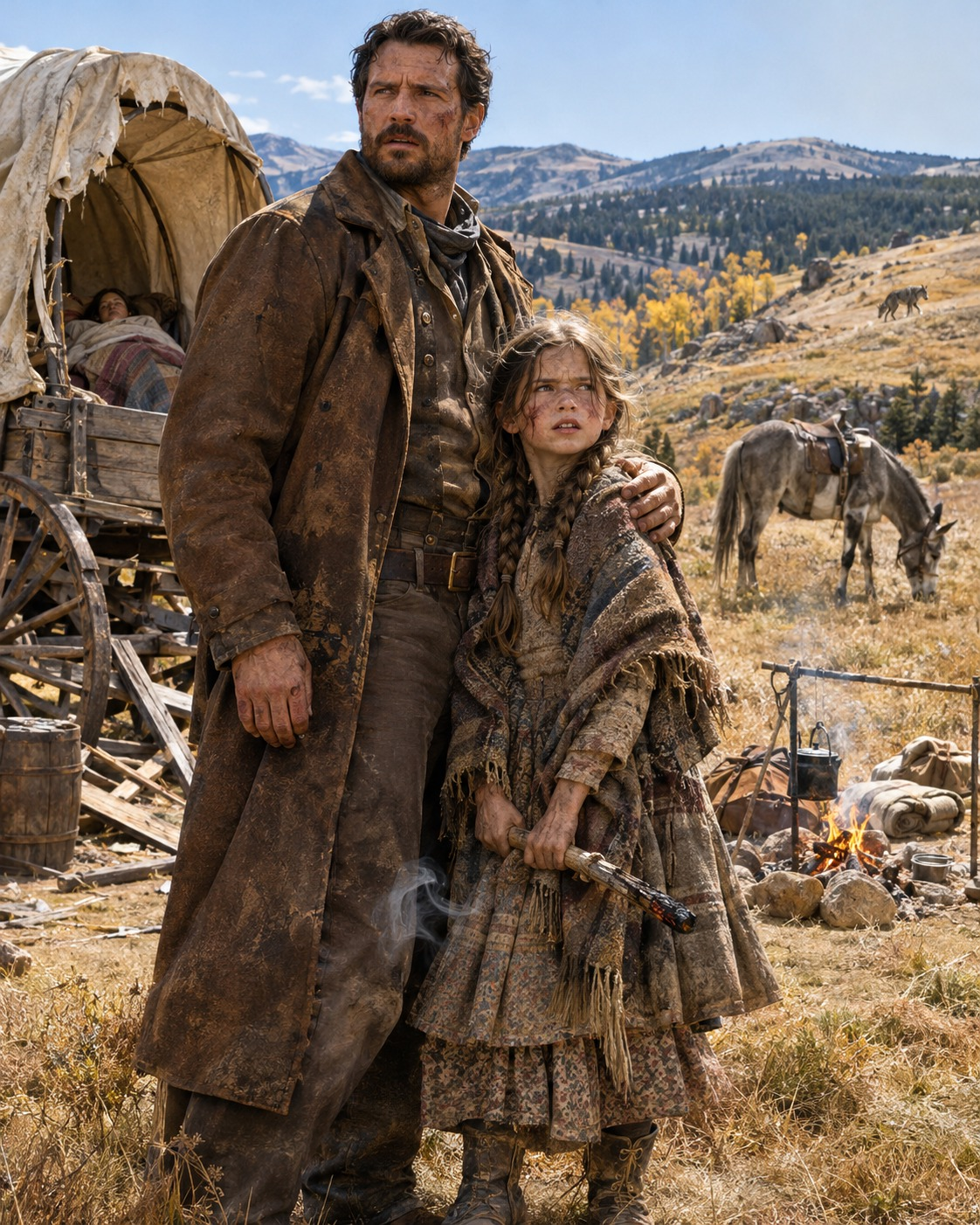
"Stay away from my mama!" the little girl screamed, swinging a burning branch at the wolf.
When rancher Eli Brandt arrived, he found a silver dollar clenched in her dirty fist.
A fresh scratch crossed the coin.
Three wagons had passed her.
Not one had stopped.
And Eli suddenly understood that the wolf wasn't the cruelest thing she had faced.
The animal stood twenty feet from the dying campfire, its gray coat almost disappearing against the dry grass. Its ears were forward. Its head hung low. Every few seconds, it took another cautious step toward the broken covered wagon.
Between the wolf and the wagon stood a child who couldn't have weighed more than forty pounds.
She was barefoot.
Her faded green dress was torn at the hem. A burgundy shawl hung crookedly from her narrow shoulders, and her long blonde hair had escaped its braid. Dirt streaked her cheeks. Her lips were cracked.
Both hands gripped a branch with flames licking one end.
"Go on!" she shouted again.
The wolf backed away.
Only a little.
Then it stopped.
The girl glanced over her shoulder.
Inside the wagon, a woman lay beneath a patchwork quilt.
"Mama," the girl whispered. "I'm still here."
The woman didn't answer.
The girl turned back toward the wolf.
Her knees were shaking so badly she could barely stand.
But she raised the branch again.
That was when the rifle fired.
The shot cracked across the valley and rolled against the distant mountains.
The wolf spun around and disappeared through the sagebrush.
The little girl screamed.
She stumbled backward, nearly falling into the campfire.
"Easy!"
A man's voice came from behind her.
She whirled.
A tall stranger sat astride a bay horse near the wagon trail. He wore a weathered charcoal coat and carried a rifle, its barrel pointed toward the ground.
He was broad-shouldered, with sandy hair and a short beard touched with gray.
He looked like the kind of man who could lift her off the ground with one hand.
The girl immediately pointed the burning branch at him.
"Don't come closer!"
The stranger stopped his horse.
"All right."
"I mean it!"
"I believe you."
He slowly swung down from the saddle.
The girl took another step backward.
"Stay there!"
The man froze.
For several seconds, neither moved.
The horse shifted its weight, leather creaking softly.
The campfire popped.
The stranger carefully set his rifle against a nearby rock.
"My name's Eli Brandt," he said. "I've got a ranch over near Little Timber Creek."
The girl said nothing.
"What's yours?"
She swallowed.
"Nell."
"That's a pretty name."
"My mama picked it."
Eli looked toward the wagon.
"Is your mama inside?"
Nell nodded.
"She's sleeping."
Something in the way she said it made him look again.
The canvas covering had been torn along one side. A wheel sat crooked in the dirt. One wooden axle had split.
The wagon hadn't moved in days.
"Is she sick?" Eli asked.
Nell's face tightened.
"She was."
"Was?"
"She got real hot. Then she got cold. Now she won't wake up."
Eli felt something heavy settle in his stomach.
"How long has she been sleeping?"
Nell looked down at her bare feet.
"Two nights."
The wind moved through the grass.
Eli didn't speak.
He knew what two nights meant.
He knew what a motionless woman beneath a quilt meant.
And he knew what it meant when a child used the word sleeping because the truth was too terrible to understand.
"Can you wake her up?" Nell asked.
Eli looked at the wagon.
Then back at the child.
"Let me see her first."
Nell hesitated.
"You won't hurt her?"
"No, ma'am."
"Promise?"
"I promise."
She lowered the burning branch.
Not completely.
Just enough to let him pass.
Eli approached the wagon slowly.
Inside, the woman lay on her back, her face turned slightly toward the opening. Her auburn hair had come loose beneath a faded bonnet.
He touched two fingers to her neck.
Then her wrist.
He already knew.
Still, he checked.
He waited longer than necessary.
Finally, he pulled the quilt gently over her shoulders.
He removed his hat.
Nell stood beside the wheel.
"Well?"
Eli closed his eyes.
Three years earlier, he had stood beside another bed, waiting for another woman to open her eyes.
Clara.
His wife.
She had been twenty-eight years old.
Their son Samuel had been only eleven months.
Fever had taken the boy first.
Clara had followed six days later.
Eli remembered the doctor standing in his bedroom doorway.
He remembered asking whether there was anything else they could try.
He remembered the silence.
Most of all, he remembered the way the doctor couldn't look him in the eye.
Now a seven-year-old girl was looking at him with the same desperate hope he had once carried.
"Mr. Brandt?"
He turned.
"Can you make her wake up?"
His throat tightened.
He could have lied.
He could have said they would wait until morning.
He could have told her the woman needed rest.
But Nell had already waited two nights.
And the world had already been cruel enough to her.
Eli crouched until they were almost eye level.
"Nell," he said gently, "your mama was very sick."
"I know."
"Sometimes people get so sick that their bodies can't keep going."
Nell frowned.
"She's just tired."
Eli swallowed.
"Sweetheart..."
"She told me we'd get to Bozeman."
"I understand."
"She said there'd be a doctor."
Eli looked down.
"She said we'd be all right."
The little girl's voice began to tremble.
"She promised."
Eli had no answer.
Because he remembered promising Clara the same thing.
Nell pushed past him and climbed into the wagon.
"Mama?"
She shook the woman's shoulder.
"Mama, the man's here."
Nothing.
"He has a horse."
Still nothing.
"He says he can help."
Eli stood outside, his hands hanging uselessly at his sides.
Nell shook her mother harder.
"Mama, please."
Her voice cracked.
"You have to wake up now."
The silence that followed seemed to swallow the whole valley.
Then Nell turned toward Eli.
Her face was changing.
Not because she had suddenly understood everything.
But because she was beginning to understand enough.
"She's not waking up, is she?"
Eli removed his hat again.
"No, sweetheart."
Nell stared at him.
"Not ever?"
He shook his head.
The little girl looked back at her mother.
For several seconds, she didn't move.
Then she whispered something Eli barely heard.
"But I kept the wolf away."
He felt his chest tighten.
"I know you did."
"I kept the fire burning."
"You did."
"I didn't leave her."
Eli's eyes stung.
"No, Nell. You didn't."
She looked down at her hands.
They were black with soot.
One palm was blistered.
"I did everything Mama told me."
Eli reached toward her, then stopped.
He didn't know whether she wanted to be touched.
Nell suddenly climbed down from the wagon.
She walked to the dying campfire.
Picked up the branch.
And sat beside the wheel.
"I have to watch," she said.
Eli stared at her.
"Nell..."
"The wolf might come back."
He looked toward the darkening hills.
Then he walked to his horse.
Nell immediately jumped to her feet.
"Where are you going?"
The fear in her voice stopped him.
"I'm getting supplies."
"You're leaving?"
"No."
"Everybody leaves."
The words came out so quietly that he almost missed them.
Eli turned.
The child stood beside the wagon, holding the branch like a weapon.
He remembered the first time he had returned to his empty farmhouse after burying Clara and Samuel.
The rooms had been silent.
Their belongings were still there.
Clara's sewing basket.
Samuel's little wooden horse.
A blue cup on the kitchen shelf.
He had stood in the doorway for nearly an hour because he couldn't bear to enter.
Now he looked at Nell and recognized something he hadn't expected.
She was already learning what an empty world felt like.
"I'm not leaving," he said.
She didn't answer.
He took a canvas bag from his saddle and returned.
Inside were biscuits, dried beef, a small tin of coffee, and a blanket.
He handed Nell a biscuit.
She stared at it.
"Go ahead."
She took it.
Then stopped.
"Does Mama need one?"
Eli felt the question like a knife.
"No, sweetheart."
Nell looked toward the wagon.
"She hasn't eaten."
"I know."
"Maybe that's why she won't wake up."
Eli sat on a rock beside the fire.
He had spent three years avoiding conversations about death.
Now he found himself having the hardest one of his life with a child he had known less than an hour.
"Your mama doesn't need food anymore," he said gently.
Nell's face crumpled.
She turned away.
For a moment, Eli thought she might cry.
Instead, she broke the biscuit in half.
She placed one piece on the wagon's wooden step.
Then she ate the other.
Eli watched without speaking.
The sun dropped behind the mountains.
The temperature fell.
He gathered dry branches and built the campfire higher.
Nell sat across from him.
Every few minutes, she looked toward the wagon.
Finally, Eli asked, "Where were you and your mama headed?"
"Bozeman."
"From where?"
"East."
He waited.
"Papa said we'd have a new house," she added.
"Where's your papa?"
Nell picked at the edge of her shawl.
"He left before we started."
"Left where?"
"I don't know."
Eli didn't press.
"Do you have family in Bozeman?"
"Aunt Ida was supposed to meet us."
"Do you know her last name?"
"Carver. Same as mine."
"All right."
Nell looked up.
"Are you going to take me there?"
Eli hesitated.
He had come down the old wagon road looking for a missing steer.
He had expected to be home before dark.
Gus Lindquist, his longtime ranch hand, would already have supper on the stove.
The barn needed repairs.
Winter hay needed stacking.
There were a hundred reasons to ride home and let someone else handle this.
But he couldn't think of one that mattered.
"First," he said, "we're going to get you warm and fed."
"And Mama?"
Eli looked toward the wagon.
"We'll take care of her, too."
Nell studied him.
"Properly?"
"Properly."
She nodded once.
It was the first sign of trust she had shown him.
Then Eli noticed the silver dollar lying beside her foot.
He picked it up.
"Where'd you get this?"
Nell's expression changed.
"A man threw it."
Eli looked at her.
"What man?"
"One of the wagons."
"How many wagons passed?"
"Three."
Eli stared.
"Three?"
Nell nodded.
"The first one had two horses. The man looked at us."
"Did he stop?"
"No."
"The second?"
"Didn't even look."
"And the third?"
Nell held out her hand.
Eli placed the silver dollar in her palm.
"He threw that."
"What did he say?"
Nell lowered her eyes.
"He yelled, 'Fever wagon.'"
Eli felt his jaw tighten.
"Anything else?"
"He told me to stay away from the road."
"Did you ask him for help?"
She nodded.
"What did you say?"
Nell's fingers closed around the coin.
"I said Mama wouldn't wake up."
Eli looked into the fire.
"And he kept driving?"
"Yes, sir."
"Did he give you his name?"
"No."
"Did you see what he looked like?"
Nell thought.
"He was big."
Eli waited.
"He had a red face. And a black hat with a silver thing on it."
"A buckle?"
"Maybe."
"Anything else?"
"He had a wagon with big barrels."
Eli's expression hardened.
Freight wagons traveled that road regularly.
Some belonged to independent haulers.
Others worked for the larger merchants in Bozeman.
A heavyset driver with a black hat and a silver buckle wasn't much to go on.
But it was something.
Nell looked at him.
"Was I supposed to pay him?"
Eli turned sharply.
"What?"
"For helping."
"He didn't help you."
"He gave me money."
Eli stared at the coin.
It was scratched across one side.
A dollar.
The price a grown man had placed on a child's desperation.
"No, Nell," he said quietly. "You weren't supposed to pay him."
She looked relieved.
"Good. Because I don't have anything else."
Eli turned away.
He had seen men do ugly things.
He had fought cattle thieves.
He had watched drunken freighters beat their horses.
He had once pulled a ranch hand from a creek while two other men stood on the bank arguing about whose rope to use.
But three wagons passing a little girl beside her dying mother?
He couldn't make sense of it.
Or perhaps he could.
Perhaps that was what frightened him.
People were capable of terrible things when helping required them to sacrifice their own comfort.
He looked back at Nell.
She was rubbing her blistered palm.
"Let me see your hand."
She hesitated.
Then held it out.
He examined the burn.
"That hurts, doesn't it?"
"A little."
"How'd it happen?"
"The stick got shorter."
Eli closed his eyes briefly.
Of course it had.
She had been feeding the same branch into the fire, holding it until the flames reached her fingers.
"You're a brave little girl," he said.
Nell shook her head.
"No, sir."
"Why not?"
"Because I was scared."
Eli looked at her.
"Being brave doesn't mean you aren't scared."
She considered that.
"Then I was brave a lot."
He almost smiled.
Almost.
Instead, he wrapped her palm with a clean strip of cloth.
"There."
Nell examined the bandage.
"Thank you."
"You're welcome."
The night deepened.
Far away, a coyote called.
Nell immediately looked toward the darkness.
Eli noticed.
"That wolf won't come close while I'm here."
"How do you know?"
"Because I'll make sure of it."
She looked at his rifle.
"Are you good with that?"
"Good enough."
"Can you shoot a wolf?"
"If I have to."
"Can you shoot two?"
Eli studied her.
"Did you see two?"
Nell hesitated.
"One was bigger."
He looked toward the hills.
"When?"
"Last night."
"Where?"
"Near the rocks."
Eli slowly reached for his rifle.
He had seen only one wolf.
But hungry animals sometimes traveled together, and the child had spent two nights keeping watch.
He wasn't about to dismiss what she'd seen.
He checked the rifle, then placed it within easy reach.
"All right," he said. "We'll keep our eyes open."
Nell pulled the blanket around her shoulders.
For a while, they sat quietly.
Then she asked, "Do you have children?"
Eli went still.
The question had been asked innocently.
But it struck him harder than anything else that evening.
"I did."
Nell looked up.
"Where are they?"
He stared into the flames.
"My little boy died."
"Oh."
She thought about that.
"Did he get sick?"
"Yes."
"Like Mama?"
Eli nodded.
"What was his name?"
"Samuel."
Nell repeated it softly.
"Samuel."
Eli looked toward the mountains.
He hadn't heard someone say his son's name in months.
Most people in town had stopped mentioning Clara and Samuel.
They thought they were being kind.
They didn't understand that silence could make a person feel as though the people he'd loved had never existed.
"Was he little?" Nell asked.
"Very little."
"Did you love him?"
Eli swallowed.
"More than anything."
Nell looked toward the wagon.
"I love Mama more than anything."
"I know."
She moved closer to the fire.
"Does it stop hurting?"
Eli looked at her.
He could have offered some comforting answer.
Time heals.
Things get easier.
God has a plan.
He had heard them all.
None had helped.
"No," he said finally. "Not completely."
Nell stared at him.
"Then what do you do?"
Eli watched a burning log collapse into the embers.
"You keep going."
"Why?"
He didn't answer immediately.
Because for three years, he hadn't known.
He had kept going because the cattle needed feeding.
Because Gus needed wages.
Because the fences needed mending.
Because morning came whether he wanted it to or not.
But none of those reasons seemed good enough to offer a child.
"Sometimes," he said, "you don't know why until later."
Nell considered that.
Then she leaned against the wagon wheel.
Her eyelids grew heavy.
Eli added another log to the fire.
"You should sleep."
She shook her head.
"I promised Mama."
"I know."
"I have to keep watch."
Eli removed his coat.
He draped it around her shoulders.
It swallowed her small frame.
"Then I'll keep watch over you."
Nell looked up.
"You promise?"
Eli stared at her.
Three years earlier, he had promised Clara he would protect their family.
He had failed.
He had carried that failure like a stone inside his chest ever since.
Now another child was asking him for a promise.
A smaller one.
A simpler one.
But somehow more frightening.
He crouched beside her.
"Yes, Nell."
She studied his face.
"Even if the wolf comes back?"
"Even then."
"Even if it's two wolves?"
"Even if it's two."
She nodded.
Then she lay down beside the fire, wrapped in his coat.
Within minutes, she was asleep.
Eli remained awake.
He fed the flames.
Checked the horses.
Walked around the wagon.
And every time Nell stirred, he returned to sit beside her.
Near midnight, she began talking in her sleep.
"Mama?"
Eli looked over.
Her face twisted.
"Don't leave me."
He moved closer.
"You're all right, Nell."
She reached into the darkness.
He took her hand.
She held on.
And for the first time in three years, Eli Brandt found himself praying.
Not for his dead wife.
Not for his son.
Not even for himself.
He prayed for the little girl sleeping beside a broken wagon.
He prayed that morning would come without another tragedy.
He prayed that he would somehow find the strength to tell her what happened next.
Just before dawn, Nell woke with a gasp.
She sat upright.
"Mr. Eli?"
"I'm here."
She looked around wildly.
The campfire was still burning.
The horse stood nearby.
Her mother's wagon hadn't moved.
And Eli was sitting exactly where he had promised to sit.
"You stayed," she whispered.
"Yes, ma'am."
Nell stared at him.
Then, very slowly, she moved closer and rested her head against his arm.
Eli didn't move.
He was afraid that even breathing too deeply might frighten her.
For several minutes, they watched the sky lighten together.
Then Nell lifted her head.
"Mr. Eli?"
"Yes?"
"Can we bury Mama where she can see the mountains?"
Eli looked toward the ridge.
A single cottonwood stood above the valley.
Its yellow leaves trembled in the morning breeze.
"I think we can."
"She liked mountains."
"Then that's where we'll put her."
Nell nodded.
She reached into her pocket and took out the silver dollar.
She stared at it for a long moment.
Then she placed it in Eli's hand.
"I don't want this anymore."
Eli closed his fingers around the coin.
"All right."
He looked down at the scratched silver.
He thought of the three wagons.
The men who had passed.
The child who had waited.
And the mother who had died without help.
He slipped the coin into his pocket.
Then he stood.
"We'd better get started."
Nell climbed to her feet.
She looked toward the wagon.
"Can I say goodbye first?"
"Take all the time you need."
She walked to the opening.
Eli turned away to give her privacy.
But a moment later, he heard her voice.
"Mr. Eli?"
He looked back.
Nell was standing inside the wagon.
She held something small in both hands.
It was a folded piece of paper.
"Mama had this in her dress," she said.
Eli approached.
"May I see it?"
Nell handed it to him.
The paper was stained and worn.
Across the front, someone had written a name.
Eli unfolded it.
His eyes moved over the first line.
Then stopped.
The handwriting was familiar.
Too familiar.
He had seen it before.
Three years earlier.
On a letter that had arrived at his ranch shortly before Clara became ill.
He turned the paper toward the morning light.
And there, beneath the name of Nell's mother, was a second name.
A name Eli Brandt had spent three years trying to forget.
It was...






Comments 0