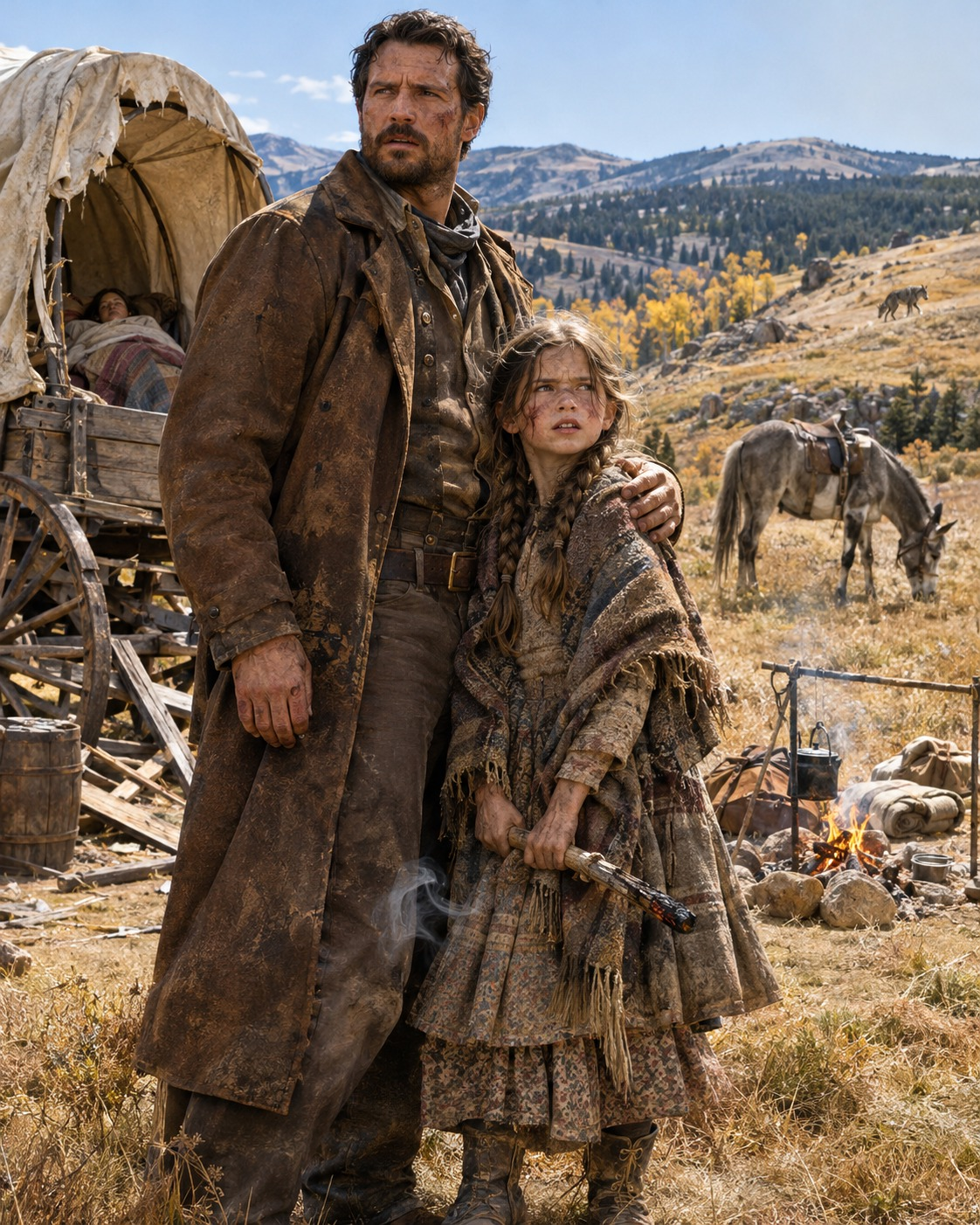
It was Clara Brandt.
The name written beneath Mary Carver's on the folded paper belonged to Eli's dead wife.
For several seconds, Eli couldn't move.
He stood beside the broken wagon, holding the yellowed document while seven-year-old Nell watched him with frightened blue eyes.
"Mr. Eli?"
He didn't answer.
The paper trembled between his fingers.
Across the top, in faded black ink, someone had written:
For Mrs. Mary Carver, should she ever need assistance.
Below it was Clara's name.
And beneath that, an address.
Little Timber Creek.
Eli Brandt's ranch.
His home.
The place where Clara had died three years earlier.
"Do you know what it says?" Nell asked.
Eli swallowed.
"Where did your mama get this?"
Nell looked confused.
"I don't know."
"Did she ever mention a woman named Clara?"
The little girl frowned.
"Maybe."
Eli crouched beside her.
"Think carefully, sweetheart."
Nell stared at the paper.
"Mama used to talk about a lady who helped her once."
"What lady?"
"She said the lady was kind."
Eli's chest tightened.
"Did she say anything else?"
Nell nodded slowly.
"She said if we ever got into real trouble, there was a place we could go."
Eli looked toward the mountains.
He had spent three years believing every part of Clara's life had ended when they buried her.
Yet somehow, here was a piece of her kindness traveling across the Montana frontier in the pocket of a dying woman.
A woman whose daughter had nearly been eaten by wolves.
"Mr. Eli?"
He turned.
"Was Clara your wife?"
The question struck him.
"Yes."
Nell studied his face.
"Is she in heaven?"
Eli looked at the paper again.
"I hope so."
"Then maybe she knows Mama."
He couldn't speak.
Nell considered this possibility with the serious expression of a child trying to understand something too large for her.
"Maybe they're together."
Eli lowered his eyes.
For three years, he had refused to imagine Clara anywhere.
He couldn't bear the thought of her existing somewhere he couldn't reach.
But Nell looked at him with such innocent certainty that he found himself wanting to believe her.
"Maybe they are," he whispered.
She nodded.
Then she looked toward the wagon.
"Can we bury Mama now?"
Eli folded the paper carefully.
"Yes, sweetheart."
He placed it inside his coat.
But he didn't forget the handwriting.
And he didn't forget the question growing inside him.
Why had Clara given Mary Carver his ranch address?
More importantly, why had Mary carried that paper all the way to Montana without ever coming to him?
The ground beneath the cottonwood was hard.
Eli worked for nearly two hours.
He had brought a shovel from the wagon's supplies, but the rocky soil fought him with every stroke.
Nell sat on a nearby stone.
She held her mother's patchwork quilt across her knees.
Every few minutes, she asked whether the grave was deep enough.
Eli answered patiently.
"Almost."
"Will the wolves get her?"
"No."
"Are you sure?"
"I'm sure."
"How?"
He drove the shovel into the earth.
"Because I'll make certain they can't."
Nell nodded.
That seemed to satisfy her.
For a while.
Then she asked another question.
"Will Mama be cold?"
Eli stopped digging.
He leaned against the shovel.
The morning sun had risen above the ridge, but the wind still carried the first warning of winter.
He remembered lowering Clara's coffin into the ground.
He remembered thinking about the cold.
He remembered wanting to climb down beside her because the idea of leaving her alone had seemed unbearable.
"No, Nell," he said quietly. "She won't feel cold anymore."
The girl looked at the quilt.
"Can she keep this?"
"Of course."
Nell smoothed the fabric.
Her mother had sewn the quilt from pieces of old dresses, worn shirts, and scraps collected during their journey.
One square was yellow.
Another had tiny blue flowers.
Near the corner was a piece of faded red cloth.
"Mama made this when Papa was still home," Nell said.
Eli continued digging.
"Did she?"
"She said every piece had a story."
"Sounds like she was a thoughtful woman."
"She was."
Nell rubbed her thumb over the yellow square.
"This was my birthday dress when I turned five."
Eli glanced toward her.
"That's a fine memory."
She nodded.
Then her face changed.
"Will I forget her?"
Eli set the shovel aside.
He walked over and sat beside her.
"No."
"How do you know?"
"Because I haven't forgotten Clara."
"But you're grown."
"That doesn't make much difference."
Nell looked doubtful.
"What if I forget Mama's voice?"
Eli stared at the mountains.
That was the question he had feared most after Clara died.
He remembered her laughter.
He remembered the way she called his name from the kitchen.
But sometimes, late at night, he struggled to remember the exact sound.
And the guilt of that frightened him.
"Then we'll remember the things she said," he told Nell.
"Like what?"
"What did she tell you most often?"
Nell thought.
"To wash my hands."
Eli almost laughed.
"That's a good one."
"And not to put frogs in her sewing basket."
He looked at her.
"Did you?"
"Only twice."
For the first time since he'd found her, something almost like amusement crossed Nell's face.
It disappeared quickly.
"She said I was her greatest blessing."
Eli nodded.
"Then that's something you can always remember."
Nell looked down at the quilt.
"She was mine, too."
Eli stayed beside her until she was ready.
Then he finished digging.
Together, they wrapped Mary Carver in the patchwork quilt.
Eli handled her with the same care he had shown Clara.
He made certain Nell could say goodbye without being hurried.
The little girl kissed her mother's forehead.
Then she whispered something Eli couldn't hear.
He turned away.
Some words belonged only to mothers and daughters.
When Nell stepped back, Eli gently covered Mary's face.
He carried her to the grave.
Nell followed.
She held a small wildflower she had found near the wagon.
Eli lowered Mary into the earth.
Then he stood beside the grave and removed his hat.
Nell took his hand.
"Can you say a prayer?"
Eli looked down.
He hadn't prayed aloud since Samuel's funeral.
At Clara's burial, the minister had spoken while Eli stood silent.
He had stopped attending church soon afterward.
The thought of thanking God for anything had become impossible.
But now Nell was waiting.
So he tried.
"Lord..."
His voice broke.
He cleared his throat.
"Please take care of Mary Carver."
Nell squeezed his hand.
Eli stared at the grave.
"She loved her little girl. And she did everything she could to keep her safe."
He paused.
The next words wouldn't come.
Nell looked up.
Then she finished for him.
"And please tell Mama I kept my promise."
Eli closed his eyes.
"And please don't let her worry about me anymore."
A tear slid down Nell's cheek.
"Because Mr. Eli found me."
Eli tightened his grip on her hand.
"Amen," he whispered.
"Amen."
They stood together for a long time.
Then Eli began filling the grave.
Nell insisted on helping.
He gave her a small wooden scoop from the wagon.
She carried little portions of dirt and placed them carefully over her mother.
When the work was finished, Eli gathered stones and built a protective border.
He cut a flat piece of wood from the damaged wagon and carved Mary's name with his pocketknife.
MARY CARVER
BELOVED MOTHER
REST IN PEACE
Nell watched every letter.
"Can you put that she was brave?"
Eli looked at her.
"Of course."
He carved one more line.
SHE WAS BRAVE.
Nell touched the words.
Then she placed the wildflower beneath the marker.
By noon, Eli had gathered what little remained of the Carvers' belongings.
There was a battered wooden trunk.
A tin cup.
A Bible with a broken clasp.
Two dresses.
A sewing kit.
And a small cloth doll missing one button eye.
Nell carried the doll everywhere.
"What's her name?" Eli asked.
"Rosie."
"That's a good name."
"Mama made her."
Eli nodded.
He packed the trunk onto his horse.
Then he examined the broken wagon.
The axle was beyond repair without proper tools.
He could return later with Gus and a team of horses.
For now, the most important thing was getting Nell somewhere safe.
He approached her.
"Ready to go?"
Nell looked toward the grave.
Her face tightened.
"Can we come back?"
"Yes."
"Whenever I want?"
Eli hesitated.
The ridge was several hours from his ranch.
Winter would soon make the trail difficult.
But he couldn't tell this child she might never see her mother's resting place again.
"We'll come back when the road allows it," he promised.
Nell nodded.
She took one last look at the cottonwood.
Then she reached for his hand.
Eli lifted her onto Duke, his bay horse.
She was so light that the effort barely registered.
He settled her in front of the saddle and climbed up behind her.
"Ever ridden a horse before?"
Nell nodded.
"Papa had a mule."
"What happened to it?"
"Biscuit's tied behind the wagon."
Eli blinked.
"You've got a mule?"
Nell looked at him as though he had asked whether the sky was blue.
"Of course."
"Why didn't you tell me?"
"You didn't ask."
Eli stared at her.
Then he let out a short breath that might once have been laughter.
"Fair enough."
He rode back to the wagon.
Behind a stand of brush, he found a small gray mule tied to a tree.
The animal lifted its head and brayed.
Nell brightened.
"Biscuit!"
The mule stepped toward her.
Eli dismounted and checked its condition.
The animal was thirsty but otherwise healthy.
He gave it water and loosened the rope.
"Well, Biscuit," he muttered, "looks like you're coming along, too."
Nell watched with relief.
"Mama said he was stubborn."
"Most mules are."
"She said he was smarter than Papa."
Eli paused.
Then he looked at Nell.
"Did she?"
"Yes, sir."
He decided not to comment.
Within minutes, Biscuit was following Duke along the trail.
Nell sat quietly in front of Eli.
At first, she kept turning to look behind them.
Each time, the broken wagon grew smaller.
Then the cottonwood disappeared behind the ridge.
Nell began crying.
Not loudly.
Not dramatically.
Just small, exhausted sobs.
Eli slowed the horse.
"You all right?"
She shook her head.
"I can't see Mama anymore."
He didn't tell her to stop crying.
He didn't promise everything would be fine.
He simply wrapped one arm more securely around her.
"I know, sweetheart."
She leaned against his chest.
For the next mile, neither spoke.
They reached the main freight road in the afternoon.
Deep wagon ruts cut through the dry earth.
Nell suddenly sat straighter.
"Mr. Eli?"
"Yes?"
"This is where they came."
"Who?"
"The wagons."
Eli looked down the road.
"All three?"
She nodded.
He stopped Duke.
"Can you show me?"
Nell pointed toward a bend in the trail.
"The first man came from there."
Eli followed her finger.
"He had a brown horse and a white one. He looked at Mama, then he looked at me."
"What happened?"
"He shook his head."
"And drove on?"
"Yes."
Nell swallowed.
"The second wagon had a woman sitting beside the driver."
Eli turned sharply.
"A woman?"
Nell nodded.
"She had a blue bonnet."
"Did she see you?"
"I think so."
"What did she do?"
Nell stared at her hands.
"She pulled her shawl over her face."
Eli felt anger rising.
He forced it down.
"And the third wagon?"
Nell pointed farther down the road.
"It came near sunset."
"The one with the silver dollar?"
"Yes."
Eli remembered the coin in his pocket.
"Tell me what happened."
Nell looked uncomfortable.
"I ran after it."
Eli said nothing.
"I thought maybe the man had medicine."
"Did you ask?"
"Yes."
"What did he say?"
"He told me to get away."
Eli's jaw tightened.
Nell continued.
"I told him Mama was sick. I said she needed help."
Her voice grew smaller.
"He said he couldn't stop."
"Why?"
"He said fever killed people."
Eli stared down the empty road.
Nell twisted her fingers together.
"I told him I wasn't sick."
"And?"
"He said that didn't matter."
Eli breathed slowly.
"He threw the money?"
Nell nodded.
"It fell in the dirt."
"Did he say anything else?"
"He told me to buy help in Bozeman."
Eli looked toward the mountains.
Bozeman was miles away.
A seven-year-old girl couldn't have reached it alone.
Not on foot.
Not with a sick mother.
Not with a broken wagon.
Nell looked up.
"Was he right?"
"About what?"
"Could I have bought help?"
Eli felt something twist inside him.
"No, sweetheart."
"Then why did he give me the dollar?"
Eli didn't know how to explain cowardice to a child.
He didn't know how to tell her that sometimes people gave money because it was easier than giving kindness.
So he answered simply.
"Because he didn't want to stop."
Nell looked down.
"I wish he had."
"So do I."
She rested her head against his chest.
After a moment, she whispered, "Maybe Mama would still be alive."
Eli closed his eyes.
He couldn't promise that.
Mary had already been gravely ill.
Even if a wagon had stopped, even if someone had brought a doctor, she might not have survived.
But someone could have tried.
Someone could have stayed.
Someone could have made certain Nell wasn't left alone.
"Maybe," Eli said.
The word hurt him.
But it was the truth.
They traveled another hour before stopping near a creek.
Eli watered the animals.
Nell sat on a rock and ate another biscuit.
Her appetite had returned a little.
That relieved him.
He washed her blistered hand and replaced the bandage.
Then he opened his saddlebag.
Inside was a small tin of salve.
Clara had made it years earlier.
Eli had kept the tin long after the last of her other medicines had been used.
He opened it.
The familiar scent of beeswax and herbs rose into the air.
For a moment, he was standing in his old kitchen.
Clara was at the stove.
Samuel was crawling across the floor.
Sunlight filled the room.
Then Nell spoke.
"What's that?"
Eli blinked.
"Medicine for your hand."
"Will it hurt?"
"Not much."
She held out her palm.
He applied the salve carefully.
Nell watched his face.
"Did Clara make that?"
Eli looked at her.
"Yes."
"She must have been nice."
"She was."
"Did she help lots of people?"
Eli nodded.
"Whenever she could."
Nell looked toward the creek.
"Mama said kindness was something you could give away without running out."
Eli stopped wrapping her hand.
Clara used to say something very similar.
He remembered her telling a young ranch hand that a generous heart was the only kind of wealth that grew when spent.
He looked at Nell.
"Did your mama say where she met Clara?"
Nell shook her head.
"Just that she helped her."
"Did she ever tell you when?"
"Before I was born, I think."
Eli considered that.
Seven years earlier, Clara had been living in eastern Montana with her sister before marrying him.
She had worked briefly at a boardinghouse.
She had helped travelers.
She had written letters for people who couldn't read.
There were dozens of ways she might have met Mary Carver.
But one detail still troubled him.
The letter he remembered receiving three years earlier.
It had been addressed in handwriting he now recognized as Mary's.
Clara had read it privately.
Afterward, she had seemed worried.
When Eli asked about it, she said an old acquaintance needed help.
He had offered to send money.
Clara had declined.
"It's something I need to settle myself," she'd told him.
Then Samuel became sick.
And the matter had disappeared beneath the weight of everything that followed.
Eli looked at the folded paper again.
Perhaps Mary had been that acquaintance.
Perhaps Clara had promised to help her.
Perhaps Nell's journey west had begun with a promise neither woman had lived long enough to fulfill.
He placed the document back inside his coat.
Whatever the connection, he would learn the truth eventually.
For now, Nell needed food, shelter, and someone who would stay.
The sun was sinking when they reached Little Timber Creek.
Eli's ranch stood beyond a line of cottonwoods.
A weathered farmhouse faced the valley.
Behind it were a barn, two corrals, a chicken coop, and several outbuildings.
Smoke rose from the kitchen chimney.
Nell sat up.
"Is that your house?"
"Yes."
"It's big."
"Not especially."
"It's bigger than our wagon."
Eli looked down at her.
"Well, I suppose it is."
"Do you live there all alone?"
"Not quite. Gus lives in the bunkhouse."
"Who's Gus?"
"My ranch hand."
"Is he nice?"
"Most days."
Nell frowned.
"What happens on the other days?"
"He complains about my cooking."
She considered that.
"Are you a bad cook?"
"Terrible."
Nell looked concerned.
Eli almost smiled.
"Fortunately, Gus does most of it."
As they approached the house, an older man emerged from the barn carrying a lantern.
Gus Lindquist was sixty-two, broad through the middle, with a thick gray mustache and a permanent expression of mild irritation.
He stopped when he saw the child.
Then he looked at the mule.
Then back at Eli.
"Well," Gus said slowly, "you went looking for one missing steer."
Eli dismounted.
"Didn't find him."
"I can see that."
Nell looked nervously between the two men.
Gus lowered the lantern.
"Who's this?"
"This is Nell Carver."
Gus removed his hat.
"Evening, Miss Nell."
She whispered, "Hello."
Eli lifted her down.
"Her mother died on the wagon road. I found her alone."
Gus's expression changed immediately.
He looked at Nell's bare feet.
Her bandaged hand.
Her exhausted face.
Then he looked at Eli.
"How long?"
"Two days."
Gus swore softly under his breath.
Eli gave him a warning look.
The older man cleared his throat.
"Well, then."
He scratched his mustache.
"Guess I'd better make more biscuits."
Nell looked up.
"Do you have butter?"
Gus stared.
Then he nodded solemnly.
"Miss Nell, I have enough butter to frighten a dairy cow."
She almost smiled.
Almost.
Eli watched the exchange.
Something unfamiliar stirred in his chest.
The farmhouse had been silent for three years.
Now a little girl was standing in the yard asking about butter.
He didn't know what to do with the feeling.
Inside, Gus built up the kitchen fire.
Eli carried Nell's trunk into the spare bedroom.
It had once been Samuel's nursery.
After the funeral, Eli had shut the door.
He hadn't entered except to dust the furniture once every few months.
Now he stood in the doorway, looking at the narrow bed Gus had moved there the previous winter.
Clara's old rocking chair remained beside the window.
A faded blue blanket lay folded across its back.
Eli touched the chair.
For a moment, he couldn't breathe.
Then Nell appeared behind him.
"Is this where I'll sleep?"
He turned.
"Yes, if you like."
She looked around.
"It's pretty."
Eli nodded.
Nell walked to the rocking chair.
"Did someone sit here?"
"My wife."
"Clara?"
"Yes."
Nell touched the wooden arm.
"Can I sit in it?"
Eli hesitated.
The chair had belonged to Clara's mother.
Clara had rocked Samuel in it every evening.
For three years, Eli hadn't allowed anyone to move it.
Now Nell was asking permission to sit.
He looked at her small face.
"Of course."
She climbed into the chair.
Her feet didn't reach the floor.
She rocked gently.
The old wood creaked.
Eli felt the sound in his chest.
It was the same sound he'd heard every night when Samuel was alive.
He turned away before Nell could see his expression.
"Come on," he said. "Let's get you supper."
Gus had prepared beans, potatoes, biscuits, and thick slices of ham.
Nell ate slowly at first.
Then faster.
Eli watched her take a third biscuit.
Gus pretended not to notice.
When she finished, he placed another on her plate.
"Can't have a guest leaving hungry."
Nell looked at him.
"Am I a guest?"
Gus glanced at Eli.
"Well, that's up to Mr. Brandt."
Nell's face changed.
Eli noticed immediately.
He set down his fork.
"You're welcome here, Nell."
"For how long?"
He hesitated.
He didn't know.
He had no legal authority over her.
He didn't know whether her father was alive.
He didn't know whether Aunt Ida could be found.
He didn't know what the town would say about a widower taking in a little girl.
But he knew one thing.
He wasn't putting her back on that road.
"As long as you need somewhere safe," he said.
Nell studied him.
"Will you be here tomorrow?"
"Yes."
"And the day after?"
"Yes."
She looked down at her plate.
"People say things sometimes."
Eli felt Gus watching him.
"What kind of things?"
"Papa said he'd come back."
The kitchen fell silent.
Nell continued.
"Mama said we'd get to Bozeman."
Her voice trembled.
"And the man with the dollar said I could buy help."
Eli looked at her.
"Well, I can't answer for them."
She raised her eyes.
"But I can answer for myself."
Nell waited.
"I'll be here tomorrow."
She nodded.
Then she picked up her biscuit.
After supper, Gus heated water for a bath.
Nell washed in a tin tub behind a folding screen while the men waited in the kitchen.
Eli examined the folded paper again.
Gus noticed.
"What's that?"
"Something her mother carried."
"Important?"
Eli stared at Clara's name.
"I think so."
Gus leaned closer.
Then his expression changed.
"That's Mrs. Brandt's handwriting."
Eli looked up sharply.
"You recognize it?"
"Of course I do."
Gus pointed at the bottom of the page.
"That little curl on the B. She always wrote it that way."
Eli felt his pulse quicken.
"So Clara wrote this?"
"Looks like it."
"Why would she give her address to Mary Carver?"
Gus frowned.
"Mary Carver?"
"That was Nell's mother."
The older man went quiet.
Eli noticed.
"What?"
Gus looked toward the hallway.
"Nothing."
"Gus."
The ranch hand rubbed his jaw.
"I heard that name once."
Eli leaned forward.
"When?"
"Years ago."
"From Clara?"
Gus nodded slowly.
Eli waited.
"She asked me to deliver a letter," Gus said.
"To whom?"
"Someone in Bozeman."
"Who?"
Gus hesitated.
"Can't remember."
Eli stared at him.
"Gus, think."
The older man looked uncomfortable.
"It was around the time Samuel took sick. Mrs. Brandt was worried about something."
Eli's stomach tightened.
"What was in the letter?"
"I never opened it."
"Did you deliver it?"
Gus shook his head.
"No."
Eli went still.
"Why not?"
"She changed her mind."
"What happened to it?"
Gus looked toward the back hallway.
"I put it in the old desk."
Eli stood.
"Which desk?"
"The one in your study."
Eli pushed back his chair.
For three years, he had avoided Clara's papers.
He had left her sewing basket untouched.
Her letters remained tied with ribbon in the desk drawer.
He had never found the courage to sort through them.
Now he walked toward the study.
Gus followed.
"Eli, maybe we ought to wait."
"For what?"
"Until the girl settles in."
Eli stopped.
He looked back.
Gus's face was pale.
"What aren't you telling me?"
The older man opened his mouth.
Then closed it.
Before Eli could press him, Nell appeared in the hallway wearing one of Clara's old nightshirts, carefully shortened and pinned by Gus.
"Mr. Eli?"
He turned.
"Yes, sweetheart?"
She held Rosie against her chest.
"Can you show me where the window is?"
Eli looked at Gus.
Then at the child.
The letter could wait a few minutes.
He led Nell to the spare bedroom.
She climbed into bed.
He pulled the quilt over her.
"Anything else?"
Nell hesitated.
"Can you leave the door open?"
"Of course."
"And the lamp?"
"I'll leave it burning."
She looked relieved.
Eli turned toward the hallway.
"Mr. Eli?"
He stopped.
"Yes?"
"Thank you for stopping."
The words nearly broke him.
He looked back at the little girl.
"You're welcome, Nell."
She closed her eyes.
Within minutes, she was asleep.
Eli stood in the doorway longer than necessary.
Then he returned to the study.
Gus was waiting.
The old desk stood beneath the window.
Eli unlocked the top drawer.
Inside were Clara's letters, tied with faded ribbon.
He untied them.
One envelope had no address.
Another contained a receipt.
A third held a small photograph of Clara and Samuel.
Then he found a folded sheet marked with a name.
MARY CARVER.
Eli looked at Gus.
The older man lowered his eyes.
Eli unfolded the letter.
The first sentence made his blood run cold.
Mary, if you ever come west, you must not let the man who abandoned you learn where you are.
Eli read it twice.
Then he noticed something beneath the letter.
A second envelope.
It was sealed.
Across the front, in Clara's handwriting, were four words.
For Eli. If necessary.
His hands trembled.
He broke the seal.
Inside was a single page.
He unfolded it.
And at the top, beneath Clara's signature, was the name of a man Eli knew.
A man who still lived in Bozeman.
A man who drove freight wagons.
Eli stared at the name.
Then he heard Gus whisper behind him.
"Lord help us."
Eli turned.
Gus was looking at the letter.
His face had gone white.
"Eli," the old man said, "before you read another word, there's something you need to know about the night Clara died."
Eli froze.
Gus reached into his coat.
He pulled out a small brass key.
"I should've given you this three years ago."
He placed it on the desk.
Then he pointed toward the locked cabinet in the corner.
"Clara made me promise never to open that cabinet unless Mary Carver came looking for you."
Eli stared at him.
"What is inside?"
Gus didn't answer.
Eli picked up the key.
He crossed the room.
The lock turned with a sharp click.
He pulled the cabinet door open.
And there, wrapped in Clara's blue shawl, was something he had never expected to see again.






Comments 0