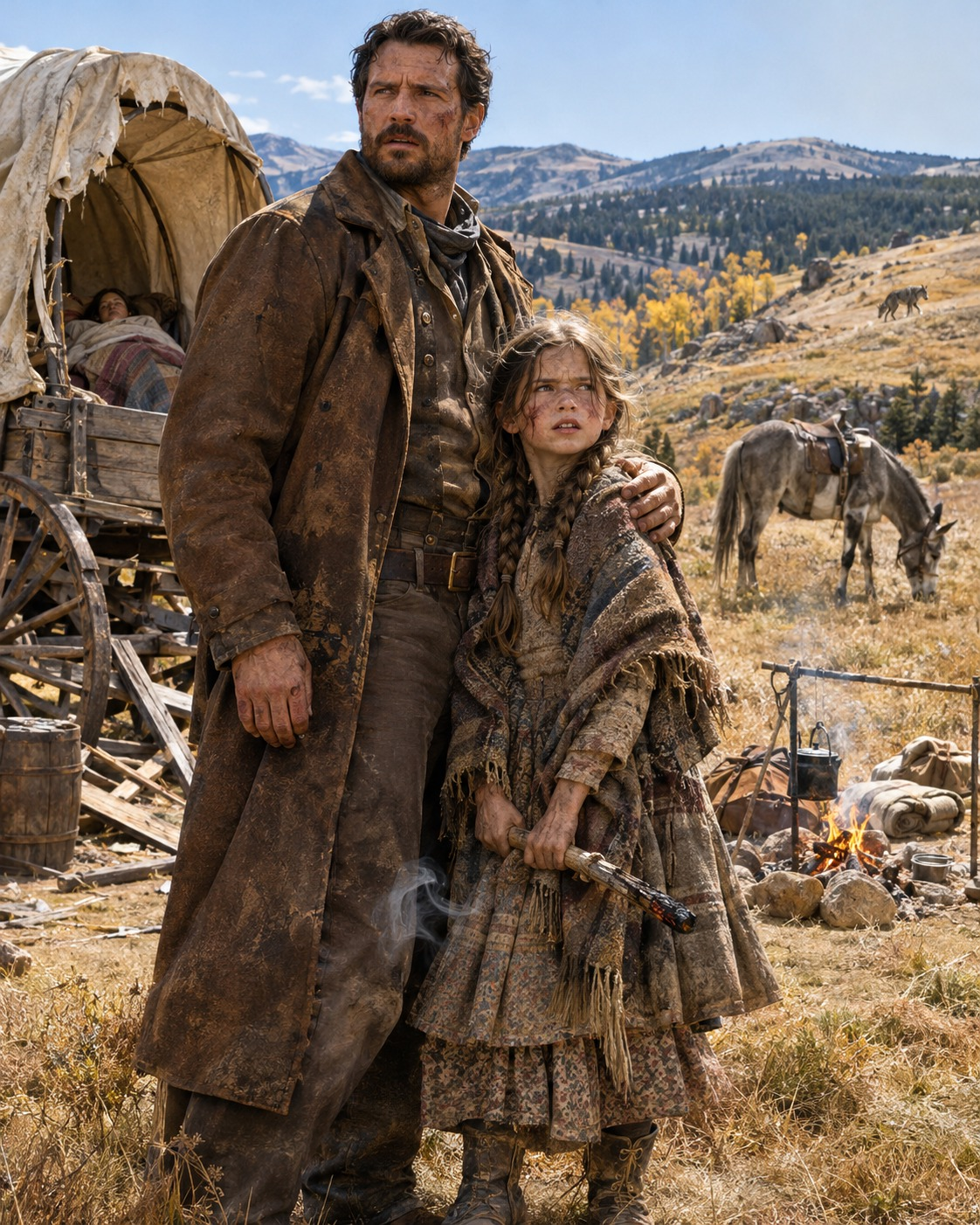
Eli Brandt had buried his wife and son three years earlier.
Now, standing in his darkened study, he was staring at the little wooden horse his dead boy had loved more than anything in the world.
It lay inside the locked cabinet, wrapped carefully in Clara's blue shawl.
One of its wheels was missing.
A tiny crack ran through its painted neck.
And beneath it was a folded piece of paper bearing the name of a man Eli had once trusted with his family's life.
Amos Kettering.
Eli stopped breathing.
For three years, he had believed Samuel's wooden horse had been buried with him.
He remembered placing it inside the little coffin himself.
He remembered Clara standing beside him, her face pale and empty, as the undertaker closed the lid.
Yet here it was.
The same chipped paint.
The same broken wheel.
The same small tooth marks Samuel had left on the wooden mane.
Eli reached into the cabinet.
His hand trembled as he lifted the toy.
"Gus."
The old ranch hand stood behind him.
"Yes?"
"How did this get here?"
Gus didn't answer.
Eli turned.
"How did my son's horse get inside a locked cabinet?"
Gus looked toward the floor.
"Clara put it there."
"That's impossible."
"Eli—"
"I put this in Samuel's coffin."
"I know."
Eli stared at him.
"Then explain it."
Gus rubbed both hands over his face.
For a moment, he looked older than his sixty-two years.
"Clara took it out before the burial."
Eli felt the room shift.
"What?"
"She asked the undertaker to open the coffin while you were outside."
Eli looked down at the little horse.
"Why?"
"She said she couldn't bear to lose every piece of him."
Eli closed his eyes.
He remembered the funeral.
The black coat.
The frozen ground.
The minister's voice.
He remembered walking away from the coffin because he couldn't stand another moment looking at it.
And while he had been outside, Clara had quietly saved one last thing that belonged to their son.
"Why didn't she tell me?"
Gus swallowed.
"She meant to."
Eli looked up.
"But then she got sick."
The old man nodded.
Silence filled the study.
Eli held the toy against his chest.
For three years, he had kept Samuel's little shoes in a drawer upstairs.
He had kept Clara's wedding ring in a wooden box beside his bed.
But the wooden horse had been different.
It had been the one thing he believed was gone forever.
And now it had returned on the same day a frightened little girl had entered his home.
Eli lowered himself into Clara's old desk chair.
He stared at the toy.
"I should have known," he whispered.
Gus stepped closer.
"Known what?"
"That she would have wanted something of his."
"You weren't thinking clearly back then."
Eli looked at him sharply.
"Neither was she."
"No."
Gus's voice softened.
"Neither of you were."
Eli ran his thumb across the broken wheel.
He remembered Samuel sitting on the kitchen floor, pushing the horse across the boards.
He remembered the boy's laughter.
He remembered Clara kneeling beside him.
For one brief moment, the room seemed full of voices that had been silent for years.
Then Eli looked at the folded paper beneath the shawl.
He picked it up.
The name Amos Kettering was written across the front.
His expression hardened.
"Why was this with Samuel's horse?"
Gus shifted uneasily.
"Because Clara wanted you to find them together."
"Why?"
"I don't know everything."
Eli looked at him.
"Then tell me what you do know."
Gus pulled a chair closer.
He sat heavily.
"Three years ago, a few days before Samuel took sick, Amos Kettering came to the ranch."
Eli frowned.
"I remember."
"He brought supplies from Bozeman."
"Flour, nails, lamp oil."
"That's right."
Eli looked toward the window.
Amos had been a regular visitor in those days.
A heavyset freighter with a loud laugh and a habit of telling stories about the road.
He had hauled supplies for half the ranchers in the valley.
He had eaten at Eli's table.
He had accepted Clara's hospitality.
Once, during a winter storm, Eli had even let him sleep in the bunkhouse.
"What does Amos have to do with Mary Carver?" Eli asked.
Gus hesitated.
"Clara asked him about her."
Eli went still.
"When?"
"The day he delivered those supplies."
"What did he say?"
"I wasn't close enough to hear all of it."
"Gus."
The old man sighed.
"I heard Clara ask whether he'd seen a woman traveling west with a little girl."
Eli looked down at the paper.
"Nell."
"Maybe."
"She would've been four."
Gus nodded.
"Clara seemed worried. Amos told her he hadn't seen anybody matching that description."
"And?"
"Then he left."
Eli waited.
Gus rubbed his jaw.
"Afterward, Clara asked me whether I trusted him."
"What did you say?"
"I told her he was a freighter. I trusted him to deliver a sack of flour. That didn't mean I'd trust him with my life."
Eli stared at him.
"Did she tell you why she was asking?"
"No."
"Did she say anything else?"
Gus hesitated.
"She said there were some men who could look a person straight in the eye while leaving out the most important part of the truth."
Eli felt a chill.
He unfolded the paper.
It wasn't a letter.
It was a freight receipt.
Dated three years earlier.
The printed heading read:
KETTERING FREIGHT AND SUPPLY.
Below it was a list of goods.
Flour.
Coffee.
Lamp oil.
Two crates of household provisions.
But someone had written a note in the margin.
Ask about the missing passenger.
Eli recognized Clara's handwriting immediately.
He looked up.
"What passenger?"
Gus shook his head.
"I don't know."
Eli examined the receipt again.
There was another mark near the bottom.
A small cross beside a number.
Fourteen.
"Did Clara ever mention a passenger to you?"
"No."
"Did Amos?"
"Not that I recall."
Eli leaned back.
His thoughts were moving too quickly.
A woman named Mary Carver.
A little girl named Nell.
A letter Clara had written.
A freight receipt marked with a warning.
And Amos Kettering, the same man whose name had surfaced in connection with Clara's private concerns.
It could all be coincidence.
But Eli had lived long enough to know that coincidences became less convincing when they began piling up.
He looked toward the hallway.
Nell was asleep.
She had no idea that the man who had found her beside the broken wagon was sitting in his study, surrounded by questions about her mother.
And she certainly didn't know that the man who had thrown her a silver dollar might have crossed paths with her family years earlier.
Eli folded the receipt.
"Did Clara ever tell you she was afraid of Amos?"
Gus shook his head.
"No."
"Then why hide this?"
The old man looked toward the cabinet.
"Maybe she wasn't hiding it from you."
Eli frowned.
"What do you mean?"
"Maybe she was keeping it somewhere safe until she understood what it meant."
Eli considered that.
Clara had always been careful with important papers.
She saved receipts.
Kept letters.
Wrote dates in the margins of books.
If she believed something was wrong, she would have preserved whatever evidence she could find.
But she had died before explaining it.
And Eli had spent three years refusing to open the drawers where she kept her life.
He stared at the wooden horse.
"I wasted so much time."
Gus shook his head.
"You were grieving."
"I was hiding."
"Sometimes that's the same thing."
Eli looked up.
The old man met his eyes.
"Clara wouldn't have wanted you to punish yourself forever."
Eli said nothing.
Because he had been punishing himself.
Every morning.
Every night.
Every time he walked past Samuel's empty room.
He had convinced himself that if he'd noticed the fever sooner, if he'd sent for another doctor, if he'd done something differently, his family might still be alive.
The doctor had told him otherwise.
Gus had told him otherwise.
Even Clara, during her final hours, had squeezed his hand and whispered that he had done everything he could.
But Eli hadn't believed any of them.
Now he sat holding his son's toy, wondering whether he had also failed to notice something important before Clara died.
The grandfather clock struck ten.
Gus stood.
"You ought to get some sleep."
Eli looked at the papers.
"Not yet."
"The girl will be awake early."
"I know."
"And she'll need you."
Those words made Eli pause.
Gus noticed.
"That's right," the old man said. "You've got somebody needing breakfast tomorrow."
Eli looked toward the hallway.
For three years, his mornings had been predictable.
Coffee.
Chores.
Silence.
He had stopped expecting anything different.
Now there was a little girl sleeping in Samuel's old room.
A girl who had asked whether he would still be there when she woke.
A girl who had spent two nights fighting off wolves because nobody had come to help her.
He couldn't imagine what she would feel if she woke in another unfamiliar place and found herself alone.
"I'll be there," he said.
Gus nodded.
"Good."
He started toward the door.
Then stopped.
"Eli?"
"What?"
"Whatever Clara was trying to do for Mary Carver, don't let it make you forget what's right in front of you."
Eli looked at him.
Gus glanced toward the hallway.
"That little girl doesn't need you solving every mystery tonight."
He paused.
"She needs you to keep your promise."
Then he left.
Eli remained in the study.
He placed Samuel's wooden horse on the desk.
Beside it, he arranged Clara's letter, the freight receipt, and the paper Mary had carried.
He studied them until the lamp burned low.
Eventually, he locked the documents in his desk.
Not because he intended to forget them.
Because Gus was right.
The truth could wait until morning.
Nell couldn't.
At half past midnight, Eli heard a scream.
"Mama!"
He was out of his chair before he realized he'd moved.
He hurried down the hallway.
Nell was sitting upright in bed.
Her blonde hair hung around her face.
Her eyes were wide with terror.
"Mama!"
Eli stopped in the doorway.
"Nell."
She didn't seem to hear him.
"The wolf!"
He crossed the room.
"Nell, you're safe."
She scrambled backward against the headboard.
"Don't let it get her!"
Eli knelt beside the bed.
"Sweetheart, look at me."
Her breathing came in sharp gasps.
"The fire went out!"
"No, Nell."
"I tried!"
He kept his voice steady.
"You're at my ranch."
She stared at him.
"Remember?"
Her eyes moved around the room.
The wooden dresser.
The rocking chair.
The lamp beside the bed.
Slowly, recognition returned.
"Mr. Eli?"
"I'm here."
She looked toward the doorway.
"Where's Mama?"
The question struck him harder than he expected.
He sat on the edge of the bed.
Nell's face crumpled.
Then she remembered.
He saw the exact moment it happened.
Her shoulders dropped.
Her eyes filled.
And she began to cry.
Not the frightened cries of a child facing a wolf.
These were different.
Deep.
Exhausted.
Heartbroken.
Eli had heard grown men cry that way after losing everything.
He had cried that way himself.
Nell reached for him.
He gathered her carefully into his arms.
She buried her face against his shirt.
"I want Mama."
"I know."
"I want her back."
Eli closed his eyes.
"I know, sweetheart."
"Why did she leave me?"
He held her tighter.
"She didn't want to."
"Then why?"
"Because she was very sick."
Nell shook her head.
"She promised we'd get to Bozeman."
Eli rested his cheek against her hair.
"She wanted to keep that promise."
"But she didn't."
"No."
Nell sobbed harder.
Eli didn't try to stop her.
He didn't tell her to be strong.
He didn't say everything happened for a reason.
He simply held her.
After a long time, her crying softened.
She pulled back.
"Did you cry when Clara died?"
Eli looked at her.
"Yes."
"A lot?"
"More than I knew a man could."
Nell wiped her face.
"Did anybody hold you?"
The question caught him off guard.
He thought about the funeral.
The neighbors.
The minister.
Gus standing beside him.
People had offered sympathy.
They had brought food.
They had told him he was strong.
But he couldn't remember allowing anyone to hold him.
"No," he said quietly.
Nell looked at him with sudden concern.
"That's sad."
Eli swallowed.
"Yes."
She reached out and wrapped her small arms around his neck.
"Then I'll hold you."
He went completely still.
For three years, Eli had believed his heart had hardened beyond repair.
But there, in a dim bedroom, with a seven-year-old girl holding him because she thought he needed comfort, something inside him finally gave way.
He lowered his head.
A tear slipped down his cheek.
Then another.
Nell didn't seem frightened.
She simply held on.
And for the first time since Clara's funeral, Eli allowed himself to grieve without feeling ashamed.
Morning came with the smell of coffee and frying bacon.
Eli woke in the rocking chair beside Nell's bed.
He hadn't intended to fall asleep.
But sometime after midnight, Nell had asked him to stay.
He had promised.
So he'd pulled the chair beside her bed and sat there until his eyes closed.
Now sunlight spilled through the curtains.
Nell was awake.
She sat cross-legged beneath the quilt, watching him.
"Morning," Eli said.
"Morning."
He rubbed his face.
"Sleep all right?"
She nodded.
Then she looked toward the rocking chair.
"You stayed."
Eli smiled faintly.
"I told you I would."
Nell studied him.
"Do grown-ups always keep promises?"
He considered the question.
"No."
Her expression changed.
"But they should."
She nodded slowly.
Eli stood.
"Come on. Gus has breakfast waiting."
Nell climbed out of bed.
Then stopped.
"Mr. Eli?"
"Yes?"
"Can Rosie come?"
He looked at the cloth doll in her hand.
"Of course."
"And Biscuit?"
Eli blinked.
"To breakfast?"
Nell nodded seriously.
He stared at her.
Then shook his head.
"I think Biscuit would be happier eating hay."
She considered that.
"You're probably right."
At breakfast, Gus had prepared enough food for six men.
Nell stared at the table.
"Are we having company?"
"Nope," Gus said.
"Then why so much?"
"Because Mr. Brandt eats like a bear."
Eli raised an eyebrow.
"Do I?"
"Only when you're awake."
Nell giggled.
It was a small sound.
Barely more than a breath.
But both men stopped.
For three years, the kitchen had heard no child's laughter.
Gus quickly turned toward the stove.
Eli looked down at his plate.
Neither wanted Nell to notice how much that tiny sound meant.
After breakfast, she insisted on helping.
Gus gave her the important responsibility of collecting eggs.
He showed her how to approach the hens.
"Slow and gentle," he instructed.
Nell nodded.
She returned ten minutes later with four eggs and a triumphant expression.
"One chicken tried to bite me."
"That'd be Mrs. Pickles," Gus said.
"Why's she mean?"
"Bad disposition."
Nell considered that.
"Maybe she's lonely."
Gus looked at Eli.
Eli looked away.
"Maybe," Gus said.
Nell decided the hen needed a friend.
She named another chicken Daisy.
Then she introduced them.
Gus watched with open fascination.
"Well," he muttered, "I've been ranching forty years, and I've never seen anybody arrange a friendship between chickens."
Eli almost laughed.
Almost.
But he noticed something else.
Nell was beginning to move through the ranch as though she belonged there.
She asked questions.
Touched things.
Followed Gus.
Watched the horses.
She even asked whether the cattle had names.
"Some do," Eli told her.
"All of them should."
"That's a lot of names."
"How many cows?"
"About a hundred and twenty."
Nell thought.
"I can do it."
Eli looked at Gus.
The older man shrugged.
"Winter's going to be interesting."
By afternoon, Nell had named seven cattle.
One was Buttercup.
Another was Queen Victoria.
A particularly stubborn steer became Mr. Trouble.
Eli found himself watching her more often than he intended.
She was still thin.
Still exhausted.
Still grieving.
But there were moments when her curiosity broke through the sadness.
He had forgotten what that looked like.
He had forgotten how children could move from tears to questions without warning.
How they could find wonder in ordinary things.
How they could make an empty house feel alive simply by asking where the spoons belonged.
That evening, while Nell helped Gus prepare supper, Eli returned to his study.
He unlocked the desk.
Spread Clara's papers across the surface.
And began reading them carefully.
The letter addressed to Mary was incomplete.
Only one page remained.
It warned Mary to avoid the man who had abandoned her.
It offered Clara's help.
It gave the ranch address.
But it didn't identify the man.
The freight receipt carried Amos Kettering's name.
And the sealed letter Clara had left for Eli contained something even more troubling.
A short statement.
Eli, if Mary Carver ever comes to us, believe her. Whatever Amos Kettering tells you, remember that he has already lied about the journey east. I cannot explain everything in this letter. There are things Mary must tell you herself.
Eli read it again.
Then again.
His wife had known something.
Something involving Mary.
Something involving Amos.
And she had believed it serious enough to leave him a warning.
But she hadn't told him directly.
Perhaps she had meant to.
Perhaps Samuel's illness had interrupted her.
Perhaps she had feared bringing danger to the ranch.
Eli couldn't know.
Not yet.
He examined the freight receipt.
Fourteen.
The number Clara had marked.
He turned the paper over.
There was a faint impression on the back.
As though someone had written on another sheet placed above it.
He held it toward the window.
A few letters were visible.
M.
C.
Then a date.
September 1881.
Three years earlier.
The same autumn Samuel had died.
Eli felt his stomach tighten.
He remembered Amos arriving at the ranch that month.
He remembered Clara questioning him.
He remembered the freighter becoming unusually quiet when she entered the room.
At the time, Eli had assumed they had disagreed about the price of supplies.
Now he wondered whether Clara had been asking about something far more serious.
A missing passenger.
A woman traveling west.
A child.
And a man who had abandoned them.
Eli leaned back.
There was another question.
If Amos had known Mary Carver three years earlier, why had he left her daughter on the road now?
Had he recognized the broken wagon?
Had he known who Nell was?
Or had he simply been another cowardly traveler unwilling to stop?
Eli stared at the silver dollar on his desk.
The scratched coin seemed almost ordinary.
Yet every time he looked at it, he pictured Nell standing barefoot beside her mother's body.
Three wagons.
Three chances for someone to help.
Three failures.
He closed his hand around the dollar.
Whatever Amos knew, Eli intended to find out.
But first, he needed to understand what Clara had been trying to tell him.
That evening, Nell found him sitting in the kitchen.
He was holding Samuel's wooden horse.
She approached quietly.
"Is that a toy?"
Eli looked up.
"Yes."
"Whose?"
"My little boy's."
Nell stopped.
"Samuel?"
He nodded.
She studied the horse.
"Can I see?"
Eli hesitated.
Then handed it to her.
Nell examined the missing wheel.
"He's broken."
"A little."
"Can you fix him?"
Eli looked at the toy.
"I suppose I could."
Nell turned it over.
"Mama used to fix Rosie when her stitches came loose."
Eli watched her.
"Did she?"
"She said broken things weren't always ruined."
The words settled heavily between them.
Nell looked up.
"Can I help you fix him?"
Eli felt something tighten in his throat.
For three years, he had avoided touching anything that belonged to Samuel.
Now a little girl was asking to help repair his favorite toy.
He looked at the wooden horse.
Then at Nell.
"I'd like that."
She smiled.
A real smile this time.
Small.
Brief.
But unmistakable.
Eli smiled back before he could stop himself.
Gus, watching from the doorway, quietly turned away.
After supper, Nell sat at the kitchen table while Eli carved a replacement wheel.
She watched every movement.
"Will it roll again?"
"That's the idea."
"Will it look like before?"
"Not exactly."
Nell frowned.
"Why?"
Eli held up the new wheel.
"Because this one's made from different wood."
She considered that.
"But it'll still be a horse."
"Yes."
"And it'll still be Samuel's."
Eli looked at her.
"Yes."
Nell nodded.
"Then that's all right."
He stared at the toy.
For three years, he had believed that anything changed by loss was ruined forever.
Yet this little girl, who had lost more than most grown people could bear, saw something different.
A broken horse could still be a horse.
A damaged thing could still have a purpose.
Perhaps even a lonely rancher could still be somebody worth loving.
Eli lowered his eyes.
He didn't trust himself to speak.
Later that night, after Nell had gone to bed, Gus found Eli standing on the porch.
The mountains were dark.
A cold wind moved through the cottonwoods.
Gus handed him a cup of coffee.
"She's a good kid."
Eli nodded.
"She is."
"Reminds me of Clara."
Eli looked at him.
"How?"
"Always asking questions. Always finding something that needs fixing."
Eli stared into the darkness.
"Clara would've loved her."
"Yes," Gus said quietly. "She would have."
They stood together.
Then Gus cleared his throat.
"There's something else."
Eli turned.
"What?"
"I remembered something about that letter."
Eli straightened.
"What letter?"
"The one Clara asked me to deliver."
"Go on."
Gus rubbed his hands together.
"It wasn't meant for Mary."
Eli frowned.
"Then who?"
"Judge Harland."
Eli stared.
"The territorial judge?"
Gus nodded.
"He was passing through Bozeman that autumn."
"Why would Clara write to him?"
"I don't know."
Eli's mind raced.
A judge.
A missing passenger.
A warning about Amos Kettering.
And a woman who had carried Clara's address across the frontier.
"Did you read the envelope?"
"Yes."
"Anything else written on it?"
Gus hesitated.
"Something about a child."
Eli felt a chill.
"What about a child?"
The old man closed his eyes, searching his memory.
"Guardianship, I think."
Eli stared at him.
"Guardianship?"
"That's the word I remember."
The porch seemed suddenly colder.
Eli looked toward the house.
Nell was asleep upstairs.
She had no living mother.
Her father had abandoned her.
Her aunt might be somewhere in Bozeman.
And now Eli was learning that Clara had once written to a judge about a child connected to Mary Carver.
He turned back to Gus.
"Why didn't you tell me this three years ago?"
Gus looked ashamed.
"Because Clara asked me not to."
"And after she died?"
"I thought whatever trouble she'd been trying to settle had died with her."
Eli shook his head.
"It didn't."
"No," Gus admitted. "I suppose it didn't."
Eli stared toward the dark hills.
Tomorrow, he would ride to Bozeman.
He would find out what Judge Harland knew.
And he would ask questions about Amos Kettering.
But before he could say another word, a sound came from inside the house.
A small cry.
Then footsteps.
Nell appeared in the doorway, clutching Rosie.
"Mr. Eli?"
He turned immediately.
"What's wrong?"
She looked frightened.
"There's someone outside."
Eli froze.
Gus set down his coffee.
"What do you mean?"
Nell pointed toward the barn.
"I saw a man."
Eli stepped off the porch.
"Where?"
"By Biscuit."
He looked toward the dark building.
The barn door stood partly open.
A lantern glowed inside.
Gus frowned.
"I put that lantern out an hour ago."
Eli felt his pulse quicken.
He reached for the rifle hanging beside the porch door.
"Nell, go inside."
She didn't move.
"Mr. Eli—"
"Now, sweetheart."
Something in his voice made her obey.
Gus followed him into the yard.
They moved quietly toward the barn.
The lantern light flickered.
A horse shifted inside.
Then came the unmistakable sound of a man's boot scraping against wood.
Eli stopped.
He raised the rifle.
"Who's there?"
Silence.
Gus moved toward the side entrance.
Eli approached the main door.
"Come out where I can see you."
A shadow moved behind the stalls.
Then a man's voice answered.
"Don't shoot, Brandt."
Eli went still.
He recognized the voice.
It belonged to someone he hadn't expected to see at his ranch.
Someone whose name had been written in Clara's warning.
Eli tightened his grip on the rifle.
"Amos?"
The barn door creaked open.
A heavyset man stepped into the lantern light.
He wore a black hat with a silver buckle.
And in his hand was a folded piece of paper.
Amos Kettering looked directly at Eli.
Then he said five words that made the rancher's blood run cold.
"That little girl isn't yours."
Eli raised the rifle slightly.
"What are you doing on my property?"
Amos looked toward the farmhouse.
Then back at Eli.
"I came to tell you something about Mary Carver."
He held up the paper.
"Something Clara never got the chance to explain."
Eli stared at him.
Amos took one step forward.
"And if you want to keep that child alive, you'd better listen."
Gus moved closer.
"Amos, you need to leave."
But Amos ignored him.
He looked straight at Eli.
Then he unfolded the paper.
At the bottom was an official territorial seal.
Above it was a signature.
Eli recognized the name.
Judge Harland.
Amos held the document toward the lantern.
"Before you decide to play father to that girl, Brandt, you ought to know who has the legal right to claim her."
Eli felt the ground shift beneath him.
He reached for the paper.
Amos pulled it back.
"There's one more thing."
His voice dropped.
"Mary Carver didn't come west looking for your wife."
Eli stared.
"Then who was she looking for?"
Amos looked toward the farmhouse window.
Nell stood behind the curtain, watching.
The freighter's face hardened.
He pointed toward the child.
Then he said the name of the person Mary Carver had been trying to find.
And it was someone Eli had buried three years ago.






Comments 0