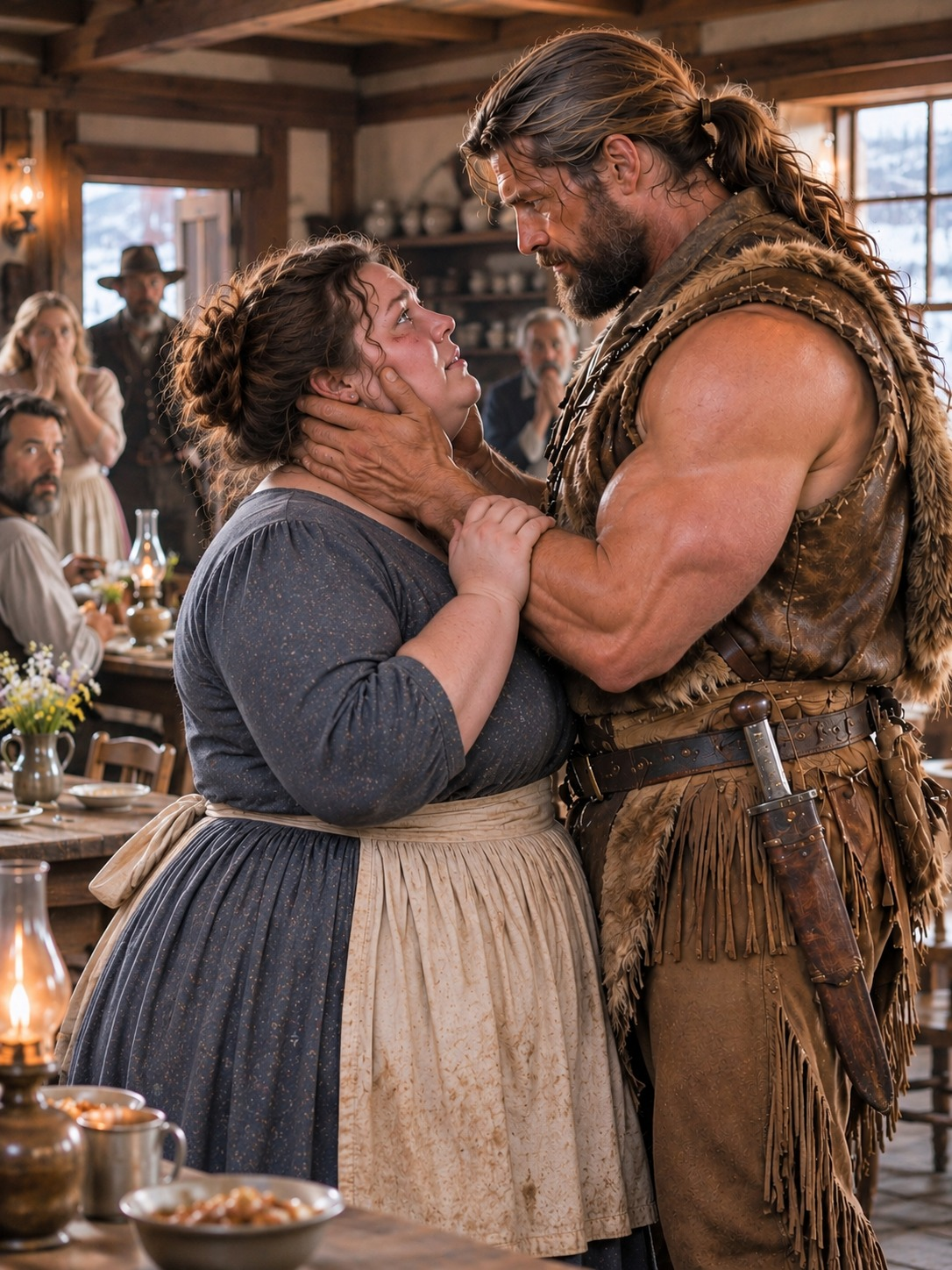
Josiah stood outside my boarding house with a folded document in his hand.
He wasn't smiling anymore.
That alone was enough to make me uneasy.
For six months, Josiah had treated my kitchen like his personal dining room. He came whenever he pleased, complained about the food, made remarks about my age, and acted as though my refusal to entertain his attention was some great personal insult.
But I had never seen him look like this.
His eyes moved from me to Caleb, then to the leather satchel on the table.
He knew what was inside.
I was certain of it.
"Well, Hattie," he said, stepping through the doorway. "I see you've taken in another stray."
I folded my father's letter and slipped it deeper into my apron pocket.
"You're tracking mud across my clean floor."
Josiah glanced down at his boots.
"That's what floors are for."
"Not mine."
He gave a short laugh, but it sounded forced.
Caleb remained seated beside the stove. His enormous hands rested on his knees, and his bandaged ribs rose and fell with each careful breath.
Even injured, he made Josiah look small.
"Who's your friend?" Josiah asked.
"You already know my name," Caleb answered.
Josiah's expression changed.
Only slightly.
But I noticed.
"Mercer."
"Josiah."
The two men looked at each other.
There was no greeting.
No surprise.
Just an unpleasant recognition.
I stepped between them.
"How do you know each other?"
Josiah shrugged.
"Everyone around here knows about Mercer. Hardly the sort of company a respectable woman should keep."
Caleb's gray eye remained fixed on him.
"That's an interesting thing to say, considering what you've done."
Josiah's fingers tightened around the document.
"Careful."
The word was quiet.
It carried more threat than his earlier insults.
I looked at Caleb.
Then at Josiah.
"What exactly is going on?"
Josiah held up the folded paper.
"That's why I came."
He placed it on the table.
The document was creased along the middle, with a dark red seal pressed into the bottom corner.
My name appeared near the top.
HATTIE MAE WHITCOMB.
Beneath it were several lines of legal language.
I picked it up.
"What is this?"
"An offer," Josiah said.
"An offer for what?"
"The boarding house."
I stared at him.
For eleven years, I had worked to keep that building standing. I had repaired the leaking roof, replaced broken windows, scrubbed the floors, cooked for travelers, and carried water until my shoulders ached.
My father had left it to me.
It was the only thing I owned that connected me to him.
"I have no intention of selling."
Josiah sighed.
"Hattie, don't be difficult."
"Then don't bring me foolish papers."
He leaned against the table.
"You owe money."
"I know what I owe."
"And the bank isn't going to wait forever."
"I have made every payment."
"Not every payment."
I felt the blood drain from my face.
The mortgage was my greatest worry, but I had never missed a payment without making arrangements with the bank.
At least, that was what I believed.
I unfolded the document.
There were figures listed beside my property description.
The amount was almost twice what I remembered borrowing.
My fingers tightened around the paper.
"Where did this number come from?"
Josiah gave a sympathetic shrug.
"Interest. Taxes. Expenses. These things add up."
"That isn't what the bank told me."
"Perhaps the bank hasn't been entirely honest with you."
Caleb shifted in his chair.
"Put the paper away, Josiah."
Josiah turned.
"Nobody asked you."
"She doesn't owe you anything."
"You don't know what she owes."
Caleb's voice dropped.
"I know exactly what her father paid."
The room went silent.
I looked at him.
"What did my father pay?"
He didn't answer immediately.
Instead, he glanced at the front window.
Josiah followed his gaze.
For the first time, the widower seemed genuinely uncomfortable.
"Your father was a foolish man," Josiah muttered.
I took a step toward him.
"Don't speak about my father."
"Then stop asking questions about things you don't understand."
That was when I realized something.
Josiah wasn't merely annoyed by Caleb's presence.
He was afraid of what Caleb might tell me.
I placed the document on the table.
"Leave, Josiah."
He stared at me.
"You'll regret this."
"I've regretted allowing you into my kitchen for six months. I don't intend to make that mistake again."
His face reddened.
Clara appeared at the edge of the dining room.
She had been listening.
Josiah noticed her and adjusted his expression, trying to recover the familiar charm he used whenever he wanted an audience.
"You're making a terrible mistake, Hattie."
"Good day."
He snatched his hat from the table and walked out.
But before he reached the door, he turned.
"Ask your mountain friend why he waited fourteen years to visit you."
Then he left.
I watched him mount his horse.
He didn't look back.
The sound of his horse's hooves gradually disappeared down the muddy street.
I closed the door.
For a long moment, I stood with my hand against the wood.
Fourteen years.
The same number of years since my father had died.
I turned toward Caleb.
"Start talking."
He looked at the floor.
"Not here."
"Why not?"
"Because there are ears in this town that belong to men who would rather see you buried than hear the truth."
I glanced toward the dining room.
Several customers had returned to their breakfast.
Clara was pretending to dust the mantel.
I lowered my voice.
"Then we can speak upstairs."
Caleb attempted to stand.
His face tightened with pain.
I immediately reached for his arm.
He was heavier than he looked, and I nearly lost my balance.
"Don't be stubborn," I said.
A faint expression crossed his face.
"You're not much for asking permission, are you?"
"I'm not much for watching injured men collapse on my floor either."
He allowed me to help him.
Together, we made our way up the stairs.
I led him into the small guest room at the end of the hallway. It had a narrow iron bed, a washstand, and a single window overlooking the back alley.
The room was modest but clean.
I helped him sit.
"Take off your coat."
He looked at me.
I raised an eyebrow.
"Your bandages need checking."
He removed the coat carefully.
Underneath, his faded burgundy shirt was stained with blood near the ribs.
The wound looked worse than it had downstairs.
"How long have you been riding with that?"
"Two days."
"Two days?"
"Perhaps three."
I stared at him.
"Are you trying to die?"
"Not particularly."
"You could have fooled me."
I heated water and brought fresh cloth from the washstand.
When I lifted the edge of his shirt, I saw the scars more clearly.
They were not limited to his face.
Old burn marks crossed his right shoulder and continued down his chest. Some were pale and smooth. Others were thick, uneven, and deeply discolored.
The newer wound along his ribs had been stitched poorly.
"Who did this?"
He looked toward the window.
"Fire."
"That much I can see."
He said nothing.
I cleaned the wound.
He didn't flinch.
That surprised me.
Most men complained when I treated a simple cut.
Caleb sat perfectly still, his hands resting against the edge of the mattress.
"You've done this before," he observed.
"Men fall off horses. Children cut themselves. People burn their hands. Running a boarding house means learning things."
"Your hands look like they've done more than wash dishes."
I glanced down.
The cracks across my knuckles were still visible.
"Work doesn't care whether a woman is tired."
"No," he said quietly. "It doesn't."
There was something in his voice that made me look at him.
He understood.
Perhaps more than I wanted him to.
I finished wrapping his ribs and tied the bandage.
"Now tell me about my father."
Caleb rested his back against the headboard.
"His name was Thomas Whitcomb."
"I know my father's name."
"He was a good man."
"I know that too."
Caleb looked at me.
"Do you?"
The question irritated me.
"Excuse me?"
"Did he ever tell you why he bought this building?"
I shook my head.
"He said it was a good investment."
Caleb gave a humorless breath.
"Your father was never much of a businessman."
"He built the place."
"Yes. With money he earned working for the railroad."
I waited.
Caleb continued.
"But that wasn't the reason he wanted this land."
"Then what was?"
He rubbed his thumb over the scar on his left hand.
"Your father helped a group of families settle in this valley. People who had nowhere else to go. He believed they deserved a place where nobody could force them out."
I frowned.
"What does that have to do with my boarding house?"
"Everything."
He leaned forward.
"The land beneath your building sits on an old property agreement. Your father held the original papers. They gave certain families the right to remain on their land, regardless of who eventually bought the surrounding property."
I stared at him.
"Why would that matter now?"
"Because the railroad wants the northern ridge."
I remembered hearing rumors about the railroad extending its line through Dakota Territory.
Men had been discussing new stations, new mining operations, and the possibility of a profitable timber route.
But I had never connected any of it to my little boarding house.
Caleb watched my expression.
"There's valuable timber up there. A mineral deposit too. The people who control the land could make a fortune."
"And Josiah?"
"He works for a man who wants it."
"Who?"
Caleb hesitated.
"Silas Rourke."
The name meant nothing to me.
"Who's that?"
"A land speculator. He buys properties cheaply, usually from people who don't understand what they're signing."
I thought of the document Josiah had brought.
The inflated debt.
The red seal.
The way he had looked at Caleb.
"He's trying to take my boarding house."
"He's trying to take more than that."
Caleb reached for the satchel.
I brought it closer.
He opened the main compartment and removed a small leather notebook.
Its cover was cracked.
Several pages had been torn out.
"This belonged to your father."
I touched the worn leather.
"He kept a ledger like this."
"He kept many things."
Caleb opened the notebook.
There were handwritten names, dates, and numbers.
Some entries had been crossed out.
Others were marked with small symbols.
I recognized my father's handwriting on the first page.
"What am I looking at?"
"Payments."
"To whom?"
"People who were promised land."
He turned several pages.
Then he stopped at an entry dated fourteen years earlier.
My father's name appeared beside a sum of money.
Below it was another name.
Josiah Pike.
I felt my stomach tighten.
"Josiah?"
Caleb nodded.
"He was a younger man then. He worked as a clerk for the land office."
"Why was my father paying him?"
"He wasn't."
Caleb tapped the page.
"Your father recorded the payment because Josiah claimed he had delivered the money to the families."
"Did he?"
"No."
I stared at the entry.
"How do you know?"
"Because I was there."
He looked down at his hands.
"I watched your father hand him the money. I was supposed to ride with him and make sure it reached the families."
"What happened?"
"Josiah disappeared for three weeks. When he came back, he said the money had been stolen."
"And my father believed him?"
"No."
Caleb closed the notebook.
"Your father confronted him. Two days later, the barn caught fire."
My throat tightened.
I remembered that night.
I had been twenty-five.
I remembered waking to the smell of smoke, running downstairs, and finding my father outside with his coat thrown over his nightshirt.
He had told me to stay inside.
The next morning, he had looked ten years older.
Three weeks later, he had died.
The doctor called it a heart attack.
I had never questioned it.
"Are you saying Josiah started the fire?"
Caleb's eye met mine.
"I'm saying your father believed he did."
I sat down beside the washstand.
For years, I had thought my father's death was simply one of those cruel things that happened without warning.
Now I was being told that someone might have taken him from me.
"Why didn't you come sooner?"
The question escaped before I could stop it.
Caleb looked away.
"I should have."
"That isn't an answer."
"No."
His voice became rough.
"It isn't."
He reached inside his shirt and pulled out a small chain.
A silver cross hung from it.
The metal was blackened in places.
I recognized it immediately.
My father had worn that cross every Sunday.
I had placed it in his coffin.
My fingers began to tremble.
"Where did you get that?"
Caleb held it out.
"Your father gave it to me."
"That's impossible."
"He gave it to me the night of the fire."
I looked at the cross.
Then at him.
"Why?"
"Because he knew he might not survive."
I covered my mouth.
Caleb continued carefully.
"He told me to protect the papers. He told me to find you if anything happened to him."
"Then why didn't you?"
His jaw tightened.
"Because the fire took more than your father's life."
He touched the scars along his cheek.
"I was trapped inside the barn. The roof collapsed. I spent months in a hospital before I could walk properly. By the time I recovered, Josiah had convinced everyone that I had stolen money and started the fire myself."
I stared at him.
"You were blamed?"
"Yes."
"And nobody believed you?"
"Not one person."
"Why didn't you tell the sheriff?"
Caleb gave a bitter laugh.
"The sheriff was paid by the same people who wanted your father's land."
I felt sick.
I had lived in Bitter Creek for years.
I had served breakfast to men who might have known the truth.
I had smiled politely at people who had allowed a murderer to walk freely through the town.
"Why did you return now?"
Caleb reached into the satchel again.
This time, he removed a small folded paper.
It was not my father's handwriting.
The paper was newer, though the ink had faded.
He placed it in my hand.
"Because I found something in the mountains."
I unfolded it.
There was a rough drawing of the boarding house.
A line had been marked beneath the foundation.
Beside it was a date.
And beneath the date were four words.
THE ORIGINAL DEED REMAINS.
I looked up.
"Where?"
Caleb shook his head.
"Your father never told me."
"Then how can you be certain it exists?"
"Because I found this."
He reached into his pocket and removed a small iron key.
It was old, heavy, and dark with age.
A number had been engraved into its handle.
SEVEN.
I turned it over.
There was a small symbol on the opposite side.
A circle with a line through it.
I had seen that symbol before.
Not on a document.
Not on the satchel.
On the underside of my father's old writing desk.
The desk was still downstairs.
My heart began to pound.
"Caleb, I think I know where it belongs."
He looked at me sharply.
"Where?"
"My father's desk."
I stood.
But before I could reach the door, Caleb caught my wrist.
His grip was gentle despite the size of his hand.
"Listen to me, Hattie."
I looked down at his fingers.
He immediately released me.
"Don't let anyone see that key."
"Why?"
"Because if Josiah knows you have it, he'll stop pretending he wants to buy your boarding house."
A chill moved through me.
"What will he do instead?"
Caleb looked directly into my eyes.
"He'll try to make sure you never open that desk."
I descended the stairs with the key hidden inside my apron pocket.
The dining room was nearly empty.
Clara was collecting plates.
I asked her to finish the dishes while I checked something in the front parlor.
My father's writing desk stood against the wall beneath the old window.
It was a heavy piece of oak furniture with a narrow drawer and a small brass lock.
I had kept it for fourteen years.
I had never been able to bring myself to sell it.
I knelt and examined the underside.
There it was.
The small circle with a line through it.
My fingers traced the mark.
The key fit.
I heard a faint click.
The drawer opened.
Inside lay an old bundle of letters, a pocket watch, and a small wooden box.
I lifted the box.
It was locked.
The same number appeared on its brass plate.
Seven.
My breath caught.
I placed the key into the lock.
It turned easily.
Inside was a folded property map, several signed agreements, and a photograph of my father standing beside Caleb.
But there was something else.
A second photograph.
It showed my father outside the boarding house.
Standing beside him was a woman I had never seen.
She wore a pale blue dress and held a baby wrapped in a white blanket.
On the back, my father's handwriting read:
Hattie, the day everything changed.
I stared at the words.
I had been an only child.
At least, that was what my father had always told me.
I turned the photograph over.
The woman had the same gray eyes I saw in my own reflection.
And the baby wore a tiny silver bracelet.
A bracelet identical to the one my father had kept locked inside his desk.
My hands went cold.
Then I heard footsteps behind me.
I turned.
Caleb stood at the entrance to the parlor, one hand pressed against his injured ribs.
His expression had changed completely.
He looked at the photograph in my hands.
Then he whispered:
"Where did you find that?"
"Inside my father's desk."
Caleb took one unsteady step forward.
"Hattie, put it down."
"Why?"
He looked toward the front window.
A shadow moved across the glass.
Then came three hard knocks at the front door.
Caleb's face went pale.
I recognized the voice outside.
It belonged to the town sheriff.
And he wasn't alone.
"Open this door, Hattie Whitcomb."
The sheriff paused.
Then he spoke the words that made Caleb reach for the old satchel.
"We have a warrant for the arrest of Caleb Mercer."
Write Chapter 2 at 2,000 words Make the cliffhanger more abrupt






Comments 0