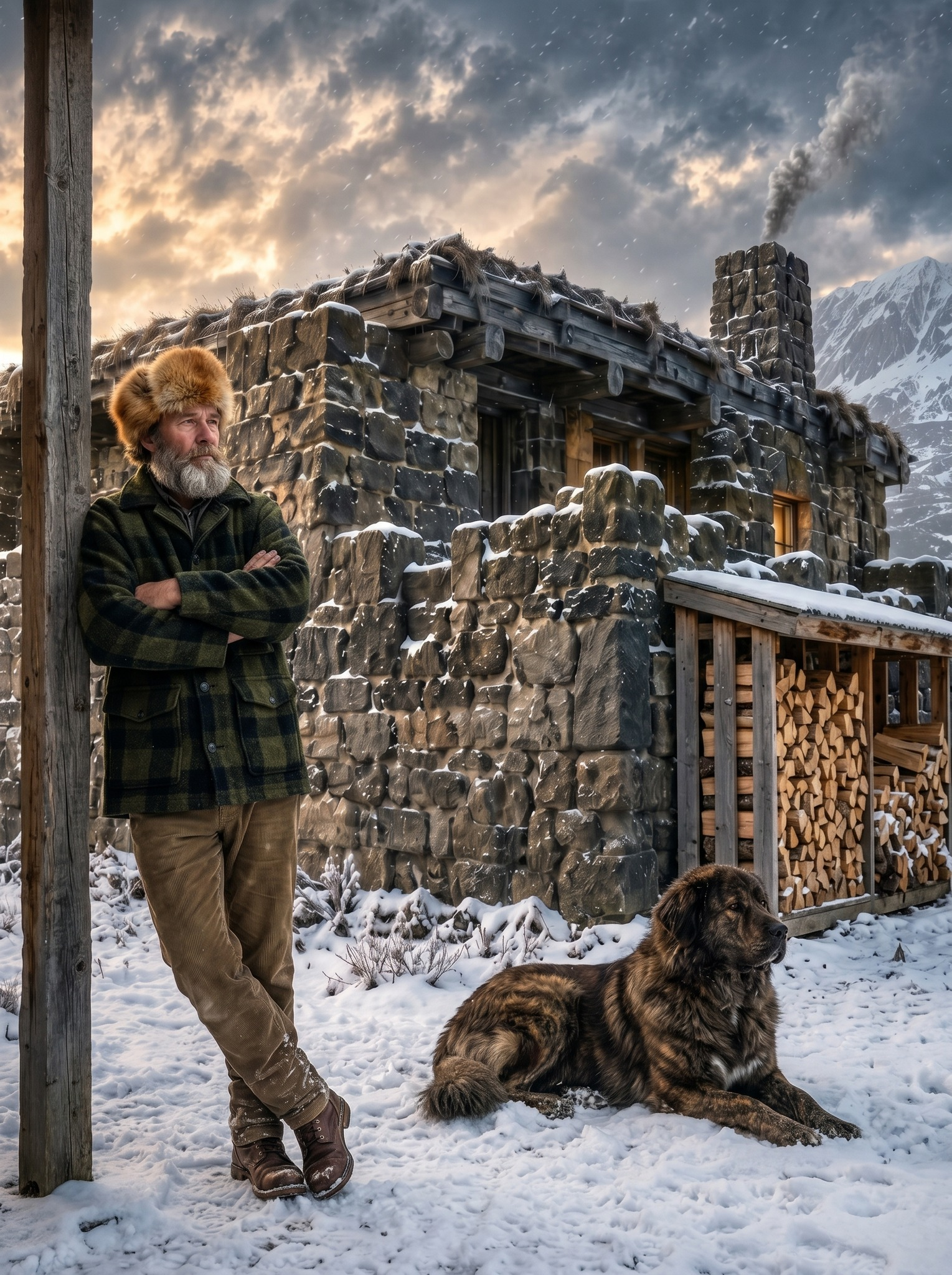
"You're throwing away every dollar you've got!" Boone Mercer shouted.
He slammed a folded land deed onto the trading post counter.
Ezekiel Hart, the valley's most respected carpenter, picked it up.
A small number was written beside the property description.
Twenty-four.
Ezekiel stopped laughing.
He had just noticed something Boone had missed.
Gideon Voss stood on the other side of the counter, watching the two men examine the document he had signed less than an hour earlier.
He was forty-three years old, with short auburn hair, a closely trimmed beard, and the kind of hands that made strangers assume he had spent his life breaking rocks.
That assumption wasn't far from the truth.
For nearly twenty years, Gideon had built retaining walls, repaired stone foundations, and constructed lime kilns across the western territories. He understood the weight of stone, the patience it demanded, and the mistakes it never forgave.
But he had never bought a house.
Until that morning.
And the house he had bought wasn't technically a house at all.
It was the remains of an abandoned frontier fort on the northern edge of Elcorn Basin.
Its roof had disappeared years earlier. Sagebrush grew through the courtyard. Several upper courses of stone had collapsed, and the wooden gate hung crookedly from a single rusting hinge.
Most settlers considered the place useless.
Some called it dangerous.
Boone Mercer had a simpler description.
"A pile of rocks."
Gideon reached across the counter and took back his deed.
"Those rocks are mine now."
Boone gave a short laugh.
"Congratulations. You've purchased the one piece of land in this valley that nobody else was foolish enough to want."
The trading post owner, Samuel Bell, pretended to rearrange a row of tin cups.
He had been present when Gideon signed the papers.
He also knew how much money had changed hands.
Enough to buy a respectable parcel of land and the lumber for a small cabin.
Enough to purchase livestock.
Enough to establish a modest farm.
Instead, Gideon had spent nearly everything he and his wife had saved on a roofless ruin.
Samuel cleared his throat.
"Mr. Voss, you understand the property is being sold as it stands?"
"I do."
"No guarantee regarding the foundation?"
"I inspected it."
"No guarantee the remaining walls are sound?"
"I inspected those too."
Samuel hesitated.
"And you understand the former military buildings were abandoned for a reason?"
Gideon folded the deed carefully.
"Soldiers moved on, Mr. Bell. Stone didn't."
Boone snorted.
Ezekiel continued staring at the number on the document.
Twenty-four.
"What does that mean?" he asked.
Gideon looked at him.
"What does what mean?"
"That measurement beside the exterior wall description."
"Wall thickness."
"Inches?"
"Yes."
Ezekiel frowned.
"Twenty-four inches of solid stone?"
"Close enough. Some sections are thicker."
Boone leaned over to examine the paper.
"Two feet of rock? Good Lord. You could spend a year trying to tear that thing apart."
"I'm not tearing it apart."
Both men looked up.
Gideon slipped the deed into his coat.
"I'm putting a roof on it."
For several seconds, nobody spoke.
Then Boone began laughing so hard he had to steady himself against the counter.
"You hear that, Ezekiel? He's putting a roof on a graveyard!"
Ezekiel didn't laugh immediately.
He was thinking about the weight of the stone.
The thickness.
The old foundation.
But then he shook his head.
"Stone's cold, Voss. Everybody knows that. You build a house out of wood if you want to survive a winter."
"Wood has its uses."
"That's a generous way of putting it."
Gideon said nothing.
Ezekiel stepped closer.
"Listen. I'm telling you this as a man who's built houses in this valley for fourteen years. The wind comes down from those mountains like a knife. You need walls that keep the weather out and a stove that can keep up with the cold."
"I agree."
"Then why in God's name would you build yourself a stone box?"
Gideon studied the carpenter.
He could have explained.
He could have described the lime kilns he had worked on in Montana, where thick masonry stayed warm long after the fire was reduced.
He could have told Ezekiel about stone ovens that held enough heat to bake bread hours after the flames had been swept away.
He could have explained that a thick wall, properly sheltered and warmed from within, could store heat and release it slowly.
But there was a difference between knowing how stone behaved and proving it could make a comfortable home in Elcorn Basin.
Gideon hadn't proved that yet.
So he answered with the only thing he knew for certain.
"Because the walls are already standing."
Boone laughed again.
"Not for long, they won't be."
Gideon picked up his hat and left.
Outside, the summer afternoon was bright and dry.
Wagons rattled along the dirt street. Horses stamped near the hitching rail. Somewhere behind the blacksmith's shop, a hammer rang against an anvil.
Elcorn Basin was growing.
Three years earlier, it had been little more than a handful of cabins and a supply trail.
Now it had a trading post, a sawmill, a blacksmith, a church, and nearly forty families scattered across the valley.
Most had come for land.
Some had come for timber.
Others had come because there was nowhere else left to go.
Gideon and Ruth Voss belonged to the last group.
They had arrived in the spring with a wagon, two trunks, a collection of masonry tools, and a large brown hound named Bristle.
They had no children.
They had no relatives in the valley.
And they had no intention of spending another winter moving from one rented room to another.
Ruth wanted a home.
Not a grand one.
Not even a particularly comfortable one.
She wanted a door she could close at night, a table that belonged to them, and a place where their belongings could remain unpacked.
Gideon had promised her that much.
He had not promised her a fort.
That was going to require some explaining.
Ruth was waiting outside their rented cabin when he returned.
She was thirty-eight, with dark chestnut hair usually pinned behind her head and a practical manner that had carried them through years of uncertain work.
She noticed the folded paper before Gideon climbed down from the wagon.
"You bought it."
Gideon nodded.
"Yes."
"The property north of the creek?"
"Yes."
She looked past him.
Bristle was stretched across the wagon bed, his enormous head resting on a sack of tools.
"How much?"
Gideon told her.
Ruth closed her eyes.
For a moment, he thought she might shout.
She didn't.
She simply turned toward the cabin.
"Come inside."
That was worse.
Gideon followed her.
The rented cabin contained a small iron stove, a narrow bed, two chairs, and a table with one uneven leg.
Ruth placed a kettle on the stove.
Then she sat down.
"Tell me what you saw."
Gideon removed his coat.
"Four standing exterior walls. Most of the original foundation is sound. The north wall needs attention. So does the upper section beside the chimney."
"Is there a roof?"
"No."
"Are there windows?"
"Openings."
"Are there doors?"
"One opening large enough for a door."
Ruth stared at him.
"You bought a place without a roof, windows, or a door."
"The stone is good."
"Gideon."
"The foundation is better than anything I could afford to build from scratch."
"Gideon."
He stopped.
Ruth folded her hands on the table.
"Can we live in it?"
"Yes."
"When?"
"Before winter."
She studied his face.
"Are you certain?"
He wanted to say yes without hesitation.
But Gideon had never lied to Ruth about work.
He had promised things before and failed to deliver them. Not because he lacked determination, but because weather, money, and human error had a way of making promises foolish.
So he chose his words carefully.
"I believe I can make it ready."
Ruth looked toward the window.
Outside, the sun was beginning to sink behind the hills.
"And if you can't?"
Gideon didn't answer.
She nodded slowly.
"That's what frightens me."
He pulled out the deed and spread it across the table.
"Look here."
Ruth leaned forward.
"The walls are two feet thick."
"Is that good?"
"For what I intend, yes."
"Which is?"
"A home that doesn't lose its warmth the moment the fire burns low."
Ruth looked at him.
"Stone feels cold."
"It does when it's cold."
"That doesn't sound reassuring."
Gideon almost smiled.
But he saw how serious she was and stopped himself.
"Ruth, think about the old bread ovens."
She nodded.
"You heat the masonry with a fire. Afterward, the stone stays hot enough to bake for hours."
"A bread oven isn't a house."
"No. But the principle matters."
He pointed to the drawing.
"If I repair the walls, seal the openings, build a tight roof, and heat the interior properly, that stone can store warmth. It won't make heat by itself. We'll still need firewood. But we may not need to burn through it as quickly as everyone else."
Ruth studied the paper.
For the first time, her expression softened.
"May not?"
"That's the part I have to prove."
She leaned back.
"And you've spent nearly all our savings on proving it."
Gideon lowered his eyes.
"Yes."
The kettle began to whistle.
Neither moved to remove it.
Finally, Ruth stood.
"Then you'd better start tomorrow."
Gideon started before sunrise.
The fort stood on a low rise beyond the northern creek, where the valley narrowed toward the mountains.
The property had been abandoned long enough for sagebrush to push through the old parade ground.
Its walls were made from dark local stone, rough-cut and fitted together with lime mortar.
Some sections remained almost perfectly straight.
Others had suffered years of wind, water, and neglect.
The southern wall rose higher than the others, with remnants of an old parapet along its upper edge.
A heavy stone chimney stood near the eastern corner.
The original roof timbers had disappeared.
But the walls remained.
Gideon climbed down from his wagon and stood in silence.
Bristle jumped to the ground.
The dog sniffed the sagebrush, circled an old stone block, and settled beside the entrance.
Gideon walked to the northern wall.
He placed his hand against it.
The surface was cool.
Of course it was.
The sun had barely risen.
But beneath his palm, the stone felt solid.
He examined the mortar joints, then the corners, then the foundation.
At the eastern wall, he found a crack running through several courses of masonry.
It worried him.
Not because the crack was especially wide.
Because it showed where water had entered and frozen repeatedly.
That was the enemy of neglected stonework.
Water.
Cold.
Movement.
He made a mark in his notebook.
Then another.
By noon, he had filled three pages.
He had identified the areas that needed rebuilding, the stones that could be reused, and the sections that would require fresh mortar.
He had also discovered something encouraging.
The original builders had laid the lower courses with remarkable care.
The stones were broad, heavy, and tightly fitted.
The walls had survived years of abandonment because the men who built them had understood their trade.
Gideon respected that.
He spent the afternoon clearing sagebrush.
Bristle followed him from one side of the fort to the other.
By evening, Gideon's shoulders ached.
His hands were scratched.
His trousers were covered in dust.
But the old entrance was clear.
He stood in the courtyard and imagined a roof overhead.
A stove burning near the chimney.
A wooden table.
Ruth sitting beside the fire.
Bristle sleeping near the door.
For a moment, the ruin became a home.
Then the wind rose.
It moved through the empty window openings and across the roofless walls.
The sound was hollow.
Gideon looked upward.
There was still an enormous amount of work to do.
Within a week, everyone in Elcorn Basin knew what Gideon had purchased.
By the second week, the jokes had begun.
Men at the sawmill called the property "Voss's cold box."
At the trading post, Boone Mercer told anyone who would listen that Gideon planned to freeze himself inside a mountain of stone.
Thaddeus Pike, a rancher known for his jokes, suggested that Gideon should save money on a coffin.
"He can just lie down inside that fort when January comes," Thaddeus said. "The ground will be too frozen to bury him anyway."
The men laughed.
Gideon heard about it from Samuel Bell.
He didn't respond.
Instead, he bought lime, sand, nails, and a small quantity of lumber.
He also arranged for a wagonload of sound roof timbers to be delivered later in the summer.
Boone Mercer owned the sawmill.
That made the transaction uncomfortable.
When Gideon arrived to place the order, Boone looked at the list and whistled.
"That's a heavy roof you're planning."
"It needs to carry snow."
"You're putting a great deal of lumber on a house that isn't worth the price of the nails."
Gideon counted out his deposit.
Boone watched the coins.
"You could still change your mind."
"No."
"I could sell you enough timber for a proper cabin."
"I have walls."
"You have rocks."
Gideon looked up.
"Then sell me the roof."
Boone's smile disappeared.
He took the money.
The work continued through July.
Gideon rebuilt the damaged upper courses one stone at a time.
He mixed mortar in small batches, careful not to waste lime.
He reset loose blocks, packed the joints, and checked every repair.
He constructed a temporary shelter for his tools.
He cleared drainage channels around the foundation.
He began shaping timber supports for the future roof.
Ruth visited whenever she could.
Sometimes she brought food.
Sometimes she carried water.
Sometimes she simply stood in the courtyard, studying the walls that were supposed to become their home.
She never mocked him.
That made her doubts harder to bear.
One afternoon, she found him struggling to raise a heavy stone into position.
He had built a simple lifting frame, but the rope had slipped.
The block hung awkwardly against the wall.
"Gideon."
He looked down.
"Don't come closer."
She stopped.
He adjusted the rope and lowered the stone carefully.
When it reached the ground, he leaned against the wall, breathing hard.
Ruth approached.
"You're doing too much alone."
"I can manage."
"That wasn't what I said."
He wiped sweat from his forehead.
She examined his hands.
The skin across two knuckles had split.
"You're bleeding."
"It's nothing."
She took a cloth from her basket.
"Sit down."
He obeyed.
As she cleaned the cuts, Ruth looked around the courtyard.
"How much longer?"
"Before the roof?"
"Before we can live here."
Gideon considered the question.
"September, if the weather holds."
"And if it doesn't?"
"October."
Ruth tied the cloth around his hand.
"Gideon, winter doesn't wait for a man to finish his work."
He looked at the walls.
"I know."
She followed his gaze.
"Do you?"
For the first time that summer, her words hurt him.
Not because they were cruel.
Because they were true.
By August, the fort had begun to change.
The entrance was squared and reinforced.
The chimney had been inspected and repaired.
Several window openings had been fitted with wooden frames.
The northern wall stood straight again.
The courtyard no longer looked abandoned.
It looked unfinished.
There was a difference.
Travelers passing along the creek road slowed their wagons to stare.
Some shook their heads.
Others stopped to watch Gideon work.
He had become a curiosity.
And Gideon, who had spent most of his life avoiding attention, found himself discussed in every gathering place in the valley.
One afternoon, Thaddeus Pike rode past with two ranch hands.
He stopped at the entrance.
"Still building your stone refrigerator, Voss?"
Gideon continued spreading mortar.
"Still riding that same horse, Pike?"
Thaddeus grinned.
"She's a good horse."
"Then I wouldn't trade her for a mule."
The ranch hands laughed.
Thaddeus's smile narrowed.
"You think you're smarter than the rest of us?"
"No."
"Then why do you keep doing everything differently?"
Gideon pressed a stone into place.
"Because I'm working with what I've got."
Thaddeus shook his head.
"Winter will teach you."
He rode away.
Gideon watched him go.
Then he returned to his work.
But that evening, as he counted the remaining coins in his small leather purse, he felt the first real pressure of the approaching season.
There was enough money for the roof timbers.
Enough for basic doors and shutters.
Enough for a stove, if he purchased a used one.
But there was almost nothing left for mistakes.
And there was still the matter of the eastern foundation.
The crack he had discovered in June had not widened.
Yet he had noticed dampness in the lower mortar after a recent rain.
It was a warning.
He marked the area for repair.
Then he closed his notebook.
Late that night, Ruth found him sitting outside their rented cabin.
Bristle lay at his feet.
Gideon was holding a small stone in his hand.
He turned it over slowly, studying its surface.
Ruth sat beside him.
"Samuel says the men are taking bets."
Gideon looked at her.
"On what?"
"Whether we'll last a month in that place."
He said nothing.
"Some say a week."
Gideon placed the stone on the step.
"Men can bet on anything."
Ruth watched him.
"Does it bother you?"
"No."
She waited.
Gideon sighed.
"Not as much as it bothers you."
Ruth looked away.
He reached for her hand.
"I'm not building this place to prove those men wrong."
"Then why are you building it?"
He considered the question.
"Because I've spent twenty years building things that belonged to somebody else."
Ruth turned toward him.
"Kilns. Walls. Foundations. Houses I never lived in. Every time the work was finished, I packed my tools and moved on."
He looked toward the northern hills.
"I wanted to build one thing that was ours."
Ruth's expression changed.
For a long moment, she said nothing.
Then she squeezed his hand.
"I want that too."
Gideon nodded.
"But I want you alive to enjoy it."
He looked at her.
"I intend to be."
She leaned her head against his shoulder.
For several minutes, they sat quietly.
The night was warm.
Crickets sounded in the grass.
Somewhere beyond the creek, a coyote called.
It was difficult to imagine that in a few months, the same valley would be buried beneath snow.
But Gideon knew how quickly the seasons could turn.
He had seen winter arrive early.
He had seen men lose fingers to frostbite.
He had seen livestock freeze in open fields.
And he had once watched a family burn the last of their furniture because the road to the timber stand had become impassable.
He knew what cold could do.
That was why he feared it.
And why he was determined to build something better.
The next morning, Gideon returned to the fort before sunrise.
He intended to finish the eastern foundation repair before the roof timbers arrived.
Bristle followed him through the entrance.
The dog stopped near the wall.
His ears lifted.
Gideon noticed.
"What is it, boy?"
Bristle moved closer to the foundation.
He sniffed the ground.
Then he gave a low, uneasy whine.
Gideon set down his tools.
At first, he saw nothing unusual.
The stone looked exactly as it had the evening before.
Then he noticed a thin line of damp earth beneath the lowest course.
He knelt.
Pressed his fingers into the soil.
It was wet.
Far wetter than it should have been after several dry days.
He scraped away a handful of loose dirt.
Water had been collecting beside the foundation.
Somewhere beneath the old wall, a drainage path had become blocked.
Gideon followed the damp line toward the eastern corner.
There, half-hidden beneath a broad foundation stone, he discovered a narrow opening.
He cleared away more earth.
The opening extended farther than he expected.
He took his lantern from the wagon, lit it, and lowered it toward the gap.
A cold draft touched his face.
Gideon stopped.
He had assumed the old fort's foundation rested on solid, undisturbed ground.
But the darkness beneath the wall suggested something else.
He lowered the lantern farther.
The flame flickered.
Then its light caught the edge of a carefully cut stone passage.
Gideon leaned closer.
Someone had built a channel beneath the foundation.
And the channel was carrying water toward the very wall he was trying to save.
He reached for his notebook.
That was when Bristle began growling.
Gideon turned.
The dog was staring at the old wooden entrance.
A wagon had stopped outside.
Three men were climbing down.
Ezekiel Hart.
Boone Mercer.
And Thaddeus Pike.
Ezekiel carried a carpenter's measuring rule.
Boone held a folded sheet of paper.
Thaddeus was smiling.
But the smile disappeared when he saw the lantern beside the exposed foundation.
Ezekiel stepped closer.
He looked down into the opening.
Then he looked at Gideon.
"Voss," he said quietly, "who told you that wall was safe?"
Gideon rose to his feet.
"Why?"
Ezekiel unfolded the paper in Boone's hand.
It was an old survey of the fort.
A red mark crossed the eastern foundation.
Beside it, someone had written three words.
UNSTABLE AFTER THAW.
Ezekiel looked toward the wall.
Then he spoke.
"There's something about this fort you need to know."
And before Gideon could ask what he meant, the ground beneath the eastern corner made a sound none of them expected.
A deep, unmistakable crack.






Comments 0