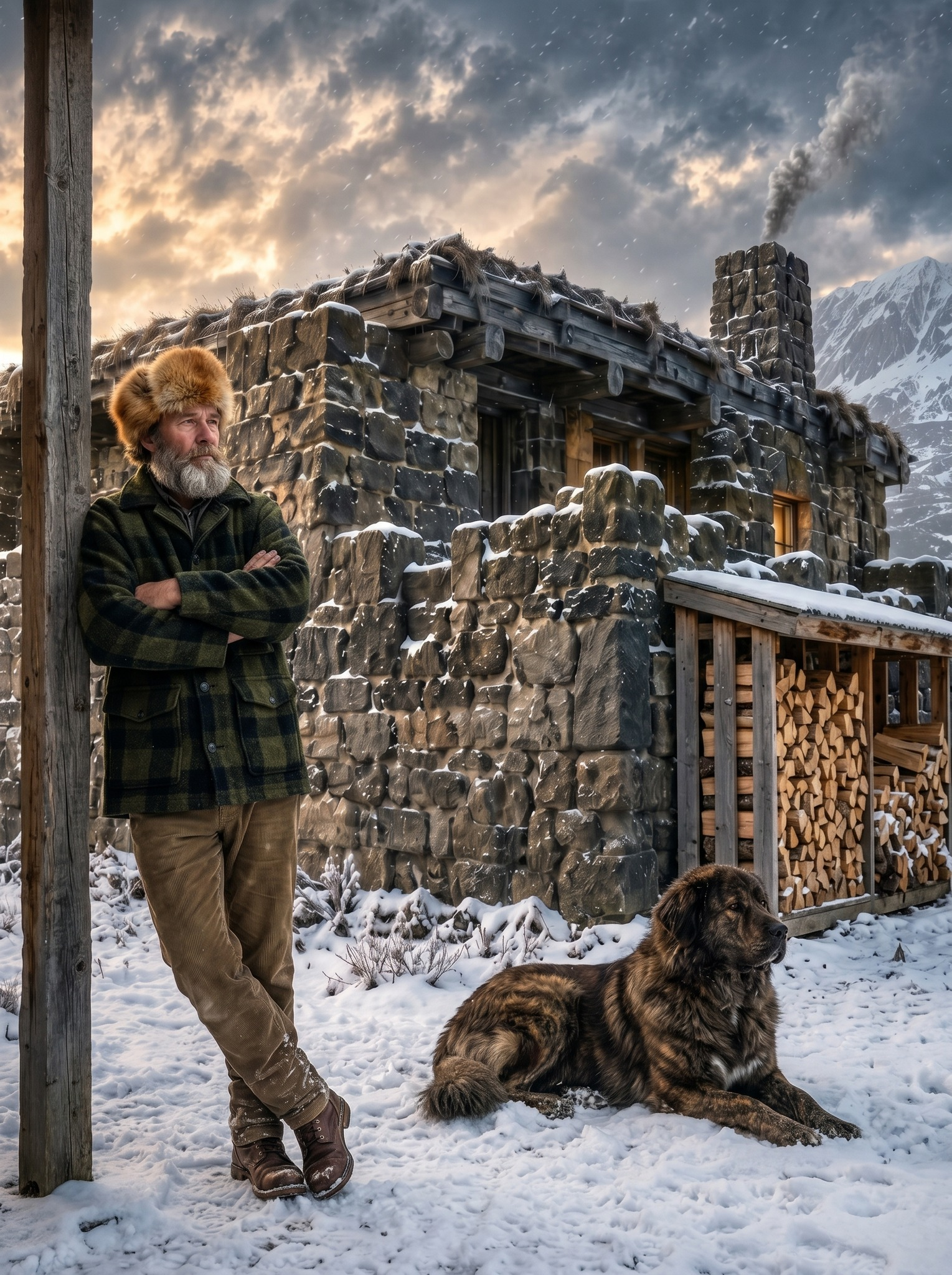
"Get away from that wall!" Ezekiel Hart shouted.
Gideon Voss barely had time to turn before another crack echoed beneath the eastern corner of the old fort.
A small shower of mortar dust fell from between two foundation stones.
Bristle barked once.
Then the enormous brown hound backed away, his thick fur rising along his shoulders.
Boone Mercer stumbled toward the entrance.
"Good Lord! The whole thing's coming down!"
But Gideon didn't run.
He stood perfectly still, listening.
There was a difference between stone breaking and stone settling. He had spent nearly twenty years learning to recognize it.
What he had just heard was neither.
It was the sound of something shifting beneath the foundation.
"Everybody stay where you are," Gideon said.
Ezekiel stared at him.
"Are you deaf? That wall could bury you!"
"Then stop shouting so I can hear it."
The carpenter fell silent.
For several seconds, nobody moved.
A few grains of sand trickled from the exposed opening.
Then everything became still.
Gideon slowly crouched beside the foundation.
He placed his palm against the lowest visible stone.
It hadn't moved.
He checked the mortar joint above it.
Still intact.
Whatever had shifted was beneath the wall, not inside it.
That was encouraging.
But it was also troubling.
He turned toward Ezekiel.
"Show me that survey."
Boone hesitated.
"Maybe we ought to get farther away first."
"Then stand farther away."
Gideon held out his hand.
Ezekiel unfolded the yellowed paper.
The survey was old, drawn in black ink with measurements written along the exterior walls. Several corners were torn, and a dark water stain covered part of the eastern boundary.
Gideon recognized the basic outline immediately.
The original fort had been constructed around a rectangular courtyard. The eastern wall contained the chimney, while the northern and southern walls formed the main defensive enclosure.
But something on the drawing caught his attention.
A narrow line extended beneath the eastern foundation.
It disappeared beyond the edge of the page.
"What is this?"
Ezekiel leaned closer.
"An old drainage channel."
"Where does it lead?"
"Nobody knows for certain."
Gideon looked up.
"Nobody?"
"The soldiers dug several channels when they built the fort. Some carried rainwater away from the courtyard. Others kept spring runoff from collecting against the walls."
"And this one?"
Ezekiel didn't answer immediately.
Boone shifted his weight.
Thaddeus Pike, who had remained unusually quiet, finally spoke.
"That one caused trouble."
Gideon looked at him.
"What kind of trouble?"
Thaddeus glanced toward Ezekiel.
The carpenter folded his arms.
"Trouble enough that the army stopped using the eastern rooms."
Gideon felt something tighten in his chest.
He looked back at the survey.
"Why wasn't this included in the land papers?"
Boone gave a humorless laugh.
"Because you bought an abandoned fort, Voss. Not a furnished hotel."
Gideon ignored him.
"Ezekiel. What happened here?"
The carpenter studied the wall.
"Years ago, during a spring thaw, water backed up beneath this corner. The ground softened. One section settled. The soldiers repaired it, but they never trusted it afterward."
"Did the wall collapse?"
"No."
"Did the foundation break?"
"Not that I know of."
"Then what happened?"
Ezekiel looked uncomfortable.
"They moved their supplies to the other side of the fort."
Gideon considered that.
A foundation that had settled once could settle again.
But the fact that the wall remained standing suggested the original builders had done something right.
He examined the narrow opening.
The stones surrounding it were carefully shaped.
This was no accidental gap.
Someone had constructed a deliberate passage through the foundation.
And someone else had allowed it to become blocked.
"Where did you get this survey?" Gideon asked.
Ezekiel glanced at Boone.
"Samuel Bell found it among some old county papers."
"When?"
"This morning."
Gideon stood.
"This morning?"
Boone shrugged.
"We thought you ought to know."
"After I've spent nearly all summer repairing the place?"
"Would you have listened before?"
Gideon looked at the three men.
He understood their skepticism.
He even understood their jokes.
But withholding information about a dangerous foundation was another matter.
For a moment, anger rose in him.
He pushed it down.
Anger wouldn't repair a wall.
"Thank you for bringing it," he said.
Boone blinked.
"That's all you've got to say?"
"For now."
Gideon took the survey and carried it to a flat stone.
He spread it open beneath his notebook.
Then he began comparing the measurements.
Ezekiel watched him.
"What are you doing?"
"Finding out whether the original drainage channel can be cleared."
Boone threw up his hands.
"You're still planning to live here?"
"Yes."
"After that noise?"
Gideon looked toward the eastern corner.
"The wall is still standing."
"That's your argument?"
"No."
He pointed to the lower courses.
"That's my argument."
The first thing Gideon did was remove the loose earth from around the foundation.
He worked carefully, using a narrow shovel and a hand trowel.
Bristle settled nearby, watching every movement.
The three visitors remained longer than Gideon expected.
Boone leaned against a broken stone block.
Thaddeus wandered around the courtyard.
Ezekiel crouched beside the exposed channel.
After several minutes, the carpenter frowned.
"Those stones are bigger than I thought."
Gideon nodded.
"Some weigh several hundred pounds."
"And they're set deeper than the surface suggests."
"Yes."
Ezekiel studied the foundation.
"Whoever laid this knew what he was doing."
Gideon glanced at him.
"That's what I've been saying."
The carpenter ignored the remark.
He reached into the opening and brushed dirt from the edge of a cut stone.
"There's a slope here."
"A deliberate one."
"Toward the creek?"
"Probably. But I need to find the outlet."
Boone shook his head.
"You're both missing the point. The ground made a cracking noise. That means something's wrong."
"Of course something's wrong," Gideon replied. "That's why I'm fixing it."
Thaddeus laughed.
"There's the answer to everything, Boone. Just fix it."
Gideon continued digging.
The soil grew wetter as he moved deeper.
Eventually, his trowel struck something hard.
Not stone.
Wood.
He cleared away the mud.
A thick, blackened timber lay across the drainage passage.
It was badly decayed.
Gideon pressed it with the end of his trowel.
The wood crumbled.
"There's your blockage," he said.
Ezekiel leaned closer.
"An old support?"
"Possibly. Or debris washed in from farther uphill."
Gideon removed several loose fragments.
A small stream of muddy water trickled through the opening.
Then it stopped.
He frowned.
Something else was blocking the passage.
He pushed the trowel farther inside.
The metal scraped against stone.
He felt resistance.
Then movement.
Suddenly, a thin stream of water burst through the gap.
Boone jumped backward.
"Watch it!"
Gideon withdrew his hand.
The stream strengthened for several seconds before settling into a steady trickle.
He watched it carefully.
Water was escaping.
That meant the pressure beneath the foundation was beginning to ease.
But he still needed to locate the other end.
He stood and wiped his hands.
"Ezekiel, how far is the creek from this wall?"
"About sixty yards."
"And how much lower?"
"Hard to say."
Gideon looked toward the slope.
"Enough, I think."
Ezekiel followed his gaze.
For the first time since arriving, the carpenter appeared genuinely interested.
"You think you can restore the drainage?"
"I think I have to."
"And if the channel's collapsed?"
"Then I'll dig a new one."
Boone stared at him.
"You've lost your mind."
Gideon picked up his shovel.
"Maybe. But the water still needs somewhere to go."
By late afternoon, the three men had departed.
Ezekiel left the old survey behind.
Boone warned Gideon that the roof timbers would arrive the following week and that the remaining payment would be due immediately.
Thaddeus offered one final joke.
"Make sure you leave enough room for us to dig you out come January."
Gideon didn't answer.
He had work to do.
For another two hours, he followed the line of damp ground downhill.
The original channel was buried beneath years of soil and vegetation.
At several points, he found stones that appeared deliberately placed.
Eventually, near a shallow depression above the creek, he uncovered a second opening.
It was almost completely filled with roots and sediment.
Gideon knelt beside it.
He removed a handful of mud.
Then another.
A cold trickle touched his fingers.
He smiled faintly.
The outlet still existed.
The problem was not a failed design.
It was neglect.
That distinction mattered.
A poorly designed foundation might have required rebuilding the entire eastern wall.
A blocked drain required hard work, patience, and proper repairs.
Those were things Gideon understood.
He spent the final hour clearing enough debris to restore a small flow of water.
By sunset, a narrow stream ran from the old channel toward the creek.
It wasn't finished.
But it was a beginning.
When Gideon finally stood, his back ached so badly he had to brace himself against a tree.
Bristle approached and pressed his enormous head against Gideon's leg.
"Yes, boy," Gideon murmured. "I know."
The dog wagged his tail once.
Gideon looked back toward the fort.
The eastern wall stood against the evening sky.
Dark.
Heavy.
Silent.
He had spent the day discovering its weakness.
But he had also discovered evidence of the intelligence of the men who had built it.
They had understood water.
They had understood foundations.
And they had understood that stone, properly supported, could outlast the people who laid it.
Gideon intended to honor their work.
Ruth was waiting when he returned to the rented cabin.
She knew something was wrong the moment she saw his clothes.
Mud covered his trousers to the knees.
His sleeves were soaked.
His hands were raw.
"What happened?"
"Found an old drain beneath the eastern wall."
"Is that bad?"
"It was blocked."
"Was?"
"I've started clearing it."
Ruth studied him.
"You're avoiding something."
Gideon removed his coat.
"The foundation shifted."
Her face went pale.
"Shifted?"
"A little."
"While you were working?"
"Yes."
"Gideon."
He sat down.
"Ruth, listen to me. The wall hasn't fallen. The foundation stones are still seated. I found the cause."
She remained standing.
"Did you know this could happen?"
"I knew the eastern corner needed attention."
"That's not what I asked."
He looked at her.
"No. I didn't know about the old drainage problem."
Ruth pulled out the chair opposite him.
For a moment, she seemed unable to speak.
Then she asked the question he had been dreading.
"Did someone know before you bought the land?"
Gideon hesitated.
"Apparently."
"Who?"
"Some of the older men. Ezekiel had heard about it."
Ruth stared at him.
"And nobody told us?"
"They brought an old survey today."
"After you bought it."
"Yes."
"After you spent months working."
"Yes."
Ruth lowered her eyes.
Gideon could see the anger building behind her silence.
She wasn't angry because the fort was damaged.
She was angry because the information had been available and nobody had thought their future important enough to mention it.
"Are we safe?" she asked.
Gideon answered carefully.
"We aren't living there yet."
"That's not an answer."
"I won't move us inside until I'm satisfied the foundation is sound."
Ruth nodded.
Then she looked toward the small pile of coins on the shelf.
"Can we afford the repairs?"
Gideon followed her gaze.
There was barely enough money left to finish the roof.
He could buy more lime.
He could buy sand.
He could provide his own labor.
But if the foundation required extensive rebuilding, they would be in serious trouble.
"I believe so," he said.
Ruth looked at him.
"You believe a great many things about that fort."
The words struck harder than she intended.
Gideon said nothing.
Ruth immediately looked away.
"I'm sorry."
"Don't be."
"I know how much this means to you."
"It means something to both of us."
"Then please remember that I'm part of it."
Gideon nodded slowly.
"You're right."
He reached across the table.
She took his hand.
For several moments, neither spoke.
Then Ruth said, "Tomorrow I'm coming with you."
"There's heavy work."
"I know."
"You don't have to—"
"I'm coming."
Gideon looked at her.
There was no point arguing.
And somewhere beneath his exhaustion, he felt relieved.
The following morning, Ruth arrived at the fort carrying a basket of food, a water jug, and a small bundle of clean cloths.
Gideon was already working.
He had cleared more of the drainage channel and begun packing the exposed ground with gravel.
Ruth examined the eastern wall.
She had seen it many times before.
But now she looked at it differently.
The stones were enormous.
Some were nearly as wide as her shoulders.
Others were shaped into broad rectangular blocks.
She placed her hand against the surface.
"It's cold."
Gideon glanced up.
"Of course."
"Then explain it to me again."
He set down his shovel.
"What?"
"Why you believe these walls will keep us warm."
Gideon walked over.
He touched the stone beside her hand.
"Because they can hold heat."
"Even when they're this cold?"
"Not by themselves. First, we have to warm them."
"With a fire."
"Yes."
"Like everybody else."
"At first."
Ruth waited.
Gideon searched for the simplest explanation.
"Think of an iron cooking pot."
She nodded.
"When you take it off the stove, does it become cold immediately?"
"No."
"It stays warm because the iron has absorbed heat. Stone can do something similar, though it warms much more slowly."
He tapped the wall.
"These walls have a great deal of mass. Once the inside has been warmed over time, the masonry can store some of that heat and release it gradually."
Ruth considered this.
"But won't the outside cold steal the warmth?"
"Some of it, yes."
"Then why is stone better?"
Gideon smiled slightly.
"That's the right question."
He led her toward the southern wall.
"The thickness slows temperature changes. But it doesn't make the wall perfect. That's why I have to keep water out, seal the joints, close the openings, and build a roof that doesn't leak air."
He pointed upward.
"A warm room with a drafty roof is just a warm room trying to heat the whole valley."
Ruth laughed softly.
It was the first time she had laughed at the fort.
Gideon continued.
"The stone won't replace a fire. It won't create warmth from nothing. But if we build the place properly, it may help keep the inside temperature steadier after the flames burn down."
"How much steadier?"
"I don't know yet."
Ruth studied him.
He didn't look away.
"That's why you have to finish it."
"Yes."
She touched the wall again.
"Then let's finish it."
They worked together for the next three days.
Ruth carried small stones, sorted usable pieces of masonry, and helped prepare mortar.
Gideon handled the heavy lifting.
They cleared the drainage outlet completely.
They rebuilt the damaged sections of the channel.
They packed the foundation trench with gravel to direct water away from the wall.
At night, Gideon checked his measurements.
The eastern corner had settled slightly over the years, but the movement appeared old.
He found no fresh displacement in the main foundation stones.
That gave him confidence.
Still, he refused to rush.
He inspected every exposed joint.
He replaced weak mortar.
He checked the wall for movement each morning.
By the fourth day, the foundation repair was nearly complete.
And the fort had begun to feel less like a dangerous ruin.
Ruth noticed the change.
So did Gideon.
But not everyone shared their optimism.
On Friday afternoon, Boone Mercer arrived with the first wagonload of roof timbers.
He climbed down and surveyed the courtyard.
"Well, I'll be damned. You haven't buried yourself yet."
Gideon approached the wagon.
"Good afternoon, Boone."
Boone gestured toward the repaired foundation.
"Heard you found a problem."
"Found it. Fixed most of it."
"That's what you say."
"That's what the measurements say."
Boone shook his head.
He turned toward the wagon.
"Where do you want these?"
Gideon showed him the prepared supports.
Boone's expression changed when he saw the timber layout.
He walked around the courtyard.
Measured the span with his eyes.
Then looked at the stone walls.
"You're planning to put the main beams directly across these?"
"With proper bearing plates and timber seats."
"That's a lot of weight."
"The walls can carry it."
"Can they?"
Gideon met his gaze.
"Yes."
Boone looked toward the eastern corner.
"You're betting your life on that."
"I'm doing the calculations."
"Calculations don't stop snow."
"No. That's why the roof needs the right pitch."
Boone frowned.
He didn't like being answered calmly.
Especially when the answers made sense.
"Well," he said, "you'd better hope your stones are as clever as you think they are."
Gideon began unloading the timber.
Boone watched for another moment.
Then, unexpectedly, he helped.
Neither man mentioned it.
By the end of August, the main roof supports were in position.
Gideon had constructed temporary lifting frames to raise the heavy beams.
Ezekiel Hart returned twice to inspect the work.
The first time, he came to criticize.
The second time, he brought his measuring rule.
"You've got the pitch steeper than most cabins," he observed.
"Snow."
"Yes, I can see that."
Ezekiel walked beneath the unfinished roof.
He examined the joints.
Then the bearing points.
Then the timber braces.
Finally, he looked at Gideon.
"Who taught you framing?"
"Men who knew more than I did."
"That doesn't narrow it down."
Gideon shrugged.
"I've worked around enough builders to learn what not to do."
Ezekiel gave a reluctant grunt.
The carpenter still believed a wooden cabin was the sensible choice.
But he could no longer pretend Gideon was simply stacking rocks and hoping for the best.
There was method in the work.
There was experience.
And there was a stubborn attention to detail that Ezekiel recognized from his own trade.
Still, he had one concern.
"Your walls are thick," he said. "But the roof has to stay tied together. If the wind gets beneath it, the weight of the stone won't save your timbers."
"I know."
"Then don't skimp on the connections."
"I won't."
Ezekiel studied him.
"You're determined to make this work."
"Yes."
"Even if it costs you everything."
Gideon looked toward the courtyard.
Ruth was stacking cleaned stones beside the entrance.
Bristle lay in the shade nearby.
"It already means everything," Gideon said.
Ezekiel followed his gaze.
For once, he had no answer.
September brought cooler mornings.
The first frost appeared along the creek.
The leaves on the cottonwood trees began turning yellow.
Across Elcorn Basin, settlers hurried to finish their cabins and fill their woodsheds.
Axes rang through the timber stands from sunrise until dusk.
Wagons carried split logs down from the foothills.
Smoke began rising from chimneys in the early morning.
Everyone knew winter was approaching.
And everyone remembered the winter before.
The previous January had been especially cruel.
Three families had lost livestock.
One cabin had burned after sparks escaped from a damaged stovepipe.
A young ranch hand had lost two fingers to frostbite after being caught overnight in a storm.
Nobody in Elcorn Basin treated winter lightly.
Except, according to the gossip, Gideon Voss.
His unusual house had become a favorite subject of conversation.
At the trading post, men argued over whether the stone walls would help or hurt.
Some insisted the fort would remain cold no matter how much wood Gideon burned.
Others believed the walls might protect him from the wind.
A few admitted they were curious.
But Boone Mercer remained certain.
"That place will swallow firewood like a hungry furnace," he declared one afternoon.
Thaddeus Pike laughed.
"Maybe he'll heat the whole mountain."
Ezekiel Hart sat nearby, sharpening a pencil.
He said nothing.
Boone noticed.
"What? You've gone quiet."
Ezekiel continued sharpening.
"Just thinking."
"About what?"
"The walls."
Boone groaned.
"Not you too."
Ezekiel looked up.
"I've built enough cabins to know that drafts are the enemy. Voss is taking care of his openings. His roof framing is sound. And those walls are thicker than anything else in the valley."
"So?"
"So I don't know how it'll perform."
Boone stared at him.
"You're supposed to be the expert."
"I am a carpenter. Not a prophet."
Thaddeus laughed.
But Boone didn't.
He had spent months mocking Gideon's project.
Now the most respected builder in the valley was admitting that the outcome wasn't certain.
Boone didn't like uncertainty.
It made ridicule harder.
At the fort, Gideon was preparing to set the final major roof beam.
Ruth stood beside the lifting frame.
Bristle watched from a safe distance.
The timber was heavy.
Far heavier than the smaller supports they had raised earlier.
Gideon checked the ropes twice.
Then he checked the timber seat.
Then he examined the temporary braces.
Ruth watched him.
"You're worried."
"Careful."
"There's a difference?"
"Usually."
She looked at the beam.
"Do you need help?"
"I need someone to watch the far end."
"I can do that."
"Stay clear of the lifting frame. If anything shifts, step back."
Ruth nodded.
Gideon began tightening the rope.
The beam rose slowly.
Wood creaked.
The lifting frame strained.
For several seconds, everything moved exactly as planned.
Then the far end caught against a projecting stone.
The timber twisted.
The rope tightened sharply.
Ruth gasped.
"Gideon!"
"Step back!"
She moved away.
Gideon released the tension just enough to stop the twisting.
The beam hung above the courtyard.
One wrong movement could bring it crashing down.
He stood perfectly still.
Studied the angle.
Then adjusted the guide rope.
Slowly, the timber straightened.
He raised it another few inches.
The far end cleared the stone.
Gideon guided it into position.
The beam settled onto its prepared seat with a deep wooden thud.
He waited.
Nothing moved.
Then he exhaled.
Ruth approached carefully.
"Is it secure?"
"Not until it's braced."
He climbed the ladder and began fastening the connections.
Ruth watched from below.
The work took another hour.
When Gideon finally descended, his hands were trembling from exhaustion.
Ruth handed him water.
He drank slowly.
Then he looked up.
The main roof structure was complete.
For the first time, the old fort had the shape of a home.
Ruth stood beside him.
"It's beautiful," she whispered.
Gideon looked at her.
She seemed surprised by her own words.
"I didn't think I'd ever say that."
He followed her gaze.
The dark stone walls rose beneath the new timber framework.
The structure was rough.
Unfinished.
Far from comfortable.
But it had character.
And strength.
And the promise of shelter.
Gideon took Ruth's hand.
"We're getting there."
She squeezed his fingers.
"Then keep going."
That evening, Gideon remained at the fort after Ruth returned to the cabin.
He wanted to inspect the roof connections one final time.
The sky was turning orange behind the mountains.
Bristle lay beside the entrance.
Gideon climbed the ladder and examined each joint.
Everything appeared secure.
He descended and walked toward the eastern wall.
The repaired foundation was dry.
The drainage channel was flowing properly.
He knelt and placed his hand against the stone.
Still cool.
Still solid.
He thought about the months ahead.
The first snow.
The first hard freeze.
The long nights when the wind would howl across the basin.
He thought about the fire he intended to build inside.
The heat slowly entering the stone.
The walls releasing that warmth after the flames died down.
He knew the process wouldn't be simple.
Stone could store heat, but it could also conduct warmth outward.
A badly designed stone house could be miserable.
He would need to manage the fire carefully.
Keep the interior dry.
Seal every draft.
Protect the roof.
And make certain the chimney drew properly.
There was no magic in the walls.
Only physics.
Only workmanship.
Only the patience to make the two work together.
Gideon stood.
He looked toward the mountains.
A bank of dark clouds had gathered along the northern ridge.
The air smelled different.
Sharper.
Colder.
He had lived long enough in the West to recognize the warning.
Weather was coming.
He turned toward Bristle.
"Time to go home, boy."
The dog rose.
But before Gideon reached the wagon, he heard hoofbeats.
A rider was approaching from the creek road.
Fast.
Too fast for an ordinary evening visit.
Gideon stepped outside the entrance.
The rider was Samuel Bell.
His horse was sweating despite the cool air.
Samuel pulled hard on the reins.
"Gideon!"
"What's wrong?"
Samuel climbed down.
He held a folded piece of paper.
"Message came through from the northern station."
Gideon frowned.
"What message?"
Samuel handed it to him.
"It's from the weather observer up near the pass."
Gideon unfolded the paper.
The message was brief.
A sharp temperature drop.
Heavy precipitation.
Strong northern winds.
Possible early mountain snow.
Gideon read it twice.
"How soon?"
Samuel swallowed.
"Three days. Maybe less."
Gideon looked back at the fort.
The roof framing stood exposed against the darkening sky.
The final covering wasn't finished.
Several window openings remained unsealed.
And the new mortar still needed time to cure.
Samuel followed his gaze.
"I thought you ought to know."
Gideon folded the warning.
"Thank you."
Samuel hesitated.
"There's something else."
Gideon looked at him.
"What?"
"The men at the trading post heard about the storm. Boone says you're going to lose the roof before you ever finish it."
Gideon said nothing.
Samuel shifted uneasily.
"He also says the eastern wall won't survive another hard freeze."
Gideon looked toward the repaired foundation.
Then back at the roof.
Three days.
Perhaps less.
He had planned on another two weeks of work.
Now he might have only seventy-two hours.
Samuel climbed back onto his horse.
"Be careful, Gideon."
"I will."
The trader rode away.
Gideon remained beside the entrance.
Bristle stood close to his leg.
The wind shifted.
A cold gust moved through the unfinished roof beams.
Gideon looked toward the northern mountains.
The clouds were spreading faster than before.
He had faced difficult deadlines.
He had worked through storms.
He had repaired damaged masonry under conditions that would have driven other men indoors.
But he had never risked so much on a single structure.
He thought of Ruth.
The savings they had spent.
The rented cabin they would soon have to leave.
The promise he had made.
He folded the weather warning and placed it in his pocket.
Then he picked up his tools.
He would work until darkness made work impossible.
And he would return before sunrise.
But as he approached the eastern wall, Bristle suddenly stopped.
The dog's ears lifted.
A low growl rose from his chest.
Gideon turned.
"What is it?"
Bristle was staring toward the creek.
Gideon followed his gaze.
At first, he saw nothing.
Then he noticed movement near the drainage outlet.
A man was standing beside the channel.
He wore a dark coat and carried a lantern.
Gideon had not heard him approach.
The stranger bent down.
He appeared to be examining the newly cleared drain.
Then he reached inside his coat.
Gideon stepped forward.
"Can I help you?"
The man froze.
Slowly, he turned.
The lantern illuminated part of his face.
Gideon recognized him immediately.
Thaddeus Pike.
But Thaddeus wasn't smiling.
And in his right hand, he held something Gideon had never expected to see beside his repaired foundation.
A heavy iron bar.
Thaddeus looked from the bar to the drainage opening.
Then he looked straight at Gideon.
For several seconds, neither man spoke.
Finally, Thaddeus whispered:
"Voss, you weren't supposed to come back tonight."
Gideon took one step closer.
"Why?"
Thaddeus glanced toward the darkening creek road.
His face had gone pale.
Then another lantern appeared beyond the trees.
A second man was approaching.
Thaddeus lowered his voice.
"Don't let him see you."
Gideon stared at him.
"Who?"
The second lantern stopped.
A familiar voice called from the darkness.
"Thaddeus? Have you finished what I asked?"
And Gideon recognized the voice before the man stepped into the light.






Comments 0