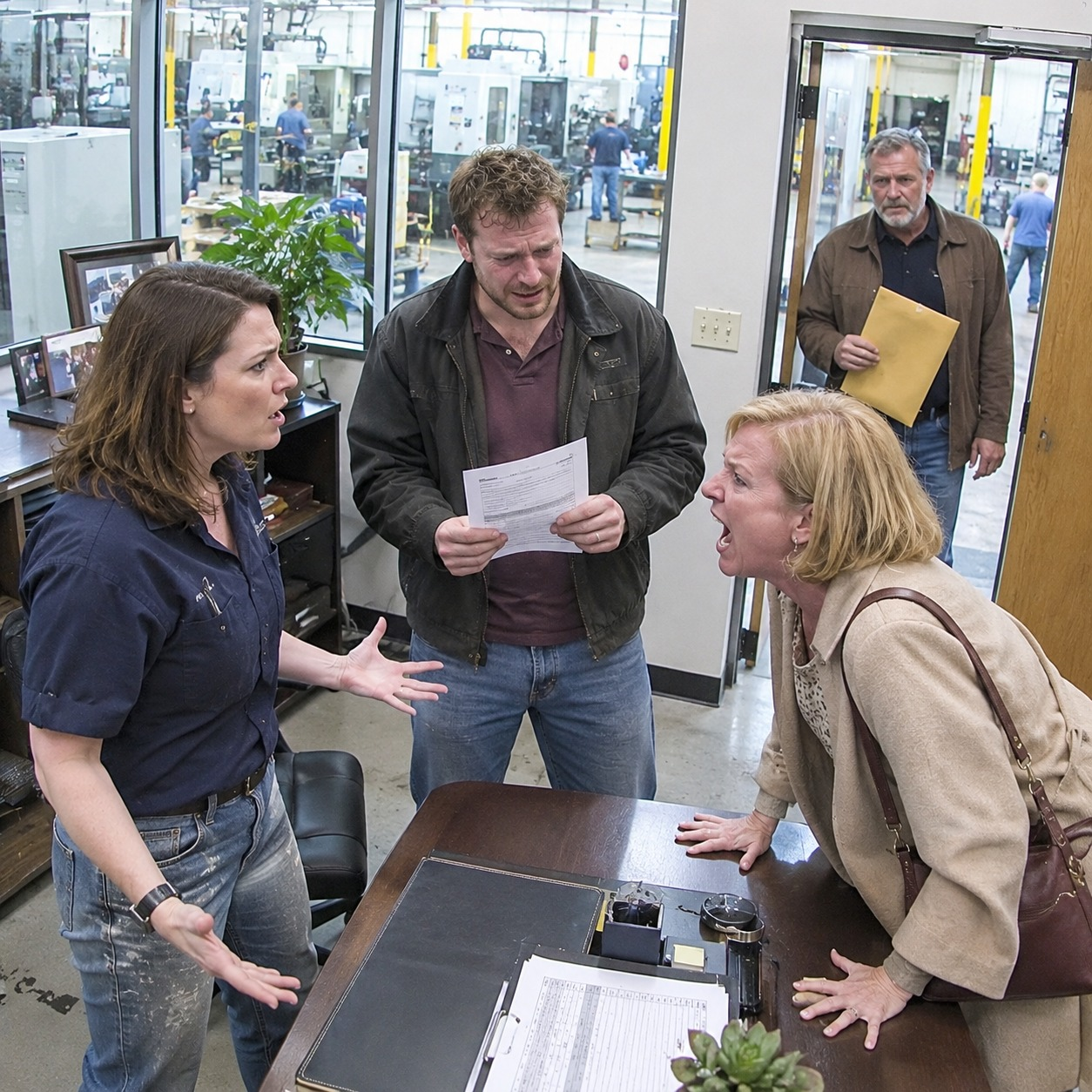
My mother slammed her palm against my desk.
“Fire her! Your brother needs that job!”
As the owner of Hayes Precision, I reached for the résumé beside my computer.
There was an unfamiliar email address beneath my brother's name.
Suddenly, this wasn't about a job anymore.
It was Tuesday morning, and thirty-two people were working inside the manufacturing company I had spent most of my adult life building.
Beyond the glass walls of my office, CNC machines hummed beneath fluorescent lights. Employees inspected finished components, moved materials between workstations, and prepared shipments for customers who depended on our precision.
Everything was operating exactly as it should.
Everything except the woman standing across my desk.
Her name was Diane Hayes.
She was my mother.
And until that morning, I hadn't seen her in eighteen years.
She looked older than I remembered. Her blonde hair was shorter, her face carried deeper lines, and the expensive beige coat she wore seemed strangely out of place inside a machine shop.
But her voice hadn't changed.
Neither had the way she looked at me.
As though I were something inconvenient that needed to be corrected.
“Emily,” she said impatiently. “Are you listening to me?”
I placed my pen beside my production schedule.
“I'm listening.”
“Then stop making this difficult.”
Beside her stood Lucas, my older brother.
He was thirty-five now. The confident teenager I remembered had become a tired-looking man wearing a charcoal jacket and faded jeans. His hair was untidy, and there was something defeated about the way he held his shoulders.
He offered me an uncomfortable smile.
“Hey, Em.”
Nobody had called me that in years.
“Hello, Lucas.”
Mom glanced around my office.
Her eyes traveled over the framed manufacturing certifications, the customer awards, the photographs of our employees, and finally the nameplate on my desk.
EMILY HAYES — PRESIDENT.
She stared at it for several seconds.
“Well,” she said. “You've certainly done better than anyone expected.”
Anyone.
Such a convenient word.
It allowed her to insult me without admitting she had once been the person who expected the least.
“What brings you here?” I asked.
She sat down without being invited.
Lucas remained standing.
“Your brother needs a fresh start.”
I looked at him.
“I'm sorry to hear that.”
“He's had some problems with his previous employer,” Mom continued. “Nothing serious. Corporate politics. You know how those people are.”
Lucas opened his mouth.
She raised her hand.
“Let me finish.”
He immediately fell silent.
I remembered that gesture.
She had used it throughout our childhood whenever someone threatened to interrupt the version of reality she preferred.
“I've been looking at your company website,” she said. “You've grown considerably. Thirty-two employees, apparently.”
“That's correct.”
“And you're making good money.”
“We're doing well.”
“Wonderful. Then Lucas can start Monday.”
I waited.
She didn't elaborate.
“Start what?”
“His management position.”
I almost laughed.
Not because it was funny, but because the alternative was allowing eighteen years of buried anger to escape through my mouth.
“What management position?”
“Operations director. He'll need a private office, obviously. Full benefits. And considering his experience, I think a hundred and twenty thousand dollars annually would be appropriate.”
Behind her, Lucas looked at the floor.
I studied my mother's face.
There wasn't a trace of embarrassment.
No hesitation.
No acknowledgment that she was asking for something extraordinary.
She genuinely believed she could walk into my business and rearrange people's lives.
“Mom,” I said, using the word for the first time in eighteen years, “we already have an operations director.”
She shrugged.
“Then move her.”
“Her name is Maya.”
“Whatever her name is.”
“Maya has worked here for nine years. She earned that position.”
My mother leaned forward.
“Family comes first.”
For a moment, the machinery beyond the windows seemed to disappear.
I was thirteen again.
Standing beside a cardboard box filled with clothes while my parents discussed which children they intended to keep.
Lucas was going with Mom.
My younger sister, Nora, was going with Dad.
And I was standing between them, waiting for somebody to remember that there were three children in our family.
Nobody did.
My mother had looked directly at me that afternoon.
“Emily needs more attention than I can give her.”
My father had sighed.
“I can't handle her school problems.”
They had spoken about me as though I were a damaged appliance neither wanted to take responsibility for.
Family comes first.
Apparently, it depended on which member of the family you happened to be.
I looked back at my mother.
“Where was that philosophy eighteen years ago?”
Her expression hardened.
“We're not discussing ancient history.”
“It's my history.”
“And you're clearly fine.”
She gestured around my office.
“Look at all this. You turned out perfectly well.”
I felt my fingers tighten beneath the desk.
There it was.
The justification I had imagined hearing a thousand times.
Because I had survived what she did, she believed what she did no longer mattered.
Lucas shifted uncomfortably.
“Mom, maybe we should—”
“Emily understands,” she interrupted.
“No,” I said. “Emily doesn't.”
For the first time since entering my office, she looked genuinely surprised.
I stood and walked toward the window.
On the manufacturing floor, Maya was inspecting a finished component beside one of our machinists.
She wore safety glasses, held a digital measuring instrument, and listened carefully as the employee explained something.
Maya had started with us as a machine operator.
She had taken night classes, earned certifications, volunteered for difficult assignments, and helped us survive a disastrous supply shortage.
When I purchased the company from Uncle Jack, she had been one of the first people to shake my hand.
She had earned every dollar we paid her.
I wasn't about to take that away because my mother remembered I existed.
“Lucas,” I said, turning around. “What experience do you have managing CNC production?”
He looked relieved that someone had finally addressed him directly.
“Well, I worked in distribution for—”
“He has extensive supervisory experience,” Mom interrupted. “Several certifications. Excellent references.”
“I asked Lucas.”
Her mouth tightened.
Lucas rubbed the back of his neck.
“I supervised shipping for a while.”
“How many machinists have you managed?”
“None, technically.”
“Have you worked with production scheduling?”
“Not manufacturing schedules.”
“Quality control?”
“Mostly shipping documentation.”
I nodded.
His answers weren't necessarily disqualifying for every position in our company.
People could learn.
Uncle Jack had taught me that better than anyone.
But learning required honesty.
And an operations director was responsible for decisions that affected employee safety, customer contracts, production deadlines, and millions of dollars in equipment.
It wasn't a position someone could simply inherit.
“Unfortunately,” I said, “that doesn't match the application we received.”
Lucas frowned.
“What application?”
Mom quickly reached for her handbag.
“The one we discussed.”
I returned to my desk and opened the folder beside my computer.
Three days earlier, our hiring coordinator had forwarded an unusual application.
It requested consideration for senior management despite the fact that no such position was available.
The applicant's name had caught my attention immediately.
Lucas Hayes.
I had spent several minutes staring at it before forwarding the résumé for routine verification.
Part of me had wondered whether my brother was finally trying to reconnect.
Another part had known better.
I removed the printed document.
“According to this, you spent six years supervising industrial machine operations.”
Lucas stared at me.
“I did?”
Mom laughed nervously.
“It's just professional wording.”
“It also says you have an unblemished workplace safety record.”
“Which he does,” she insisted.
I opened the verification notes.
“His previous employer says otherwise.”
The room went quiet.
Lucas stopped moving.
My mother stared at the folder.
“What exactly did they tell you?”
“That Lucas was dismissed after signing an equipment inspection he hadn't performed.”
Her palm struck the desk.
“So one mistake makes him worthless?”
“I didn't say that.”
“You're acting like you're better than him!”
“I'm protecting my employees.”
“He's your brother!”
“And thirty-two people depend on me making responsible decisions.”
Her cheeks reddened.
“You always were stubborn.”
I nearly smiled.
When I was thirteen, stubborn had meant refusing to stop crying.
At nineteen, stubborn had meant finishing an apprenticeship despite struggling with written examinations.
At twenty-six, stubborn had meant refusing to ship defective components even when a customer threatened to cancel a contract.
At thirty-one, stubborn had paid off the bank loan that allowed me to purchase this company.
I had finally learned to appreciate the qualities my mother despised.
I slid the résumé toward Lucas.
“Would you like to explain this?”
He picked it up.
His eyes moved across the first paragraph.
Then the second.
He turned the paper over, checked the bottom, and returned to the heading.
His expression changed.
“Wait.”
Mom reached toward him.
“Lucas, sweetheart—”
He stepped away.
His eyes settled on the contact information.
Then he looked at her.
“I never sent this résumé.”
Five words.
That was all it took.
My mother's face changed completely.
The anger disappeared.
The confidence vanished.
What remained was something I had rarely seen in her.
Fear.
Lucas held up the document.
“That's your email address.”
She swallowed.
“I was helping you.”
“You told me Emily personally invited me here.”
“I was arranging things.”
“You said she'd already offered me the job.”
I looked at my brother.
He looked back at me.
For the first time that morning, I realized he might not have come here expecting to exploit me.
He might have been deceived, too.
Mom opened her mouth, but no words emerged.
Then someone knocked against the open office door.
We turned.
Uncle Jack stood in the doorway.
His gray beard was neatly trimmed, his brown jacket carried familiar traces of machine-shop dust, and his expression was more serious than I had seen in years.
In his hand was an old yellowed envelope.
My mother saw it.
She immediately stood.
“Jack,” she whispered. “Don't.”
He stepped inside.
“Eighteen years is long enough, Diane.”
He placed the envelope on my desk.
I recognized my mother's signature.
Then I noticed the handwritten words beneath it.
FOR EMILY — WHEN SHE IS OLD ENOUGH TO KNOW.






Comments 0