I stared at the email until the words began to blur.
FAMILY BUSINESS SUCCESSION AGREEMENT.
My mother had been absent from my life for eighteen years, yet somehow she had decided she possessed the authority to discuss the future of my company.
I opened the message.
There was no greeting.
No acknowledgment of the years we had spent apart.
No apology.
Just a short paragraph written with the confidence of someone arranging a meeting with a subordinate.
Emily,
Lucas and I will be visiting tomorrow morning to finalize his management position and discuss the appropriate distribution of family business responsibilities. Please ensure that all necessary financial and ownership documents are available. I expect this matter to be handled privately and respectfully.
Mom.
I read the message twice.
Then I opened the attachment.
It was a three-page document outlining what my mother apparently considered a reasonable arrangement.
Lucas would become operations director immediately.
His annual salary would be $120,000, with additional performance bonuses, health insurance, and a company vehicle.
After twelve months, he would become eligible to acquire a significant ownership interest in Hayes Precision.
The proposed purchase price for that ownership interest was one dollar.
One dollar.
I leaned back in my chair.
For years, I had sacrificed vacations, postponed personal purchases, worked weekends, and carried the responsibility of keeping an entire company financially stable.
My brother was apparently supposed to receive a substantial portion of it for less than the price of a cup of coffee.
But the most disturbing detail appeared on the final page.
My mother had listed herself as a family business adviser entitled to participate in major financial decisions.
There was a signature line beneath her name.
Another beneath Lucas's.
And one beneath mine.
Hers was already signed.
I called Uncle Jack.
He answered on the third ring.
“Everything okay, kiddo?”
“Did you know Mom was planning to come here?”
Silence.
“Diane?”
“Unless I have another mother nobody told me about.”
“What does she want?”
I explained the email, the proposed salary, the ownership arrangement, and the request for financial records.
Jack didn't interrupt.
When I finished, he released a long breath.
“That woman hasn't changed.”
“Did she ever own any part of Hayes Precision?”
“No.”
“Did Grandma?”
“No.”
“Did anyone in the family have a financial interest besides you?”
“Absolutely not.”
“Then why does she think she can do this?”
Jack hesitated.
“Because she thinks being related to someone gives her rights over everything they've earned.”
I looked at the document again.
“She's asking me to give Lucas ownership.”
“Don't sign anything.”
“I wasn't planning to.”
“And don't let her make you feel guilty.”
That was easier said than done.
My mother had spent the first thirteen years of my life teaching me that disappointing her was a personal failure.
Eighteen years away from her hadn't entirely erased those lessons.
“There's something else,” Jack said.
“What?”
“Has she mentioned your grandmother?”
“No.”
“Any inheritance?”
“No.”
“Any agreement from when you came to live with me?”
I remembered the yellow envelope.
“Should she have?”
Jack remained silent for several seconds.
“Call me if she does.”
“Uncle Jack, what aren't you telling me?”
“I need to check something first.”
He promised to call later.
After we hung up, I forwarded my mother's email to our company attorney, Rebecca Miller.
Rebecca had handled the legal aspects of my purchase of Hayes Precision. She was thorough, practical, and remarkably unimpressed by people who attempted to substitute confidence for legitimate authority.
She called twenty minutes later.
“Please tell me this is a joke.”
“I wish it were.”
“Your mother has no ownership interest. Your brother has no ownership interest. This proposed agreement creates no obligations unless you voluntarily enter into it.”
“I understand.”
“Good. Because this document reads like someone believes your company is a family inheritance.”
“It isn't.”
“Exactly. You purchased it. We have the records.”
She advised me to preserve all communications, notify the bank that nobody outside our authorized representatives could access company information, and avoid discussing sensitive financial details with my relatives.
Then she asked a question that caught me off guard.
“Emily, has your mother ever used your personal information without permission?”
“Not that I know of.”
“Do you know whether she still has access to old documents containing your Social Security number or other identifying information?”
“Probably. She's my mother.”
“Then I recommend checking your credit reports.”
The conversation ended, but her question stayed with me.
I had spent years learning to protect a business from financial risks.
I had never considered protecting myself from my own family.
That afternoon, Maya entered my office carrying two cups of coffee.
She placed one beside my keyboard.
“You look like somebody just canceled Christmas.”
“Something like that.”
I showed her the proposed agreement.
She read the first page.
Then the second.
By the third, she was laughing.
“I'm sorry,” she said. “I know this is serious, but does your mother understand what an operations director actually does?”
“I don't think she cares.”
Maya stopped laughing.
“Does your brother know about this?”
“I don't know.”
She returned the document.
“Emily, if you're worried about my position—”
“I'm not replacing you.”
“I didn't think you would.”
“Good.”
“But I want you to understand something. You don't need to prove you're a good sister by becoming a bad employer.”
I looked at her.
She shrugged.
“Thirty-two people work here. None of them should lose their livelihood because someone shares your last name.”
Her words reminded me of Jack.
Simple.
Direct.
Impossible to argue with.
I thanked her and returned to work.
But concentration became increasingly difficult.
I wondered what Lucas looked like now.
Whether he had children.
Whether he remembered our childhood.
Whether he had ever wondered what happened to me after I left.
Part of me wanted to believe that his application represented an awkward attempt at reconciliation.
The proposed agreement suggested something different.
That evening, I drove home and searched through a box of childhood photographs.
There was Lucas holding a baseball trophy.
Nora wearing a pink birthday dress.
My parents standing together at a neighborhood barbecue.
And one photograph of all three of us sitting on the front porch.
Lucas had his arm around Nora.
I sat beside them, holding a book upside down because somebody had told me to smile before I noticed.
I remembered that afternoon.
Mom had laughed when she saw the photograph.
“Typical Emily.”
Everyone else laughed, too.
I had laughed because I didn't know what else to do.
Looking at the picture now, I wondered whether Lucas remembered those moments differently.
Perhaps he hadn't understood how much they hurt.
Perhaps he had been too young to recognize the favoritism that shaped our household.
But he hadn't been too young to know I disappeared.
He was seventeen when Mom left.
Old enough to drive.
Old enough to make a telephone call.
Old enough to ask whether his sister was all right.
For eighteen years, he hadn't.
I put the photograph away.
Then I checked my phone.
There was a new text message from an unfamiliar number.
Hey, Em. Mom says we're meeting tomorrow. Looking forward to seeing you.
Lucas.
I stared at the message.
My first instinct was to reply with everything I had wanted to say since childhood.
Where were you?
Why didn't you call?
Did you ever miss me?
Instead, I typed a single sentence.
We need to discuss your application.
His response arrived almost immediately.
Sure. Mom's handling the details.
I frowned.
What details?
The message showed as delivered.
He didn't answer.
Twenty minutes later, my mother called.
I considered ignoring her.
Then I answered.
“Hello?”
“Emily, why are you questioning Lucas?”
Her voice sounded irritated.
“Because someone submitted a management application in his name.”
“He's nervous enough without you interrogating him.”
“I asked him one question.”
“You always make things more complicated than necessary.”
There it was again.
That familiar accusation.
I was difficult.
I was complicated.
I was the problem.
“Mom, there is no available operations director position.”
“We'll discuss that tomorrow.”
“There is nothing to discuss.”
“Don't be ridiculous. You're the owner. You can create whatever position you want.”
“That's not how responsible businesses operate.”
“Responsible businesses take care of their families.”
I closed my eyes.
“Did you take care of yours?”
She went silent.
For a moment, I thought she might finally acknowledge what had happened.
Instead, she sighed.
“Are you seriously going to punish your brother because your childhood wasn't perfect?”
“Being abandoned isn't an imperfect childhood.”
“Oh, Emily.”
She said my name as though I were embarrassing her.
“Jack gave you everything you needed. You should be grateful.”
“I am grateful. To Jack.”
“And who do you think made that possible?”
I sat upright.
“What does that mean?”
“Your uncle wouldn't have taken you if I hadn't arranged it.”
“That isn't how I remember it.”
“You were a child. You didn't understand adult decisions.”
“Then explain them.”
She hesitated.
“Tomorrow.”
The call ended.
I sat alone in my living room, staring at the dark television screen.
Something about her words disturbed me.
She hadn't simply claimed that allowing Jack to raise me had been a generous decision.
She had spoken as though there had been an arrangement.
Something beyond guardianship.
Something involving conditions I had never known.
I called Jack again.
He didn't answer.
A few minutes later, he sent a message.
We'll talk tomorrow morning. Don't worry. I've got everything.
Everything.
I wondered what that meant.
I slept poorly.
By six the following morning, I was already inside Hayes Precision.
The first shift was preparing to begin.
Employees greeted me as they arrived, carrying lunchboxes, coffee cups, and the ordinary concerns of working people.
One machinist asked whether his vacation request had been approved.
Another wanted to discuss a training opportunity.
Maya needed my signature on a purchase order.
Their problems were real.
Their responsibilities were real.
And their trust in me was real.
Whatever happened with my mother, I couldn't allow it to interfere with that.
At eight-fifteen, Rebecca emailed confirmation that the bank had been notified about the unauthorized inquiry.
At eight-thirty, I reviewed the verification report concerning Lucas's employment history.
The report was worse than I had initially understood.
His former employer hadn't merely disputed his manufacturing experience.
They had documented a serious breach of workplace safety procedures.
Lucas had signed an equipment inspection form without performing the inspection.
The discrepancy was discovered before anyone was injured, but the company had terminated his employment.
I felt disappointed.
Still, I wanted to hear his explanation directly.
People made mistakes.
I had made plenty.
What mattered was whether they accepted responsibility.
At nine, my receptionist called.
“Emily, there are two people here asking for you.”
“Send them in.”
My office door opened.
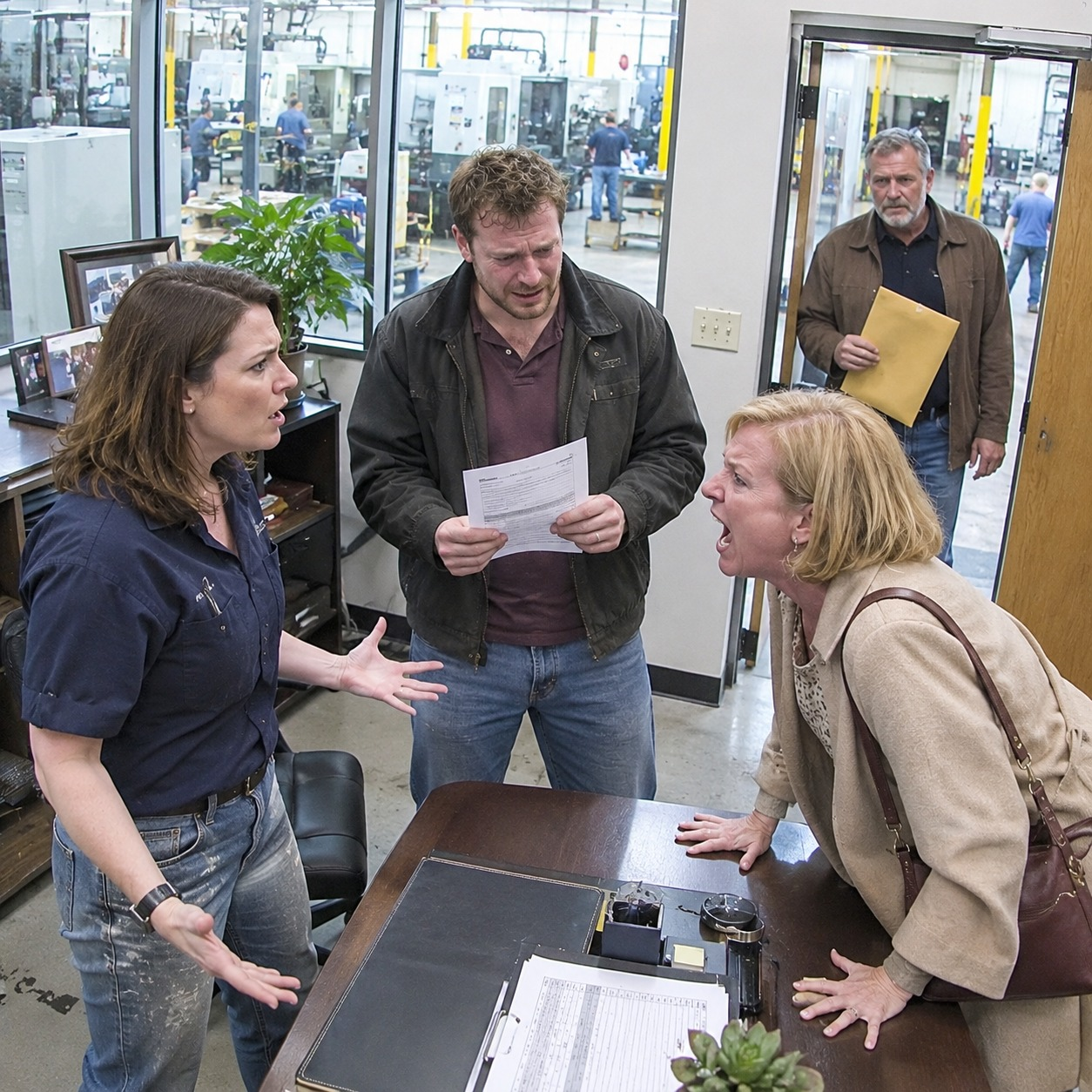
Mom entered first.
She wore a beige coat and carried a brown leather handbag.
Lucas followed her.
For a brief moment, seeing them together transported me back to the afternoon they had driven away without me.
Then Mom looked around my office and smiled.
Not at me.
At the furniture.
The windows.
The manufacturing floor.
The evidence of everything I had built.
“Well,” she said. “This will do nicely.”
She turned toward Lucas.
“You could have an office just like this.”
I stood behind my desk.
“Before we discuss anything, I need to make something clear.”
Mom waved dismissively.
“There's no need for a speech.”
“There is no management vacancy, and I'm not transferring ownership.”
Lucas looked startled.
“Transferring ownership?”
Mom immediately interrupted.
“We'll handle that later.”
I watched my brother's face.
His confusion seemed genuine.
For the first time, I seriously considered the possibility that he hadn't seen the proposed agreement.
“Lucas, did you prepare your application yourself?”
Mom stepped between us.
“That's irrelevant.”
“No, it isn't.”
She leaned toward my desk.
“He's your brother, Emily. Pay him what he's worth.”
I opened the folder containing his résumé.
“Then let's establish what he's qualified to do.”
Her expression hardened.
Before I could hand Lucas the document, my phone vibrated.
A message from Rebecca appeared on the screen.
Emily, we located another document connected to your mother's inquiry. Please call me before signing or agreeing to anything.
A second message arrived.
It concerns a purported ownership transfer bearing your signature.
My hands went cold.
I opened the attached photograph.
There was my full legal name.
There was the name of my company.
And beneath a declaration authorizing the transfer of business assets was a signature that looked almost exactly like mine.
I had never signed that document.
I slowly raised my eyes toward my mother.
She was already watching me.
And she was smiling.






Comments 0