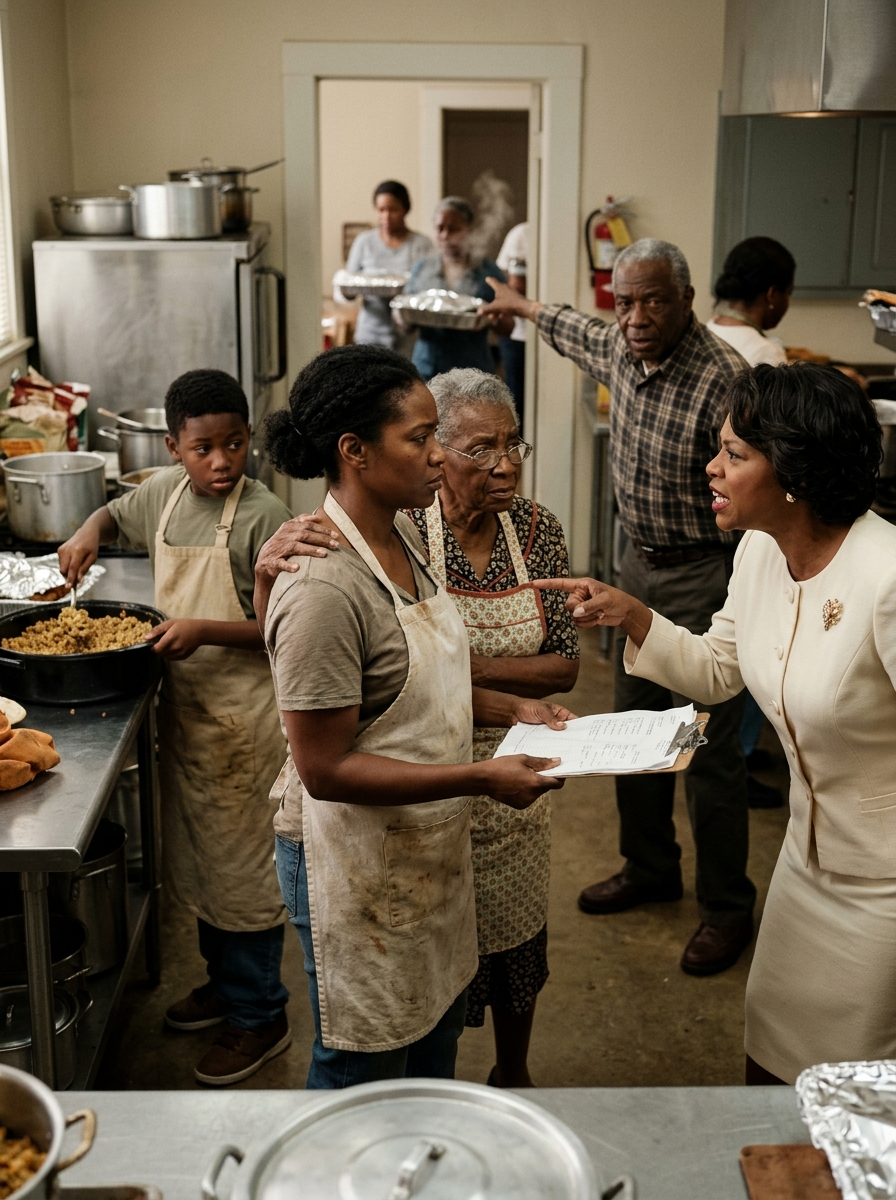
"Take her name down. Right now."
Charlene Thibodeaux pointed at the volunteer board while fourteen church workers watched.
In her other hand was a replacement card.
On the back, written in blue ink, were three words:
APPROVED BY PASTOR.
That was when I realized this wasn't a misunderstanding.
It had been planned.
And I was the last person in that kitchen to know.
My name is Evette Broussard, and for eleven years, I had cooked Thanksgiving dinner for three hundred people at Bethel Fellowship Church in Lafayette, Louisiana.
Eleven years.
That was longer than some of our volunteers had been married. Longer than half the children in our Sunday school had been alive. Longer than our current pastor had even known where Bethel Fellowship was located.
Every November, I took two weeks of vacation from my job driving a school bus so I could organize the church's Thanksgiving meal.
I didn't get paid.
I didn't ask to.
My reward came when an elderly widow carried home an extra plate because she didn't have anybody waiting for her. Or when a father who had lost his job brought his children through our serving line and left with enough food to last the weekend.
That was why I did it.
At least, that was what I believed until the Tuesday before Thanksgiving.
I was standing beside the stainless steel counter, checking the dressing schedule on my clipboard, when Charlene walked into the kitchen wearing a burgundy blazer that probably cost more than my monthly grocery bill.
She wasn't wearing an apron.
Charlene never wore an apron.
She had been the pastor's wife for five months, and in those five months, I had never once seen her wash a dish, peel a potato, or carry a heavy pan.
But she certainly knew how to give instructions.
"Everybody, could I have your attention?"
Her voice carried over the clatter of aluminum trays.
Mr. Purvis Guidry looked up from the boxes of dinner rolls he was counting.
Miss Odile Fontenot stopped checking the vegetable inventory.
My twelve-year-old son, Remy, stood on a small rubber kitchen mat beside a pot of dressing, stirring carefully with both hands.
I glanced at the clock.
We were already behind schedule.
"Charlene, can this wait until we finish the inventory?"
She smiled.
It was the kind of smile people use when they want everyone watching to believe they're being gracious.
"It'll only take a moment, Evette."
Then she walked to the volunteer board.
The board had been hanging beside the kitchen pass-through since before I became head cook.
It wasn't fancy.
Just a large corkboard with laminated cards arranged beneath handwritten headings.
TURKEY.
DRESSING.
VEGETABLES.
SERVING LINE.
DELIVERIES.
CLEANUP.
At the very top, beneath HEAD COOK, was my name.
EVETTE BROUSSARD.
Charlene reached up.
Pulled out the thumbtack.
And removed my card.
For a second, I honestly thought she was straightening the board.
Then she turned around.
"After prayerful consideration," she announced, "we've decided to make a few changes to the leadership of this year's Thanksgiving outreach."
Nobody moved.
The refrigerator hummed behind me.
Somewhere near the doorway, a metal serving spoon slipped from somebody's hand and hit the counter.
Charlene continued.
"The local television station is coming Thursday morning. They're doing a special segment about family values and community service."
She looked directly at me.
"And we want to make sure the person representing our church reflects those values."
I felt something cold settle beneath my ribs.
"What's that supposed to mean?"
Charlene tilted her head.
"Evette, please don't make this uncomfortable."
That was when I knew.
Not because of what she said.
Because of how prepared she sounded.
She had practiced this conversation.
Probably in front of a mirror.
"Just tell me what you're saying," I replied.
Charlene held my name card between two fingers.
"Well, given your personal circumstances, we feel it would be more appropriate to have a married woman serving as the public face of our Thanksgiving ministry."
Nobody spoke.
My eyes moved toward Remy.
He had stopped stirring.
His wooden spoon rested against the edge of the pot.
He was watching Charlene with the confused expression children get when adults say something cruel in a pleasant voice.
"Personal circumstances?" I repeated.
Charlene sighed.
"Your divorce, Evette."
There it was.
Six years after my husband abandoned our marriage, a woman who barely knew me had decided that his decision should disqualify me from serving dinner.
I looked around the kitchen.
Fourteen volunteers.
People who had worked beside me for years.
People who had seen me arrive before sunrise and leave after midnight.
People who had watched me carry hot pans until my wrists ached.
Nobody knew where to look.
Charlene mistook their silence for agreement.
"We're not questioning your cooking abilities," she said. "You've done wonderful work. But the church has an image to maintain."
Miss Odile made a small sound beside me.
"Image?"
Charlene turned toward her.
"Yes, ma'am. Our public witness matters."
Miss Odile was eighty-eight years old.
She had been cooking Thanksgiving dinners at Bethel before Charlene was old enough to drive.
Her husband, Alphonse, had helped start the ministry when half the neighborhood was struggling after a factory closed.
She stared at Charlene through her glasses.
"People don't eat an image, baby."
A few volunteers shifted.
Charlene's smile tightened.
"Miss Odile, I respect your experience, but this decision has already been made."
"By who?" Mr. Purvis asked.
Charlene looked toward him.
"Church leadership."
"Which church leadership?"
"Mr. Guidry, I don't think we need to turn this into a debate."
He stood straighter.
"I'm not debating. I'm asking."
For the first time, Charlene's expression flickered.
Then she lifted the replacement card.
"Mrs. Denise Landry will be overseeing the kitchen this year."
Denise was the wife of one of the church trustees.
She was a perfectly nice woman.
She had brought deviled eggs to two fellowship lunches and once helped organize the Christmas decorations.
As far as I knew, she had never cooked for more than twenty people.
Charlene pinned Denise's name beneath HEAD COOK.
The little click of the thumbtack sounded louder than it should have.
Then she turned toward me.
"Of course, Evette, we'd love for you to continue helping behind the scenes."
I stared at her.
"Behind the scenes?"
"Yes. You know the recipes and the kitchen. We certainly don't want to lose your expertise."
I almost laughed.
Not because anything was funny.
Because I suddenly understood what she wanted.
She wanted my labor.
My recipes.
My supplier contacts.
My eleven years of experience.
She wanted me to arrive at four in the morning, cook three hundred meals, clean the kitchen, and make sure everything went smoothly.
She just didn't want my name attached to any of it.
Especially not when the television cameras arrived.
"Let me make sure I understand," I said.
Charlene folded her hands.
"Of course."
"You want me to do the cooking."
"Help with the cooking."
"But Denise gets the credit."
"That's not a charitable way to look at it."
"And the reason is because I'm divorced."
Her eyes hardened.
"Evette, I think you're allowing your emotions to cloud your understanding."
My emotions.
I hadn't raised my voice.
I hadn't moved from my spot.
I hadn't even put down my clipboard.
But somehow, I was the emotional one.
I looked toward my son again.
Remy was staring at the floor.
And suddenly, I remembered something he'd asked me a month earlier.
"Mom, does Miss Charlene think we're not a real family?"
We had been driving home from Wednesday Bible study.
He was sitting in the back seat with his basketball bag beside him.
I remembered gripping the steering wheel.
"Why would you ask that?"
"Because she asked if I had a man teaching me how to grow up."
I had pulled into a pharmacy parking lot.
Then I turned around and told him something I should have said long before.
"Remy, you and I are a family. Nobody gets to decide otherwise."
He had nodded.
But then he asked a question that stayed with me.
"Then why do you let her talk to us like that?"
I didn't have a good answer.
Not then.
But standing in that kitchen, looking at my son's bowed head, I realized I was about to give him one.
I placed my clipboard on the counter.
Then I reached into the pocket of my apron.
My key ring was heavy.
Three keys hung from it.
One opened the kitchen.
One opened the pantry.
One opened the outside service entrance where our deliveries arrived.
I had carried those keys for so long that I could tell them apart without looking.
I slid the first key off the ring.
Then the second.
The third caught against the metal.
I pulled a little harder.
Its edge split my thumbnail.
A sharp sting ran through my finger.
I pressed my thumb against the apron until the pain settled.
Charlene watched me.
"What are you doing?"
I removed the last key.
Then I held all three out to her.
"Here."
She blinked.
"What's this?"
"The kitchen keys."
"Evette—"
"You said Denise is in charge."
"Yes, but—"
"Then she'll need these."
Charlene looked around the room.
I could see the calculation happening behind her eyes.
She had expected an argument.
Maybe tears.
Maybe an apology.
Maybe she imagined I'd beg her to reconsider.
Instead, I was handing her exactly what she'd asked for.
Control.
At least, the part of control that fit on a key ring.
"There's no reason to be dramatic," she said.
"I'm not being dramatic."
"You're taking this personally."
"You made it personal."
Her cheeks darkened.
I placed the keys in her palm.
They landed with a small metallic sound.
Nobody moved.
I pointed toward the stack of cooking pans beside the stove.
"The deep black pan is for the dressing. Don't use the shallow one. It'll dry out before the second serving."
Charlene stared at me.
"The turkey roasters on the left have bad temperature gauges," I continued. "You'll need the oven thermometers from the pantry. And somebody needs to check the refrigerator seals before tomorrow morning."
"Evette, you don't have to—"
"The rolls arrive at six on Thursday. The vegetables are scheduled for tomorrow afternoon. And the dressing needs to rest before it goes into the ovens."
I stopped.
Because I realized I was still doing her job for her.
Old habits are hard to break.
Especially when you've spent eleven years making sure nobody goes hungry.
I took off my apron.
It was mustard yellow, faded almost brown in places, with a cranberry stain near the pocket.
I'd washed it a hundred times.
That stain never came out.
Remy used to joke that it was older than he was.
I folded the apron carefully.
Set it beside my clipboard.
Then picked up my purse.
Charlene looked startled.
"Where are you going?"
"Home."
"But we have three hundred people coming Thursday."
"I know."
"And the preparations aren't finished."
"I know that too."
Her voice sharpened.
"You're really going to abandon this ministry because you didn't get your way?"
That one hurt.
More than I wanted it to.
Because it was the kind of accusation that could follow a woman around a church for years.
Not that she'd been humiliated.
Not that she'd been treated unfairly.
But that she'd walked away from people who needed her.
I looked at Charlene.
Then at the volunteers.
Then at my son.
"I'm not abandoning anybody," I said quietly. "I'm respecting the decision you made."
Miss Odile reached for my arm.
"Evette, honey."
I covered her hand with mine.
"It's all right."
It wasn't.
But I couldn't let my voice shake.
Not in front of Remy.
Not in front of Charlene.
Not when I knew she would remember my tears instead of her own words.
Mr. Purvis stepped forward.
"Charlene, I think you need to reconsider."
"The decision is final."
"Then you ought to understand what you're asking."
"I understand perfectly."
He looked at the keys in her hand.
"No, ma'am. I don't believe you do."
Charlene turned away from him.
"Let's get back to work, everyone."
Nobody moved.
She clapped her hands once.
"Please. We have a lot to do."
I walked toward Remy.
He was still standing beside the pot.
His eyes were bright, but he wasn't crying.
"Come on, baby."
"Are we leaving?"
"Yes."
"Are we coming back?"
I looked at him.
Then at the board.
Denise Landry's name was already pinned where mine had been.
"No," I said. "Not tonight."
He set down the wooden spoon.
Then he wiped his hands on his apron.
I helped him untie the strings.
He looked past me toward Charlene.
"Mom?"
"Yes?"
"Did you do something wrong?"
The kitchen went completely silent.
Charlene turned around.
"Remy, sweetheart, this is an adult matter."
He didn't look at her.
He looked at me.
And I knew that whatever I said next would stay with him longer than anything that had happened in that kitchen.
"No, baby," I said. "I didn't do anything wrong."
He nodded once.
"Okay."
Then he took my hand.
We walked out together.
I didn't look back.
But I heard Mr. Purvis say something as we reached the doorway.
"Some folks don't know what they're holding until they let it go."
Charlene answered him.
"Mr. Guidry, I would appreciate your cooperation."
His reply was quiet.
"So would I."
Outside, Remy walked beside me without speaking.
We reached my old silver Chevrolet.
I unlocked the passenger door.
He climbed in.
I walked around to the driver's side, sat down, and placed my purse on the seat between us.
For a long moment, neither of us moved.
Then Remy asked, "Are you still making Thanksgiving dinner?"
I stared through the windshield.
I had been asking myself the same question.
Three hundred people.
Forty-two donated turkeys.
Hundreds of pounds of potatoes, rice, green beans, and dressing ingredients.
Elderly residents who counted on a hot meal.
Families who had already signed up.
Volunteers who had taken time off work.
And now Charlene had turned all of it into a question about whether a divorced mother deserved to stand in front of a television camera.
"I don't know," I admitted.
Remy looked down at his hands.
"But you always make Thanksgiving."
"I know."
"Who's gonna feed everybody?"
I didn't answer.
Because that was the question that frightened me most.
Not losing my title.
Not losing my place at the church.
Not even having fourteen people watch while another woman removed my name.
It was the thought of three hundred people arriving Thursday and finding that the meal they were promised wasn't ready.
I had spent eleven years making sure that never happened.
And Charlene knew it.
Maybe that was why she'd felt so comfortable humiliating me.
She believed I would never let the people down.
She believed my love for that ministry would force me to accept whatever treatment she gave me.
For the first time, I wondered how many other women had been trapped by that same expectation.
Women who cleaned churches.
Women who cooked meals.
Women who watched children.
Women who worked until their feet swelled and their backs hurt.
Women who were told that service meant never saying no.
I started the engine.
"Mom?"
"Yes, baby?"
"Are you mad?"
I considered lying.
Then I remembered the promise I'd made him in the pharmacy parking lot.
"Yes," I said.
He looked surprised.
"Really?"
"Really."
"You don't look mad."
"That doesn't mean I'm not."
He thought about that.
Then he asked, "What are you gonna do?"
I put the car in reverse.
"I haven't figured that out yet."
We drove home without turning on the radio.
Our house was small, with two bedrooms, one bathroom, and a kitchen table that had belonged to my grandmother.
There were scratches across the tabletop from years of homework, school projects, and hurried dinners.
The refrigerator made a clicking noise whenever it shut off.
The back door stuck when the humidity got bad.
It wasn't much.
But it was ours.
Six years earlier, when my husband left for Houston with another woman, I'd been terrified I wouldn't be able to keep it.
Remy was six.
He didn't understand divorce.
He understood that his father had stopped coming home.
For weeks, he insisted we leave the porch light on at night.
"Just in case Daddy forgets where we live."
I left it on.
Even when I knew his father wasn't coming.
Eventually, Remy stopped asking.
But I never forgot the sound of his little voice.
I never forgot how hard I'd worked to keep our lives steady.
I drove my school bus route every morning.
I picked up extra shifts when the district needed drivers.
I cooked at church.
I helped neighbors.
I stretched every dollar.
And somehow, through all of it, I'd convinced myself that being useful would protect me from being judged.
Charlene had proved otherwise.
That evening, Remy ate leftover chicken and rice while I sat across from him with a cup of coffee I barely touched.
He finished his homework.
I checked it.
We talked about his basketball practice.
I reminded him to put his uniform in the laundry.
Ordinary things.
The kind of things that keep a family moving when something painful has happened.
At eight-thirty, he came into the kitchen carrying his empty glass.
"Mom?"
"Yes?"
"Miss Charlene said they wanted a family woman."
I looked up.
He stood beside the table.
"Does that mean she doesn't think we're a family?"
I felt my throat tighten.
There are moments when being a mother means telling the truth even though you wish the world had given you something kinder to say.
"She was wrong," I told him.
He nodded slowly.
"Then why didn't anybody tell her?"
I looked down at my coffee.
Because they were afraid.
Because they didn't want trouble.
Because people sometimes stay quiet when they should speak.
Because I'd done the same thing before.
But I didn't want to hand my son a list of excuses.
"Some people need time to find their courage," I said.
He thought about that.
"Did you find yours?"
I looked at him.
"I think I'm starting to."
He gave me a small smile.
Then he hugged me.
I held him longer than usual.
After he went to bed, I sat alone at the kitchen table.
The house was quiet.
I could hear the refrigerator clicking in the next room.
My phone lay beside my coffee cup.
There were seven unread messages.
Three from volunteers.
One from Mr. Purvis.
Two from women who had heard what happened.
And one from a number I didn't recognize.
I opened Mr. Purvis's message first.
Evette, what happened today wasn't right. Don't let anybody tell you otherwise.
I read it twice.
Then I opened the messages from the volunteers.
One said she was sorry.
Another said Charlene had gone too far.
The third asked whether I would still be coming Thursday morning to help with the turkeys.
I stared at that last message.
Then I set the phone down.
Because there it was again.
The assumption that I would come back.
That I would swallow the humiliation.
That I would do the work anyway.
At nine-thirty, my phone rang.
MISS ODILE.
I answered immediately.
"Yes, ma'am?"
"Evette Broussard, did you give that woman your keys?"
I closed my eyes.
"Yes, ma'am."
"All three?"
"All three."
"Good."
I blinked.
"Good?"
"Did you bring your folder home?"
I glanced toward the kitchen drawer beside the stove.
"What folder?"
"Don't play with me, child. The Thanksgiving folder."
"Oh."
"Is it there?"
"Yes, ma'am."
"Then get it out."
I hesitated.
"Miss Odile, I'm tired."
"I know you're tired."
"I don't want to fight with Charlene."
"Nobody asked you to fight."
"I don't want to hurt the church."
Her voice softened.
"Baby, the church isn't the woman who embarrassed you."
I swallowed.
She continued.
"And feeding hungry people isn't the same thing as letting somebody use you."
I looked toward the drawer.
"What's in that folder that's so important?"
Miss Odile was quiet for a moment.
Then she said something that made me sit straighter.
"Do you remember who started our Thanksgiving dinner?"
"You and Mr. Alphonse."
"And do you remember what we told you when we handed you the responsibility?"
I thought back eleven years.
I remembered Miss Odile standing beside the old church stove.
I remembered her husband carrying a box of canned green beans.
I remembered being nervous because I'd never cooked for three hundred people before.
But I couldn't remember her exact words.
"No, ma'am."
She sighed.
"That's what I was afraid of."
"Miss Odile?"
"Get the folder out, Evette."
"Why?"
"Because Charlene thinks she took something from you today."
I looked toward the drawer again.
"And?"
Miss Odile's voice became very quiet.
"She doesn't understand what she actually took responsibility for."
I waited.
But she didn't explain.
"Call me in the morning," she said.
Then the line went dead.
I sat there for almost a minute.
The house felt unusually still.
Finally, I stood up.
Walked to the kitchen drawer.
Pulled it open.
The folder was exactly where I'd left it.
Thick.
Blue.
Held together with a rubber band.
Inside were eleven years of Thanksgiving records.
Receipts.
Donation letters.
Supplier information.
Volunteer schedules.
Food safety certificates.
Delivery arrangements.
Old photographs.
And a sealed envelope Miss Odile had given me after her husband died.
I had never opened that envelope.
She'd told me to keep it with the ministry paperwork.
I'd assumed it contained some old church records.
I removed the rubber band.
Set the folder on the table.
Then began sorting through the pages.
The first section contained the current year's donation commitments.
Forty-two turkeys.
Thirty cases of canned vegetables.
Two hundred pounds of potatoes.
Fifty pounds of rice.
Bread rolls.
Dessert supplies.
I recognized every donor.
Most had been supporting the Thanksgiving dinner for years.
Some had become friends.
I turned another page.
Then another.
At the back of the folder, beneath the older records, was a document I hadn't looked at in almost a decade.
It was dated eleven years earlier.
There were three signatures at the bottom.
Miss Odile's.
Her husband's.
And mine.
I stared at the heading.
Then I read the first paragraph.
My heartbeat changed.
I turned the page.
Read the second paragraph.
Then the third.
And suddenly, I understood why Miss Odile had told me to get the folder.
The Thanksgiving meal had never been organized quite the way Charlene believed.
The church had provided the kitchen.
The congregation had provided volunteers.
But the community outreach itself had been established under a separate agreement.
One that involved the donors.
One that involved the food deliveries.
And one that named a person responsible for accepting those donations.
I looked at the signatures again.
My name was there.
Not beneath HEAD COOK.
Not beneath VOLUNTEER.
Beside a different title entirely.
I sat back slowly.
For the first time since leaving the church, I felt something other than humiliation.
I felt the beginning of an answer.
Then my phone vibrated.
An unfamiliar number appeared on the screen.
I opened the message.
Mrs. Broussard, this is Daniel Mercer from Acadiana Food Distribution. We received an unusual call from Bethel Fellowship this evening regarding the forty-two Thanksgiving turkeys. Before we make any changes, there's something you need to know.
A second message arrived.
Someone claiming to represent the church has requested that your name be removed from the delivery authorization.
Then a photograph appeared.
It showed a signed request form.
At the bottom was a signature.
I enlarged the image.
My breath caught.
Because the name written there was mine.
And I had never signed it.






Comments 0