The signature at the bottom of the delivery form looked exactly like mine.
That was the first thing that frightened me.
The second was the date.
Tuesday, November 21.
That very afternoon.
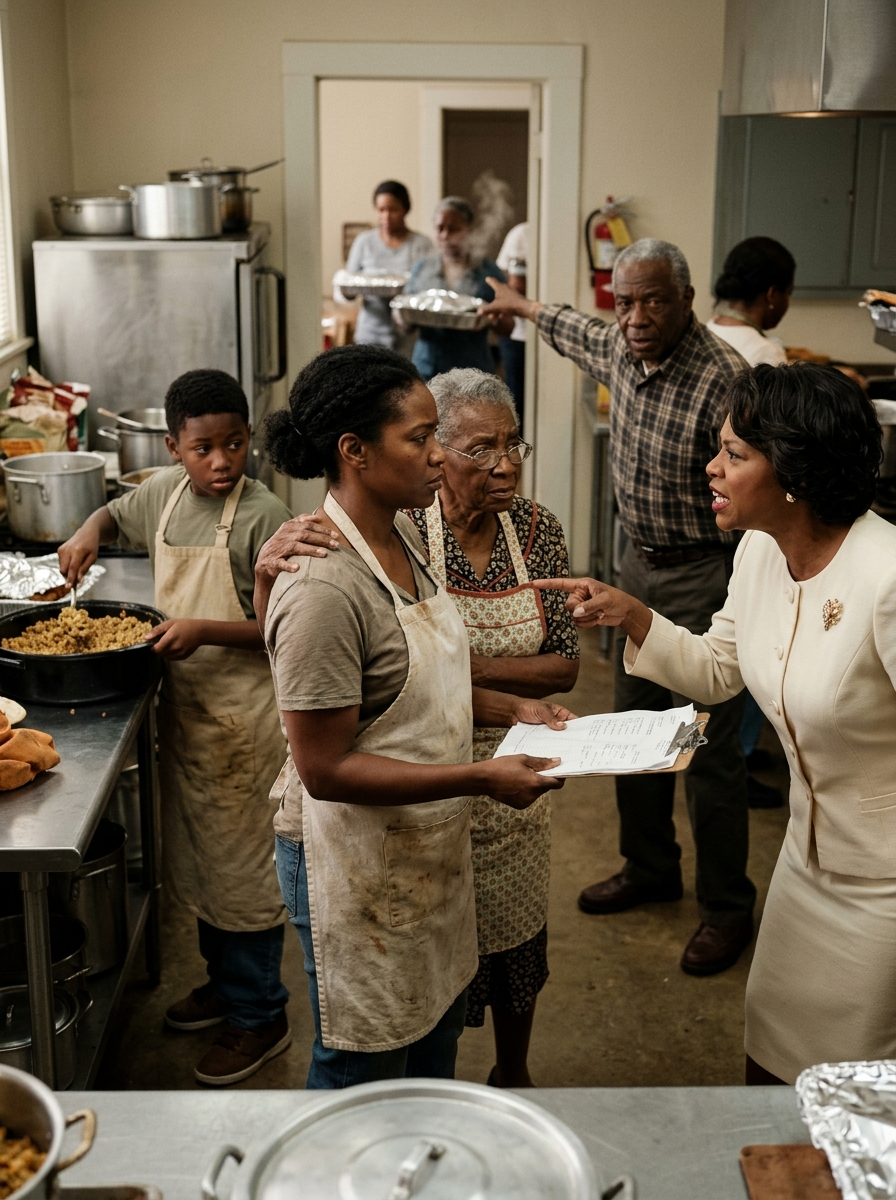
While Charlene Thibodeaux had been standing in the church kitchen, humiliating me in front of fourteen volunteers, somebody had been using my name to take control of forty-two donated Thanksgiving turkeys.
I enlarged the photograph on my phone.
EVETTE BROUSSARD.
The letters slanted slightly to the right. The capital E had the same long lower stroke I always used. Even the final d looked familiar.
But there was one problem.
I hadn't signed that document.
I hadn't authorized anyone to change the delivery arrangements.
And until twenty minutes earlier, I hadn't even known such a request existed.
My kitchen clock read 10:17 p.m.
Remy was asleep down the hall.
The blue Thanksgiving folder lay open in front of me, surrounded by old receipts, volunteer schedules, and donation records.
I stared at the photograph until the letters began to blur.
Then I called the number that had sent it.
A man answered on the third ring.
"Acadiana Food Distribution. Daniel Mercer speaking."
"Mr. Mercer? This is Evette Broussard."
His voice changed immediately.
"Mrs. Broussard. Thank you for calling."
"I need to ask you something."
"Of course."
"Where did you get that form?"
There was a pause.
"Someone from Bethel Fellowship emailed it to our office this afternoon."
"Who?"
"I'm not comfortable identifying the sender until I've verified the information."
I closed my eyes.
"Mr. Mercer, somebody signed my name to a document I never saw. I think that gives me a right to know."
"I understand."
"Then tell me."
He exhaled.
"The email came from an address associated with the church administration office."
I gripped the phone.
"Was it Charlene Thibodeaux?"
Another pause.
"I can't confirm that yet."
I looked down at the paper in front of me.
The old agreement.
The one Miss Odile had insisted I find.
"Did you process the request?"
"No, ma'am."
My shoulders loosened slightly.
"Why not?"
"Because our records show that you're the authorized coordinator for the Thanksgiving Community Table program. Any changes to the donation recipient or delivery location require verification directly from you."
I looked at the signature again.
"So somebody tried to make that change without calling me?"
"That's correct."
"And the turkeys?"
"They're still scheduled for delivery Wednesday afternoon."
"To Bethel?"
"Under the original arrangement, yes. But the delivery instructions are currently flagged for review."
I pressed my fingers against my forehead.
"Please don't change anything until we speak again."
"That's exactly why I contacted you."
I heard papers moving on his end.
"Mrs. Broussard, there's something else."
My stomach tightened.
"What?"
"The request didn't just remove your name."
I waited.
"It asked us to transfer the entire donation account to the church's new Thanksgiving leadership committee."
I stared at the wall.
"Entire account?"
"All future correspondence, donation records, and delivery authorization."
"Who would have authority after that?"
"The person named as the new representative."
I already knew the answer.
But I asked anyway.
"Who was that?"
He hesitated.
"Mrs. Charlene Thibodeaux."
For several seconds, I couldn't speak.
The kitchen refrigerator clicked off.
The sudden quiet made his words seem louder.
Charlene hadn't simply taken my name off a corkboard.
She had tried to take control of the donations I had spent eleven years organizing.
And she'd done it using my signature.
"Mrs. Broussard?"
"I'm here."
"Do you want us to place a temporary hold on any changes?"
"Yes."
"All right. I'll document that."
I swallowed.
"And please preserve the original email."
"We will."
"Don't delete anything."
"Understood."
I looked toward Remy's bedroom.
"Mr. Mercer?"
"Yes, ma'am?"
"Please don't mention this call to anyone at the church yet."
His answer was careful.
"I can't promise that no one will contact us independently, but I won't disclose our conversation unnecessarily."
"Thank you."
"One more thing."
I waited.
"Do you still intend to coordinate the Thanksgiving meal?"
I looked at the blue folder.
Then at the photograph of my forged signature.
"I intend to make sure those three hundred people eat."
He was quiet for a moment.
"That's what I needed to hear."
After we hung up, I sat motionless at the table.
I wanted to call Charlene.
I wanted to ask her what kind of woman stood in a church kitchen talking about family values while someone used another woman's name without permission.
I wanted to know whether Pastor Thibodeaux had approved the request.
I wanted to know how far this had gone.
But I didn't call.
Because I had learned something during six years of raising Remy alone.
When you're angry, the first thing you want to do isn't always the first thing you should do.
And right then, I needed facts more than I needed an argument.
I picked up the old agreement.
The paper had yellowed around the edges.
At the top, in faded black letters, were the words:
THANKSGIVING COMMUNITY TABLE
COMMUNITY OUTREACH OPERATING AGREEMENT
Eleven years earlier, those words hadn't meant much to me.
I'd been thirty-two, recently promoted to head cook, and terrified of ruining Thanksgiving dinner.
Miss Odile and her husband, Alphonse, had explained that the outreach had been established as a community-supported meal program hosted at Bethel Fellowship.
The church provided the kitchen, dining hall, utilities, and volunteer space.
Community donors provided most of the food.
A designated coordinator managed the donations, confirmed deliveries, and ensured that the meals reached the intended recipients.
That coordinator was me.
I remembered Alphonse handing me the paperwork.
"Read everything before you sign, Evette."
I'd laughed.
"Mr. Alphonse, I thought you wanted me to cook turkeys, not buy a house."
He'd smiled.
"Food belongs to the people who need it. Paperwork helps make sure it gets there."
I hadn't understood how important that distinction was.
Not until tonight.
The agreement stated that the church served as the program's host location.
It did not say the church automatically owned every donated item.
It did not give the pastor's wife authority to redirect donations.
And it certainly didn't allow anyone to sign my name.
I turned to the last page.
There was my signature.
The real one.
I placed my phone beside it and compared the two.
At first glance, they looked almost identical.
Then I noticed something.
I always crossed the capital B in Broussard with a short downward stroke.
The signature on the photographed request had a longer, curved line.
Someone had copied my name.
But they hadn't copied it perfectly.
I took photographs of both documents.
Then I emailed them to myself.
After that, I put the original agreement back into the folder.
I didn't know exactly what I was going to do.
But I knew one thing.
Charlene wasn't getting another opportunity to take something from me simply because I was too exhausted to protect it.
At 10:46, my phone rang again.
Miss Odile.
I answered before the second ring.
"Did you find it?" she asked.
"Yes, ma'am."
"And?"
I looked at the paperwork.
"Why didn't you tell me?"
"Tell you what, baby?"
"That the Thanksgiving program wasn't just a church committee."
She made a small sound.
"Evette, we told you when you signed the agreement."
"That was eleven years ago."
"Then I reckon it's a good thing somebody kept the paperwork."
I almost smiled.
Almost.
"Miss Odile, somebody forged my signature."
The line went silent.
Then she said, very quietly, "Say that again."
I told her about Daniel Mercer.
The photograph.
The request.
Charlene's name.
By the time I finished, Miss Odile wasn't speaking.
"Miss Odile?"
"I'm here."
"What should I do?"
"First, don't throw away a single piece of paper."
"I won't."
"Second, don't call Charlene tonight."
"I wasn't planning to."
"Good. That woman likes an audience. Don't give her one before you know what she's done."
I leaned back in my chair.
"Did you know she was going to remove me?"
"No."
"Did the pastor?"
"I don't know."
"Mr. Purvis said she claimed church leadership approved it."
"Church leadership can approve whoever they want to supervise their kitchen," Miss Odile said. "That doesn't mean they can rewrite agreements with the people who donated the food."
I looked down at the document.
"Are you saying I could move the dinner?"
"I'm saying you need to read the agreement carefully, talk to the donors, and make sure the people depending on us aren't forgotten."
I hesitated.
"Move it where?"
Miss Odile didn't answer immediately.
Then she asked, "You remember the old community kitchen across the street?"
I sat up.
"The one beside the laundromat?"
"That's the one."
"It's been closed for years."
"Not as long as you think."
I stared at the refrigerator.
"What does that mean?"
"It means you ought to get some sleep. I'll explain what I know in the morning."
"Miss Odile—"
"Evette, you have been taking care of everybody else for eleven years. Tonight, take care of yourself."
Her voice softened.
"And check on that boy of yours. He saw more today than a child should have to see."
I swallowed.
"Yes, ma'am."
"Good night, baby."
"Good night."
After the call, I walked down the hallway.
Remy's bedroom door was open a few inches.
His basketball shoes were beside the bed.
His school backpack leaned against the dresser.
He was asleep on his side, one hand tucked beneath his pillow.
I stood there longer than I intended.
Six years earlier, when his father left, I'd promised myself that my son would never feel unwanted in his own home.
I couldn't control what happened outside it.
I couldn't stop every cruel remark.
But I could make sure he knew the truth.
He belonged.
He mattered.
And our family wasn't incomplete simply because somebody had decided it didn't look the way theirs did.
I pulled his blanket over his shoulder.
He stirred.
"Mom?"
"I'm here."
"Are you okay?"
I sat on the edge of his bed.
"Getting there."
He opened one eye.
"Are you still sad?"
I thought about lying.
Instead, I brushed a curl away from his forehead.
"A little."
"Because of Miss Charlene?"
"Yes."
He was quiet.
Then he whispered, "I didn't like what she said."
"Neither did I."
"Mr. Purvis looked mad."
"He was."
"Miss Odile too."
"She was."
Remy looked at me.
"Then why didn't everybody leave with us?"
That question stayed between us.
I didn't know how to explain that good people sometimes hesitate.
That loyalty can make people afraid to challenge authority.
That some folks confuse keeping peace with avoiding responsibility.
So I told him the simplest truth I knew.
"People make their own choices, baby."
He nodded.
Then he asked, "Did you make the right one?"
I looked at his face.
"I believe I did."
He closed his eyes.
"Good."
A moment later, he was asleep again.
I stayed beside him until his breathing became steady.
Then I returned to the kitchen.
My phone showed another message.
This one was from Denise Landry.
Evette, I'm so sorry about today. Charlene told me you were stepping down voluntarily. I didn't know she was going to announce it like that.
I read the message twice.
Then typed:
Denise, I didn't volunteer to step down. Charlene removed me because I'm divorced.
The reply came almost immediately.
Oh my goodness.
A second message followed.
She told me you were exhausted and wanted someone else to handle the public responsibilities.
I felt my jaw tighten.
Of course she had.
Charlene hadn't simply humiliated me.
She'd created a story to explain why.
One where she was being helpful.
One where I was tired.
One where my removal was practically a favor.
I typed carefully.
I was prepared to lead the dinner, as I have for eleven years. I did not ask to be replaced.
Denise called.
I considered letting it ring.
Then I answered.
"Evette, I am so sorry."
Her voice sounded strained.
"I had no idea."
"It's not your fault."
"She called me Sunday afternoon and asked whether I'd be willing to represent the Thanksgiving ministry when the television crew came."
I frowned.
"Sunday?"
"Yes."
Two days before the kitchen meeting.
Charlene had been planning this longer than I'd realized.
"What did she say?"
"That you were stepping back from leadership because you had personal responsibilities."
I looked toward Remy's room.
"Personal responsibilities?"
"She mentioned your son."
I closed my eyes.
Denise continued quickly.
"I thought she meant you wanted more time with him. I honestly believed you had agreed."
"Did she ask you to cook?"
There was a pause.
"Well, she said you'd still be handling the food."
I let out a slow breath.
There it was.
The whole arrangement.
Denise would stand in front of the camera.
I would stand in front of the stove.
And Charlene would congratulate herself for maintaining the church's image.
"Denise, have you ever coordinated a meal for three hundred people?"
"No."
"Have you ever managed forty-two donated turkeys?"
"No."
"Have you ever prepared the kitchen inspection paperwork?"
"Evette, I don't even know where that paperwork is."
I rubbed my forehead.
"Then you need to understand something. This isn't about who gets to wear a nice dress for television. There are people counting on that food."
"I know."
"And the meal has to be safe."
"I know that too."
Her voice broke slightly.
"I don't think I can do this."
I felt a familiar instinct rise inside me.
The instinct to reassure her.
To tell her not to worry.
To promise I'd come fix everything.
For eleven years, that instinct had made me useful.
Tonight, it nearly made me surrender again.
But I stopped myself.
"Denise, you need to tell Charlene what you just told me."
"She won't listen."
"Then tell the pastor."
"He approved the change."
I went still.
"What?"
"That's what Charlene told me."
"Did he tell you himself?"
"No."
I waited.
Denise sighed.
"No, he didn't."
"Then maybe somebody should ask him."
She was quiet for a long moment.
"Evette?"
"Yes?"
"I don't want your position."
My throat tightened.
"Then don't take it."
"I thought I was helping."
"I believe you."
"I'll call the pastor tomorrow."
"Thank you."
Before hanging up, she added something I hadn't expected.
"Charlene told me not to worry about the donors. She said she was taking care of all that personally."
I looked at the photograph on my phone.
The forged signature.
The transfer request.
The name of the new representative.
"Did she say how?"
"No."
"Did she mention Acadiana Food Distribution?"
Denise hesitated.
"Yes."
My fingers tightened around the phone.
"When?"
"This afternoon. Before the meeting."
"What did she say?"
"She said the turkey delivery needed to be transferred into the church's official name before Thanksgiving."
I closed my eyes.
"Anything else?"
"She said the paperwork was already handled."
I thanked her and ended the call.
Then I wrote down everything she'd told me.
The time.
The date.
Her exact words.
I wasn't a lawyer.
I wasn't an investigator.
I was a school bus driver who knew how to cook enough dressing to feed three hundred people.
But I understood the importance of keeping records.
You don't drive a school bus for fifteen years without learning that.
Every route has a schedule.
Every incident has a report.
Every passenger has a seat.
And when something goes wrong, the details matter.
I placed Denise's account beside Daniel Mercer's messages.
Then I opened the section of the folder marked DONORS.
There were handwritten notes dating back more than a decade.
Names.
Telephone numbers.
Delivery arrangements.
Letters of appreciation.
Photographs of Thanksgiving meals.
I turned the pages slowly.
Eleven years of work.
Eleven years of early mornings.
Eleven years of missed holiday shopping trips, sore feet, and burned fingers.
I remembered the first year I'd been in charge.
The ovens had stopped working at five in the morning.
Mr. Alphonse had called a restaurant owner who let us finish cooking the turkeys in his commercial kitchen.
We carried the pans back to Bethel in three pickup trucks.
Nobody missed a meal.
The second year, a storm knocked out electricity to half the neighborhood.
We served by flashlight until the power returned.
The fourth year, a donor backed out at the last minute.
I spent two days calling grocery stores.
A butcher in Broussard donated six turkeys.
A farmer brought sweet potatoes.
A woman I'd never met arrived with enough butter to fill an entire refrigerator shelf.
Every year, something went wrong.
And every year, we found a way.
I remembered the seventh Thanksgiving most clearly.
Remy was eight.
His father had been gone two years.
Money was tight.
I'd been working extra bus routes.
One afternoon, Remy asked why I spent so much time feeding other people when we sometimes ate leftovers three nights in a row.
I told him that having less didn't mean we had nothing to give.
He thought about it.
Then he disappeared into his room.
When he came back, he was carrying twelve dollars from his birthday money.
"For the turkeys," he said.
I cried that night.
Not because of the money.
Because my little boy had understood something that some adults never learned.
Generosity wasn't about having the most.
It was about refusing to forget the people who had less.
I looked at the donor records again.
The names weren't just names.
They were people who trusted me.
Mr. Landry from the grocery warehouse.
Mrs. Babineaux, who organized the canned vegetable collection.
The Broussard family, who donated bread rolls every year.
Daniel Mercer, whose company handled the turkey shipment.
They hadn't given because Charlene asked.
Most of them had never met her.
They gave because they'd watched the program feed people year after year.
And because they trusted that the food would reach the people it was meant to reach.
I picked up my phone.
Then stopped.
It was nearly midnight.
Too late to start calling donors.
Too late to make decisions that might affect three hundred people.
But not too late to prepare.
I opened a notebook.
On the first page, I wrote:
THANKSGIVING — WEDNESDAY.
Beneath it, I made three headings.
DONATIONS.
LOCATION.
VOLUNTEERS.
Under DONATIONS, I wrote Daniel Mercer's name.
Under LOCATION, I wrote the old community kitchen across the street.
Under VOLUNTEERS, I wrote Miss Odile and Mr. Purvis.
Then I paused.
There were fourteen volunteers in that room.
Fourteen people who had watched Charlene remove my name.
I didn't know how many would stand beside me if things became difficult.
I didn't know whether the church would allow us to use the kitchen.
I didn't know whether Charlene would try to stop the donations.
And I didn't know whether the pastor understood what his wife had done.
But I knew I wasn't going to disappear quietly and let someone else rewrite eleven years of work.
I closed the notebook.
Then I noticed something beneath the folder.
A small envelope.
Cream-colored.
The edges were yellowed.
My name was written across the front in Mr. Alphonse's handwriting.
EVETTE.
I stared at it.
Miss Odile had given it to me after his funeral.
I'd put it in the folder and forgotten about it.
I picked it up.
There was no date on the front.
No return address.
Only my name.
I turned it over.
The flap was still sealed.
For a moment, I felt guilty.
Mr. Alphonse had been like a grandfather to me.
He'd taught me how to stretch a food budget, how to negotiate with suppliers, and how to recognize when somebody was trying to take advantage of my kindness.
He'd once told me, "Evette, don't confuse being humble with letting people walk over you."
I'd laughed.
He hadn't.
"One day you'll understand," he'd said.
I ran my thumb along the edge of the envelope.
Then set it down.
I wasn't ready to open it.
Not yet.
At 12:14 a.m., I finally went to bed.
I slept badly.
I dreamed about empty serving trays.
About people standing in a long line.
About Charlene smiling beneath a television camera while three hundred hungry people waited behind her.
At 5:30, my alarm rang.
I got dressed for my school bus route.
Forest-green shirt.
Dark jeans.
Work shoes.
I tied my hair back and poured coffee into a travel mug.
By six, I was outside checking the tires on my car.
Remy came to the doorway wearing his school uniform.
"Mom?"
"Yes?"
"Are we going to church today?"
I looked at him.
"Not before school."
"What about after?"
"I have some things to take care of."
He nodded.
Then he walked down the porch steps.
"Can I help?"
I smiled faintly.
"You already have."
He frowned.
"How?"
"By reminding me who I am."
He looked embarrassed.
"Mom."
I laughed softly.
"Go get your backpack."
For the first time since the kitchen meeting, the laugh felt real.
My bus route began at 6:45.
I picked up children along the familiar roads outside Lafayette.
Some were sleepy.
Some were loud.
One little girl had forgotten her lunchbox.
A boy in the third row insisted his brother had stolen his pencil.
Ordinary problems.
Manageable problems.
I was grateful for them.
At 8:20, after dropping the last students at school, I parked the bus and checked my phone.
There were eleven new messages.
Two from volunteers.
One from Denise.
Three from church members.
One from Daniel Mercer.
And four from Miss Odile.
I opened Daniel's first.
Good morning, Mrs. Broussard. The donation account remains unchanged. No transfer has been authorized. Please call when available.
Then Denise's.
I spoke with Pastor Thibodeaux. He says he wants to meet with you before Thanksgiving.
I stared at the message.
A meeting.
Of course.
I could already imagine it.
A quiet office.
A polite conversation.
A request for understanding.
Perhaps an explanation about unity.
Perhaps a reminder that church disagreements shouldn't become public.
And perhaps, somewhere in the middle, an invitation to return to the kitchen and finish the work without my name on the board.
I didn't answer.
Instead, I opened Miss Odile's messages.
The first said:
I'm awake.
The second:
Call me when you finish your route.
The third:
Purvis is coming over.
The fourth arrived while I was reading.
Bring the folder. And bring Alphonse's envelope.
I looked at the screen.
My stomach tightened.
How did she know I still had the envelope?
I called her.
She answered immediately.
"Good morning, baby."
"Miss Odile, what's going on?"
"Come to my house."
"Why?"
"Because there's something you need to understand before you speak to that pastor."
I leaned against the steering wheel.
"About the Thanksgiving agreement?"
"About more than that."
I looked out at the school parking lot.
"Miss Odile, I found the envelope Mr. Alphonse left me."
"I know."
"I never opened it."
"I figured."
"Should I open it now?"
"No."
Her answer was so quick that I sat straighter.
"Why not?"
"Because I want to be there when you do."
I swallowed.
"What's inside?"
She was quiet.
Then she said, "Something Alphonse hoped you'd never need."
The words settled heavily in my chest.
"Miss Odile—"
"Come over, Evette."
"All right."
"And don't go to Bethel first."
I frowned.
"Why would I?"
"Because Charlene has been making phone calls since seven this morning."
"To who?"
"People who donated food."
I felt my pulse quicken.
"What is she telling them?"
"That you're no longer involved. That all donations should be handled through her office."
I closed my eyes.
"She can't do that."
"She's trying."
"Did anybody agree?"
"Some folks are confused. Some are asking questions."
I gripped the steering wheel.
"And the turkeys?"
"That's why you need to get here."
I looked at the time.
8:34.
I could reach Miss Odile's house in fifteen minutes.
"I'm coming."
"Good."
She paused.
"And Evette?"
"Yes?"
"Bring every paper you have."
The line went dead.
I sat in the bus for another moment.
Then I gathered my things and drove home to collect the folder.
When I pulled into my driveway, I noticed a dark sedan parked across the street.
I didn't recognize it.
The engine was running.
As I stepped out of my car, the driver's window lowered.
A woman I had never seen before leaned toward the opening.
"Mrs. Broussard?"
I stopped.
"Yes?"
She held up a brown envelope.
"My name is Margaret Ellis. I'm with the community outreach foundation that helped establish the Thanksgiving program."
I stared at her.
She looked toward my house.
Then back at me.
"Miss Odile asked me to find you before you went to the church."
My mouth went dry.
"Why?"
The woman glanced at the blue folder in my hands.
"Because there's a document missing from your records."
I looked down.
"What document?"
She opened the brown envelope.
Inside was a single sheet of paper.
At the bottom were two signatures.
One belonged to Mr. Alphonse.
The other belonged to someone whose name I recognized immediately.
Margaret watched my face.
"Mrs. Broussard, before you open your husband's old envelope, you need to know who witnessed the agreement."
She turned the paper toward me.
And pointed to the second signature.
I leaned closer.
The name was partly covered by her thumb.
Then she moved her hand.
And I saw who had signed it.






Comments 0