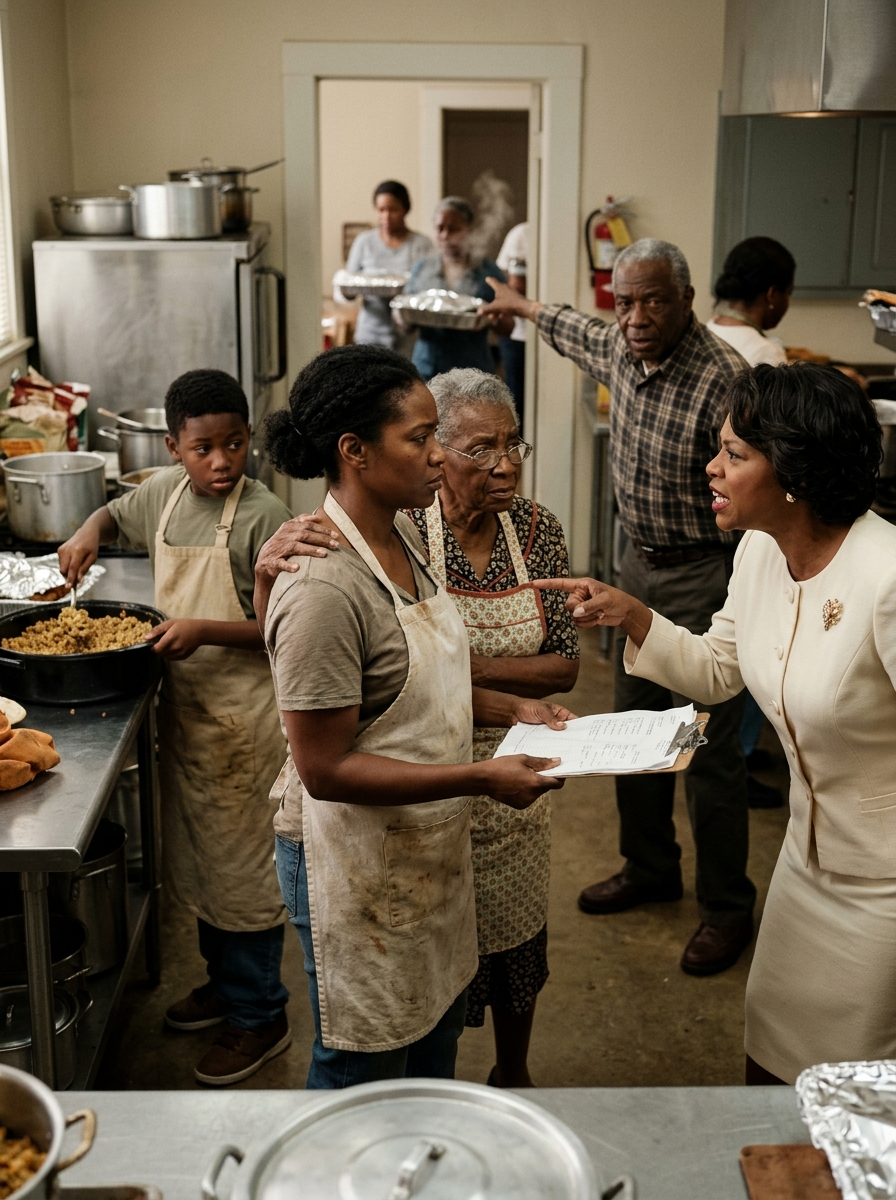
Alphonse Fontenot had been dead for eight years.
And yet his signature was sitting on a document dated three weeks ago.
For a moment, I thought my eyes were playing tricks on me.
I leaned closer.
The name was written in blue ink beneath a paragraph authorizing the transfer of the Thanksgiving Community Table's assets, donor relationships, and administrative control to Gulf South Community Partners.
ALPHONSE FONTENOT.
I knew that handwriting.
For eleven years, I had seen it on recipe cards, delivery receipts, church notices, and little notes he left beside the stove.
His capital A always leaned slightly forward.
The F in Fontenot had a long horizontal stroke.
And he never crossed his t's the same way twice.
This signature looked like his.
Almost.
But there was one problem no amount of careful handwriting could explain.
The document was dated November 5.
Three weeks before Thanksgiving.
Eight years after we buried him.
I looked up at Victor Hale.
"Where did you get this?"
He smiled.
"From the program's historical records."
I stared at him.
"Historical records?"
"Yes."
"With a signature dated three weeks ago?"
His smile weakened.
The church trustees leaned forward.
Pastor Thibodeaux looked from the document to Victor.
Miss Odile stood beside me, her small hands resting on the table.
She had been quiet since Victor entered the room.
Now she reached for the paper.
"Let me see that."
Victor hesitated.
Margaret spoke immediately.
"Please leave the original where it is. We can examine a copy."
Victor looked irritated.
"It's a legitimate authorization."
"Then preserving it shouldn't be a problem," Margaret replied.
He said nothing.
Miss Odile adjusted her glasses and leaned over the document.
She read the date.
Then the signature.
Her face changed.
I had seen that expression only twice in my life.
Once when Mr. Alphonse died.
And once when she learned that the church roof had collapsed after a hurricane.
She looked up slowly.
"Mr. Hale."
Victor straightened.
"Yes, ma'am?"
"My husband died on February 17, eight years ago."
The room went completely silent.
Victor blinked.
Then glanced at the document.
"Mrs. Fontenot, I understand your concern."
"No," she said.
Her voice was quiet.
But it carried through the entire room.
"You don't."
He opened his mouth.
She continued.
"Because if you understood, you wouldn't be standing in front of me pretending my dead husband signed something three weeks ago."
One trustee made a sharp sound.
Victor's expression hardened.
"I didn't prepare the original documents."
Margaret leaned forward.
"Then who did?"
He looked toward Charlene.
Charlene looked down.
I watched the exchange.
The smallest movement.
The briefest glance.
But it told me something.
Victor had expected Charlene to support him.
And Charlene had suddenly decided not to speak.
I looked at the document again.
Then at Victor.
"Is this the document you used to justify transferring the forty-two turkeys?"
He shook his head.
"Not exactly."
"What does that mean?"
"It establishes the historical authority behind the program."
I pointed toward the date.
"Then why is it dated this month?"
He hesitated.
"That may be an administrative error."
I stared at him.
"An administrative error?"
"Yes."
"An administrative error that made a dead man sign a transfer?"
Victor's jaw tightened.
"Mrs. Broussard, there's no need to become emotional."
I almost laughed.
There it was.
The same old trick.
When a woman asked an uncomfortable question, call her emotional.
When she demanded an answer, call her difficult.
When she refused to cooperate, suggest she didn't understand.
I folded my hands on the table.
"All right, Mr. Hale."
My voice was steady.
"Let's keep this simple."
He watched me.
"Who signed Alphonse Fontenot's name?"
He didn't answer.
I waited.
Nobody moved.
Finally, the church's attorney spoke through the video connection.
"Mr. Hale, I recommend that you stop making representations about the authenticity of this document until its origin can be established."
Victor looked toward the screen.
"I have every right to present evidence."
"You may provide records for review," the attorney replied. "But this document raises obvious questions."
Pastor Thibodeaux stood.
"Victor, did you know Mr. Fontenot was deceased?"
Victor hesitated.
"Yes."
The pastor stared at him.
"Then why did you bring us a document bearing his signature and a current date?"
Victor looked toward Charlene again.
She wouldn't meet his eyes.
Finally, he said, "I was told the authorization was valid."
"By whom?" Margaret asked.
He pressed his lips together.
I looked at Charlene.
She was gripping the edge of her chair.
For the first time since I'd met her, she looked like a woman who had lost control of the room.
I should have felt satisfied.
Instead, I felt exhausted.
I wanted to go home.
I wanted to sit beside Remy and watch a movie.
I wanted to stop thinking about signatures, contracts, and people who believed Thanksgiving dinner was something they could buy and sell.
But Miss Odile was standing beside me.
And her husband's name had been used.
That changed everything.
"Miss Odile," I whispered, "sit down."
She shook her head.
"No, baby."
Her eyes remained fixed on Victor.
"I've got something to say."
The pastor nodded.
"Mrs. Fontenot, please."
She straightened.
At eighty-eight, she was smaller than nearly everyone in the room.
Her back curved slightly.
Her hands trembled when she held a cup of coffee.
But when she spoke, the room listened.
"Alphonse and I were married fifty-three years," she began.
Nobody interrupted.
"We didn't have much money when we started the Thanksgiving Community Table. What we had was a little church kitchen, some neighbors willing to help, and Evette."
She looked at me.
I felt my throat tighten.
"Evette was raising a little boy. Working hard. Trying to keep her family together after life didn't turn out the way she expected."
I looked down.
Miss Odile continued.
"Alphonse used to say she worked harder than three grown men put together."
Mr. Purvis nodded.
"He sure did."
A faint smile touched Miss Odile's face.
Then she looked back at Victor.
"My husband was a careful man. He saved receipts. He wrote dates on everything. And he believed that when people gave food for hungry neighbors, that food belonged to those neighbors."
She placed one hand on the table.
"He didn't create this program so a company could collect fees from it."
Victor shifted.
Miss Odile continued.
"And he certainly didn't come back from the grave to sign your paperwork."
Nobody laughed.
The words were too painful.
Too true.
She looked toward Charlene.
"Charlene, I don't know what you were promised."
Charlene's eyes filled.
"But I know you hurt a good woman to get it."
Charlene opened her mouth.
Miss Odile raised one hand.
"I'm not finished."
Charlene closed it.
Miss Odile took a breath.
"You told Evette she wasn't fit to represent a family ministry because she was divorced."
Her voice trembled.
"Well, I watched that woman raise her son. I watched her work before sunrise and come here after dark. I watched her feed people when she barely had enough time to eat herself."
She looked around the table.
"If that isn't family, I don't know what is."
My eyes burned.
Miss Odile turned toward Victor.
"And as for my husband's name, you will not use it again until somebody explains how it got on that paper."
She sat down.
I reached for her hand.
She squeezed mine.
Victor looked toward the pastor.
"This meeting has become unnecessarily personal."
Pastor Thibodeaux stared at him.
"Mr. Hale, you brought a document bearing the signature of a deceased founding member."
Victor opened his mouth.
The pastor continued.
"And we have security footage showing you copying Mrs. Broussard's signature."
Victor went still.
His eyes moved toward Charlene.
Then toward the trustees.
For the first time, his confidence disappeared completely.
"I think," he said carefully, "that I should speak with counsel."
The church's attorney nodded.
"That would be appropriate."
Margaret closed her laptop.
"I also recommend that the original document be preserved and that no one attempt further transfers while the disputed authorizations are under review."
The trustees agreed.
One of them, Robert Landry, leaned forward.
Robert was Denise's husband.
He had served on the church's financial committee for years.
His face was pale.
"I want to know whether any money has actually left the church or the outreach accounts."
Victor looked toward him.
"That's a separate matter."
Robert shook his head.
"No. It isn't."
I looked at Robert.
He was a quiet man.
Not someone who enjoyed confrontation.
But his voice was firm.
"If money was collected for the Thanksgiving Community Table, we need to know where it is."
Charlene suddenly stood.
"This is ridiculous."
Everyone turned.
She looked at her husband.
"Richard, are you really going to let these people tear apart our ministry?"
The pastor's face tightened.
"Our ministry?"
Charlene blinked.
He stood slowly.
"Charlene, you've been calling it our ministry all week."
She stared at him.
"But the documents show it was established by the founding committee and supported by community donors."
She looked away.
He continued.
"And Evette has been coordinating it for eleven years."
Charlene folded her arms.
"Under the church's roof."
"That doesn't give us ownership of everything people donate."
Her face reddened.
"You're taking her side."
The pastor shook his head.
"I'm trying to understand the truth."
Charlene laughed bitterly.
"The truth?"
She pointed toward me.
"That woman has spent years making everyone think she's some kind of saint."
I stared at her.
She continued.
"She gets all the praise. All the attention. People bring donations to her. They call her. They thank her."
I felt something cold settle in my chest.
There it was.
Not concern about church oversight.
Not worry about the donors.
Not even the sponsorship.
Jealousy.
Charlene looked at me.
"And what does the church get?"
I took a breath.
"Three hundred people fed."
She laughed.
"Don't be clever."
I looked at her.
"Three hundred and twenty-seven today, actually."
Her face tightened.
"And if the church gets credit too, that's fine with me."
I leaned forward.
"But you didn't want to share credit, Charlene. You wanted to take control."
She stared at me.
I continued.
"You could have helped. You could have volunteered. You could have stood beside us and served plates."
My voice remained steady.
"Instead, you stood beside a man who copied my signature."
Charlene looked away.
For a moment, nobody spoke.
Then Robert Landry asked a question that changed the direction of the meeting.
"Charlene, did you authorize Gulf South Community Partners to receive money on behalf of the church?"
She went still.
Robert repeated the question.
"Did you?"
Charlene looked toward Victor.
He said nothing.
Then she whispered, "I signed a preliminary agreement."
Pastor Thibodeaux stared at her.
"You signed what?"
She swallowed.
"A preliminary agreement."
"Without trustee approval?"
She looked down.
"It wasn't supposed to be final."
Robert leaned forward.
"Did any money move?"
Charlene didn't answer.
My heart began pounding.
Robert's voice sharpened.
"Charlene."
She looked up.
"I don't know."
Victor suddenly spoke.
"That's not accurate."
Every head turned.
Charlene stared at him.
"Victor."
He looked at her.
"The payment instructions were included in the documents you approved."
Her face went white.
"I didn't approve any payment."
Victor opened his briefcase again.
Removed a page.
And placed it on the table.
Robert reached for it.
Read it.
Then looked up.
His expression had changed.
"What is this account?"
Charlene stared at the paper.
Victor folded his arms.
"The designated receiving account."
Robert looked toward the pastor.
"Richard, this isn't a church account."
The pastor went still.
"What?"
Robert turned the paper toward him.
"The routing information doesn't match any account we use."
My stomach tightened.
Margaret leaned forward.
"May I see that?"
Robert passed her a copy.
She examined it.
Then looked toward Victor.
"Who controls this account?"
Victor hesitated.
"That information is in the financial file."
"Then please identify the authorized recipient."
He didn't answer.
The attorney spoke through the screen.
"At this point, the trustees should preserve the financial records and obtain independent verification from the bank and the relevant donors."
Robert nodded.
"I'll contact our treasurer."
Charlene sank into her chair.
Her hands were shaking.
I looked at her.
For the first time, I wondered whether she'd understood the entire arrangement.
She had wanted control.
She had wanted publicity.
She had wanted to remove me.
But perhaps Victor had promised her something he never intended to deliver.
Perhaps she had helped open a door without understanding who would walk through it.
That didn't excuse what she'd done.
But it made the situation more dangerous.
Because people who realize they've been used sometimes become desperate.
And desperate people make terrible choices.
Victor closed his briefcase.
"I believe this meeting is over."
Pastor Thibodeaux looked at him.
"Not until we have copies of the documents you've presented."
Victor's jaw tightened.
"My attorney will handle that."
The pastor nodded.
"Then please have your attorney contact ours."
Victor looked toward Charlene.
She wouldn't meet his eyes.
He picked up his briefcase.
Then turned toward the door.
As he passed me, he stopped.
"Mrs. Broussard."
I looked up.
He smiled faintly.
"You've made this much more complicated than it needed to be."
I stared at him.
"I didn't forge anybody's signature."
His smile disappeared.
Then he walked away.
I watched until the door closed.
Only then did I realize how tightly I'd been gripping Miss Odile's hand.
I loosened my fingers.
"I'm sorry."
She shook her head.
"Don't be."
The meeting continued for another half hour.
The trustees agreed to suspend any proposed partnership with Gulf South Community Partners pending review.
They agreed to preserve the security footage.
They agreed to verify the disputed financial transactions.
And Pastor Thibodeaux promised that the church would not make further accusations against me without evidence.
Charlene remained silent.
When the meeting finally ended, she stood and walked toward the side door.
I didn't stop her.
I had nothing left to say.
Not tonight.
Margaret gathered the documents.
Robert Landry approached me.
"Evette."
I looked up.
"Yes?"
He seemed uncomfortable.
"I owe you an apology."
I sighed.
"Robert—"
"No. Please."
He took a breath.
"Denise told me what happened Tuesday. I should have asked questions sooner."
I looked at him.
"You weren't there."
"That doesn't mean I couldn't have helped."
I studied his face.
He looked genuinely ashamed.
Then he said, "I'm going to review the church's financial records with the treasurer."
I nodded.
"Thank you."
"And if anything was moved improperly, we'll document it."
"Good."
He hesitated.
"Evette, I also want you to know something."
I waited.
"Denise came home yesterday and told me she'd never been prouder of a Thanksgiving dinner."
My throat tightened.
He smiled faintly.
"She said she finally understood what you meant when you told her to put everybody's name on the volunteer board."
I looked down.
"She did a lot of work."
"I know."
He nodded toward the door.
"She's waiting for you across the street."
I smiled.
"Then I'd better get back."
We left the fellowship hall together.
Outside, the sky had darkened.
The church parking lot was nearly empty.
A few cars remained.
The streetlights had come on.
Across Cypress Street, the community kitchen still glowed.
I could see people cleaning through the windows.
Mr. Purvis carried a stack of trays.
Denise stood beside the sink.
And Remy sat at the table with Miss Odile's neighbor.
I felt a wave of exhaustion.
The kind that settles into your bones after too many hours of worry.
Margaret walked beside me.
"How are you holding up?"
I let out a long breath.
"Ask me tomorrow."
She smiled faintly.
"Fair enough."
Then her expression grew serious.
"Evette, I need to tell you something."
I looked at her.
"What?"
"Andrew is concerned about the financial account Victor presented."
I nodded.
"So am I."
"The bank information doesn't match the foundation's approved recipient records."
I frowned.
"Does that mean the money was stolen?"
"Not necessarily. We need the transaction records before we can say what happened."
I nodded.
"But it means we need to move quickly."
She looked at me.
"Yes."
We reached the curb.
I looked toward the community kitchen.
Then stopped.
Something was wrong.
The front entrance was open.
Not just unlocked.
Wide open.
A volunteer stood outside, looking down the street.
Another was speaking urgently into a phone.
I frowned.
"What's happening?"
Margaret followed my gaze.
"I don't know."
I started walking faster.
Then I heard someone call my name.
"Evette!"
It was Denise.
She stood in the doorway.
Her face was pale.
I hurried across the street.
"What happened?"
She grabbed my arm.
"Where's Remy?"
My heart stopped.
"What?"
"Where's Remy?"
I stared at her.
"He was inside."
Denise shook her head.
"He went out a few minutes ago."
My stomach dropped.
"With who?"
She swallowed.
"He said he was going to get something from Mr. Purvis's truck."
I looked toward the parking area.
Mr. Purvis's pickup was still there.
The driver's door was closed.
Nobody stood beside it.
I turned back to Denise.
"Did anybody see him leave?"
She shook her head.
"Not clearly."
My heart began pounding.
I pushed past her.
"Remy!"
The kitchen was almost empty.
A few volunteers were cleaning.
Miss Odile's neighbor stood near the table.
Her face was frightened.
I looked around.
"Remy!"
No answer.
I hurried toward the storage room.
Empty.
The restroom.
Empty.
The back office.
Empty.
I turned toward Mr. Purvis.
"Where's my son?"
He looked stunned.
"I thought he was with Denise."
Denise shook her head.
"He was here ten minutes ago."
My hands began shaking.
I took out my phone.
Called Remy.
It rang.
Once.
Twice.
Three times.
Then went to voicemail.
I called again.
Nothing.
I looked toward the back door.
It stood partly open.
The cool evening air moved through it.
I hurried outside.
"Remy!"
The alley was dark.
The laundromat sign flickered.
A delivery van was parked farther down the street.
I looked toward Mr. Purvis's pickup.
Then I saw something on the ground.
A small blue notebook.
Remy's notebook.
The one he'd carried into the kitchen that morning.
I bent down.
Picked it up.
His name was written on the cover.
REMY BROUSSARD.
My heart began pounding so hard I could hear it.
I opened the notebook.
Inside were the little notes he'd made during the day.
How many rolls he'd handed out.
How many plates he'd helped carry.
A drawing of a turkey wearing a chef's hat.
Then, on the last page, something was written in hurried pencil.
Dad said he needed to show me something.
I stared at the words.
The street seemed to tilt beneath my feet.
Jerome.
I looked up.
"Margaret!"
She hurried toward me.
"What?"
I handed her the notebook.
She read the sentence.
Her face changed.
"Evette—"
I was already dialing Jerome's number.
The old number.
The one I'd kept for six years.
It rang.
Once.
Twice.
Then someone answered.
"Evette."
Jerome's voice.
My hands shook.
"Where is my son?"
There was silence.
Then he said, "Listen to me."
"Where is Remy?"
"He's okay."
My knees nearly gave out.
"Where is he?"
Jerome took a breath.
"I need you to stay calm."
I felt something inside me snap.
"Jerome, if you don't tell me where my child is right now, I'm calling the police."
He was quiet.
Then he said, "I didn't take him."
I froze.
"What?"
"I swear to you, Evette. I didn't take him."
I looked down at the notebook.
"Then why did he write that you wanted to show him something?"
Jerome's breathing changed.
"What?"
I repeated the sentence.
There was a long silence.
Then he whispered, "Oh, God."
My stomach turned.
"Jerome?"
He didn't answer.
"Jerome!"
His voice came back.
Low.
Frightened.
"Evette, listen carefully."
I gripped the phone.
"What?"
"Victor called me twenty minutes ago."
My blood went cold.
"What did he say?"
Jerome hesitated.
Then whispered, "He said if I didn't cooperate, he'd find another way to make me understand."
I couldn't breathe.
"Jerome, where is my son?"
"I don't know."
I looked toward the dark alley.
The empty street.
The delivery van.
My hands were shaking so badly I could barely hold the phone.
Then Jerome said something that made my whole body go cold.
"Evette, Victor knows where Remy goes to school."
I closed my eyes.
"No."
"He knows your address."
"Stop."
"And he knows about the community kitchen."
I opened my eyes.
Across the street, the church lights were still on.
A car moved slowly past the corner.
I looked toward the delivery van.
Its engine started.
The headlights came on.
I stared at it.
Then I heard a sound.
A faint tapping.
Coming from the back of the van.
Three quick knocks.
A pause.
Then three more.
I lowered the phone.
Margaret looked at me.
"Evette?"
I couldn't answer.
Because I recognized that rhythm.
Three knocks.
A pause.
Three more.
When Remy was little, we used to knock that way on his bedroom door.
It was our secret signal.
Our way of saying I'm here.
I took one step toward the van.
Then another.
The engine grew louder.
The brake lights flashed.
I began running.
"REMY!"
The van started moving.
I ran faster.
My shoes slapped against the pavement.
"STOP!"
The driver didn't stop.
I reached for the rear door.
My fingers brushed the handle.
Then the van accelerated.
I stumbled backward.
Margaret caught my arm.
The vehicle turned toward the intersection.
And disappeared around the corner.
For one terrible second, I couldn't move.
Then I looked down.
Something had fallen from the rear bumper.
A small piece of paper.
Folded twice.
I bent down.
Picked it up.
My hands were shaking.
I opened it.
There were only six words.
Written in black ink.
Three hundred plates. One boy missing.
I stared at the note.
Then my phone vibrated.
An unknown number.
A photograph arrived.
I opened it.
And saw Remy sitting in the back of the van.
His hands were visible.
His face was pale.
He was looking directly at the camera.
Beneath the photograph was a message.
If you want your son back, bring the original blue folder to the old church kitchen. Come alone.
I stared at the screen.
Then another message appeared.
And don't call the police.
I looked toward the empty street.
The van was gone.
My son was gone.
And somebody knew exactly which documents I had been protecting.
Then the phone rang again.
Unknown number.
I answered.
A man's voice spoke.
"Mrs. Broussard?"
I couldn't breathe.
"Where is my son?"
The man ignored my question.
"Do you have the blue folder?"
I gripped the phone.
"Who are you?"
A pause.
Then the voice said, "You have fifteen minutes."
I looked toward the church.
The old kitchen.
The dark windows.
The place where Charlene had removed my name.
"Please," I whispered. "Let me speak to Remy."
There was silence.
Then I heard movement.
A muffled sound.
A breath.
And finally, my son's voice.
"Mom?"
My knees nearly gave out.
"Remy!"
He was crying.
"Mom, I'm scared."
I pressed the phone against my ear.
"Baby, listen to me. I'm coming."
A man's voice interrupted.
"Fifteen minutes, Mrs. Broussard."
Then the call ended.
I stood in the alley.
The phone still pressed against my ear.
Margaret was beside me.
Mr. Purvis was running toward us.
Denise stood near the back door.
Miss Odile had come outside.
Everyone was looking at me.
Waiting.
I lowered the phone.
"My son," I whispered.
Margaret took my hand.
"Evette?"
I looked toward the church.
Then toward the dark street where the van had disappeared.
And suddenly I understood why the delivery truck had never stopped at Bethel.
The forty-two turkeys had gone to the kitchen where they belonged.
The documents had exposed the truth.
The money was being investigated.
Charlene's accusations were collapsing.
And now someone had decided that the only way to make me surrender was to take the one person I loved more than anything.
I looked at Margaret.
"Call the police."
Her eyes widened.
"But the message—"
"I don't care."
My voice shook.
"That's my son."
She nodded and reached for her phone.
I looked toward the old church kitchen.
Its windows were dark.
The side entrance stood beneath a flickering security light.
Then my phone vibrated again.
Another photograph.
This time, Remy wasn't in the van.
He was standing in front of a familiar door.
A stainless steel door.
The pantry entrance inside Bethel Fellowship.
I stared at the image.
Then looked across the street.
The church was supposed to be nearly empty.
But the kitchen light had just come on.
And through the window, I saw a shadow move.
A man's shadow.
Then a second figure appeared.
Smaller.
A child.
My heart stopped.
I began running toward the church.
Behind me, Margaret shouted my name.
I didn't stop.
I crossed Cypress Street.
Reached the side entrance.
Pulled the door open.
And hurried down the hallway.
The kitchen door was closed.
Light spilled beneath it.
I could hear voices inside.
One belonged to a man.
The other—
I pressed my ear against the door.
A small voice whispered, "Please don't hurt my mom."
I gripped the handle.
Then I heard a familiar voice answer.
A woman's voice.
Calm.
Cold.
And unmistakable.
Charlene Thibodeaux.
"Then tell your mother to give me what I want."
I turned the handle.
The door opened.
And standing beside my terrified son was the last person I expected to see.






Comments 0