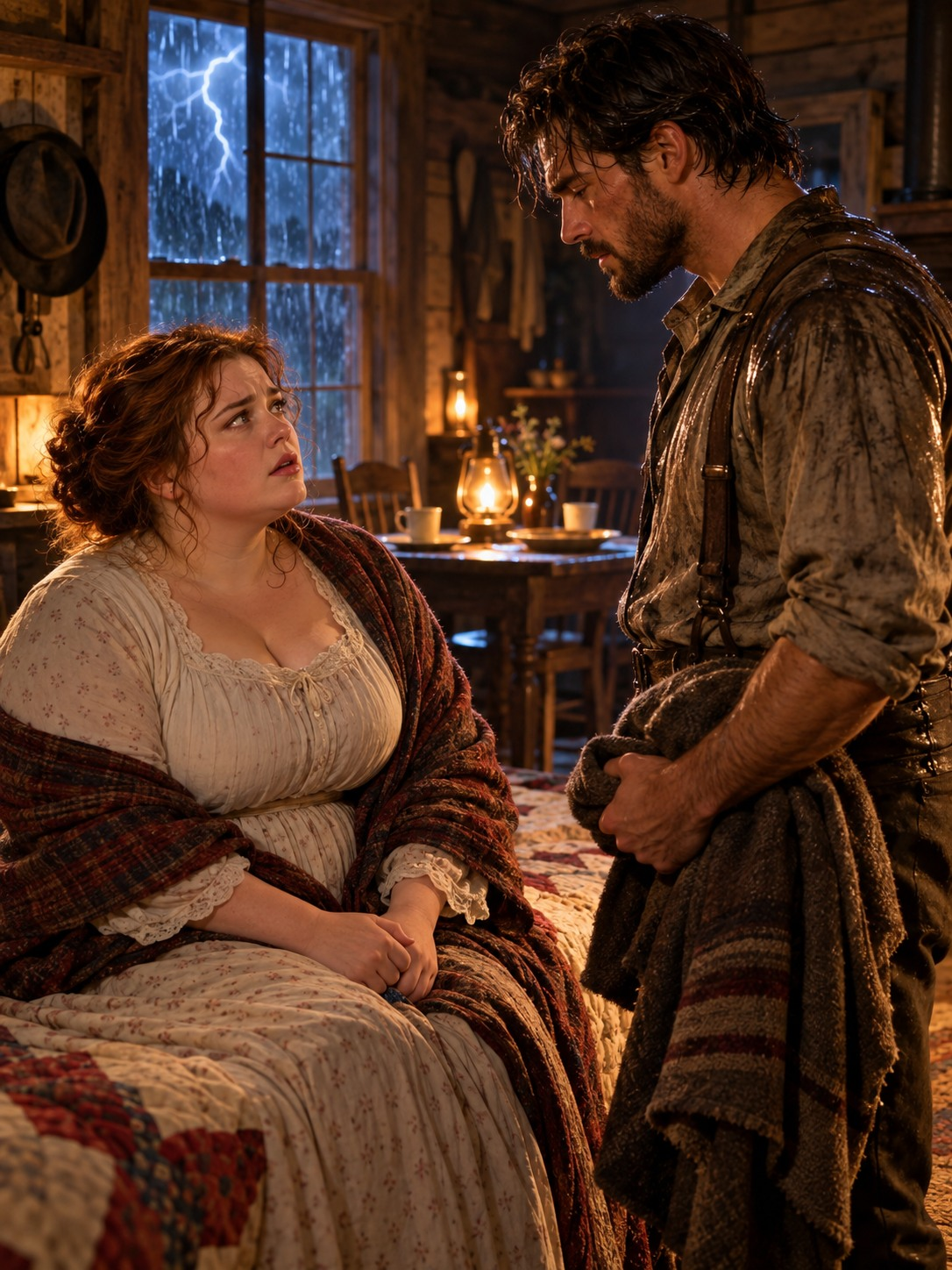
Callaway slowly lifted the faded cloth from the wooden box.
Maeve stood beside the dresser, unable to look away.
Inside the box lay a small silver pocket watch, a folded photograph, and several letters tied together with a piece of dark blue ribbon. Everything appeared to have been kept carefully, protected from dust and moisture for years.
Callaway picked up the pocket watch first.
His thumb moved across its scratched silver cover.
For a moment, he looked like a man remembering something he had spent a lifetime trying to forget.
Maeve waited.
"Is that my father's?" she finally asked.
Callaway did not answer immediately.
He opened the watch.
The delicate mechanism had stopped.
On the inside cover, two initials had been engraved.
P.O.
Patrick O'Rourke.
Maeve's breath caught.
She stepped closer.
"Where did you get that?"
Callaway closed the watch.
"Your father gave it to me."
The words struck her harder than she expected.
She stared at him.
"You knew my father?"
"Yes."
"How?"
Callaway placed the watch carefully on the dresser.
"We worked together."
Maeve shook her head.
"That cannot be right."
"Why not?"
"My father never worked in America."
Callaway looked at her.
"Are you certain?"
"Of course I'm certain. He died when I was twelve. My mother told me everything about his life."
Callaway lowered his eyes.
"Perhaps she told you what she believed."
Maeve felt a sudden chill.
"What does that mean?"
He picked up the folded photograph.
The paper had yellowed with age, and one corner was slightly torn. He held it between his fingers as though it were something fragile.
Then he turned it toward her.
Maeve looked.
Three people stood in front of a wooden building.
One was Callaway, much younger, with darker hair and a face that had not yet acquired the hard lines she knew.
Another was a man with broad shoulders, a dark mustache, and familiar eyes.
The third was a woman.
She wore a long dress and held a small child against her chest.
Maeve stopped breathing.
She knew the man immediately.
Even after all those years, she could recognize her father's face.
The photograph trembled in her hands.
"That's him."
Callaway nodded.
"Patrick."
Maeve stared at the woman.
"Who is she?"
Callaway looked at the photograph.
"Her name was Eleanor."
"Was?"
He took a slow breath.
"She died many years ago."
Maeve studied the woman's face.
Something about it seemed familiar, though she could not understand why.
"Was she his wife?"
"No."
"Then who was she?"
Callaway hesitated.
"Someone your father was trying to protect."
Maeve looked up sharply.
"My father?"
"Yes."
"From whom?"
Callaway returned the photograph to the box.
"I can't answer that yet."
Maeve felt frustration rising inside her.
"Then why show me any of this?"
"Because you deserve to know that your father was not the man you were told he was."
She stepped backward.
"Don't talk about him as though you knew him better than I did."
Callaway did not argue.
Instead, he looked at the photograph again.
"I knew him in a place where nobody had time to pretend to be someone they weren't."
Maeve folded her arms.
"My father was a good man."
"He was."
"Then what are you suggesting?"
Callaway looked directly at her.
"That he carried a secret."
The cabin suddenly seemed smaller.
Maeve glanced at the window.
Rain clouds were gathering in the distance, though the afternoon remained bright.
She had spent fifteen years believing she understood her father's life.
Patrick O'Rourke had been a quiet man.
He repaired furniture, worked wherever he could find employment, and returned home each evening with dirt on his boots.
He had loved his daughter.
He had taught her how to read.
He had shown her how to mend a torn dress and how to recognize the first signs of approaching rain.
She remembered his laughter.
His rough hands.
The way he used to whistle while working.
Then one winter, he became ill.
He died before spring.
Her mother had never spoken much about his final months.
Whenever Maeve asked about him, her mother had simply said that Patrick had worked too hard and had never recovered.
There had been no mention of America.
No mention of a rancher.
No mention of Eleanor.
And certainly no mention of a photograph taken thousands of miles away.
"Why did you contact me?" Maeve asked.
Callaway looked at the wooden box.
"Because I promised him I would."
Her eyes narrowed.
"When?"
"Years ago."
"What did you promise?"
He rubbed his thumb along the edge of the pocket watch.
"That if anything happened to him, I would find his daughter."
Maeve's expression changed.
"You mean you knew about me all this time?"
"I knew your name."
"And you waited until now?"
Callaway looked uncomfortable.
"I didn't know where you were."
"You sent me three letters."
"Yes."
"But why did you need a housekeeper?"
He was silent.
Maeve stepped closer.
"Was that the reason? Did you actually need someone to cook and clean, or was that just an excuse to bring me here?"
Callaway raised his eyes.
"I needed help in the house."
"That isn't an answer."
"No," he admitted. "It isn't."
She felt her stomach tighten.
For the first time since arriving at the ranch, she wondered whether the safe arrangement she had trusted had been built around a deception.
She had crossed the Atlantic because she believed she was accepting employment.
She had not agreed to become part of an old mystery.
"Did you know my father was dead when you wrote to me?"
"Yes."
Maeve looked away.
"Did you know my mother was dead?"
Callaway hesitated.
"Yes."
Her head snapped toward him.
"You knew?"
"I received a letter."
"From whom?"
He reached into the wooden box and removed one of the folded envelopes.
It had been opened and resealed.
The handwriting on the front was delicate and familiar.
Maeve recognized it immediately.
Her mother's handwriting.
She reached for the envelope.
Callaway did not release it at first.
"Maeve."
"Give it to me."
He slowly handed it over.
Her fingers shook as she turned it around.
The date was written beneath the address.
It had been sent nearly six months before her mother's death.
She carefully unfolded the paper.
The writing was faded, but most of the words remained readable.
Mr. Callaway,
I am writing because I have reached the point where I can no longer keep this matter from my daughter. Patrick made me promise that she would never be drawn into what happened in America.
I have honored that promise for as long as I could.
But the people who once searched for him have begun asking questions again.
If they discover where Maeve is, I fear they will come looking for her.
Please, if you still remember your promise to Patrick, find a way to keep my daughter safe.
Do not tell her everything until you are certain it is safe.
There are things she does not know.
Things about the night Patrick left Ireland.
Maeve lowered the letter.
She read the final paragraph again.
Then once more.
"The night he left Ireland?"
Callaway nodded.
"Your father spent time in America before you were born."
Maeve looked at him.
"Why would my mother lie about that?"
"To protect you."
"From what?"
Callaway's jaw tightened.
"I don't know everything."
"You're telling me you brought me across the ocean without knowing everything?"
"I knew enough to believe you were safer here than where you were."
Maeve shook her head.
"That makes no sense."
Callaway walked toward the window.
For several seconds, he watched the empty pasture.
Then he spoke.
"Your father came to this country when he was a young man. He worked with me for nearly three years."
Maeve listened without interrupting.
"He wasn't a ranch hand when I first met him. He was a carpenter. A good one. He could build almost anything, and he had a way of making people trust him."
Callaway paused.
"He saved my life once."
Maeve looked at him.
"How?"
"We were working near the northern boundary of the property. A horse broke loose, and I went down hard. I was trapped beneath a fallen section of fencing. Your father pulled me out before the animal came back."
Callaway looked down at his hands.
"I would have died if he hadn't been there."
Maeve swallowed.
"Then why did he leave?"
"Because someone came looking for him."
"Who?"
"I never learned his real name."
Callaway returned to the table.
"There was a man in Hartwell who claimed Patrick owed him money. He brought documents and threatened to take him before the sheriff."
"Was my father in debt?"
"Not to that man."
"Then what did he want?"
Callaway shook his head.
"Patrick wouldn't tell me."
Maeve looked at the photograph again.
"What about Eleanor?"
Callaway's expression hardened.
"She was involved in the matter."
"How?"
"Your father trusted her."
"Was she his friend?"
"Yes."
"Did she know my mother?"
Callaway paused.
"I believe they knew each other."
Maeve's eyes widened.
"My mother knew her?"
"I believe so."
The room fell silent.
Maeve felt as though the ground beneath her life had shifted.
She had spent years believing her parents had lived an ordinary, difficult life.
Now a stranger was telling her that her father had crossed an ocean, worked on a ranch, saved a man's life, and become involved in something serious enough that her mother had spent her final months fearing for her daughter's safety.
It was too much to understand.
"Why didn't you tell me in your letters?" she asked.
Callaway looked at her.
"Because I didn't know who might read them."
"Someone was watching my family?"
"I can't say for certain."
"But you suspected it."
"Yes."
Maeve moved toward the bedroom.
Callaway watched her.
"Where are you going?"
"I need to think."
"Maeve—"
"Please."
He stopped.
She entered the bedroom and closed the door.
For several minutes, she sat on the edge of the bed.
Her mother's letter rested in her lap.
She wanted to cry.
But the tears did not come.
Instead, she felt an unfamiliar anger.
Not because her father had kept secrets.
Not even because Callaway had hidden the truth.
She was angry because everyone seemed to have decided that she was too fragile to know anything about her own family.
Her mother had protected her.
Her father had protected her.
Now Callaway was doing the same.
Yet nobody had asked what she wanted.
She stood and approached the dresser.
Her carpet bag remained beside it.
She opened the smaller pocket and removed the last letter her mother had written before her death.
Maeve had carried it across the Atlantic.
She had read it so many times that she knew every sentence by heart.
My darling Maeve,
Whatever happens, remember that your father loved you more than anything in this world.
Do not let the mistakes of other people become the burden of your life.
You deserve a future that belongs to you.
Maeve pressed the paper against her chest.
Then she noticed something.
The envelope had a second fold inside.
She had never examined it closely.
Carefully, she opened the inner crease.
A small piece of paper slipped out.
It was not part of the original letter.
Someone had written four words in faded ink.
Ask Callaway about Eleanor.
Maeve stared at the message.
Her mother had deliberately hidden it.
She returned to the kitchen.
Callaway was standing beside the stove, pouring coffee into two cups.
He looked up when she entered.
"Feeling better?"
"No."
He placed the coffee pot down.
Maeve held out the small piece of paper.
"Who wrote this?"
Callaway looked at it.
The color drained from his face.
He did not touch it.
For several seconds, he simply stared.
Then he slowly pulled out a chair.
"Sit down."
Maeve remained standing.
"I've been sitting long enough."
Callaway looked toward the window.
"Your mother knew Eleanor."
"You said that already."
"She knew her before your father came to America."
Maeve frowned.
"How?"
He took a breath.
"Because Eleanor was not just your father's friend."
Maeve felt her heartbeat quicken.
"Then what was she?"
Callaway opened the wooden box again.
He removed the photograph and turned it over.
There was writing on the back.
Maeve had not noticed it before.
The handwriting was small and uneven.
Callaway placed the photograph on the table.
"Read it."
Maeve leaned forward.
The inscription contained a date, a place, and one sentence.
For the two people who must never meet again.
She looked up.
"What does that mean?"
Callaway's eyes remained fixed on the photograph.
"It means your father was afraid of what would happen if Eleanor and your mother ever saw each other again."
"Why?"
He opened his mouth.
But before he could answer, three hard knocks sounded against the front door.
Both of them turned.
Callaway's expression changed instantly.
He moved toward the window and looked through a narrow gap in the curtain.
Maeve noticed his right hand moving toward the heavy leather belt at his waist.
"Who is it?" she whispered.
He did not answer.
The knocks came again.
Three times.
Then a man's voice called from outside.
"Callaway! I know you're in there!"
Callaway's face went pale.
Maeve stepped closer.
"Do you know him?"
He slowly turned toward her.
For the first time since she had arrived at the ranch, she saw something she had never expected to see in his eyes.
Fear.
Not for himself.
For her.
Then the stranger outside spoke again.
"Open this door, Callaway. I've come for Patrick O'Rourke's daughter."
And Maeve suddenly understood that someone else knew she had arrived.






Comments 0