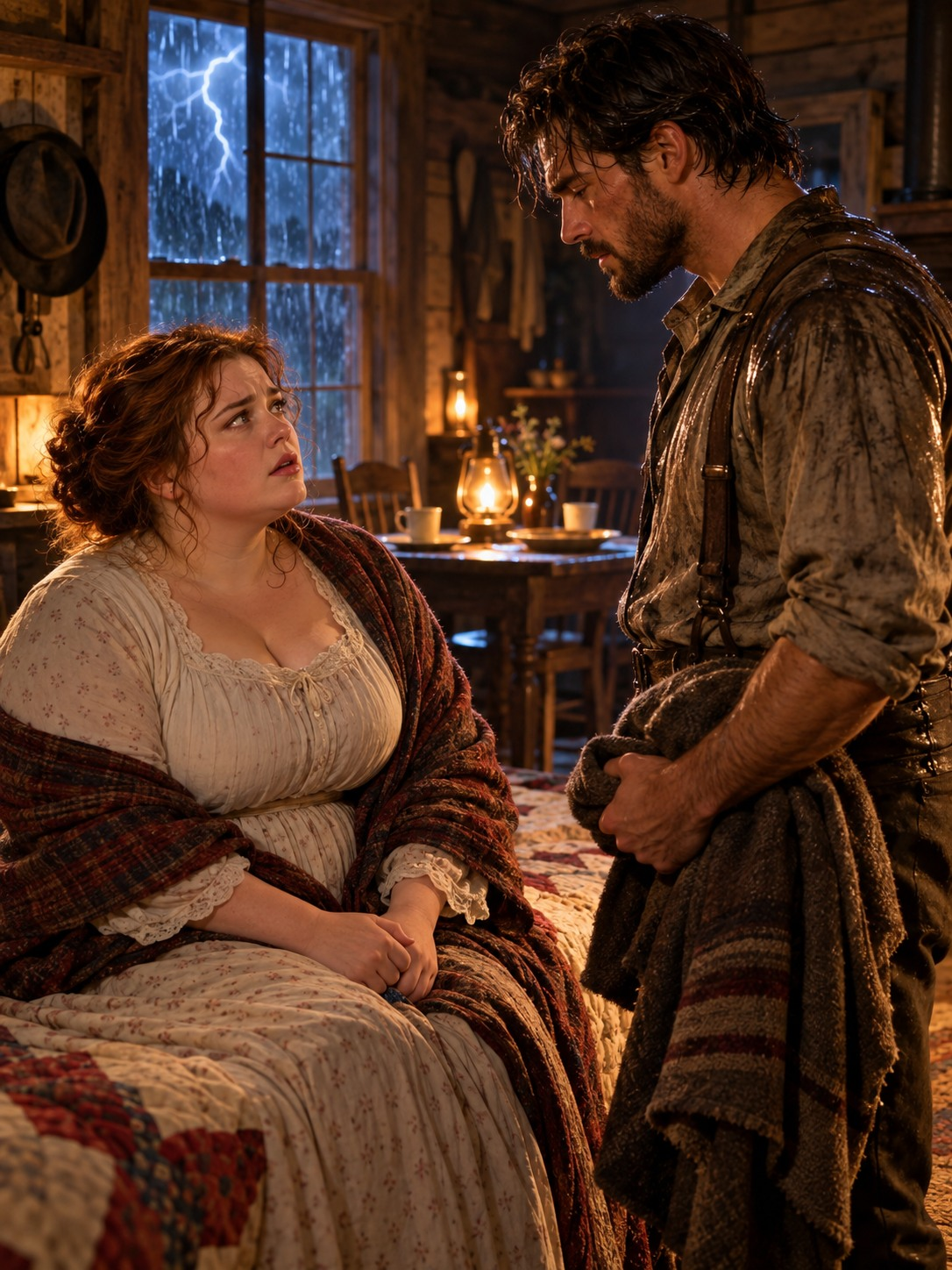
A young Irish woman grabbed the stationmaster's sleeve as the last train disappeared into the distance.
"Please, sir. I have nowhere else to go."
When rancher Callaway finally arrived, he noticed the battered carpet bag beside her feet.
A familiar name was written on the envelope sticking out of its pocket.
Patrick O'Rourke.
Callaway suddenly realized who had arrived in Hartwell.
The young woman had been standing on the platform for nearly an hour when the stationmaster finally stopped pretending not to notice her.
Her name was Maeve O'Rourke, and she had crossed an ocean with fourteen dollars and sixty cents, one battered suitcase, and a letter promising honest employment in the American West.
She was twenty-seven years old.
She had left Ireland with no family waiting for her in America, no friends in Hartwell, and no certainty that the man who had written to her would keep his promise.
The train had arrived before sunset.
Now the sky was darkening.
Families had already collected their belongings and disappeared toward the nearby streets. A young mother had kissed her husband. Two children had raced into their father's arms. A traveling salesman had climbed into a waiting carriage.
Maeve had watched every reunion with the uncomfortable awareness that nobody was waiting for her.
She checked the eastern road again.
Nothing.
She pulled her coat tighter around herself.
Callaway had written three letters.
The first explained that he owned a working ranch several miles outside Hartwell and needed someone to cook, clean, and maintain the household.
The second described the wages, the accommodations, and the difficult winters.
The third contained only a few sentences.
If you decide to come, I will meet your train. You will have honest work and a safe roof. Nothing more will be expected of you.
That final sentence had mattered more than he could have known.
Maeve had spent too many years discovering that kindness sometimes arrived with invisible strings attached.
She had learned not to trust charming men.
She had learned not to believe promises made too easily.
Callaway's letters had been plain, almost severe.
That was why she had believed him.
Now she wondered whether believing him had been another terrible mistake.
"Miss," the stationmaster said, approaching her. "You can't stay here all night."
"I understand."
"Have you got somewhere to go?"
"Someone is supposed to collect me."
The stationmaster glanced toward the empty road.
"Looks like someone forgot."
Maeve lowered her eyes.
She could have explained that the man might have suffered an accident. She could have told him about the horse, the ranch, and the letters.
Instead, she simply nodded.
"I suppose I'll have to find somewhere."
The stationmaster sighed.
"There's a boardinghouse near the church. But you'll need money."
She knew that.
Fourteen dollars and sixty cents would not last long in a strange town.
Before she could answer, the sound of wheels reached the platform.
A buggy emerged from the dust.
A powerful bay mare pulled it along the road, favoring one leg slightly.
The man holding the reins wore a dark navy work shirt beneath a charcoal leather vest. His sandy-blond hair was brushed backward, and his face carried the unmistakable marks of someone who had spent most of his life working beneath an unforgiving sun.
He stopped directly in front of Maeve.
His gray eyes moved from her face to the carpet bag.
Then he climbed down.
"Maeve O'Rourke?"
She almost laughed from relief.
"Yes."
"Callaway."
He extended his hand.
His grip was firm, but not rough.
"The mare threw a shoe," he explained. "Lost half the afternoon getting her sorted."
Maeve nodded.
"Thank you for coming."
He looked at her for a moment.
Then his eyes moved toward the darkening sky.
"Long journey?"
"Long enough."
He lifted her carpet bag and placed it in the back of the buggy.
When she reached for the step, he offered his hand.
She accepted.
There was something unusual about him.
He did not look at her as though she owed him gratitude.
He did not ask personal questions.
He did not compliment her appearance or make jokes about her accent.
He simply made sure she was safely seated before climbing onto the driver's bench.
As they left the station, Maeve watched Hartwell disappear behind them.
The town was smaller than she had imagined.
A church.
A general store.
A blacksmith's workshop.
A few wooden buildings with lamps glowing in their windows.
Beyond them stretched an enormous landscape of open fields, distant hills, and scattered ranches.
"How far?" she asked.
"About forty minutes."
"Is the road always this rough?"
"Only when it rains. Or snows. Or when the ground decides it doesn't like you."
Maeve glanced at him.
For a moment, she thought he might be joking.
But his expression remained completely serious.
She almost smiled.
Almost.
They traveled in silence for several minutes.
Finally, Callaway spoke.
"I should warn you. My place isn't much."
"I wasn't expecting a mansion."
"Two rooms. One stove. A barn that needs repairs."
"That sounds perfectly manageable."
"You'll have your own bedroom."
Maeve looked at him.
He kept his attention on the road.
"I work outside most of the day," he continued. "You won't be expected to do ranch work. Just the house."
"And my wages?"
"Every Saturday."
"Thank you."
He nodded.
Another silence settled between them.
Maeve noticed that Callaway occasionally looked at her when he thought she wasn't watching.
There was something almost searching in his expression.
Not suspicion.
Not curiosity.
Something she couldn't identify.
She turned toward the fields.
By the time they reached the ranch, darkness had settled over the land.
The cabin stood beneath a weather-beaten roof. A barn leaned slightly to one side, and a wooden fence stretched around the nearest pasture.
There were no flowers.
No welcoming decorations.
No sign that anyone had tried to make the place beautiful.
Yet the cabin had warm light glowing behind its windows.
Callaway helped her down.
"Watch your step."
He carried her bag inside.
The room smelled faintly of woodsmoke, leather, and old furniture.
A battered stove stood in one corner.
A small table occupied the center of the room.
Two wooden chairs sat opposite each other.
There was a narrow cot near the stove and a closed door leading to the bedroom.
"This is the kitchen," Callaway said. "The bedroom is yours."
Maeve stepped inside.
The room was simple.
But the bed was clean.
A folded quilt rested at its foot.
A small washbasin stood beside the dresser.
She touched the edge of the quilt.
"Thank you."
Callaway placed her bag beside the bedroom door.
"I'll show you where the supplies are tomorrow."
He walked toward the kitchen.
Then stopped.
"There's something else."
Maeve turned.
He seemed uncomfortable.
"If you need anything, ask. I may not notice."
She nodded.
"I can manage."
He looked at her for another moment.
Then he removed his hat.
"Good."
That night, Maeve lay awake listening to the strange sounds of the American countryside.
She missed Ireland.
She missed familiar voices, familiar roads, and the smell of rain against the stone walls of her childhood home.
But she had made a decision.
She would work.
She would save her wages.
She would build a life that belonged to her.
Downstairs, she heard Callaway moving a chair.
Then silence.
She closed her eyes.
She had no idea that the man sleeping only a few yards away had spent years searching for someone with her surname.
And she certainly did not know that the name written on the envelope inside her carpet bag had once been the last thing Callaway's closest friend had written before dying.






Comments 0