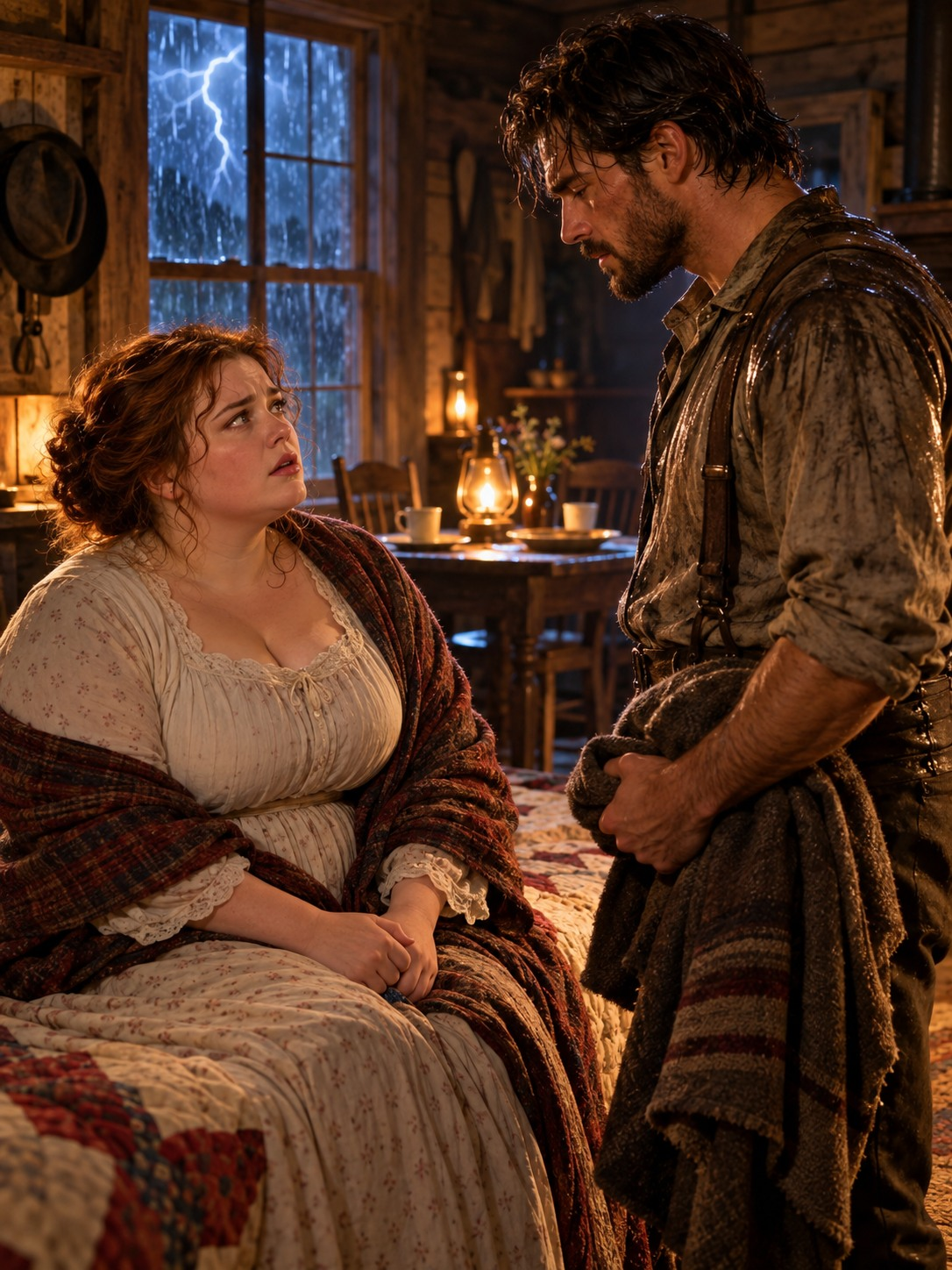
Maeve stepped backward when the stranger knocked again.
"Callaway! Open the door!"
His voice carried through the wooden walls.
Callaway stood between Maeve and the entrance, his shoulders rigid. The man who had once seemed almost impossible to frighten now looked like someone facing a nightmare he had spent years trying to escape.
"Stay behind me," he whispered.
Maeve stared at him.
"Who is that?"
"Someone who should never have found you."
The answer made her stomach tighten.
Outside, the stranger struck the door with the flat of his hand.
"I haven't ridden all this way to stand in the rain!"
Callaway reached for his hat, then seemed to reconsider. He glanced toward the wooden box on the table.
"Put those letters away."
Maeve did not move.
"Callaway, tell me who he is."
"Not now."
"You keep saying that. Not now. Not yet. Not until you're ready. I'm tired of being told that my own life is none of my business."
Callaway looked at her.
For a moment, something softened in his expression.
Then another blow landed against the door.
"Callaway!"
He turned toward the entrance.
"Go into the bedroom, Maeve."
"No."
"Please."
It was the first time she had heard him say the word with such urgency.
She looked toward the window.
A shadow moved across the glass.
Someone was standing outside.
Maeve's fingers tightened around the folded letter from her mother.
She had crossed thousands of miles to escape a life in which other people decided what she should know, where she should go, and whom she should trust.
She would not begin another one.
"I'm staying."
Callaway studied her face.
Then he nodded once.
"Then stay behind me."
He crossed the room and opened the door.
A tall man stood on the porch.
He appeared to be in his late forties, with thinning dark hair, a narrow face, and a carefully trimmed mustache. His black coat was wet from the rain, and mud covered the lower part of his trousers.
A leather travel bag hung from one shoulder.
His eyes moved immediately past Callaway.
They found Maeve.
The stranger stopped smiling.
For several seconds, he simply stared at her.
Then he removed his hat.
"Well," he said quietly. "Patrick's girl."
Maeve felt a chill travel down her spine.
"Who are you?"
The stranger ignored her question.
He looked at Callaway.
"You didn't tell her."
"There's nothing for you to discuss with her."
The stranger laughed without humor.
"Still pretending you can control everything?"
Callaway stepped outside, partially blocking the doorway.
"Say what you came to say."
The stranger looked toward Maeve again.
"My name is Silas Mercer."
He spoke as though the name should mean something.
It did not.
"I knew your father," he continued.
Maeve felt her heart begin to race.
"How?"
Silas smiled faintly.
"Your father and I had business together."
Callaway's expression hardened.
"That's enough."
Silas looked at him.
"Is it? After all these years?"
He reached inside his coat.
Callaway immediately moved forward.
"Don't."
Silas slowly withdrew a folded piece of paper.
It was old, yellowed, and creased several times.
He held it between two fingers.
"Do you recognize this?"
Callaway said nothing.
Silas turned the paper toward Maeve.
There was a signature at the bottom.
Patrick O'Rourke.
Her father's handwriting.
Maeve moved closer.
"Where did you get that?"
"From something your father left behind."
"Why do you have it?"
Silas looked directly at her.
"Because your father owed people more than money."
Callaway stepped between them.
"She has nothing to do with this."
Silas gave a quiet laugh.
"That's what you told yourself when you sent for her, isn't it?"
Maeve looked sharply at Callaway.
The stranger noticed.
His smile widened.
"Ah. So she doesn't know."
"Leave," Callaway ordered.
Silas folded the paper.
"I came to deliver a warning."
"Nobody asked you to."
"Some people in Hartwell have heard that Patrick's daughter is here. They're asking questions. They want to know whether she brought anything with her."
Maeve felt her hand instinctively move toward the pocket of her coat.
Her mother's letter was still there.
Silas noticed the movement.
His eyes narrowed.
"What have you got there?"
"Nothing."
"Nothing?"
Callaway stepped forward.
"You're finished."
For a moment, the two men stared at each other.
Silas finally lowered his eyes.
"You're making a mistake, old friend."
"I stopped being your friend a long time ago."
The words seemed to surprise him.
Then Silas placed his hat back on his head.
"Think carefully about what you're protecting."
He turned toward the buggy waiting near the fence.
Before climbing aboard, he looked over his shoulder.
"Tell the girl to ask about the winter of 1868."
Maeve frowned.
"What happened in 1868?"
Silas did not answer.
He climbed into the buggy and disappeared down the muddy road.
Callaway remained outside until the sound of the wheels faded.
Then he closed the door.
For a long moment, neither spoke.
Maeve finally broke the silence.
"Who was that man?"
Callaway removed his hat.
"Silas Mercer."
"I heard his name."
"He used to work with your father."
"Doing what?"
Callaway looked toward the table.
"Things that should never have happened."
Maeve folded her arms.
"That's not an explanation."
"No."
"Then give me one."
He rubbed his forehead.
"Silas was involved in a land dispute. Your father helped him keep records. He was good with numbers and documents. Better than most men around here."
"Was he a criminal?"
Callaway looked directly at her.
"Your father wasn't."
"That wasn't what I asked."
Callaway took a slow breath.
"Silas was dishonest. Patrick discovered it. And when he threatened to expose him, things became dangerous."
Maeve felt her stomach tighten.
"Was my father threatened?"
"Yes."
"Did someone hurt him?"
Callaway did not answer.
She stepped closer.
"Did someone hurt my father?"
His eyes dropped.
"Not while I was there."
Maeve stared at him.
"Then what happened?"
Callaway walked toward the stove and poured himself a glass of water.
He drank slowly.
When he finally spoke, his voice was lower.
"Your father disappeared one morning. He left without saying goodbye. I searched for him for weeks."
"And you never found him?"
"Not until a letter arrived from Ireland."
Maeve looked toward the wooden box.
"From my mother?"
"Yes."
"What did it say?"
Callaway placed the glass down.
"That Patrick was dead."
Maeve closed her eyes.
The memory of her father's funeral returned with painful clarity.
The small church.
The cold air.
Her mother's black dress.
The smell of wet earth.
She remembered standing beside the grave, unable to understand why everyone was crying.
She had been twelve.
Old enough to know death was permanent.
Too young to understand how many things could remain unfinished.
"Why did my mother never tell me about you?"
Callaway looked uncomfortable.
"She didn't know whether she could trust me."
"Why?"
"Because I had been friends with Silas."
Maeve looked at him.
"You were friends with that man?"
"Once."
"And now?"
"Now I know what he's capable of."
She moved toward the table.
The photograph was still there.
Maeve picked it up.
"Tell me about Eleanor."
Callaway's face changed.
"Not tonight."
Maeve gave a small, bitter laugh.
"Of course."
"Maeve—"
"No. You don't get to decide when I can hear the truth."
She placed the photograph on the table.
"My father is dead. My mother is dead. Whatever secrets they carried cannot hurt them anymore."
Callaway remained silent.
"But they can hurt me," she continued. "Because I am the one left wondering whether everything I remember about my family was a lie."
Her voice trembled slightly.
She hated that.
She took a breath and steadied herself.
"I want to know why you chose me."
Callaway looked at the photograph.
Then he walked to the small cupboard beside the stove.
He opened the lower drawer and removed a narrow leather case.
Maeve had never seen it before.
He placed it on the table.
Inside was a collection of documents.
Some were folded.
Others had been carefully protected between sheets of brown paper.
At the bottom lay a second photograph.
Maeve picked it up.
It showed a young woman standing beside a wooden fence.
She wore a pale dress and held a little girl by the hand.
The child looked to be around five years old.
Maeve studied the woman's face.
Her breath caught.
It was her mother.
Younger than Maeve had ever seen her.
And beside her stood a child whose face looked remarkably familiar.
"That's me," she whispered.
Callaway nodded.
The photograph had been taken in America.
Maeve turned it over.
On the back, a date had been written.
July 1868.
She stared at the numbers.
"How is that possible?"
Callaway pulled out a chair.
"Your mother brought you here when you were very young."
Maeve shook her head.
"No."
"Maeve—"
"I was born in Ireland."
"You were."
"My mother never came to America."
Callaway looked at her carefully.
"She did."
Maeve felt suddenly dizzy.
She sat down.
"Why?"
"To meet your father."
"But he was in Ireland."
"Not at that time."
She looked at the photograph again.
The little girl in the picture wore a ribbon around her hair.
Maeve remembered that ribbon.
She had seen it in her mother's sewing box.
A faded blue ribbon with a small silver clasp.
Her mother had told her it belonged to a childhood dress.
Now she understood that it had been part of this photograph.
"What happened after this was taken?"
Callaway hesitated.
"Your mother returned to Ireland with you."
"Why?"
"Because Patrick asked her to."
"Why would he send his wife and daughter away?"
Callaway looked down.
"Because he believed someone was going to kill him."
Maeve covered her mouth.
For several seconds, she could not speak.
Then she looked at the photograph again.
There was another detail she had not noticed.
Behind her mother, partially obscured by the wooden fence, stood a man.
His face was blurred.
But he appeared to be watching them.
"Who is that?"
Callaway leaned forward.
His eyes followed her finger.
The moment he recognized the figure, his expression changed.
He took the photograph from her.
"Where did you find this?"
"In the case."
Callaway studied the image.
Then he turned it over again.
His thumb moved across the faded paper.
"That shouldn't be there."
"What?"
He did not answer.
Maeve stood.
"Who is the man behind my mother?"
Callaway looked toward the window.
"Someone I thought was dead."
The room fell silent.
Maeve approached him.
"Was it Silas?"
"No."
"Then who?"
Callaway carefully returned the photograph to the leather case.
"I need to check something."
He moved toward the bedroom.
Maeve followed him.
He opened the wardrobe and pushed aside several hanging coats.
Behind them was a narrow wooden compartment.
He removed a small key from his pocket and unlocked it.
Inside were several rolled maps, an old leather journal, and a sealed envelope.
Maeve watched as he reached for the envelope.
His hands were shaking.
"What's that?" she asked.
"Something Patrick left with me."
"Why didn't you show me earlier?"
"Because I wasn't certain the people who wanted it had stopped looking."
He broke the seal.
Inside was a single sheet of paper.
He unfolded it.
His eyes moved across the writing.
Then he went completely still.
Maeve stepped closer.
"What does it say?"
Callaway looked at her.
For the first time, he appeared unable to decide whether telling her the truth would protect her or destroy the little security she had found.
He handed her the paper.
At the top was her father's name.
Below it was a short message.
If my daughter ever returns to this land, do not let her trust the man who comes looking for the silver key.
Maeve read it twice.
Then she looked up.
"What silver key?"
Callaway slowly closed his eyes.
Before he could answer, a horse screamed outside.
The sound was followed by the sharp crack of a gunshot.
Callaway rushed toward the window.
Maeve froze.
He pulled the curtain aside.
A horse stood riderless near the barn.
Something had been tied to its saddle.
A white envelope.
Callaway stared at it.
Then he saw the writing on the front.
His face turned ashen.
Maeve approached.
"What is it?"
He did not answer.
She looked over his shoulder.
The envelope carried only one name.
Not Callaway's.
Not Silas's.
It was addressed to Maeve.
And beneath her name, someone had written five words:
"Your father is not who you think."
Callaway slowly reached for the door.
But before he could open it, a second gunshot rang out.
This time, it came from inside the barn.






Comments 0