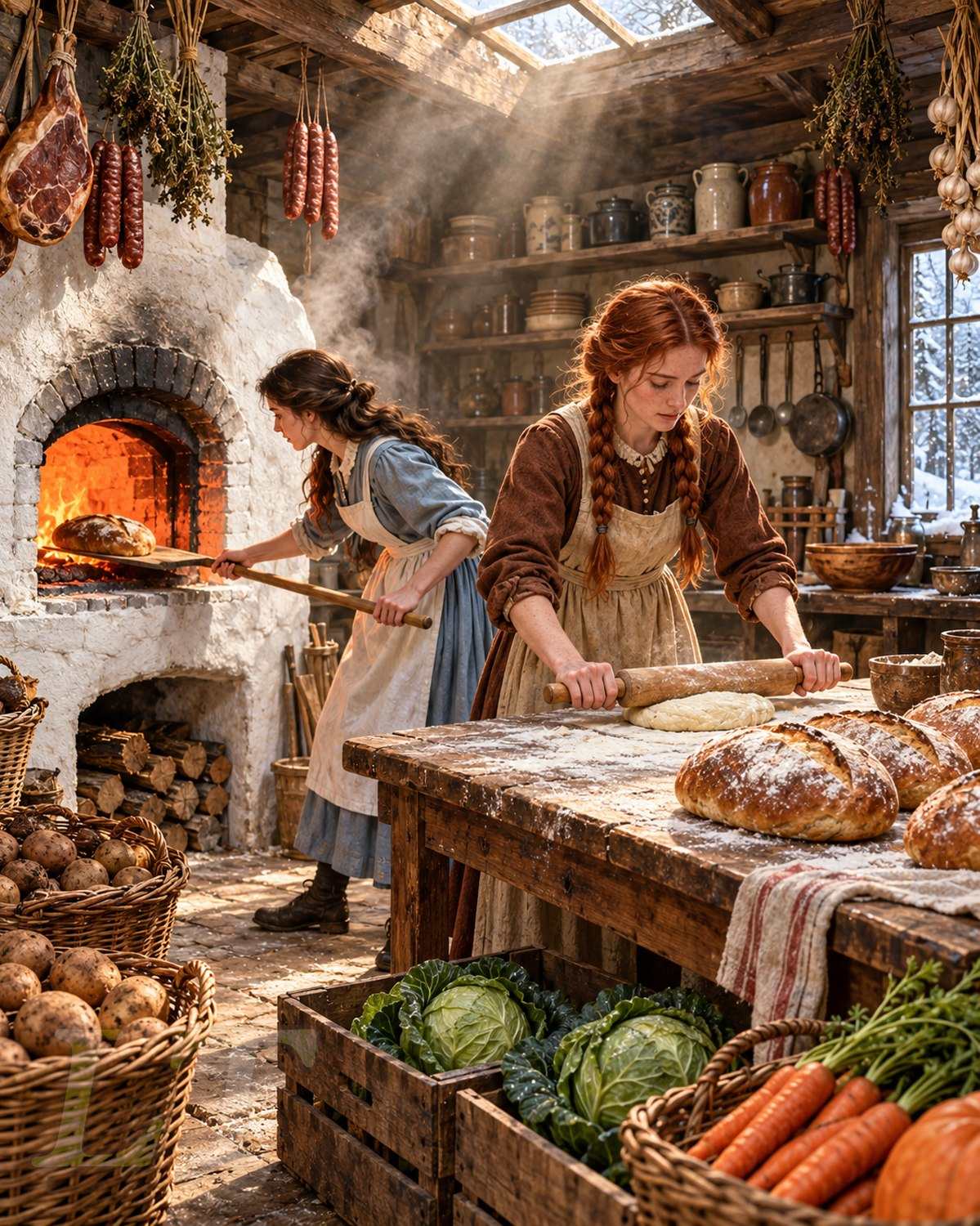
We worked through the night to protect the garden.
Maeve moved the smallest plants into wooden containers.
I collected stones and placed them along the edge of the growing area.
We redirected the water into a lower section of the chamber.
The work was exhausting.
Every time we thought the flow had slowed, another small stream appeared.
By dawn, the garden was wet but not destroyed.
The cabbage plants had survived.
The herbs were still standing.
Some of the carrot seeds had been washed away.
Maeve examined the damage.
She looked tired and disappointed.
But she did not cry.
"We can replant."
I nodded.
"We'll find a better way to control the water."
I examined the new crack.
It was not a major opening.
But it suggested that another water channel was running behind the wall.
The mountain was changing around us.
Or perhaps we were only beginning to understand its natural movement.
I marked the location.
Then I followed the stream toward the lower passage.
It disappeared beneath a natural stone ledge.
I crouched and listened.
The sound was steady.
There was more water than before.
Maeve joined me.
"Could we use it?"
"Possibly."
"For the garden?"
"If we can control it."
She looked at the narrow channel.
"We need something to keep the water away from the roots."
I examined the available materials.
We had stones.
Wood.
Clay.
And a limited amount of metal from our cooking supplies.
We could build a simple diversion channel.
It would not be perfect, but it might prevent another flood.
We spent the next two days constructing it.
I arranged the stones.
Maeve prepared the clay mixture.
We tested the flow with small amounts of water.
The first attempt leaked.
The second overflowed.
The third worked better.
The water now passed along the outer edge of the growing area and collected in a shallow basin.
We could use some of it for washing and irrigation.
The rest continued toward the lower passage.
The garden was safe again.
More importantly, we had learned something about the mountain.
Its warmth and water were connected.
The same natural system that protected us from freezing could also create unexpected problems.
We needed to respect it.
After the repairs, Maeve returned to planting.
She replaced the lost seeds.
She moved the cabbage plants to slightly higher ground.
The herbs were placed near the daylight opening.
The carrots were planted in a deeper section of soil.
We also began experimenting with potatoes.
Maeve had brought only a few small pieces that had started developing eyes.
She cut them carefully and planted them separately.
We did not know whether the conditions would support them.
But we had learned not to dismiss possibilities too quickly.
Our days became increasingly structured.
We woke.
Checked the garden.
Collected water.
Prepared food.
Maintained the oven.
Recorded the temperature.
Inspected the entrance.
Then we rested.
It was not an easy life.
We still had limited clothing.
Our shoes were wearing down.
The food supply remained uncertain.
But we were no longer helpless.
One afternoon, while checking the outer passage, I discovered something unexpected.
A narrow section of the entrance had become visible again.
The snow had settled.
The opening was larger than it had been during the previous week.
I could see a pale strip of daylight beyond it.
I hurried back to Maeve.
"The entrance is opening."
She looked up.
"Can we leave?"
"Not yet."
"Why not?"
"The snow above it is still unstable."
She nodded.
We approached cautiously.
The outside world looked almost entirely white.
The ravine had disappeared beneath deep snow.
The trees were bent under the weight.
The sky was pale and heavy.
But the storm had weakened.
For the first time since entering the mountain, we could hear birds.
A distant sound.
Faint.
But unmistakable.
Maeve stood beside me.
"Spring?"
"Not yet."
"But it's coming."
I looked toward the valley.
I could not see Promise Creek from our position.
The mountains blocked the view.
Still, I wondered what the people below were doing.
Had they already assumed we were dead?
Had Silas told everyone that we had disappeared?
Had Reverend Miller offered prayers for two young women he had helped drive away?
I wondered whether anyone had searched the ravine.
The thought made my stomach tighten.
Maeve noticed.
"What is it?"
"Nothing."
She looked at me.
"You were thinking about them."
I did not answer.
She turned toward the entrance.
"They chose to leave us there."
"Yes."
"Then why do you keep wondering what they think?"
I looked at her.
Because I was still human.
Because ten years of living in one house did not disappear simply because someone closed a door.
Because a part of me still wanted to understand why our own family had considered us disposable.
But I did not say any of that.
Instead, I said, "I want to know what is happening in the valley."
Maeve nodded.
"So do I."
We returned to the main chamber.
That evening, we prepared bread with herbs from the garden.
The first harvest was small.
But the flavor was extraordinary.
The fresh leaves gave the bread a pleasant smell.
We ate beside the oven.
Maeve looked toward the growing chamber.
"We should make a bigger garden."
I considered it.
"We need more containers."
"We can make them."
"We need more soil."
"There's plenty behind the western passage."
"We need more light."
She looked toward the natural opening.
"Maybe we can improve the planting arrangement."
I smiled faintly.
"You've already decided."
"Yes."
We began planning the expansion.
I drew a larger map.
Maeve divided the growing area into sections.
We considered where to place cabbages, carrots, potatoes, and herbs.
We also discussed preserving food.
If the garden produced enough vegetables, we could dry some and store others.
We would need proper containers.
We would need additional wood.
We would need to make better shelves.
Every improvement created another task.
But that was a good problem.
It meant we were planning for a future.
A future we had not expected to have.
A few days later, we discovered another advantage of the chamber.
The air near the upper opening remained relatively dry.
Maeve hung a bundle of herbs there.
They began drying naturally.
We placed a few pieces of bread nearby to test how quickly they lost moisture.
The results were encouraging.
We began using the upper shelf for drying herbs and preserving small amounts of food.
The underground home was becoming increasingly practical.
One evening, while organizing our remaining belongings, Maeve found a folded piece of paper in her clothing.
She opened it.
It was an old note from our mother.
I had forgotten she carried it.
The handwriting was faded.
The paper had been folded so many times that the edges were almost torn.
Maeve read it silently.
Then she passed it to me.
It contained only a few sentences.
Our mother had written it years earlier, shortly before her illness became serious.
She had reminded us to care for each other.
To remain curious.
And never to allow another person's fear to determine what we believed about ourselves.
I read the words twice.
Then I folded the paper carefully.
Maeve sat beside me.
"Do you think she knew?"
"About what?"
"That we would end up somewhere like this?"
I shook my head.
"No."
"Then why did she write that?"
I looked at the note.
"Perhaps she knew people wouldn't always understand us."
Maeve lowered her eyes.
For a long moment, we sat quietly.
Then she reached for my hand.
"Promise me something."
"What?"
"If we ever get the chance to leave this mountain, we won't let them make us feel ashamed again."
I squeezed her hand.
"I promise."
She looked toward the garden.
"And we won't tell anyone about the warm chambers until we know what we're dealing with."
I understood.
Our discovery could change everything.
People who had mocked our growing frame might suddenly become interested in our knowledge.
People who had called us unnatural might want to take control of what we had built.
And Silas might claim that the mountain belonged to him simply because he had once been our guardian.
We had no intention of giving anyone the power to take our home away.
I looked at the map.
At the word BREATH.
Then at the little garden growing beneath the mountain.
"We keep it to ourselves," I said.
Maeve nodded.
Outside, the snow continued falling.
Inside, the fire burned steadily.
Neither of us knew that far below the mountain, rumors about our disappearance had already begun changing.
Some people believed we had died.
Others claimed we had escaped to another territory.
And Reverend Miller had begun telling the congregation that our disappearance was a warning against disobedience.
But one person had started asking questions.
Silas.
He had discovered something missing from our old room.
Something he had not noticed before.
My geological notebook.
And inside its last pages was a drawing of the northern ridge.
Alongside the drawing was the word that would eventually bring the entire town to our door.
BREATH.






Comments 0