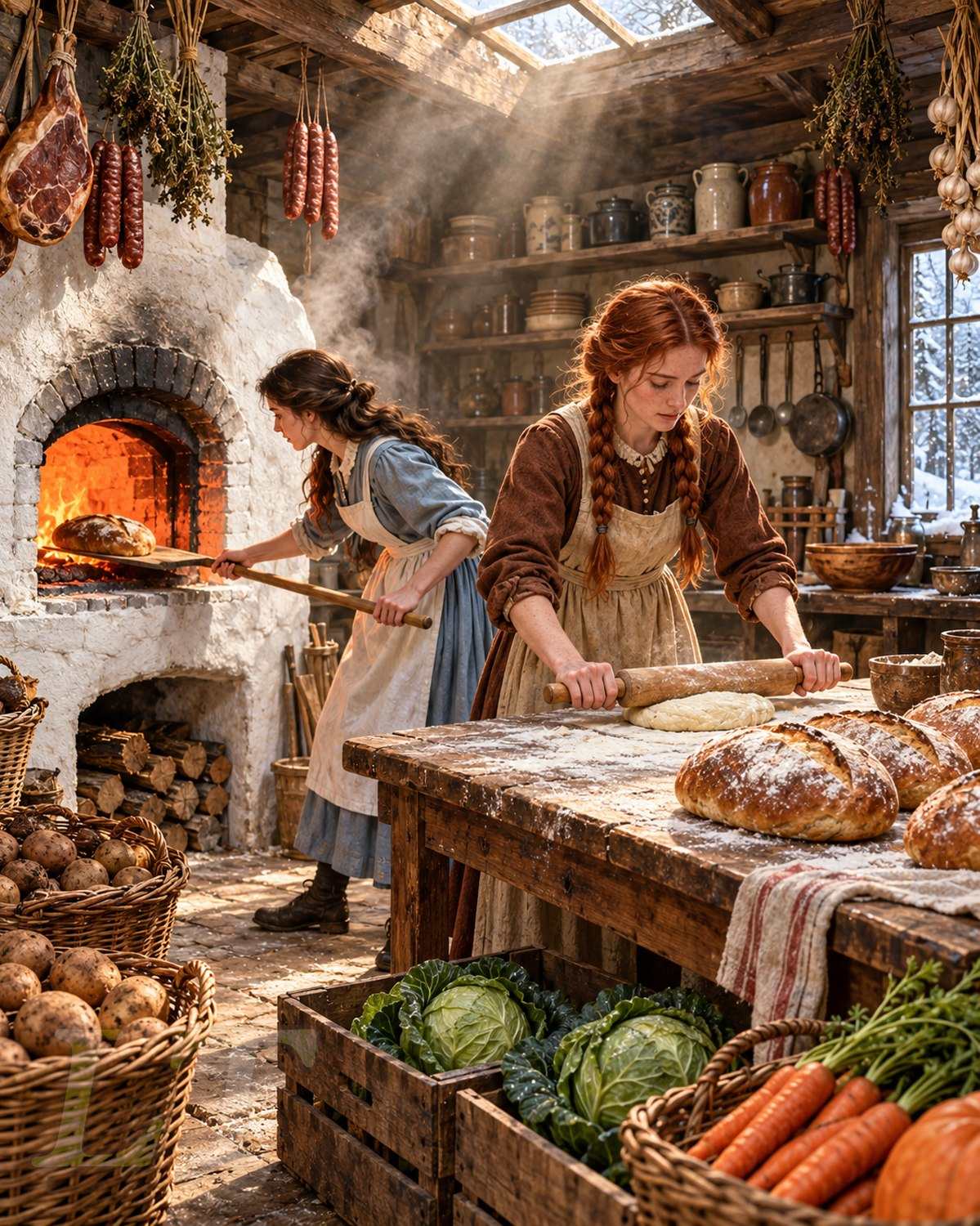
By the beginning of the fourth month, we had learned that survival was not a single victory.
It was a collection of small decisions.
Every morning, we checked the water.
Every afternoon, we inspected the garden.
Every evening, we counted our food.
And every night, we made certain the fire was safe.
The garden was producing vegetables, but not enough to allow careless eating.
Maeve became increasingly strict about harvesting.
She refused to cut a cabbage before it had developed properly.
She kept the strongest plants for producing seeds.
She stored the potatoes carefully.
She also began drying herbs in small bundles.
Our underground home had become more comfortable, but food remained our greatest concern.
The first serious warning came when Maeve opened the flour sack.
There was almost nothing left.
She turned it upside down.
A small amount of flour fell into the wooden bowl.
She stared at it.
"That's all?"
I looked inside.
"Yes."
"How many loaves?"
"Perhaps two small ones."
She closed the sack.
We had known this moment would come.
Our original supplies had never been enough for a long winter.
We had survived by rationing, growing vegetables, and using every resource available.
But bread had become an important part of our meals.
Without flour, our oven would become less useful.
"We need to find more food," Maeve said.
I nodded.
The storm outside had weakened.
We could finally consider exploring the surrounding mountain.
I examined the entrance.
The snow remained deep, but the passage was no longer completely blocked.
We agreed to make a short trip when the weather became stable.
We would not travel far.
We would simply search for dry wood, edible plants, and anything that might help us preserve food.
Maeve prepared our belongings.
She packed the small knife, two cloth bags, and a little water.
I carried the map and rope.
Before leaving, we checked the oven.
The fire was extinguished.
The food was secured.
The garden was protected from excessive water.
Then we stepped outside.
The cold struck immediately.
After months underground, the open air felt almost overwhelming.
The ravine had changed.
Snow covered everything.
The trees were bent beneath the weight.
Several branches had broken.
The entrance was partly hidden by snowdrifts.
I looked toward the sky.
It was pale and cloudy, but the wind was relatively calm.
We moved slowly.
The first thing we found was a collection of dry branches beneath a fallen tree.
Maeve gathered what she could.
I examined the surrounding area.
There were no signs of recent human activity.
No footprints.
No broken equipment.
No evidence that anyone had entered the ravine.
We continued toward a sheltered section near the cliff.
There, we found more wood.
We also discovered several plants that had survived beneath the snow.
Maeve examined them carefully.
She identified a few familiar varieties.
We collected only what we knew was safe.
Nothing was worth risking our health.
After several hours, our bags were full.
We returned to the entrance.
The journey had exhausted us.
But it had provided something important.
A reminder that the mountain offered resources beyond the chamber itself.
Over the next few days, we made several short trips.
We collected dry wood.
We found more edible plants.
We also discovered a small area where the snow melted more quickly than elsewhere.
The ground beneath was damp.
Maeve believed the warmer conditions might support additional planting later.
I marked the location.
We began expanding our plans.
Then, just as we were starting to feel secure, Maeve became ill.
It began with a headache.
She complained of dizziness.
By evening, she was shivering.
I checked her forehead.
She was warm.
Too warm.
I made her drink water and rest.
The next morning, she was worse.
Her appetite disappeared.
She barely touched the vegetable broth I prepared.
I sat beside her.
"How do you feel?"
"Terrible."
"Can you drink?"
She nodded.
I gave her water.
I was frightened.
We had no doctor.
No medicine beyond the small supplies we had brought.
And the nearest settlement was far away.
I examined her carefully.
She had no obvious injury.
Her breathing was steady, but she was exhausted.
I made certain she remained warm and rested.
I also increased the ventilation in our sleeping area.
We could not afford to create another problem while trying to keep her comfortable.
For two days, I barely slept.
I watched her breathing.
I prepared broth.
I brought water.
I kept the fire controlled.
On the third morning, she finally sat upright.
"Elspeth?"
I hurried toward her.
"What?"
"I'm hungry."
I nearly laughed with relief.
I brought her the remaining cabbage broth.
She ate slowly.
Then she asked for a small piece of bread.
I gave her the last portion.
She looked at me.
"What are you eating?"
"I'm fine."
She frowned.
"Don't lie."
I sat beside her.
"We'll make more food."
She shook her head.
"We need flour."
"I know."
She looked toward the garden.
"Perhaps we can make something from the potatoes."
That afternoon, we experimented with a simple potato mixture.
Maeve mashed the cooked potatoes and mixed them with a small amount of flour.
The result was not bread.
But it was filling.
We cooked small portions on the heated stone.
The first one fell apart.
The second held together.
We ate it with herbs.
It became another addition to our limited menu.
We also began experimenting with drying vegetables.
Maeve sliced carrots and cabbage into thin pieces.
We placed them in the driest section of the chamber.
The process was slow, but it worked.
Our supplies became more diverse.
We were still vulnerable.
But we were learning.
By the fifth month, the garden had expanded.
The potatoes were producing healthy growth.
The cabbages were larger.
The herbs had spread into several small planting beds.
We had enough to preserve a little food for later.
And then something unexpected happened.
One morning, Maeve found a small animal near the outer passage.
It was a rabbit.
It had entered through a narrow opening and become trapped behind a fallen branch.
Maeve approached slowly.
The animal was frightened.
She carefully moved the branch and allowed it to escape.
I watched her.
"That could have been food."
She looked at me.
"It could also have been something trying to survive."
I nodded.
We did not chase it.
Instead, we examined the opening.
It might provide another source of natural ventilation.
But it also meant small animals could enter.
We decided to secure the lower section without blocking the airflow.
The following week, we discovered something even more useful.
A small patch of wild edible plants had survived beneath the snow near the southern cliff.
Maeve collected a few leaves.
She examined them carefully before identifying them.
We brought them back and tested a small amount.
They were safe.
The discovery did not solve every problem.
But it reminded us that the mountain was not entirely barren.
There was life outside.
There was life inside.
And we were learning to work with both.
One evening, Maeve sat beside the oven.
She held a small piece of potato bread.
"I used to think surviving meant getting through one more day."
I looked at her.
"What do you think now?"
She glanced toward the garden.
"I think it means building something that can last beyond us."
I understood.
We were no longer simply trying to stay alive.
We were building a place where life could continue.
But that same evening, I noticed something outside the entrance.
A small piece of wood had been placed against the limestone.
It was not from our collection.
It was not something we had dropped.
Someone had left it there.
I picked it up.
There was a fresh cut across one end.
And beside it, pressed into the snow, was a human bootprint.






Comments 0