The first man through the entrance dropped his lantern.
"Good Lord!"
Silas stood behind him, staring into the underground chamber.
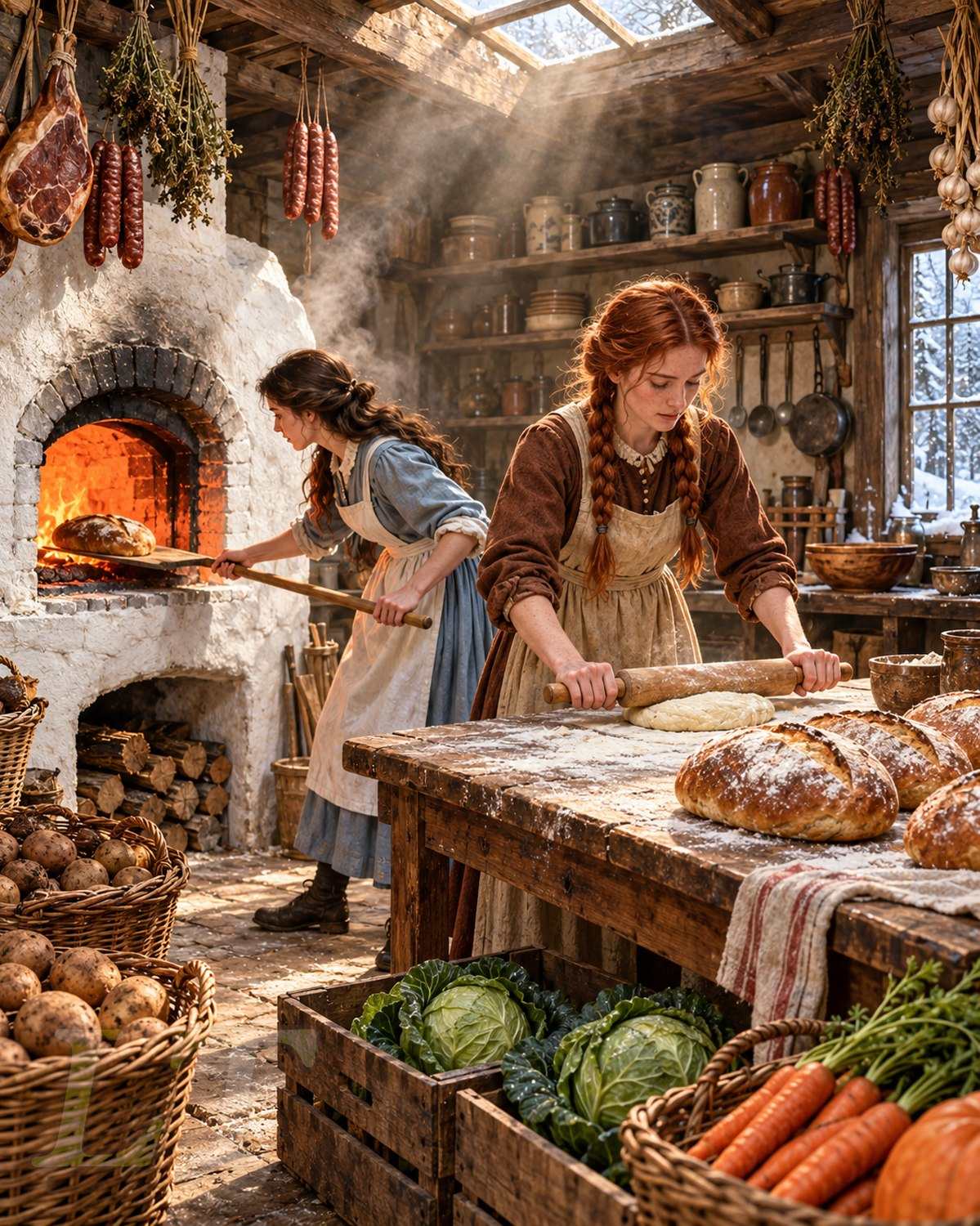
A stone oven was burning.
Fresh bread rested on a wooden table.
Green cabbages filled carefully arranged growing boxes.
And two young women stood beside the oven, watching the men who had once believed they would never see them again.
For several seconds, nobody moved.
I recognized my uncle immediately.
His beard had grown longer, his shoulders seemed narrower, and his face carried the exhaustion of a man who had spent too many nights remembering something he wished he could undo.
Beside him stood Reverend Miller.
Behind them were two hunters and several townspeople.
They had climbed the mountain expecting to find our remains.
Instead, they had found a home.
Maeve stood beside me.
Her honey-blonde braids rested over her burgundy dress, and her hands were lightly dusted with flour.
I wore my forest-green wool dress and leather apron.
Neither of us looked like the frightened girls who had disappeared into the blizzard months earlier.
We looked like women who had learned to survive.
Silas took one step forward.
"Elspeth?"
I did not answer immediately.
He looked at Maeve.
Then back at me.
"You're alive."
Maeve folded her arms.
"Apparently."
One of the hunters slowly removed his hat.
"How in God's name did you survive down here?"
I looked toward the stone oven.
"One day at a time."
The man stared at the garden.
"Those vegetables..."
"Maeve grew them."
He walked closer to the wooden boxes.
He examined the cabbage leaves.
Then he touched the soil.
It was dark, moist, and unmistakably warm.
"These are growing inside the mountain?"
"Yes," Maeve answered.
"But there's no sunlight."
"There is some daylight from the opening above," I explained. "The warmth comes from the natural conditions inside the limestone formation. We learned where the air moves, where the water flows, and which areas are suitable for planting."
The hunter looked at his companion.
Neither seemed able to understand what they were seeing.
Then Silas spoke again.
"Girls, you must come home."
Maeve turned toward him.
"Our home is here."
His face tightened.
"I didn't mean it that way."
I looked directly at him.
"Then what did you mean?"
He glanced at the oven.
At the vegetables.
At the wooden shelves filled with preserved food.
"I thought you were dead."
The words came out quietly.
For a moment, I felt something move inside me.
Not forgiveness.
Not anger.
Something more complicated.
"You knew there was a blizzard coming," I said.
Silas lowered his eyes.
"Yes."
"You knew we had nowhere to go."
"Yes."
"You gave us enough food for perhaps three days."
He did not answer.
"And then you closed the door."
Maeve stepped forward.
"You didn't even watch to see which direction we went."
Silas's shoulders dropped.
"I know."
The chamber became silent.
Reverend Miller moved closer.
"Perhaps this is not the time to revisit old grievances."
Maeve turned toward him.
"Then perhaps you should not have come."
The reverend looked uncomfortable.
I had never seen him speechless before.
He glanced at the garden.
Then at the oven.
Finally, his eyes settled on the small table.
There were two cups beside the bread.
Two wooden bowls.
Two folded pieces of cloth.
Everything in the chamber showed evidence of careful work.
He seemed to understand that we had not simply hidden here.
We had built something.
"How long have you been living here?" he asked.
"Months," I replied.
"And you have been growing food all this time?"
"Yes."
He looked at Maeve.
"How?"
She explained the soil, the temperature differences, the water, and the natural opening.
She described the experiments that had failed.
The plants that had died.
The seeds that had survived.
The way she had gradually learned which crops could grow in different sections of the chamber.
The reverend listened.
For the first time, he seemed genuinely interested in our knowledge.
When she finished, he looked toward the wooden planting boxes.
"I was wrong about you."
Maeve did not respond.
He continued.
"I told people your experiments were dangerous. I encouraged Silas to believe that your work was something shameful."
I felt my jaw tighten.
"You did more than that."
He nodded.
"Yes."
He removed his hat.
"I was afraid of what I did not understand. I mistook my fear for wisdom, and I allowed other people to suffer because of it."
Maeve looked at him for a long moment.
Then she said something I had never expected to hear.
"Being afraid doesn't excuse what you did."
The reverend lowered his head.
"No. It doesn't."
Silas moved closer to the wooden table.
He noticed the folded geological map.
It was the same map he had seen in his house.
He picked it up carefully.
His fingers moved across the markings.
BREATH.
The word was still there.
He looked at me.
"You found it because of this?"
"Yes."
He examined the drawing.
Then he looked around the chamber again.
"I sent you away from my house," he whispered.
I waited.
"And you found all this."
"We found it together."
Silas placed the map down.
For a moment, he seemed unable to speak.
Then his eyes moved toward the oven.
"Is that fresh bread?"
Maeve looked at him.
"Yes."
"Could I..."
He stopped.
Perhaps he finally understood that he had no right to ask.
Maeve looked at the loaf.
Then at me.
I gave her a small nod.
She cut a modest slice and placed it on a wooden plate.
Silas accepted it with both hands.
He broke off a piece.
The steam rose between his fingers.
He tasted it.
His eyes closed briefly.
"Your mother used to make bread like this," he said.
Maeve looked away.
"She taught us."
Silas swallowed.
For the first time, tears appeared in his eyes.
He did not try to hide them.
"I should have protected you."
Neither of us answered.
He placed the remaining bread on the table.
Then he looked directly at us.
"I am sorry."
The apology was not dramatic.
There was no excuse attached to it.
No attempt to blame the storm, the town, or Reverend Miller.
It was simply an admission.
But an apology could not erase the months we had spent fighting to survive.
I looked at my uncle.
"Do you understand what you did?"
He nodded.
"I do."
"Do you understand that we might not have survived?"
His voice broke.
"Yes."
"Then don't ask us to pretend it never happened."
"I won't."
Maeve approached the table.
She picked up her tin of seeds.
It was the same small container she had carried through the blizzard.
Several packets remained inside.
She opened it.
"I used to think these seeds were the most valuable things I owned."
Silas watched her.
"They helped us survive."
"They did."
She placed the tin back on the shelf.
"But the most valuable thing we brought here was our ability to work together."
She looked at me.
"We didn't abandon each other."
I took her hand.
That was the truth.
Our uncle had closed his door.
The town had turned away.
The storm had nearly destroyed us.
But we had never let go of each other.
One of the hunters suddenly spoke.
"There's something else you should know."
We turned.
He removed a folded piece of paper from his coat.
"We weren't the first people to search the mountain."
Silas looked at him.
"What do you mean?"
"Several men from the valley came up here weeks ago. They found the ravine, but the snow had covered the entrance."
He looked toward the narrow passage.
"We nearly turned back today."
My stomach tightened.
"Why?"
"Because the weather was getting worse. But Silas insisted."
The hunter paused.
"Your uncle said he had to find you, even if he never made it back down."
I looked at Silas.
He lowered his eyes.
I did not know what to say.
Then Maeve noticed something.
The men were still standing near the entrance.
Their coats were covered with snow.
Their faces were pale from the cold.
One of them was rubbing his hands together.
"You're freezing," she said.
The hunter laughed weakly.
"We've been climbing since dawn."
Maeve looked toward the oven.
"Sit down."
The men hesitated.
She pointed toward the wooden benches.
"There's room."
They slowly removed their gloves and sat.
I brought water.
Maeve cut bread.
We prepared a simple vegetable broth using cabbage, potatoes, and dried herbs.
The hunters watched us work.
They seemed astonished that two women who had been presumed dead could offer them a meal.
But we did not think about that.
They were cold.
They were tired.
And they needed food.
The same people who had once believed we did not belong in their town were now sitting in our kitchen.
I placed the bowls on the table.
Silas accepted one.
Reverend Miller bowed his head.
Nobody said anything for several moments.
Then the older hunter tasted the broth.
He looked at Maeve.
"That's the best thing I've eaten all winter."
She smiled faintly.
"It's mostly cabbage."
"Then I owe cabbage an apology."
For the first time, laughter filled the chamber.
Even Silas managed a small smile.
But the most important conversation came after the meal.
The hunters began asking questions about the mountain.
They wanted to know whether the warmth came from underground water.
They asked whether the garden could support more vegetables.
They wondered whether the chamber was safe during severe weather.
I answered as carefully as I could.
We had learned a great deal.
But we had also learned that the mountain required respect.
There were unstable passages.
Water channels could change.
Some areas were too damp.
Others had poor ventilation.
The natural opening needed to remain clear.
The oven required careful management.
And nobody should enter the deeper passages without proper equipment.
The hunters listened.
One of them suggested that the town might benefit from our knowledge.
Maeve looked at him.
"Why?"
He seemed surprised.
"Because people are struggling."
"So are we."
He lowered his eyes.
I understood what he meant.
Promise Creek had suffered through the winter.
Families had lost crops.
Food was becoming scarce.
Several elderly residents were struggling to keep warm.
Our discovery could help them.
But we were not prepared to hand over everything simply because the town had finally become interested.
I stood beside the table.
"We are willing to share what we have learned."
The men looked at me.
"But there are conditions."
Silas nodded.
"Of course."
"First, nobody takes our home from us."
"Agreed," the hunter answered.
"Second, nobody enters the deeper passages without our permission and proper precautions."
"Agreed."
"Third, Maeve's work with the garden belongs to Maeve. Our knowledge is not something people can take and claim as their own."
The older hunter looked toward her.
"That seems fair."
"And finally, we will not be treated as strange or dangerous because we understand something other people don't."
Reverend Miller lowered his head.
"You should never have been treated that way."
I looked at him.
"No. We shouldn't."
The agreement was simple.
But it meant something.
For the first time, people from Promise Creek were listening to us instead of deciding what we were allowed to say.
Before leaving, the hunters promised to return with supplies.
They would bring additional flour, tools, dry wood, and proper materials for repairing the entrance.
Silas offered to help.
He did not ask whether we would return to his house.
He did not demand that we forgive him.
He simply asked what needed to be done.
I looked toward Maeve.
She nodded.
"There is plenty of work."
The following morning, the men returned.
They brought supplies and additional help.
But this time, they came with respect.
The first task was reinforcing the entrance.
The second was repairing the damaged section near the upper opening.
The third was improving the storage area.
Silas worked quietly.
He carried stones.
He repaired shelves.
He brought wood.
He listened whenever we explained what needed to be done.
Several times, I caught him looking at the old map.
He seemed amazed by how much we had discovered.
But the moment that changed everything came when Reverend Miller asked Maeve to teach him how the underground garden worked.
Maeve looked at him.
"You want to learn?"
"Yes."
"Why?"
He considered the question.
"Because I have spent too much of my life telling people what they should believe without taking the time to understand what they have discovered."
Maeve studied him.
Then she handed him a small wooden tool.
"Start by loosening that soil."
The reverend rolled up his sleeves.
And for the first time, the man who had once warned the town against our experiments was kneeling beside our cabbage plants, learning how to care for them.
It was a small victory.
But a meaningful one.
Over the following weeks, the relationship between the mountain shelter and Promise Creek changed.
The townspeople began visiting with supplies.
Some brought flour.
Others brought tools, blankets, and seeds.
A local carpenter helped us build stronger shelves.
A farmer brought several varieties of vegetables for Maeve to experiment with.
In return, we taught them how to protect seedlings from frost, preserve vegetables, and use simple growing frames.
Maeve became increasingly respected.
People who had once whispered about her now came to ask questions.
She never boasted.
She simply demonstrated what she knew.
I continued studying the limestone formation.
With the help of the hunters, I mapped additional passages and identified safer routes.
We also improved the ventilation and water channels.
The shelter became more secure.
Silas changed too.
He began visiting regularly.
At first, Maeve avoided speaking to him unless necessary.
I did not blame her.
Trust could not be restored simply because someone had finally apologized.
But he kept showing up.
He worked without expecting praise.
He brought supplies without asking for anything in return.
And whenever Maeve explained something about the garden, he listened.
One afternoon, he arrived carrying a small wooden box.
He placed it on the table.
"I found this in the old house."
Maeve opened it.
Inside were several things that had belonged to our mother.
A pair of small silver earrings.
An old ribbon.
A handwritten recipe book.
And a photograph of the three of us taken shortly before our parents died.
Maeve picked up the photograph.
Her fingers trembled.
"Why did you keep these?"
Silas looked down.
"I couldn't throw them away."
I examined the photograph.
Our mother stood between us.
We were children, perhaps ten years old.
She had one arm around each of us.
For a moment, the years seemed to disappear.
Maeve held the photograph against her chest.
Silas spoke quietly.
"I should have given these to you long ago."
Maeve looked at him.
"Yes."
He nodded.
Then he stepped back.
He did not ask for forgiveness.
But Maeve surprised both of us.
"Would you like some bread?"
Silas looked up.
"Yes."
She cut a slice.
Then she placed it on a plate and handed it to him.
It was not a complete reconciliation.
Not yet.
But it was a beginning.
As the winter finally weakened, the underground garden continued producing food.
The cabbage leaves grew larger.
The potatoes became stronger.
The herbs spread across the planting beds.
The oven remained warm.
And the mountain continued breathing.
One morning, I walked toward the entrance alone.
The snow had begun melting.
Small patches of earth were visible between the rocks.
Water moved down the ravine.
I looked toward the valley.
Promise Creek was waking from winter.
Smoke rose from the houses.
People moved along the road.
The church bell rang in the distance.
Maeve joined me.
She carried two small cups of warm tea.
She handed one to me.
"Beautiful, isn't it?"
I nodded.
For months, we had believed the mountain was the only place in the world where we could be safe.
Now we understood that the world outside could change too.
Not because everyone had suddenly become kind.
Not because the past had disappeared.
But because people had finally begun to recognize the value of what they had once rejected.
Maeve looked at me.
"Do you ever wish we had gone back that first night?"
I thought about the frozen ravine.
The hunger.
The fear.
The moment her hand had touched the warm stone.
"No."
She smiled.
"Neither do I."
We returned to the main chamber.
The oven was burning.
Fresh bread was cooling on the table.
The garden was green.
Silas was repairing a wooden shelf.
Reverend Miller was carefully watering the seedlings.
The hunters were organizing supplies.
Nobody was shouting.
Nobody was accusing us.
Nobody was telling us that we did not belong.
I looked around the room.
This was the place where we had nearly died.
It was also the place where we had discovered what we were capable of.
Later that spring, the people of Promise Creek helped us establish a small community growing project near the mountain entrance.
Maeve taught families how to protect their crops from frost.
I showed several local farmers how to recognize different limestone formations and locate naturally sheltered areas.
We made it clear that the underground chamber would remain our private home.
The town respected that agreement.
Silas eventually repaired the old house and began helping families who had lost their food stores during the winter.
He never again spoke of our knowledge as something unnatural.
And Reverend Miller changed the way he spoke about people he did not understand.
As for Maeve and me, we remained in the mountain.
We built a larger wooden table.
We added more shelves.
We expanded the garden.
We planted additional cabbages, carrots, potatoes, and herbs.
We also kept a small place beside the oven for our mother's photograph.
One evening, several months after the discovery, Maeve placed a freshly baked loaf on the table.
She brushed flour from her hands.
Then she looked toward the warm stone floor.
"Do you remember the first time I touched it?"
I nodded.
"You said my name."
"And you looked as though you had seen a ghost."
I laughed.
She broke the bread.
The crust cracked softly.
Steam rose from the center.
Outside, the mountains were green again.
Inside, the fire burned steadily.
I looked at my sister.
"Do you know what I think?"
"What?"
"I think the mountain saved us because we refused to give up on each other."
Maeve considered that.
Then she shook her head gently.
"No, Elspeth."
She placed half the bread in my hands.
"We saved each other."
I looked at her.
She was right.
The mountain had given us shelter.
The water had given us life.
The garden had given us food.
But it was our love, our patience, and our determination that had carried us through the worst winter of our lives.
We had entered that cave as two frightened young women with almost nothing.
We had emerged with a home, a purpose, and a future.
And the town that had once watched us disappear into the snow now knew our names for a very different reason.
They no longer called us strange.
They called us the sisters who found warmth beneath the mountain.
But Maeve and I preferred a simpler description.
We were sisters.
We were survivors.
And we were finally home.






Comments 0