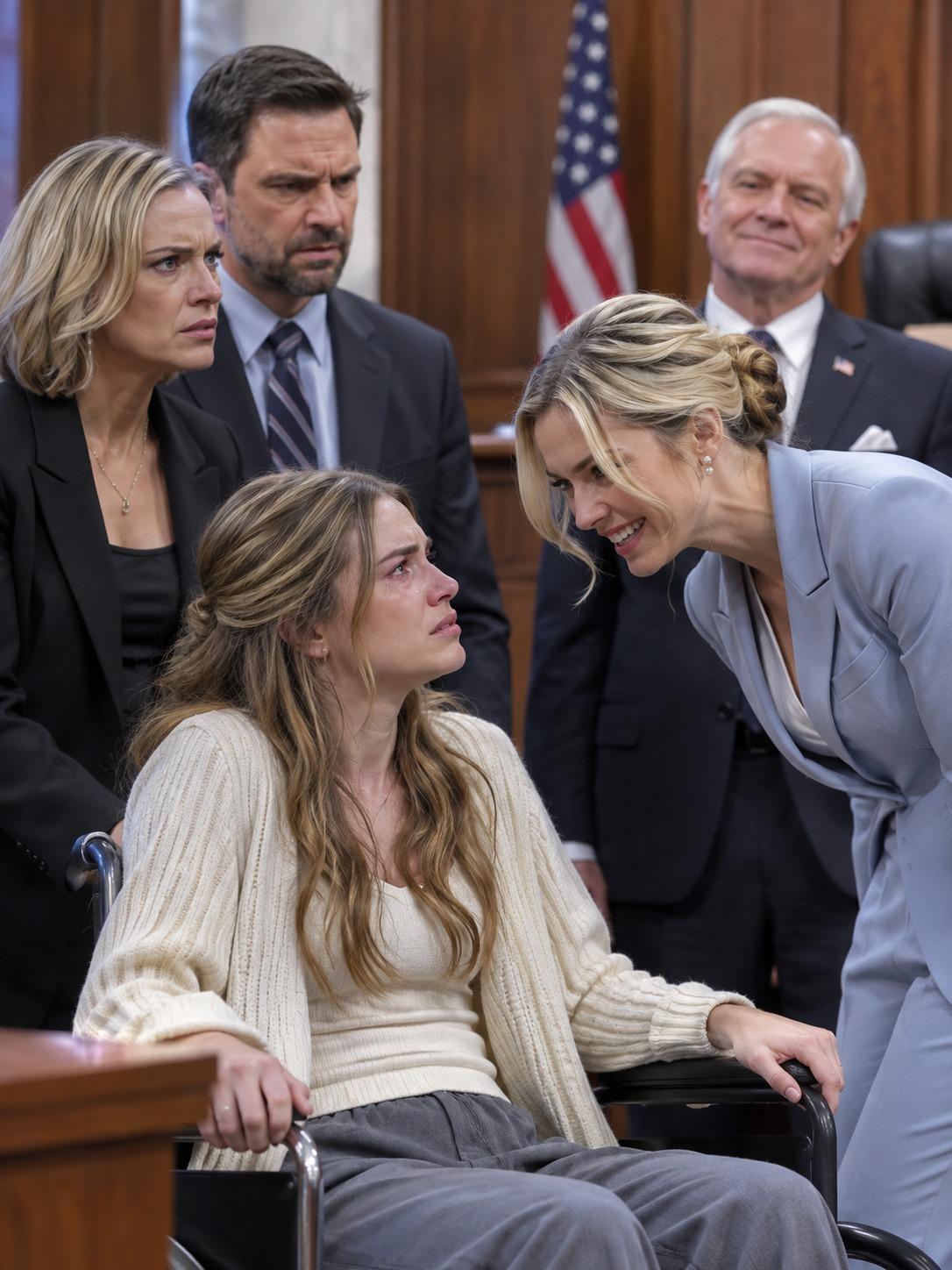
"IF ANOTHER GIRL COMES FORWARD, HANDLE IT BEFORE THE POLICE DO."
I read the sentence three times.
Then I asked Tessa's attorney to repeat it.
He did.
The handwritten note had been attached to a confidential settlement agreement involving Chloe, a university student who had reportedly suffered a serious injury four years earlier.
The agreement had been signed by her family and a company connected to Senator Alaric's political associates.
The payment authorization came from someone inside the senator's office.
And now, years later, another young woman had been left permanently injured after an encounter with Sutton.
I looked across my office.
Hayes was standing near the door, his arms folded.
"Tell me that isn't what I think it is," he said.
"I don't know what it is yet."
"Vesper."
"I need to see the documents."
The attorney explained that the original materials were being preserved and reviewed by the legal team. We would receive copies through the appropriate process.
I asked him to make sure the handwritten note was included.
He promised he would.
Then I ended the call.
Hayes walked toward my desk.
"How many girls?"
I looked at the photograph of Jovi on the wall.
"I don't know."
"Do you think Chloe was attacked by Sutton too?"
"I don't know that either."
He rubbed his face.
"How can someone do this more than once?"
I didn't answer.
Because I had begun asking myself a different question.
How many times could a powerful family make a problem disappear before someone noticed the pattern?
At nine the following morning, Daria arrived at the civil litigation firm's office.
She had spoken with Tessa's attorney and arranged a formal review of the newly discovered records.
The conference room contained four people.
Daria.
Two civil attorneys.
And me.
Tessa joined by secure video with her own lawyer.
She looked frightened.
"Before we start," one of the attorneys said, "I want everyone to understand that these records are being reviewed for authenticity and legal relevance. We are not making conclusions beyond what the documents support."
Tessa nodded.
Then she shared her screen.
The first file was an invoice.
The date was four years earlier.
The recipient was a company called Northbridge Resolution Services.
The amount was $175,000.
The description read:
CONFIDENTIAL DISPUTE RESOLUTION — EDUCATIONAL INCIDENT.
Daria leaned forward.
"Who authorized it?"
Tessa opened the next page.
A payment approval form appeared.
The signature belonged to a senior administrative officer in Senator Alaric's political office.
Not the senator himself.
Not yet.
But someone who had access to the office's financial operations.
"Was this payment made directly to Chloe's family?" Daria asked.
"No," Tessa replied. "It went through Northbridge."
"Do you know who controlled Northbridge?"
Tessa opened another file.
The company's registered manager was a former political consultant who had worked with Merrick.
Daria exchanged a glance with the attorney beside her.
I studied the dates.
The agreement had been signed eleven days after Chloe's injury.
The payment had been processed three days later.
The speed was remarkable.
"What happened to Chloe?" I asked.
Tessa looked at her attorney.
He nodded.
"According to the records I found, she was injured at a private boarding school in Connecticut. There was an incident involving Sutton. The family agreed to a confidential settlement."
"Was there a police investigation?"
"I don't know."
"Was Sutton charged?"
"Not according to the records."
Daria made a note.
"Do we have the original incident report?"
"No."
"Medical documentation?"
"Only a reference to medical expenses in the settlement agreement."
I leaned back.
We were looking at evidence of a payment.
We were not yet looking at proof of what happened.
That distinction mattered.
But the connection was too significant to ignore.
"Does the agreement identify who was responsible for Chloe's injury?" I asked.
Tessa scrolled down.
A paragraph appeared.
The document referred to an unnamed student who had been involved in a physical confrontation.
There was no admission of wrongdoing.
There was no detailed description of the incident.
But the handwritten note attached to the agreement had been signed with two initials.
M.A.
I looked at the attorneys.
"Do those initials mean anything?"
One of them examined the page.
"They could refer to several people. We cannot attribute them without verification."
I nodded.
Then Tessa opened another file.
It was an internal email.
The sender was Merrick.
The recipient was a staff member in Alaric's office.
The subject line read:
CHLOE — FINAL RESOLUTION.
The email contained only two sentences.
The first said the family had accepted the proposed arrangement.
The second said the matter should not be discussed with anyone outside the approved group.
I felt my jaw tighten.
Daria looked toward me.
"Vesper, we need to get the original documents preserved through counsel."
"I agree."
Tessa's attorney closed the shared screen.
"There's something else."
Everyone looked at him.
He continued.
"My client found a second payment reference connected to Northbridge. It was issued several months after the original settlement."
"How much?" Daria asked.
"Sixty thousand dollars."
"To whom?"
He hesitated.
Then he said:
"Chloe's father."
We spent the next two hours organizing the material.
The attorneys prepared a chronology connecting the available records.
Four years earlier, a student named Chloe had been injured.
A confidential settlement had followed.
A company connected to Senator Alaric's political network had handled a substantial payment.
Merrick had been involved in communications.
The same political network later appeared in records connected to Venue Partners.
And now, after Jovi's assault, suspicious financial activity had surrounded the jury process.
The pattern was concerning.
But there was another possibility.
Perhaps Sutton had been involved in two separate incidents.
Perhaps her family had responded to each differently.
Perhaps the political network had grown accustomed to solving personal problems with money.
We needed Chloe.
More importantly, we needed Chloe to be able to speak freely.
I asked Daria whether the civil attorneys could locate her through lawful channels.
"They're already looking into it," she said.
"Can we contact her?"
"Not without considering her privacy and the circumstances of the old agreement."
I nodded.
"Then we do it properly."
Daria closed the folder.
"There's something I want you to understand."
"What?"
"If Chloe was injured and her family accepted a settlement, that doesn't automatically mean a crime was committed. The agreement may have been entirely legal."
"I know."
"But if the settlement was designed to conceal criminal conduct or interfere with an investigation, that's different."
I looked at the handwritten note.
"Then we find out which one it was."
At home, Jovi was watching a documentary about medical engineering.
She had become interested in assistive technology since her injury.
Sometimes she watched rehabilitation videos for hours, studying the movements of people using different devices.
I stood in the doorway.
"Can I come in?"
She nodded.
I sat beside her.
"What are you watching?"
"An experimental exoskeleton."
"Is it any good?"
"Depends on the patient. It's not something I could use right now."
She paused the video.
"But the engineering is interesting."
I smiled.
"That sounds like you."
She looked at me.
"What's happening with the case?"
I considered my answer.
"We found information about another incident involving Sutton."
Her expression changed.
"Another girl?"
"Possibly."
"What happened to her?"
"We're still verifying the records."
Jovi looked toward the window.
"How long ago?"
"Four years."
She remained quiet.
Then she said:
"Did they do the same thing to her?"
"I don't know."
Jovi's hands tightened around the armrests.
"Mom, if she hurt someone else, why did nobody stop her?"
I pulled my chair closer.
"That's what we're trying to establish."
She looked at me.
"Maybe she thought she could do whatever she wanted."
I didn't answer.
Because I suspected that was exactly what Sutton believed.
Jovi turned the documentary back on.
After a few minutes, she spoke again.
"Mom?"
"Yes?"
"Please don't let this become the only thing our family talks about."
I felt something tighten in my chest.
"It won't."
"I mean it."
"I know."
"I don't want to spend every day thinking about Sutton."
I reached for her hand.
"Then we won't."
She looked at me.
"Promise?"
"Promise."
I stayed with her until the documentary ended.
Then I went back to my office.
There were documents to review.
But for the next hour, I deliberately didn't open them.
I wanted my daughter to have one evening that belonged to her.
Not to Sutton.
Not to Alaric.
Not to the people who had made her life smaller.
Just Jovi.
The next morning, the rehabilitation facility called.
A representative informed me that the appeal of Jovi's insurance denial had been received.
There was no guarantee that coverage would be restored.
However, the company had agreed to review the decision again.
I asked what had prompted the review.
The representative said she couldn't discuss the internal process.
I thanked her and ended the call.
It was a small development.
But I was relieved.
At least someone had finally agreed to reconsider the decision.
Then I received another email.
This one came from the civil litigation firm's lead attorney.
The subject line read:
CHLOE — POTENTIAL WITNESS IDENTIFIED.
I opened it immediately.
The legal team had located a woman matching Chloe's name and educational history.
She was now twenty-four.
She lived in Connecticut.
She had completed a degree but had withdrawn from competitive athletics after the incident.
The attorneys had not contacted her directly yet.
They were preparing a letter explaining the nature of the inquiry and offering her the opportunity to speak with independent counsel.
I read the information twice.
Then I called Daria.
"Did you see the email?"
"Yes."
"What do you think?"
"I think we should let the attorneys handle the first contact."
"Agreed."
"Vesper, if Chloe was harmed, she deserves the same privacy we're trying to protect for Jovi."
"I know."
"And we cannot promise her that cooperation will be easy."
"I wouldn't."
Daria was quiet.
Then she said:
"There's another thing."
"What?"
"One of the attorneys found a reference to a second Northbridge payment in a political disclosure database."
I sat forward.
"Who was the recipient?"
"Not Chloe."
"Then who?"
"A university administrator."
I stared at the screen.
"Which university?"
"That's what we're trying to establish."
Two days later, the first letter was sent to Chloe.
The attorneys kept it short.
They explained that they were investigating financial arrangements surrounding an earlier incident involving Sutton.
They made clear that Chloe was under no obligation to respond.
They also offered to arrange a confidential conversation with independent legal counsel if she wished.
For forty-eight hours, nothing happened.
Then, on Friday afternoon, Daria called.
"Chloe's attorney responded."
I stood up.
"What did she say?"
"Chloe is willing to meet."
I closed my eyes.
"Good."
"But she has conditions."
"What conditions?"
"She wants to speak without anyone connected to the senator being present. She also wants assurances that her medical information will not be made public."
"That's reasonable."
"She asked whether Jovi would be attending."
I paused.
"Why?"
"I don't know."
I looked toward the hallway.
"Tell her Jovi won't be pressured into anything. If she wants to meet me and the attorneys first, we'll respect that."
Daria agreed.
The meeting was scheduled for the following Wednesday.
I spent the next few days trying not to imagine what Chloe might say.
I didn't want to turn her into a character in our investigation.
She was a real person.
She had lived through something painful.
If she wanted to speak, I would listen.
If she didn't, we would continue with the evidence we had.
On Tuesday evening, Hayes came into my office carrying a printed email.
"Have you seen this?"
I took it.
It was a message from the rehabilitation facility.
Jovi's appeal had been escalated to a senior review committee.
The company requested additional medical documentation.
Hayes sat down.
"Is that good?"
"It means they're reviewing it."
"Do you think Alaric's people are behind the denial?"
"I don't know."
He looked at me.
"You're allowed to suspect them."
"I'm allowed to suspect anyone. I'm not allowed to treat suspicion as proof."
He shook his head.
"Sometimes I think your old job made you impossible to argue with."
I smiled faintly.
"Only sometimes?"
He laughed.
Then his expression changed.
"There's something else."
"What?"
"I received a call from the school principal."
I sat upright.
"Why?"
"Someone had contacted the district office asking whether I'd been disciplined for misconduct."
I stared at him.
"Who?"
"They wouldn't tell me."
"Did they make a formal complaint?"
"Apparently not. They just asked questions."
I felt a familiar chill.
They were no longer simply trying to discourage us.
They were looking for ways to make us vulnerable.
"Hayes, document the call. Ask the district to preserve any written communication."
He nodded.
Then he looked at me.
"Do you think they'll come after Jovi?"
I didn't answer immediately.
"I think we need to be careful."
"That's not what I asked."
"I know."
He lowered his voice.
"She's already been through enough."
I reached across the desk.
"We'll protect her."
He held my hand.
Neither of us spoke for a while.
Wednesday arrived.
The meeting with Chloe was scheduled for two o'clock at the civil litigation firm's office.
Daria and I arrived early.
The lead attorney had prepared a private conference room.
There were no cameras.
No reporters.
No unnecessary staff.
At 1:47, Chloe's attorney called.
She was running late.
At 1:56, another message arrived.
Chloe was on her way.
At 2:08, the elevator opened.
A young woman stepped out.
She was tall and thin, with dark hair tied into a low ponytail.
She wore a gray sweater, black trousers, and a pair of comfortable shoes.
She walked slowly.
Her attorney was beside her.
I stood up.
"Chloe?"
She nodded.
"Yes."
"I'm Vesper."
She shook my hand.
Her palm was cold.
We entered the conference room.
She sat near the door.
Her attorney explained the purpose of the meeting and reminded her that she could leave at any time.
Daria introduced herself.
Then I sat across from Chloe.
For several seconds, nobody spoke.
Finally, Chloe looked at me.
"Is Jovi okay?"
I swallowed.
"She's recovering as best she can."
"Does she know about me?"
"She knows we found information about an earlier incident."
Chloe nodded.
Then she looked down at her hands.
"I heard about the trial."
I waited.
"I saw the news about Sutton."
Her voice became quieter.
"When I saw her photograph, I knew."
Daria leaned forward.
"Knew what?"
Chloe looked at her.
"That she hadn't changed."
The room became silent.
I studied her face.
"Chloe, you don't have to tell us anything you're not ready to discuss."
She nodded.
Then she reached into her bag.
She removed a small envelope.
"I kept something."
She placed it on the table.
"What is it?" Daria asked.
Chloe looked at me.
"Something they told my parents had been destroyed."
She opened the envelope.
Inside was a folded photograph.
It showed a young woman standing outside a boarding school.
Sutton stood beside her.
But it wasn't the photograph we had seen before.
This one showed something else.
In Sutton's hand was a customized nine-iron golf club.
And on the back of the photograph, written in black ink, was a date.
Four years earlier.
Chloe looked directly at me.
"That's not the worst part."
I felt my heartbeat quicken.
"What is?"
She turned the photograph over.
There was another handwritten sentence beneath the date.
SHE WASN'T THE FIRST GIRL.
Then Chloe reached into her bag again.
She pulled out a second envelope.
And whispered:
"Your daughter wasn't the first person Sutton tried to silence. She was just the first one whose family refused to take the money."






Comments 0