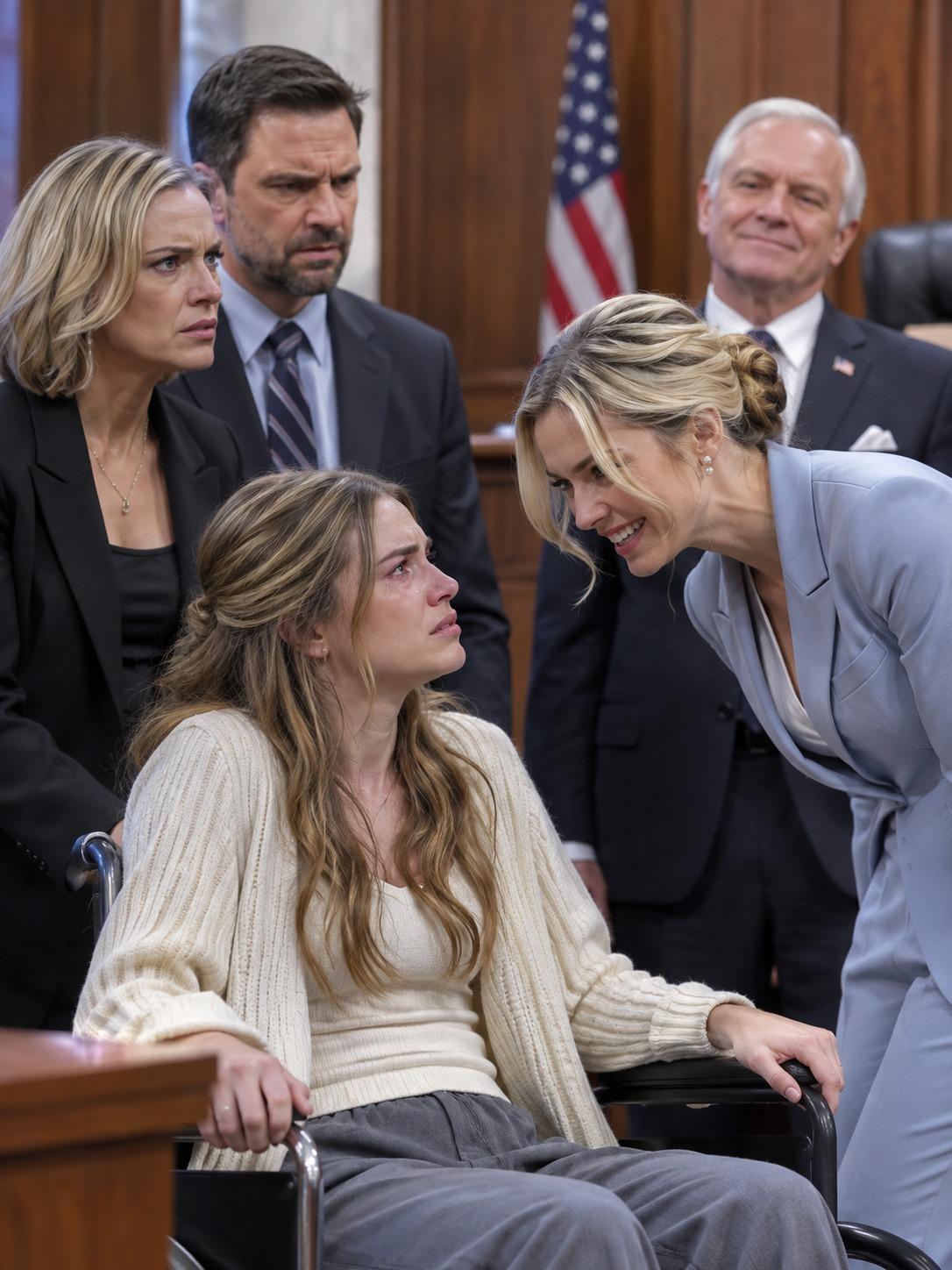
"Why did you put our daughter's name on that list?"
I stood in the middle of our kitchen, holding the document that had just arrived from the attorneys.
Hayes was standing opposite me.
His face had gone pale.
For several seconds, neither of us spoke.
The intake form carried his signature.
Five years earlier.
The applicant's name was Jovi.
And beneath the section marked FAMILY CONNECTION, someone had written a reference to Senator Alaric's educational foundation.
"Vesper," Hayes finally said. "You need to let me explain."
I placed the paper on the table.
"Then explain."
He pulled out a chair but didn't sit down.
"I didn't know what it was."
"How did you know about the foundation?"
He rubbed his forehead.
"Five years ago, Jovi applied for a summer biomedical engineering program. It was a scholarship opportunity."
I stared at him.
"She was fourteen."
"I know."
"Who gave you the application?"
"A school counselor. She said the program had private funding and that families could apply for additional educational support."
"And you signed it?"
"Yes."
"Did you read it?"
"Not carefully enough."
I felt anger rising.
"What exactly did you authorize?"
Hayes shook his head.
"The application asked for basic family information, school history, extracurricular activities, and emergency contacts. I thought it was a scholarship application."
"Did it ask about her activities?"
"Yes."
"Her athletic achievements?"
"Yes."
"Her medical history?"
He hesitated.
"I don't remember."
I picked up the document.
There was a section containing information about Jovi's athletic performance, school schedule, and future academic interests.
Someone had added a handwritten note.
FAMILY CONNECTION — MONITOR.
"Hayes, what does that mean?"
"I don't know."
"Did anyone contact you afterward?"
He nodded slowly.
"A woman from the foundation called. She said Jovi's application had been received and that they might contact us about a scholarship interview."
"Did they?"
"No."
"Did you follow up?"
"No."
I looked at him.
"Why didn't you tell me?"
He lowered his eyes.
"Because I forgot about it. It was five years ago, Vesper. We applied for dozens of programs."
I wanted to believe him.
But the document had opened another question.
Why had Jovi's name appeared on a list connected to students Sutton later targeted?
And why had the foundation been monitoring her family?
I called Daria.
She answered immediately.
"Have you seen the document?"
"Yes."
"Hayes says he submitted an educational application."
"That matches the initial information we have. But the attorneys have found something else."
"What?"
"The application was forwarded to an external assessment office. That office was controlled by a company connected to Merrick."
I closed my eyes.
"Can we establish whether Hayes knowingly authorized that?"
"We're examining the original application and its accompanying disclosures."
I looked at my husband.
"Find out everything."
The attorneys obtained the original application through the legal process.
It contained an authorization allowing the foundation to evaluate the applicant's academic potential and educational circumstances.
It did not authorize surveillance.
It did not authorize the transfer of sensitive information to unrelated political consultants.
It did not authorize anyone to use Jovi's personal information to intimidate or manipulate our family.
The signature was Hayes's.
But the handwritten monitoring note had been added later.
A document examiner identified differences between the original handwriting and the additional notation.
That distinction mattered.
Hayes had submitted a scholarship application.
Someone else had transformed it into a monitoring record.
The attorneys also discovered that Jovi had been assigned an internal identification number.
That number appeared in the same database as the names of Chloe, Lauren, Natalie, and Emily.
The database was not a school scholarship register.
It was an internal risk-management file maintained by the foundation.
Its categories included:
STUDENT RELATIONSHIPS.
FAMILY CONNECTIONS.
POTENTIAL PUBLIC EXPOSURE.
CONFIDENTIALITY RISK.
Jovi's entry had been created because of her athletic achievements and her connection to a university scholarship network that included students who had previously challenged Sutton.
The foundation had identified her as someone who might become acquainted with those students.
There was no evidence that Hayes had known about this classification.
There was, however, evidence that Adrian Vale had approved it.
And that was the beginning of the end for the people who had built the system.
The following week, the attorneys received permission to inspect the Pennsylvania storage facility.
The inspection was conducted under legal supervision.
The storage company provided access to the relevant records and documented every item examined.
There were several boxes.
One contained financial records.
Another contained correspondence involving Venue Partners.
A third was labeled CASE 0147.
Inside were copies of Emily's school records, transportation documents, medical correspondence, and personal belongings.
At the bottom of the box was the blue music box.
It was exactly like the one in the anonymous photograph.
The attorneys photographed it.
They documented its condition.
Then they used the silver key Lauren had preserved.
The lock opened.
Inside was a small folded letter.
There was also a flash drive.
And a second envelope.
The letter was addressed to Chloe.
It was dated four years earlier.
The attorneys preserved the original and created secure forensic copies of the digital material.
The flash drive contained a collection of files.
Among them was a video.
The video showed Sutton threatening another student inside the school.
It also contained footage from the incident involving Chloe.
The recording was incomplete, but it clearly contradicted the school's original description of an accidental injury.
Another file contained a series of messages.
They showed Sutton discussing the recording with Merrick.
One message referred to the need to remove the material before the school conducted its internal review.
Another contained a request to contact Adrian Vale.
The final message was dated the day Emily disappeared.
It read:
WE NEED THE GIRL MOVED BEFORE HER FAMILY ASKS QUESTIONS.
The sender was Merrick.
The recipient was Richard Bell.
I read the report twice.
Then I called Daria.
"We found it."
She exhaled.
"Is the evidence usable?"
"The attorneys are reviewing the chain of custody and authentication."
"Good."
I looked at the report.
"What about Emily?"
There was a pause.
"We found her medical file."
My heart began beating faster.
"Where?"
"Inside the same box."
"Does it identify the facility?"
"Yes."
"Was she a patient?"
Daria's voice became quiet.
"Yes."
I closed my eyes.
For four years, her family had been told that she had transferred.
The school had documented her departure.
The foundation had recorded her as a closed case.
But Emily had never voluntarily left.
She had been placed in a private residential facility after the school described her as emotionally unstable.
The medical file contained no adequate evidence supporting that classification.
The records showed that she had repeatedly requested contact with her mother.
Those requests had not been properly documented.
Some had been marked as withdrawn.
Others had no recorded response.
The attorneys immediately contacted the relevant authorities.
Emily was alive.
And we finally knew where to look.
The authorities located Emily at a residential care facility in another state.
She was twenty-one.
Her health had improved, but the years of uncertainty had left deep emotional scars.
She had been living under a different administrative placement arrangement after her original facility closed.
The investigation established that her family had not been given accurate information about her location.
Her mother had spent years trying to find her.
The first meeting between Emily and her mother took place privately, with appropriate medical and legal support.
I wasn't present.
I didn't need to be.
Some moments belonged entirely to the people who had suffered through them.
A few days later, Daria called me.
"Emily has agreed to provide a statement."
"Is she safe?"
"Yes. She's receiving support, and her family is with her."
I sat down.
"Does she remember what happened?"
"Some of it. She has also confirmed the authenticity of the letter and the files."
I closed my eyes.
"Thank God."
Daria continued.
"She wants to speak with Chloe and Lauren."
I smiled faintly.
"Then I hope they can meet."
The criminal investigation moved quickly once the digital evidence was authenticated.
Authorities obtained financial records, internal communications, and testimony from former employees.
Maren cooperated fully.
She disclosed the payment she had received after Sutton's acquittal and provided information about the jury recruitment process.
Tessa supplied the archived invoices.
Natalie provided the original student lists.
Chloe and Lauren gave formal statements.
The former school employee who had remembered Emily at the residential facility also cooperated.
The evidence showed that Venue Partners had used legitimate-looking mock-jury recruitment activities as part of a scheme to influence the selection of potential jurors.
The financial records connected payments to several individuals involved in the original trial.
The investigators also established that Richard Bell had coordinated the movement of student records and personal belongings through Meridian Residential Services.
Adrian Vale had approved the administrative arrangements.
Merrick had coordinated payments and communications between the foundation and outside companies.
And Senator Alaric's office had received information about the operation.
The senator initially denied knowing about the misconduct.
But internal correspondence showed that he had been briefed about the student incidents and had approved funding for the foundation's confidential resolution program.
His defense team argued that he had been unaware of the illegal conduct.
The investigators continued examining the evidence.
Nobody was allowed to escape accountability simply because of a political title.
Sutton was arrested several weeks later.
The charges involved the original assault, intimidation, and her alleged participation in the scheme to conceal evidence.
Merrick was arrested for his role in the financial and administrative arrangements.
Richard Bell faced charges relating to the unauthorized handling of student records, false documentation, and his involvement in Emily's placement.
Adrian Vale was charged after investigators established his role in the concealment of evidence and the improper transfer of students.
Senator Alaric resigned from his committee leadership positions while the investigation continued.
He eventually faced federal charges arising from his involvement in the financial arrangements and obstruction of the investigation.
The legal proceedings lasted months.
There were motions.
Hearings.
Depositions.
Arguments about jurisdiction.
And repeated attempts by the defense teams to challenge the authenticity of the evidence.
But the records held up.
The digital files were authenticated.
The payment trails were documented.
The original student lists were examined.
The witness statements were consistent with the surviving records.
The truth was no longer dependent on one person's memory.
It existed in documents, recordings, transactions, and sworn testimony.
And it could no longer be quietly removed from a filing cabinet.
The civil lawsuit against Sutton and the other responsible parties also moved forward.
Jovi's medical expenses had become overwhelming.
Her rehabilitation costs, specialized equipment, transportation, and home modifications had placed enormous financial pressure on our family.
The attorneys pursued compensation for her injuries and the additional damages connected to the conspiracy.
The court ultimately approved a substantial settlement funded by the responsible parties and applicable insurance arrangements.
The settlement included compensation for Jovi's ongoing medical care, rehabilitation, adaptive equipment, and future support.
It also provided funding for her education.
But the most important development wasn't financial.
The original criminal case was reviewed in light of the newly discovered jury interference.
The court determined that the integrity of the original proceedings had been compromised.
Sutton's acquittal was set aside through the appropriate legal process, and a new trial was ordered.
The second trial was different.
There were no mysterious payments.
No manipulated jury panel.
No carefully arranged appearances by political supporters.
The prosecution presented the authenticated recordings, witness testimony, medical evidence, and financial documentation.
Sutton was found guilty of the assault on Jovi.
She was also convicted on additional charges supported by the evidence concerning the concealment and intimidation scheme.
When the verdict was read, Jovi sat beside Hayes.
I held her hand.
She didn't cheer.
She didn't smile.
She simply closed her eyes and breathed.
For the first time in months, she wasn't waiting for someone to tell her that the truth didn't matter.
It mattered.
And the people who had tried to bury it had finally been held accountable.
The most emotional day came three months later.
Chloe, Lauren, Natalie, and Emily met for the first time in years.
The meeting took place in a private rehabilitation center.
I accompanied Jovi.
She was using her wheelchair, and Hayes pushed her through the entrance.
Chloe stood near the window.
Lauren was beside her with her cane.
Natalie had brought a small box of photographs.
Emily entered with her mother.
For several seconds, nobody moved.
Then Chloe walked toward her.
"Emily?"
Emily nodded.
"Hi, Chloe."
Chloe began crying.
"I thought you were gone."
Emily reached for her hand.
"I thought nobody would remember me."
Lauren joined them.
Natalie stood behind the group, covering her mouth.
I watched the four women embrace.
They had been teenagers when the adults around them failed to protect them.
They had been separated by fear, money, lies, and carefully constructed silence.
Now they were standing together.
Jovi looked at me.
"Mom."
"Yes?"
"Can I talk to them?"
"Of course."
I wheeled her closer.
Chloe knelt beside her chair.
"Hi, Jovi."
"Hi."
Lauren smiled.
"I've wanted to meet you."
Jovi looked at all of them.
"I wish we had met under different circumstances."
Emily nodded.
"So do I."
Then Jovi said something I would remember for the rest of my life.
"But I'm glad we found each other."
Nobody disagreed.
Over the following months, the women worked with their attorneys and counselors to establish a support initiative for students facing intimidation in private educational institutions.
They called it The Open Door Project.
Its purpose was simple.
Students who reported abuse or threats would have access to independent legal guidance, medical support, and confidential assistance outside the control of their schools.
The initiative also helped families understand their rights when institutions attempted to pressure them into private agreements.
Chloe became one of its first public advocates.
Lauren helped organize rehabilitation resources.
Natalie assisted with student outreach.
Emily worked with a small team to develop a secure system for preserving evidence.
Jovi initially wanted nothing to do with public appearances.
She needed time.
She needed space.
She needed to decide what her future would look like without anyone demanding that she become a symbol.
Eventually, she agreed to help design the project's educational program.
Her interest in biomedical engineering had never disappeared.
She still wanted to understand the human body.
She still wanted to help people recover movement and independence.
The injury had changed her life.
It hadn't erased her ambitions.
One afternoon, nearly a year after the original verdict, Hayes and I sat in the backyard.
Jovi was inside, working on an online university assignment.
The rehabilitation schedule had become part of our daily routine.
Some days were exhausting.
Others were encouraging.
She had regained a degree of upper-body control and had learned to use adaptive equipment independently.
She still used her wheelchair.
There was no miraculous recovery.
No sudden return to running.
Her doctors remained cautious about predicting how much additional neurological function she might regain.
But she was studying again.
She was making plans.
And she was laughing.
That mattered.
Hayes handed me a cup of coffee.
"I've been thinking about something."
"What?"
"That scholarship application."
I looked at him.
He shook his head.
"I should have read it more carefully."
"You should have."
"I know."
He looked down.
"I keep thinking that if I had understood what it was, maybe we could have stopped this earlier."
I reached for his hand.
"Hayes, the person who altered that application was responsible for what happened. Not you."
"But I signed it."
"You signed a legitimate-looking educational application. They abused your trust."
He nodded slowly.
"I still hate that they used our daughter's name."
"So do I."
We sat quietly.
Then he looked toward the house.
"She's doing well today."
"She is."
"And she has a future."
I smiled.
"She always had one."
Six months later, Jovi received an academic award from her university.
She attended the ceremony in a dark green dress.
Her hair was tied back.
Her wheelchair was decorated with a small ribbon in the university colors.
When her name was announced, Hayes and I stood.
She wheeled herself toward the stage.
She accepted the certificate.
Then she looked toward the audience.
She found us.
And she smiled.
It was not a smile for Sutton.
It was not a smile for the jury.
It was not a performance for anyone who had doubted her.
It was simply Jovi being proud of herself.
After the ceremony, she introduced us to her academic advisor.
He told us that she had been selected for a research placement involving adaptive mobility technology.
She wanted to study devices that could help people with spinal injuries regain greater independence.
Hayes hugged her.
I kissed her cheek.
"You're going to do wonderful things."
Jovi laughed.
"One assignment at a time, Mom."
"One assignment at a time."
The Open Door Project held its first annual gathering the following spring.
The event was small.
There were no politicians.
No expensive hotel ballroom.
No speeches about family influence.
Just students, parents, counselors, medical professionals, and people who had survived institutional intimidation.
Emily spoke briefly.
She talked about the importance of being believed.
Lauren spoke about rebuilding a life after an injury.
Chloe discussed the financial pressure that had kept her family silent.
Natalie spoke about the courage required to preserve evidence when everyone around you insists that nothing happened.
Then Jovi took the microphone.
She looked around the room.
"My life changed when someone decided that my refusal to obey her was an insult."
The audience became quiet.
"I spent a long time believing that the most important thing had been taken from me. I thought my future was gone."
She paused.
"But I was wrong."
She looked toward the other women.
"My life is different now. I still have difficult days. I still need help with things I used to do without thinking. And I don't know what my recovery will look like five years from now."
Her voice remained steady.
"But I know this."
She looked directly at the audience.
"Nobody gets to decide that my life is worth less because I use a wheelchair."
People stood.
The applause filled the room.
I looked at Hayes.
He was crying.
I was too.
That evening, we returned home.
The house was quiet.
Hayes prepared dinner while Jovi sat at the kitchen table reviewing her university assignments.
I placed a glass of water beside her.
She reached for it independently.
Then she looked up.
"Thanks, Mom."
I smiled.
"You're welcome."
She took a drink.
Outside, the evening light settled over the neighborhood.
The medals from her track career still hung on the wall.
We had never taken them down.
But they no longer represented a life she had lost.
They represented the girl she had been, the woman she was becoming, and the determination that had survived everything Sutton tried to destroy.
My daughter would probably never run a mile in under five minutes again.
She might never compete in another track event.
But she had found another way forward.
And she wasn't walking that road alone.
I thought about Emily's letter.
I thought about Chloe's photograph.
I thought about the twelve jurors, the missing records, the payments, and the people who had believed money could make the truth disappear.
They had mistaken silence for surrender.
They had mistaken fear for weakness.
And they had underestimated a family that refused to abandon its daughter.
I sat beside Jovi.
She leaned her head against my shoulder.
"Mom?"
"Yes?"
"I'm happy we're home."
I wrapped my arm around her.
"Me too, sweetheart."
For the first time in a very long time, there was nothing left to investigate.
No missing girl.
No hidden letter.
No secret payment waiting to be discovered.
No powerful family standing between us and the truth.
There was only our family, our future, and the ordinary life we had fought so hard to reclaim.
And that was more than enough.






Comments 0