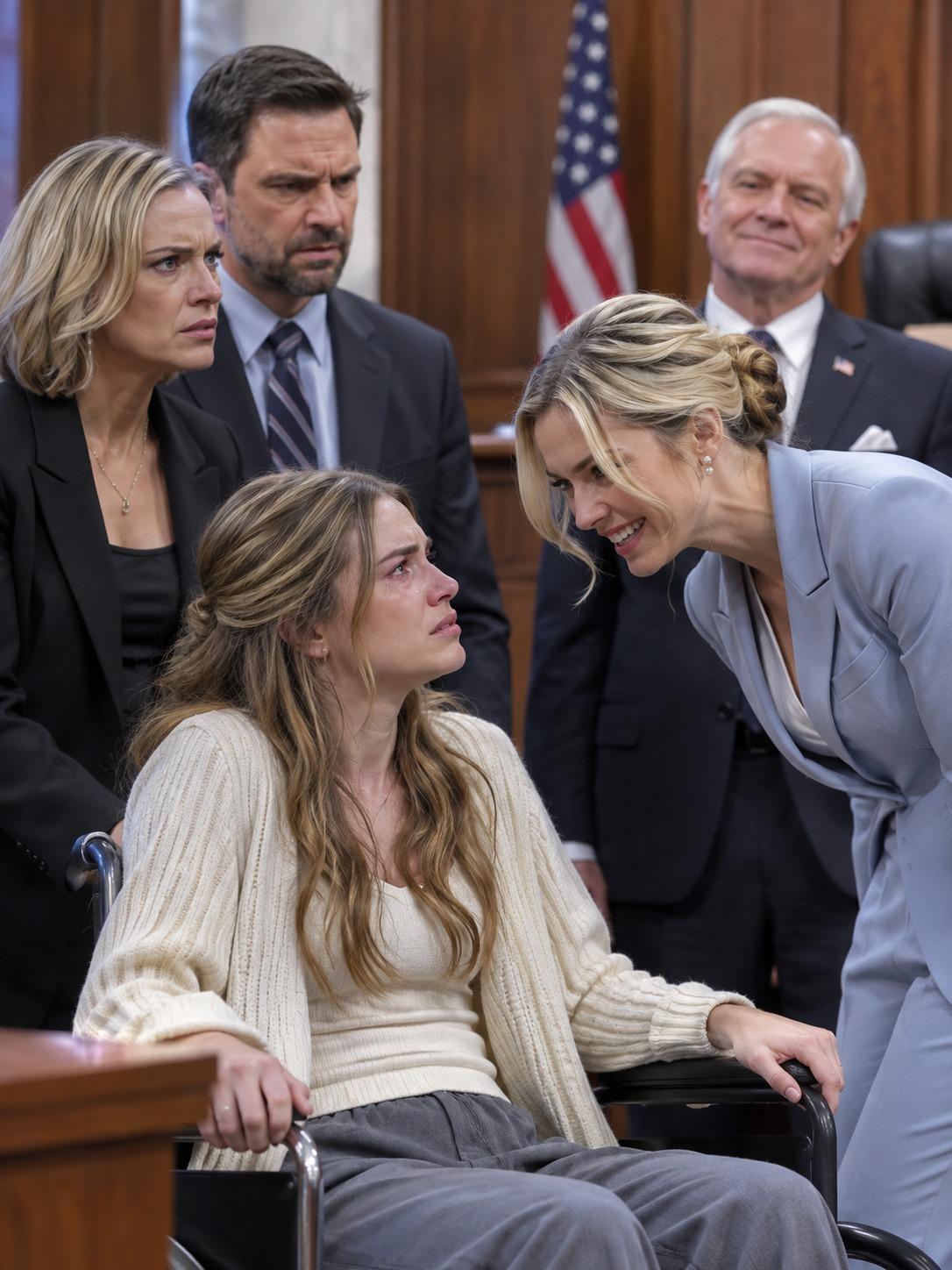
"She deserved it!"
A young woman leaned over a nineteen-year-old girl's wheelchair and whispered those words.
Vesper caught her husband's wrist before he could strike back.
But Senator Alaric had just noticed the expression on Vesper's face.
And he suddenly stopped smiling.
"Not guilty."
The words came from the jury foreman at 2:17 p.m. on a Thursday afternoon.
I remember the exact time because I was staring at the courtroom clock when he spoke. Its second hand moved with irritating precision, as if the world hadn't just split into two different versions of my daughter's life.
In one version, Jovi was a nineteen-year-old college student with a scholarship, a bright future, and a running career that had barely begun.
In the other, she was sitting in a wheelchair, listening to twelve strangers declare that the woman who had destroyed her spinal cord was free.
The jury had deliberated for forty minutes.
Forty minutes.
It had taken surgeons eleven hours to stabilize Jovi's spine with titanium hardware.
It had taken her months to learn how to transfer herself from her wheelchair to her bed.
It had taken our family almost a year to understand that she might never run again.
And twelve people had needed less than an hour to decide that none of it was enough to hold Sutton accountable.
I looked toward the defense table.
Sutton was smiling.
She wore an expensive powder-blue designer suit, her blonde hair falling in perfectly arranged waves over her shoulders. Her makeup was flawless. A diamond bracelet glittered on her wrist.
She looked like a woman attending a charity luncheon rather than someone who had faced criminal charges for permanently injuring another human being.
Her attorney leaned toward her.
She laughed.
Then she looked at Jovi.
I watched her rise from her chair and walk across the courtroom.
My husband, Hayes, stood behind our daughter's wheelchair. His shoulders were rigid, his face pale.
I was beside Jovi, one hand resting on her shoulder.
Sutton stopped directly in front of us.
For a moment, she pretended to examine Jovi's wheelchair.
Then she leaned down.
"Your daughter should've known her place," she whispered. "Maybe next time she'll do what she's told."
I stared at her.
"Excuse me?"
Sutton moved closer.
"She deserved it."
Her smile widened.
Then she straightened her jacket and walked away.
I heard Hayes inhale sharply.
"What did she say?"
I watched Sutton throw her arms around her attorney.
"She said Jovi deserved it."
Hayes's hands tightened around the wheelchair handles.
"Tell me you're joking."
"I wish I were."
He took one step toward her.
I caught his wrist.
"Not here."
He turned toward me.
"She gets to walk out of here?"
"Yes."
"After what she did to our daughter?"
"Yes."
"And we're supposed to do what? Go home?"
I looked at the twelve empty seats in the jury box.
"For now."
Hayes stared at me as though he no longer recognized his wife.
Perhaps he didn't.
For the past five years, I had been Vesper, the woman who checked grocery prices, attended school meetings, reviewed household expenses, and reminded her husband to replace the air filters.
Before that, I had spent nearly twenty years analyzing financial intelligence for the CIA.
I followed money.
I had traced payments through shell corporations, identified hidden financial relationships, and investigated people who believed their wealth made them invisible.
I had left that world when Jovi was fourteen.
I wanted ordinary evenings.
I wanted to be home for birthdays.
I wanted my daughter to grow up knowing that her mother would always be there when she needed her.
For five years, I had managed to build that ordinary life.
Then Sutton happened.
And now, standing in an Ohio courtroom, I understood something I had forgotten.
Leaving a dangerous profession did not mean forgetting how to recognize danger.
I looked at Sutton again.
Her uncle, United States Senator Alaric, was standing several feet behind her. He was accepting congratulations from two men in expensive suits.
He looked pleased.
Not relieved.
Pleased.
There was a difference.
"Mom?"
Jovi's voice brought me back.
I looked down.
Her eyes were red.
"Can we go?"
"Of course, sweetheart."
I bent down and kissed her forehead.
She looked away before I could see another tear fall.
We left through the side entrance.
Nobody stopped us.
Nobody apologized.
Nobody offered an explanation.
Outside the courthouse, reporters were gathered near the steps. A camera flashed as Sutton emerged with her attorney and uncle.
She raised one hand toward them.
I helped Jovi into the modified Toyota Sienna while Hayes folded the wheelchair ramp.
Then I looked through the open passenger door.
Sutton was laughing.
I memorized the expression.
Not because I wanted revenge in that moment.
Because I wanted to remember exactly how a person looked when they believed consequences were meant for everyone else.
The drive home took thirty-eight minutes.
Hayes drove.
Jovi sat behind us, staring through the window.
I tried twice to ask whether she wanted lunch.
Both times, she shook her head.
When we reached our driveway, Hayes lowered the wheelchair ramp.
I went inside to clear the hallway and open the door to Jovi's temporary downstairs bedroom.
A few months earlier, that room had been our guest bedroom.
Now it contained a hospital bed, medical supplies, a transfer board, and equipment we had never imagined needing.
The bathroom renovation had cost more than our original kitchen.
We were still paying for it.
Jovi wheeled herself into the living room.
Her track medals hung along the wall.
There were nine of them.
She had won the last one three weeks before the assault.
She stopped looking at them weeks ago.
"Want me to take those down?" Hayes asked.
"No."
"Okay."
She parked beside the coffee table and reached for her glass of water.
It was just beyond her reach.
She shifted forward, trying to compensate for the loss of trunk control.
Her fingertips caught the rim.
The glass tipped.
Water spilled across the table and onto the hardwood floor.
I grabbed a towel from the kitchen.
"Leave it!" she snapped.
I stopped.
Jovi stared at the overturned glass.
"I can't even do that."
"It was just a glass, sweetheart."
"That's the problem, Mom."
Her voice trembled.
"It was just a glass."
Hayes moved toward her.
"Jovi—"
"I used to run six miles before breakfast."
She gripped the armrests.
"I used to carry my own groceries. I used to climb stairs without thinking about them. I used to go anywhere without checking whether there was an accessible entrance."
Her eyes filled.
"Now I need help getting dressed. I need someone to move things closer to me. I can't even reach my own water."
She looked directly at me.
"And the woman who did this gets to celebrate."
I pulled a chair beside her.
"I know."
"No, you don't."
She wiped her cheek.
"You don't know what it feels like to wake up every morning and realize your body isn't yours anymore."
I didn't argue.
She was right.
I could understand the medical reports. I could understand the financial consequences. I could understand the legal arguments.
But I could never fully understand what it felt like to be nineteen and lose the future you had planned.
Jovi looked toward her medals.
"She smiled at me in court."
I followed her gaze.
"Who?"
"Sutton."
Her voice became quieter.
"She looked right at me and smiled. Like she was proud."
Hayes lowered his head.
"That girl is going to answer for this."
Jovi shook her head.
"No, Dad. She isn't."
The room became silent.
"She already answered," she continued. "Twelve people said she was innocent."
I reached for her hand.
She allowed me to hold it.
We sat there for several minutes.
Then she whispered something that hurt more than anything else she had said that afternoon.
"I don't want to be the reason you and Dad spend the rest of your lives fighting."
I squeezed her hand.
"You aren't the reason."
"Mom—"
"You are our daughter. That's all the reason we need."
She looked down.
I stayed until Hayes helped her settle into bed.
Then I walked into my office.
I closed the door.
And I opened my laptop.
Sutton's Instagram account was public.
That was the first thing I checked.
Her profile contained photographs from country clubs, expensive restaurants, university events, and political fundraisers.
Her biography described her as an entrepreneur, philanthropist, and aspiring public speaker.
I almost laughed.
Then I found her newest video.
It had been posted seventy minutes earlier.
Sutton stood on a private golf course wearing a crisp white golf skirt. A brand-new club rested in her hands.
She adjusted her stance.
Swung.
The ball disappeared into the distance.
Then she turned toward the camera and laughed.
The caption read:
NOTHING CAN BREAK MY STRIDE.
I watched the video three times.
On the fourth viewing, I noticed something in the background.
A man standing beside the golf cart.
He was wearing a navy polo shirt.
I recognized him.
Not personally.
I recognized his face from the courtroom.
Merrick.
He had been one of Senator Alaric's senior campaign aides.
During the trial, he had spent most of his time sitting behind the defense table, quietly passing documents to Sutton's attorney.
I enlarged the image.
The video was blurry, but the resemblance was unmistakable.
I saved the post.
Then my phone rang.
Daria.
The assistant district attorney who had prosecuted Sutton.
I answered.
"Vesper."
"I'm sorry."
I leaned back in my chair.
"You presented the evidence."
"I lost."
"The jury acquitted her."
"That's a polite way of saying I lost."
Her voice sounded exhausted.
I waited.
Then she said something I hadn't expected.
"I resigned this afternoon."
I sat upright.
"What?"
"I walked into my supervisor's office, told him the prosecution had been compromised, and handed him my badge."
"Do you have proof?"
"No."
"Then why resign?"
"Because I watched twelve people ignore evidence they knew was real. Then my supervisor told me to stop asking questions."
I looked at Sutton's Instagram video.
"Forty minutes," I said.
"What?"
"The jury took forty minutes."
"I know."
"Did you notice the foreman?"
"Dwight?"
"He didn't look surprised."
Daria said nothing.
"Neither did Sutton's attorney," I continued. "Neither did Senator Alaric."
"Vesper, what are you thinking?"
I closed the Instagram video.
"That someone arranged the outcome before the first witness testified."
"That's a serious accusation."
"I know."
"If you're right, you'll need more than suspicion."
"I know that too."
She sighed.
"Please don't do anything reckless. These people have influence."
I looked through the office window.
Hayes was outside, folding Jovi's old running clothes into a plastic storage bin.
"I am not planning to do anything reckless."
"Then what are you planning?"
I opened a blank spreadsheet.
"To find out who paid for the verdict."
Daria remained silent for several seconds.
Then she asked:
"Vesper, are you sure you want to go back into this?"
I looked at the first empty row.
For the first time in five years, my fingers hovered over a keyboard for a reason that had nothing to do with household bills or ordinary financial reports.
I typed one word.
JURY.
Then I added a second column.
MONEY.
"I'm sure," I said.
At that moment, another notification appeared on my screen.
It was an email from Jovi's rehabilitation facility.
The subject line contained seven words.
IMPORTANT UPDATE REGARDING YOUR DAUGHTER'S ADMISSION.
I opened it.
And the first sentence made my blood run cold.
Her rehabilitation coverage had been denied.






Comments 0