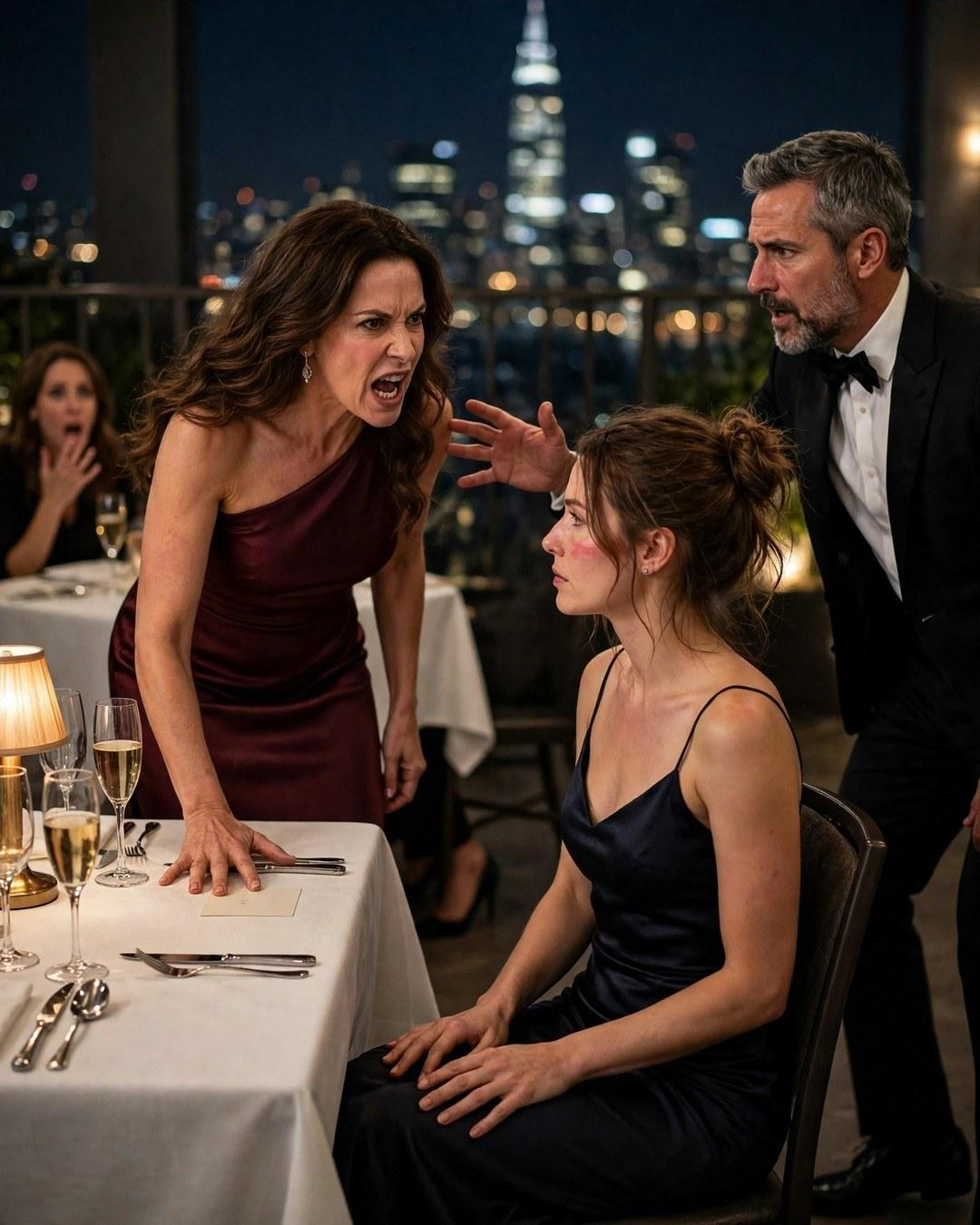
"How long have you been sleeping with my husband?"
The woman shouted as she struck me across the face.
Two tables away, her husband, a powerful Manhattan businessman, stood beside a cream-colored envelope.
Seven words were written on the card inside.
After tonight, she deserves to know.
He wasn't looking at his wife.
He was looking at the photograph sticking out of my purse.
And suddenly, he looked terrified.
I hadn't expected to be slapped that night.
Actually, I hadn't expected anything particularly interesting to happen.
I had come to the rooftop restaurant because of an invitation that arrived without a return address, without a signature, and without any explanation of why someone would want to meet me at one of the most expensive restaurants in Manhattan.
The invitation contained only a reservation confirmation and a handwritten sentence.
There is something you deserve to know about your mother.
That was enough.
For most people, a message like that might have seemed suspicious.
For me, it was impossible to ignore.
My name is Claire Bennett.
I was twenty-seven years old, worked as a freelance restoration specialist for a small historical archive in Brooklyn, and lived in an apartment where the radiator made more noise than the television.
I didn't have much money.
I didn't have influential friends.
And until that evening, I had never eaten dinner anywhere that required a reservation three weeks in advance.
But I had something most people didn't.
A photograph.
An old, faded photograph that had followed me through childhood, college, three apartments, and every unanswered question I had ever asked about my family.
I had carried it in my purse for years.
I never really understood why.
Maybe because it was the only proof that the stories I had been told about my mother were incomplete.
Or maybe because some part of me had always known that one day, someone would recognize the faces.
That evening, I was about to find out.
The restaurant occupied the top floor of a luxury building overlooking Lower Manhattan.
One World Trade Center stood in the distance, its silver spire cutting through the dark sky.
Inside, everything seemed designed to remind guests that they belonged to a world most people only saw in magazines.
Crystal glasses.
White linen.
Soft golden lighting.
Waiters who moved so quietly they seemed to appear whenever someone thought about needing something.
I arrived at 8:17 p.m.
The hostess looked at my reservation, then at me.
"Miss Bennett?"
"Yes."
"Of course. We've been expecting you."
Something about the way she said that made me uncomfortable.
"Has someone already arrived?"
Her expression shifted.
Only slightly.
"I'm afraid I wouldn't know, ma'am."
She led me to a small table near the windows.
There was one chair.
One water glass.
One folded napkin.
No flowers.
No explanation.
"Would you like something to drink?"
"Just water, please."
She smiled professionally and disappeared.
I sat down, placed my black clutch beside my plate, and tried to ignore the uncomfortable feeling growing in my stomach.
I had told no one where I was going.
Not my coworkers.
Not my neighbor.
Not even my best friend, Natalie.
That was unusual for me.
Natalie and I had known each other since college, and she had spent years reminding me that accepting mysterious invitations was how people ended up in true-crime documentaries.
But this invitation mentioned my mother.
And my mother was the one subject capable of making me ignore my better judgment.
I opened the menu.
I read the first line.
Then I read it again.
I couldn't concentrate.
Two tables away, a man laughed.
I glanced up.
He was probably in his mid-forties, with neatly styled auburn hair and the confident posture of someone who had never worried about whether his credit card would be declined.
He wore a midnight-blue tuxedo.
Across from him sat an older woman in a beautifully tailored burgundy pantsuit.
She had a short silver-blonde bob, diamond earrings, and the kind of carefully controlled expression that made it difficult to guess what she was thinking.
They looked wealthy.
Not simply comfortable.
Wealthy in the way people became when money stopped being something they discussed.
The woman said something.
The man smiled.
But it didn't reach his eyes.
Then he looked toward my table.
I quickly lowered my gaze.
A moment later, a waiter approached him carrying a small cream-colored envelope.
The man took it.
His smile disappeared.
He opened the envelope beneath the table.
I watched him read.
His shoulders stiffened.
For a few seconds, he looked like someone who had received terrible news and was trying not to react.
Then he folded the card and slipped it into his jacket.
The waiter turned.
And walked directly toward me.
"Miss Bennett?"
I looked up.
"Yes?"
He placed an identical cream-colored envelope on my table.
"This is for you."
"From whom?"
"I'm sorry, ma'am. I was only asked to deliver it."
"By who?"
He hesitated.
"I wasn't given a name."
He left before I could ask another question.
I stared at the envelope.
It was thick, expensive paper.
My name was written across the front in dark blue ink.
Not printed.
Handwritten.
I recognized the handwriting immediately.
Or thought I did.
There was something familiar about the shape of the letters.
The long downward stroke of the B.
The unusual way the writer crossed the t.
My hands suddenly felt cold.
I opened the envelope.
Inside was a single card.
Seven words.
After tonight, she deserves to know.
I read them once.
Then again.
She.
Who was she?
Me?
The woman across the restaurant?
Someone else?
I turned the card over.
Nothing.
No signature.
No date.
No instructions.
Just those seven words.
I looked toward the man in the tuxedo.
He was watching me.
When our eyes met, he looked away.
The older woman noticed.
She followed his gaze.
And saw me.
For a moment, we simply looked at each other.
Her expression was difficult to read.
Then she glanced at the cream-colored envelope beside my water glass.
Something changed in her face.
Her mouth tightened.
She leaned toward the man and said something I couldn't hear.
He shook his head.
She said something else.
His answer was shorter.
Then she looked at me again.
This time, she wasn't merely curious.
She looked furious.
I lowered my eyes.
Whatever argument they were having, I wanted no part of it.
I picked up my water glass.
My hand was trembling.
I hated that.
I had spent years learning how to remain calm when circumstances became uncomfortable.
It was a habit I developed growing up with more questions than answers.
When you didn't know why people lied to you, you learned to listen.
When you didn't know who to trust, you learned to observe.
And when you couldn't control what happened around you, you learned to control your own reactions.
I took a small sip of water.
Then I heard a chair scrape against the floor.
Hard.
I looked up.
The older woman was standing.
Her husband reached for her wrist.
She pulled away.
"Victoria," he said.
It was the first time I heard her name.
"Don't."
She ignored him.
Her heels struck the polished stone floor as she crossed the restaurant.
One step.
Then another.
People began turning their heads.
I watched her approach, increasingly confused.
She stopped directly in front of my table.
Up close, I could see the fine lines around her eyes.
Her diamonds caught the candlelight.
Her expression was cold.
"How long?"
I blinked.
"I'm sorry?"
"How long has this been going on?"
I looked behind me, wondering if she was speaking to someone else.
There was no one.
"I don't understand."
She gave a short, bitter laugh.
"Of course you don't."
"Ma'am, I think there's been a misunderstanding."
"Don't call me ma'am."
I placed my water glass down carefully.
"All right."
Her eyes moved to the envelope.
"Where did you get that?"
"A waiter brought it."
"Don't insult my intelligence."
"I'm not trying to."
She leaned closer.
"Do you know who I am?"
"No."
That seemed to offend her more than anything else.
"I'm Victoria Whitmore."
I waited.
The name meant nothing to me.
Her eyebrows lifted.
"Victoria Whitmore," she repeated, as though saying it twice would suddenly make me recognize her.
"I'm sorry," I said. "Should I know you?"
Her face reddened.
Behind her, the man in the tuxedo had stood up.
"Victoria," he called.
She raised one hand without looking back.
"Stay out of this, Richard."
So his name was Richard.
I looked from her to him.
Then back again.
"I'm really not sure what this is about."
Victoria placed both hands on my table.
"How long have you been seeing my husband?"
For a second, I genuinely thought I had misheard her.
"Your husband?"
"Don't play games with me."
"I've never met your husband."
"Then why was he looking at you?"
"I don't know."
"Why did you receive the same envelope?"
"I don't know that either."
Her laugh was sharp.
"How convenient."
I felt people watching.
At the nearest table, a woman had stopped eating.
A waiter stood motionless beside a service station.
Someone farther away whispered something.
I could feel the humiliation rising in my chest.
Not because I had done anything wrong.
Because I was being accused of something I couldn't even understand.
"Mrs. Whitmore," I said carefully, "I think someone has made a mistake."
"Yes," she replied. "My husband made the mistake of thinking he could hide you from me."
I looked toward Richard.
He was pale.
Not embarrassed.
Not angry.
Pale.
Like someone who had just seen the first crack appear in a wall he had spent years building.
"Richard," I said, raising my voice slightly, "could you please explain what's happening?"
He opened his mouth.
Nothing came out.
Victoria turned toward him.
"Don't you dare."
He looked at her.
Then at me.
And for one strange second, I thought he was about to say something important.
Instead, he lowered his eyes.
That was when Victoria lost her patience.
"How long?" she demanded again.
"I told you. I don't know your husband."
"Do you expect me to believe that?"
"It's the truth."
"Then ask your husband."
I stared at her.
"What?"
"Ask your husband how long he's been lying to you too."
I almost laughed.
Not because anything was funny.
Because the accusation was so absurd that I couldn't immediately process it.
"I don't have a husband."
The words came out quietly.
Plainly.
Without anger.
Victoria's face changed.
For one instant, I thought she might finally realize her mistake.
Instead, she raised her right hand.
And slapped me.
The sound was astonishingly loud.
My head turned.
My cheek burned.
Someone gasped.
A fork struck a plate.
The entire restaurant seemed to stop breathing.
I sat motionless.
For a moment, I couldn't hear anything except the rushing sound in my ears.
I had never been slapped by a stranger.
I had certainly never been slapped in front of a room full of people wearing jewelry worth more than my annual salary.
My first instinct was to stand.
My second was to leave.
But then I heard Victoria speak.
"Girls like you think you can take whatever you want."
I slowly turned back toward her.
Her chest rose and fell.
She was waiting for me to cry.
Or shout.
Or apologize.
I did none of those things.
Instead, I looked at Richard.
He was staring at me with an expression I couldn't understand.
His gaze wasn't on my burning cheek.
It was on my purse.
More specifically, on the small corner of an old photograph that had slipped from the inner pocket when I reached for the envelope.
I followed his gaze.
And suddenly remembered why I had come.
My mother.
The invitation.
The handwriting.
The seven words.
I looked back at Victoria.
Something about her face bothered me.
Not the anger.
Not the diamonds.
Not even the resemblance I couldn't quite place.
It was the way her eyes narrowed when she looked at me.
The slight tilt of her chin.
The shape of her mouth.
I had seen those features before.
Not on television.
Not in a magazine.
Somewhere much closer.
I reached into my clutch.
Victoria immediately stepped back.
"What are you doing?"
I didn't answer.
My fingers found the familiar paper sleeve.
The photograph was older than I was.
Its edges had turned brown.
A crease ran diagonally across the lower corner.
I had kept it protected for years because it was one of the few things left to me by the woman who raised me.
Her name was Eleanor Bennett.
She had never been rich.
Never been famous.
Never owned anything particularly valuable.
But before she died, she made me promise something.
"Never throw that picture away, Claire."
I was nineteen when she told me.
I had been sitting beside her hospital bed.
"Why?"
She had looked at the photograph for a long time.
Then she said something I had never forgotten.
"Because one day, someone may tell you that the people in it never existed."
At the time, I thought she was confused by medication.
Now, standing in front of Victoria Whitmore, I wasn't so sure.
I removed the photograph from its sleeve.
Victoria looked impatient.
"What is that supposed to be?"
I held it up.
Three women.
One baby.
A summer afternoon captured thirty years earlier.
The first woman was young and laughing.
The second had dark eyes, a narrow jaw, and a familiar tilt to her chin.
The third held a baby against her chest.
She had been beautiful.
Confident.
Her hair swept away from her face.
I had studied that photograph hundreds of times.
But I had never met anyone who recognized the third woman.
Until now.
Victoria looked at the picture.
Her expression remained angry for half a second.
Then her eyes moved toward the woman holding the baby.
Her lips parted.
The color drained from her face.
She stopped breathing for what felt like an eternity.
"Where..."
Her voice cracked.
She swallowed.
"Where did you get that?"
I looked at her.
For the first time, I understood that the photograph meant something to her.
Something terrible.
Something she had never expected to see again.
"From the woman who raised me."
Victoria shook her head.
"No."
Her eyes moved across the photograph again.
The laughing woman.
The woman who looked like me.
The baby.
Then back to the woman holding the child.
"No," she whispered again.
Richard had started walking toward us.
"Victoria."
She didn't look at him.
"Where did you get this photograph?"
Her voice was no longer angry.
It was frightened.
I felt my pulse quicken.
I had imagined this moment for years.
Not this exact confrontation.
Not the slap.
Not the restaurant.
But the moment when someone finally recognized the faces.
The moment when the past stopped being a collection of unanswered questions.
I held the photograph steady.
"From the woman you think died thirty years ago."
Victoria's hand flew to her mouth.
Her diamond earrings trembled.
She stared at me.
Then at the photograph.
Then at Richard.
He had stopped walking.
His face looked gray.
"Claire," he said.
I froze.
I had never told him my name.
Not once.
Victoria turned slowly toward her husband.
"What did you just call her?"
Richard said nothing.
I looked at him.
"How do you know my name?"
His jaw tightened.
He glanced toward the exit.
Then toward the waiter.
Then back at the photograph.
"Who invited you here?" he asked.
I didn't answer.
Victoria's eyes widened.
"Richard."
He ignored her.
"Claire, listen carefully. Who gave you that photograph?"
I felt anger rise beneath my calm exterior.
"Why does everyone keep asking me that?"
He stepped closer.
"Because you don't understand what you're holding."
"Then explain it."
He looked at Victoria.
She was shaking now.
"Richard," she whispered, "tell me that's not her."
He closed his eyes.
For a moment, he looked much older than he had when I first entered the restaurant.
Then he said something so quietly I almost missed it.
"I thought she was dead."
Victoria staggered backward.
Her hand caught the edge of an empty chair.
I stared at him.
"Who?"
He opened his eyes.
And looked directly at me.
"The woman who gave birth to you."
I couldn't move.
The restaurant disappeared around me.
The candles.
The skyline.
The staring guests.
All of it seemed to fade.
My mother.
Not Eleanor Bennett.
The woman who had given birth to me.
The woman Eleanor had refused to discuss.
The woman whose name had never appeared on my original birth certificate.
I opened my mouth.
But before I could speak, the waiter who had delivered the envelopes appeared beside our table.
His face was pale.
"Mr. Whitmore?"
Richard turned sharply.
"What?"
The waiter held out a black smartphone.
"There's a call for you, sir."
Richard frowned.
"Not now."
The waiter didn't move.
"The caller said you would want to answer."
"Who is it?"
The waiter looked at Victoria.
Then at me.
His voice dropped.
"She said her name was Eleanor Bennett."
My stomach tightened.
Eleanor Bennett had been dead for eight years.
Richard's face went completely white.
Victoria gripped the chair.
And the waiter slowly turned the phone toward me.
A woman's voice came through the speaker.
"Claire, sweetheart, don't let him take that photograph."
I recognized the voice.
I had heard it in old birthday recordings.
In saved voicemail messages.
In dreams I had never told anyone about.
It was Eleanor.
Then the woman on the phone said:
"Ask Richard Whitmore what he did to your real mother on October seventeenth, 1996."
Richard lunged toward the phone.
But the voice spoke again before he could reach it.
"And Claire..."
I leaned forward.
"Yes?"
A pause.
Then three words.
"She's still alive."
End of Chapter 1.






Comments 0