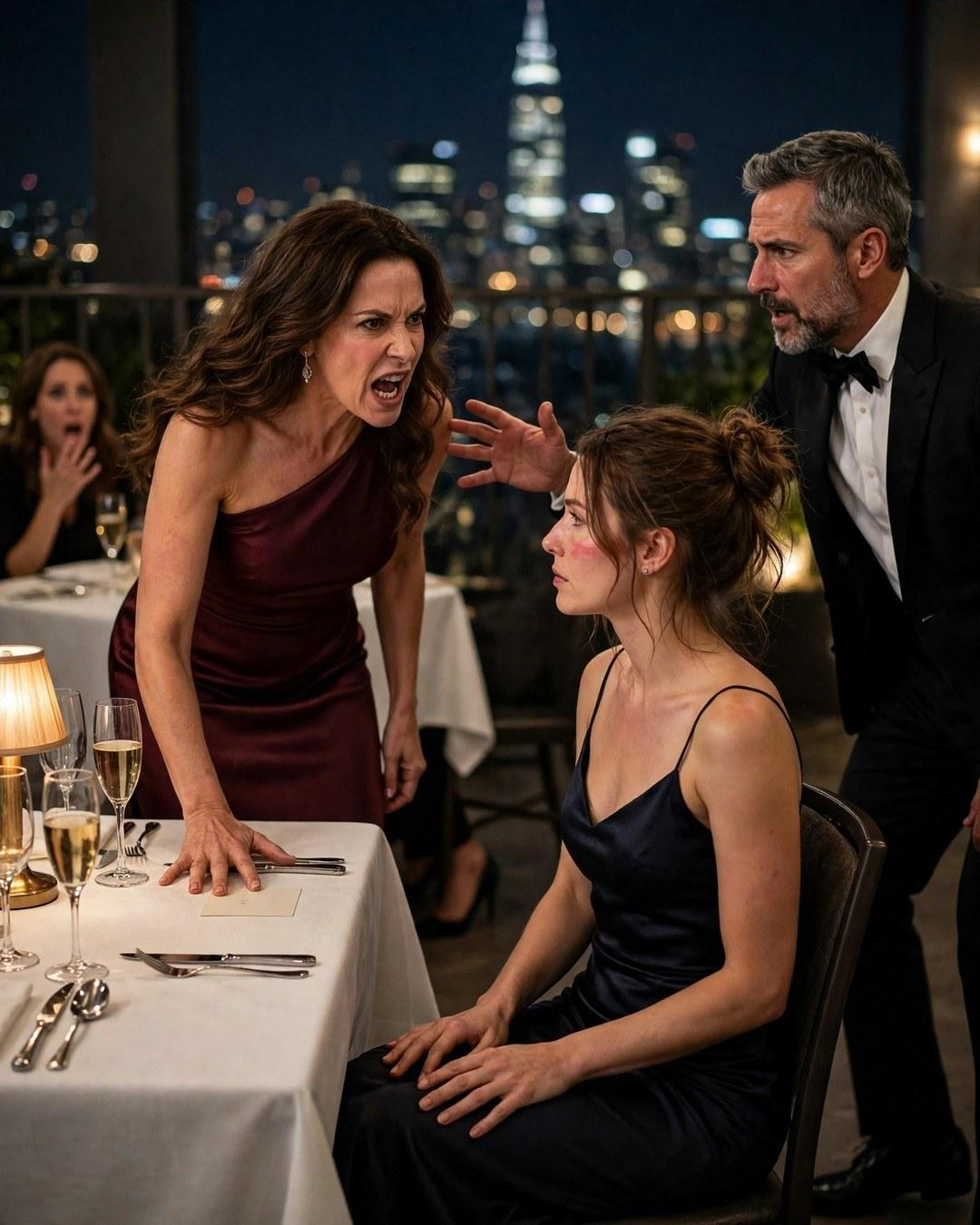
"She's still alive."
Those three words came through the phone in a voice that belonged to a dead woman.
For eight years, I had believed Eleanor Bennett was buried beneath a maple tree in a cemetery outside Philadelphia.
I had chosen the flowers for her funeral.
I had signed the paperwork.
I had stood beside her grave until everyone else went home.
And now someone who sounded exactly like her was telling me that my real mother was alive.
"Who is this?" I whispered.
The line crackled.
"Claire, listen to me. You need to leave that restaurant."
My fingers tightened around the old photograph.
"Who are you?"
"There's no time."
"Then make time."
The words came out louder than I intended.
Across the table, Richard Whitmore stopped moving.
Victoria stood beside him, one hand pressed against her chest. The anger that had brought her across the restaurant had vanished. She looked like a woman who had opened a familiar closet and discovered a stranger standing inside.
"Claire," the voice continued, "don't trust Richard. And whatever happens, don't give him the photograph."
Richard reached for the phone.
"That's enough."
I stepped backward.
"Don't touch it."
He froze.
For the first time that evening, I saw something other than confidence in his expression.
Fear.
Real fear.
Not the embarrassment of a wealthy man whose private affairs had become public.
Not the irritation of someone losing control of a conversation.
This was different.
Richard Whitmore looked like a man who had spent thirty years making sure a particular door remained locked.
And someone had just turned the key.
"Who is speaking?" he demanded.
The voice on the phone went silent.
Then it said, "Hello, Richard."
He went pale.
Victoria looked between them.
"Richard? Who is that?"
He didn't answer.
The voice continued.
"You always did hate unfinished business."
Richard snatched the phone from the waiter's hand.
"Whoever you are, this isn't funny."
A faint laugh came through the speaker.
It wasn't a happy laugh.
It was tired.
Almost sad.
"Thirty years, Richard. And you still think everything is a game you can win."
He ended the call.
Just like that.
The screen went black.
For several seconds, nobody moved.
Then I heard myself say, "You had no right to do that."
Richard looked at me.
"Claire, you need to understand something."
"No. You need to give me that phone."
"That woman is dangerous."
"Which woman?"
He hesitated.
"The one who called."
I held out my hand.
"Give it back."
"It isn't your phone."
"Then give it to the waiter."
The waiter, who had been standing beside us with the expression of someone regretting every career decision that had brought him to this moment, quietly extended his hand.
Richard ignored him.
"Claire, please. Sit down."
I almost laughed.
An hour earlier, I had been an ordinary woman hoping to learn something about her family.
Now I had been publicly accused of having an affair, slapped by a stranger, and told that two women I believed were dead might not be dead at all.
And Richard Whitmore wanted me to sit down.
"No," I said.
His jaw tightened.
"You're making this harder than it needs to be."
"Then stop lying."
Victoria suddenly turned toward him.
"Richard."
He didn't look at her.
"Not now."
"Who was on that phone?"
"Victoria—"
"Don't you dare tell me not now."
Her voice broke on the last word.
I watched her face.
She was no longer looking at me as though I were her husband's mistress.
She was looking at him as though she had never met him before.
"Was it Eleanor?" she asked.
Richard said nothing.
Victoria took a step closer.
"Was that Eleanor Bennett?"
The name hung between them.
I felt my stomach tighten.
"You knew Eleanor?"
Victoria looked at me.
For a moment, she seemed to forget where we were.
Then she glanced at the photograph in my hand.
"Of course I knew Eleanor."
My breath caught.
"How?"
She swallowed.
"She worked for my family."
I stared at her.
"Eleanor never told me that."
Victoria's expression changed.
"She wouldn't have."
"Why?"
Richard interrupted.
"This conversation is over."
Victoria turned on him.
"No, Richard. I think it's finally beginning."
The restaurant manager arrived a moment later.
He was a thin man in a perfectly fitted black suit, with the carefully neutral expression of someone trained to manage wealthy people's disasters without acknowledging them.
"Mr. Whitmore," he said quietly, "perhaps we could arrange a private room."
Richard nodded immediately.
"Excellent idea."
"No," I said.
Three people looked at me.
I took a slow breath.
"I am not going into a private room with people I don't know."
Victoria flinched.
It was a small reaction.
But I noticed.
Richard lowered his voice.
"Claire, people are staring."
"Then perhaps your wife shouldn't have slapped me."
Victoria closed her eyes.
For the first time, she looked ashamed.
"She's right," she said.
Richard stared at her.
"What?"
"She's right."
Victoria turned toward me.
"I owe you an apology."
I said nothing.
She looked at the red mark on my cheek.
"I had no right to touch you."
"No," I replied. "You didn't."
Her lips trembled.
"I thought—"
"You thought I was sleeping with your husband."
She looked down.
"Yes."
"Why?"
Victoria glanced at Richard.
He looked away.
And that was answer enough.
Whatever had happened between them before I arrived, it had nothing to do with me.
But I had somehow walked directly into the middle of it.
The manager offered to call security.
Richard said that wouldn't be necessary.
I disagreed.
"I'd like someone to make sure nobody takes my belongings."
Richard looked offended.
"Nobody is going to take your belongings."
I glanced at the phone still in his hand.
"Really?"
The waiter made a small coughing sound.
Victoria held out her hand.
"Richard. Give him the phone."
He hesitated.
Then returned it.
The waiter immediately checked the screen.
"Was the call recorded?" I asked.
He shook his head.
"I'm afraid not, miss."
"Can you see the number?"
He looked at the call history.
Then frowned.
"No caller ID."
Of course.
I should have expected that.
Whoever had arranged this evening knew exactly what they were doing.
They had chosen the restaurant.
They had sent the invitations.
They had delivered the envelopes.
And they had called at precisely the moment the photograph appeared.
Nothing about this was accidental.
I looked at Richard.
"Who invited me here?"
"I don't know."
"You're lying."
His expression hardened.
"Be careful, Claire."
Something inside me went still.
I had heard that tone before.
Not from Richard.
From men who believed money gave them the right to decide how other people behaved.
I placed the photograph back inside its protective sleeve.
"You know my name. You know Eleanor. You know something about my mother. And somehow, I'm the one who needs to be careful?"
Richard said nothing.
"Fine," I continued. "I'll leave. But I'm calling the police first."
Victoria looked up sharply.
"Please don't."
I turned toward her.
"Why not?"
She seemed to struggle with the answer.
Then she whispered, "Because if you call the police, Richard will make sure you never find out what happened."
Richard's face changed.
"Victoria."
She ignored him.
I looked at her for a long moment.
Then I asked the question that had been growing inside me since she first saw the photograph.
"Who is the woman holding the baby?"
Victoria's eyes filled with tears.
She looked at the picture again.
And for the first time, she answered me.
"That's me."
I had imagined a hundred possible explanations for the photograph.
I had imagined the women were relatives.
Friends.
Neighbors.
Maybe former coworkers of Eleanor's.
But I had never imagined I would find one of them in a luxury restaurant, thirty years older, wearing diamond earrings and looking as though the photograph might kill her.
"That's you?" I repeated.
Victoria nodded.
"Yes."
I looked down at the picture.
The younger woman had long, dark hair swept over one shoulder.
Victoria's hair was now silver-blonde and cut into a short bob.
But the eyes were the same.
The shape of her mouth.
The slight lift of her left eyebrow.
I could see it now.
"Who is the baby?"
Victoria's fingers tightened around the edge of the table.
Richard spoke before she could answer.
"That's enough."
I turned toward him.
"Why?"
"Because this is not the place."
"Then tell me where the place is."
He looked toward the windows.
"Somewhere private."
I shook my head.
"No."
Victoria was still staring at the photograph.
Her voice came out barely above a whisper.
"I haven't seen that picture in thirty years."
I looked at her.
"Where was it taken?"
She swallowed.
"At my parents' summer house."
"Where?"
"Connecticut."
"Who are the other women?"
She closed her eyes.
Richard took a step toward her.
"Victoria, don't."
She opened them again.
And looked directly at me.
"The woman on the left was my younger sister."
My heart began pounding.
"What's her name?"
Victoria's lips parted.
But Richard interrupted again.
"Victoria, think carefully."
She turned toward him.
Something cold entered her expression.
"I have spent thirty years thinking carefully."
He went silent.
She looked back at me.
"Her name was Caroline."
Caroline.
I repeated it silently.
The name meant nothing.
And yet it felt important.
Like a key I had been carrying without knowing which lock it opened.
"Caroline what?"
"Caroline Ashford."
I looked at the photograph.
The young woman on the left was laughing.
Her head was tilted backward.
One hand rested on the shoulder of the woman beside her.
She looked happy.
Uncomplicated.
Alive.
"What happened to her?"
Victoria's eyes moved toward Richard.
Then back to me.
"She died."
My stomach tightened.
"When?"
Victoria didn't answer immediately.
Richard stared at the floor.
Finally, she said, "October seventeenth, 1996."
I felt the blood drain from my face.
The date.
The same date the voice on the phone had mentioned.
I looked at Richard.
"What happened that night?"
He remained silent.
Victoria shook her head.
"We were told there was an accident."
"What kind of accident?"
"A fire."
I stared at her.
"Where?"
"At the summer house."
I looked down at the photograph.
Caroline Ashford.
A summer house in Connecticut.
A fire in October 1996.
And a woman on the phone claiming that someone believed dead was still alive.
I could barely organize the questions in my head.
"Was Eleanor there?"
Victoria's expression changed.
"Yes."
"Did she die in the fire?"
"No."
"Then what happened to her?"
Victoria glanced at Richard.
"She disappeared."
I felt the floor shift beneath me.
"Eleanor raised me."
Victoria stared.
"What?"
"She raised me. In Pennsylvania."
For the first time, Victoria looked genuinely confused.
"That's impossible."
"Why?"
"Because Eleanor left the country."
I shook my head.
"No. She didn't."
"Richard told me she moved to Canada."
I looked at Richard.
He didn't move.
Victoria turned toward him.
"You told me she moved to Canada."
He said nothing.
"You told me she wanted nothing more to do with our family."
Still nothing.
Her voice rose.
"Richard!"
He finally looked at her.
"I did what I thought was necessary."
Victoria stepped backward.
I recognized the expression on her face.
It was the same expression I had seen on patients' relatives when a doctor delivered news they had not prepared themselves to hear.
Disbelief.
Followed by the slow realization that the truth might be worse than the lie.
"What did you do?" she whispered.
Richard rubbed his forehead.
"Victoria, please."
"What did you do?"
He looked at me.
Then at the photograph.
And said something I would remember for the rest of my life.
"I was trying to protect the family."
I had heard that phrase before.
Not those exact words, perhaps.
But the idea behind them.
People did terrible things and called them sacrifices.
They hid information and called it protection.
They decided what others deserved to know and called it love.
I had grown up surrounded by that kind of silence.
Eleanor had loved me.
I never doubted that.
She had worked two jobs when I was little.
She had learned to braid my hair from a library book.
She had sat through every school concert, even when I was terrible at the violin.
When I was twelve, she sold her wedding ring to pay for my dental surgery.
She was my mother in every way that mattered.
But she had also kept secrets.
And now those secrets were standing in front of me wearing expensive clothes.
I looked at Victoria.
"Was Caroline my mother?"
She stared at me.
For a moment, I thought she might faint.
Richard immediately said, "Claire, you need to stop."
I ignored him.
"Was she?"
Victoria pressed her fingers against her lips.
Her eyes filled with tears.
"I don't know."
"How can you not know?"
"Because I never knew she had a child."
I felt something twist inside my chest.
I looked at the photograph again.
Three women.
One baby.
"Then whose baby is this?"
Victoria shook her head.
"I can't..."
Her voice broke.
"I can't explain that."
Richard stepped between us.
"That's enough for tonight."
I moved around him.
"No. It isn't."
He lowered his voice.
"Claire, you're upsetting my wife."
I looked at Victoria's trembling hands.
Then at the red mark still burning on my cheek.
"Your wife slapped me because she thought I was having an affair with you. Now she's telling me she knew the woman who raised me and that her sister died on the same date someone warned me about. I think we're a little past worrying about anyone being upset."
Victoria gave a strange, broken laugh.
It lasted less than a second.
Then she began crying.
Not loudly.
Not dramatically.
Just tears slipping down her face while she stared at the photograph.
I didn't know what to do.
An hour earlier, I had disliked this woman.
Ten minutes earlier, I had been furious with her.
Now I was watching her grieve someone who might not even be dead.
And somehow, I felt sorry for her.
That frightened me almost as much as everything else.
"Victoria," I said quietly.
She looked up.
"Did you love your sister?"
Her face crumpled.
"More than anything."
"Then help me find out what happened to her."
Richard turned sharply.
"No."
Victoria looked at him.
"Why not?"
"Because Caroline is dead."
"How do you know?" I asked.
His eyes flashed.
"Because I was there."
Silence.
Victoria slowly turned toward him.
"What?"
Richard seemed to realize what he had said.
He looked away.
I felt my pulse quicken.
"You were at the fire?"
He didn't answer.
Victoria took a step closer.
"Richard, you told me you were in Boston that night."
His jaw tightened.
"I was."
"You just said you were there."
"I meant afterward."
She shook her head.
"No."
He looked at her.
"Victoria—"
"No. I remember."
Her voice was shaking.
"You came home the next morning. Your shirt smelled like smoke."
Richard went completely still.
"You told me there had been a fire at a warehouse near your hotel."
I watched him.
His expression was no longer frightened.
It was calculating.
And that was worse.
"Victoria," he said carefully, "you're remembering things incorrectly."
She stared at him.
"Am I?"
"Yes."
She stepped away.
Then looked at me.
"I need to show you something."
Richard moved immediately.
"Absolutely not."
Victoria ignored him.
She reached into her handbag and removed her phone.
Her hands were shaking so badly that she struggled to unlock it.
"After Caroline died," she said, "my father had all her belongings removed from the house."
I watched her scroll.
"He said keeping them would only make the grief worse."
She swallowed.
"But I kept one thing."
Richard's face tightened.
"Victoria."
She looked up.
"Don't."
There was something different in her voice now.
Not anger.
Not fear.
Decision.
She continued scrolling.
"A few years ago, I had it photographed for insurance."
"What was it?" I asked.
"A letter."
My heart jumped.
"From Caroline?"
Victoria nodded.
"She wrote it the week before the fire."
I stepped closer.
"What did it say?"
Victoria found the image.
Then hesitated.
Her eyes moved across the screen.
Her face changed.
"What?" I asked.
She shook her head.
"That can't be right."
Richard reached for her phone.
She pulled it away.
"Don't touch me."
I leaned closer.
The photograph showed an old handwritten letter on pale blue stationery.
The ink had faded.
But the handwriting was still visible.
I recognized it.
The same unusual t.
The same long downward stroke.
The same handwriting as the invitation that had brought me to the restaurant.
My mouth went dry.
"Victoria."
She looked at me.
"That handwriting."
"What about it?"
I reached into my purse and removed the invitation.
I placed it beside her phone.
She compared them.
Her eyes widened.
"No."
"They're the same," I whispered.
Victoria looked at Richard.
Then at me.
"Caroline wrote that letter thirty years ago."
I stared at the invitation.
Someone had written to me in the same handwriting.
Someone had invited me here.
Someone wanted me to know the truth.
And someone had arranged for Richard Whitmore to receive a matching envelope.
I felt cold all over.
"Who has access to Caroline's letters?"
Victoria shook her head.
"Nobody."
"Are you sure?"
"I kept them locked away."
"Where?"
"At our house."
Richard suddenly looked toward the restaurant entrance.
It was a quick movement.
Almost invisible.
But I saw it.
"Richard," I said.
He didn't look at me.
"Who else has a key to your house?"
Victoria answered before he could.
"Only us."
Richard's phone vibrated.
He glanced down.
And whatever he saw made him go completely still.
"Who is it?" Victoria asked.
"Nobody."
He turned the screen facedown.
I watched him carefully.
"Richard."
He looked at me.
"What?"
"Show us the message."
His expression hardened.
"Absolutely not."
Victoria held out her hand.
"Richard, give me your phone."
He laughed without humor.
"Have you both lost your minds?"
"Give it to me."
"No."
For a moment, they stared at each other.
Then Victoria did something unexpected.
She took off her wedding ring.
It was a large diamond set in platinum.
The kind of ring that probably cost more than everything I owned.
She placed it on the table.
Richard looked at it.
"What are you doing?"
"Thirty years," she whispered.
"Victoria—"
"Thirty years I've believed you."
He stared at her.
"I believed you when you told me Caroline was dead. I believed you when you said Eleanor abandoned us. I believed you when you said there was nothing more to investigate."
Her voice strengthened.
"I even believed you when you told me the police had closed the case."
Richard looked around.
People were still watching.
"Lower your voice."
Victoria didn't.
"And tonight, a young woman I've never met walks into a restaurant carrying a photograph I thought had been destroyed."
She pointed toward me.
"A photograph of my sister."
Richard said nothing.
Victoria took one slow breath.
"Give me the phone."
He looked at the ring.
Then at her.
Finally, he unlocked the screen.
But instead of handing it over, he read the message himself.
His face changed.
He looked toward the elevator.
Then toward the windows.
I saw his hand begin to tremble.
"What does it say?" I asked.
He didn't answer.
Victoria stepped closer.
"Richard."
He slowly turned the screen toward us.
The message contained only one sentence.
You should have checked the coffin.
Victoria made a small sound.
I felt my stomach drop.
The sender was listed as an unknown number.
Below the message was a photograph.
A wooden coffin.
Closed.
Covered in white flowers.
A funeral.
Victoria stared at the image.
"That's Caroline's funeral."
Richard said nothing.
I looked at her.
"You buried her?"
Victoria nodded slowly.
"Yes."
"Did you see her body?"
She looked at me.
And suddenly, I already knew the answer.
"No."
"Why not?"
Her eyes moved toward Richard.
"He told me the fire had made it impossible."
Richard looked away.
I felt something cold settle in my chest.
A closed coffin.
A fire.
A death certificate.
A missing woman.
And a family that had accepted one man's explanation for thirty years.
"Victoria," I asked quietly, "who identified Caroline's body?"
She looked at Richard.
He didn't move.
Then she whispered, "My husband."
The manager returned and informed us that several guests had complained about the disturbance.
Richard immediately offered to pay for everyone's dinner.
Under ordinary circumstances, that might have impressed me.
Now it only made me angry.
Money.
Always money.
It seemed to be the first language Richard Whitmore spoke whenever something went wrong.
He offered to cover my meal.
Then my transportation.
Then, incredibly, he suggested that we arrange a meeting with his attorney.
I stared at him.
"Your attorney?"
"To make sure everything is handled properly."
"What exactly needs to be handled?"
He hesitated.
"The misunderstanding."
I looked at Victoria.
She was still staring at the message on his phone.
"Your wife thought I was your mistress. She slapped me. Then you admitted you were involved in a fire that supposedly killed her sister. And now someone is sending you photographs of a funeral."
I leaned forward.
"Which part is the misunderstanding?"
Richard said nothing.
"Because from where I'm standing, the only misunderstanding is that you think I'm going to accept an apology and disappear."
His expression changed.
Something hard appeared behind his eyes.
"Claire, you have no idea what you're getting involved in."
"Then tell me."
"I can't."
"Won't," I corrected.
He looked away.
Victoria suddenly spoke.
"Claire, do you have somewhere safe to stay tonight?"
The question surprised me.
"Yes."
"Does Richard know where you live?"
I looked at him.
"I don't think so."
Victoria gave a bitter smile.
"Don't be so sure."
Richard turned toward her.
"That's ridiculous."
She ignored him.
"Do you have anyone you trust?"
I thought of Natalie.
My best friend.
The person who knew almost everything about me.
Almost.
"Yes."
"Call them."
I hesitated.
"Why?"
Victoria glanced toward the elevator.
"Because I don't think you should be alone."
Richard's phone vibrated again.
He looked down.
This time, he didn't show us the screen.
He simply slipped the phone into his pocket.
Then he said, "I need to make a call."
He walked away before either of us could stop him.
I watched him disappear toward a private hallway.
Victoria remained beside me.
For several seconds, neither of us spoke.
Then she reached toward my hand.
I instinctively pulled back.
She stopped.
"I'm sorry," she whispered.
I looked at her.
She glanced at my cheek.
"For what I did."
I swallowed.
"Why did you think I was having an affair with him?"
She lowered her eyes.
"Because Richard has lied to me before."
I waited.
She gave a tired sigh.
"Not about another woman. Not exactly."
"What does that mean?"
She looked toward the hallway.
"Years ago, I found out he had been paying someone every month."
"Who?"
"I never learned her name."
"How much?"
"Five thousand dollars."
I stared at her.
"Every month?"
She nodded.
"For almost twenty years."
My mouth went dry.
"What happened when you confronted him?"
"He told me it was a charitable arrangement."
"Did you believe him?"
Victoria looked at the wedding ring lying on the table.
"I wanted to."
I understood that answer more than I wanted to admit.
Sometimes believing a lie was easier than accepting what the truth might cost.
"Do you still have the records?" I asked.
She nodded.
"Some of them."
"Could I see them?"
She hesitated.
Then opened her handbag.
From a small inner pocket, she removed a folded piece of paper.
It was a bank statement.
Old.
Creased.
The account number had been partially blacked out.
But the recipient's name was still visible.
I read it once.
Then again.
My heart began pounding.
The payments had been sent to a trust account.
The account was managed by a law firm in Philadelphia.
I knew the address.
I had been there.
Eight years earlier.
After Eleanor died.
I looked at Victoria.
"Where did you get this?"
"From Richard's files."
I stared at the name of the law firm.
Harrison, Cole & Mercer.
The same firm that had handled Eleanor Bennett's estate.
The same firm that had told me she left behind nothing except a small savings account and a box of personal belongings.
The same firm that had given me the photograph.
"Claire?" Victoria asked.
I couldn't speak.
She touched my arm.
"What is it?"
I looked up.
"Those payments."
"What about them?"
I swallowed.
"I think they were going to Eleanor."
Victoria stared at me.
For a moment, neither of us moved.
Then she whispered, "Oh, God."
I took out my phone.
My hands were shaking now.
I opened my contacts and found Natalie's number.
She answered on the second ring.
"Claire? Where are you?"
"At dinner."
"At dinner? It's almost ten. You told me you were staying home."
"I know."
"Are you okay?"
I looked at Victoria.
Then at the hallway where Richard had disappeared.
"No."
Natalie's tone changed immediately.
"What happened?"
"I need you to come get me."
"Where?"
I gave her the restaurant's address.
She went silent.
"Claire, that's one of the most expensive restaurants in the city."
"I know."
"Are you on a date?"
"No."
"Then what are you doing there?"
I closed my eyes.
"Trying to find out who my mother was."
There was a pause.
Then Natalie said, "Don't move. I'm coming."
I almost cried.
Not because I was frightened.
Because hearing her voice reminded me that somewhere outside this nightmare, ordinary life still existed.
People still ordered takeout.
Watched television.
Argued about parking spaces.
Complained about work.
I wanted that life back.
But I knew I couldn't return to it without answers.
I ended the call.
Victoria was watching me.
"Your friend?"
I nodded.
"She'll be here soon."
"Good."
I looked down at the photograph.
"Victoria, there's something I don't understand."
She waited.
"If Caroline was your sister, why didn't you recognize me?"
Her expression softened.
"I never knew Caroline had a daughter."
"But you recognized the photograph."
"Because I remember the day it was taken."
I looked at her.
"Tell me."
She hesitated.
Then slowly sat down in the chair across from me.
The same chair I had occupied alone less than two hours earlier.
"It was August," she said. "1996. My parents were hosting a small family gathering at the summer house."
I listened.
"Caroline had been acting strangely for weeks. She was nervous. Secretive. She kept disappearing to make phone calls."
"To whom?"
"I don't know."
Victoria looked at the photograph.
"That day, she seemed happy for the first time in months."
She touched the edge of the picture.
"The woman beside her was someone she trusted."
I leaned forward.
"Who?"
Victoria looked at me.
"Her name was Margaret."
I froze.
Margaret.
I had heard that name before.
Not often.
Only once.
Eleanor had been ill with pneumonia when I was fifteen.
I had stayed home from school to take care of her.
During the night, she developed a high fever.
She kept calling out a name.
Margaret.
I had asked her about it the next morning.
She told me it was someone she used to know.
Someone she missed.
Then she changed the subject.
"Margaret what?" I asked.
Victoria frowned.
"I don't remember her last name."
"Was she related to you?"
"No."
"Was she Caroline's friend?"
"More than that, I think."
"What do you mean?"
Victoria looked uncomfortable.
"Caroline trusted Margaret with things she wouldn't tell anyone else."
I stared at the photograph.
The second woman.
The one who looked like an older version of me.
The same jaw.
The same eyes.
The same slight tilt of the chin.
My heart began pounding.
"Victoria."
She looked up.
"Could Margaret have been my mother?"
Victoria's eyes moved to my face.
Then to the photograph.
She studied me carefully.
For the first time, she seemed to notice the resemblance.
Her lips parted.
"I..."
She stopped.
I leaned forward.
"What?"
She looked frightened.
"Claire, I need to see the back of that photograph."
I frowned.
"Why?"
"Please."
I removed it from the protective sleeve.
Then turned it over.
There was nothing unusual about the back.
Just old paper.
A faint watermark.
And a small handwritten number near the bottom.
17.
Victoria stared at it.
Her face went pale.
"Where did Eleanor get this?"
"I don't know."
"Did she ever tell you what that number meant?"
"No."
Victoria closed her eyes.
I waited.
Then she whispered, "Caroline used to number everything."
"What do you mean?"
"Photographs. Letters. Documents. Anything she thought was important."
I looked at the number again.
"Why?"
Victoria opened her eyes.
"Because she was afraid someone would destroy them."
I felt a chill move through me.
"Who?"
She looked toward the hallway.
Then whispered, "Richard."
At that moment, the restaurant lights flickered.
Only once.
A brief interruption.
But it was enough to make Victoria stop speaking.
She looked toward the ceiling.
Then toward the private hallway.
Richard still hadn't returned.
I checked the time.
10:14 p.m.
Natalie would need at least twenty minutes to reach me.
I slipped the photograph back into its sleeve.
Victoria leaned closer.
"Claire, I need you to promise me something."
"What?"
"Don't give that photograph to anyone."
"I wasn't planning to."
"Not even the police."
I frowned.
"Why?"
She hesitated.
"Because thirty years ago, the police told me my sister was dead."
"That doesn't mean—"
"They told me the fire was accidental. They told me there was nothing suspicious. They told me there was no reason to investigate."
Her voice trembled.
"And I believed them."
I studied her face.
"Do you think they lied?"
Victoria looked toward the hallway again.
"I think someone made sure they never asked the right questions."
Before I could respond, my phone vibrated.
An unknown number.
A text message.
I opened it.
Do not leave with Victoria Whitmore.
My heart stopped.
Another message appeared.
She knows more than she's telling you.
I stared at the screen.
Victoria noticed.
"What is it?"
I didn't answer.
A third message arrived.
Ask her what happened to the baby.
I slowly looked up.
Victoria was watching me.
Her expression had changed.
"Claire?"
I looked down at the photograph.
The baby.
The one Victoria had been holding.
The one she claimed she couldn't explain.
"Victoria," I said quietly.
"Yes?"
"Whose baby were you holding?"
She went completely still.
I watched her face.
Her eyes moved toward my phone.
Then toward the photograph.
"Why are you asking me that?"
"Because I need to know."
She swallowed.
"Claire, some things are complicated."
"Whose baby?"
Her hands began trembling.
She looked toward the hallway.
Richard was still gone.
Then she leaned forward.
Her voice dropped to a whisper.
"That baby wasn't Caroline's."
I felt my stomach tighten.
"Then whose was it?"
Victoria closed her eyes.
For several seconds, she said nothing.
Then she opened them.
And looked directly at me.
"Mine."
I couldn't breathe.
I stared at her.
"Yours?"
She nodded.
"But I was told she died."
The words seemed to hang in the air.
I looked at the photograph.
The baby.
Victoria.
Caroline.
Margaret.
Eleanor.
Richard.
Thirty years of lies.
Thirty years of missing pieces.
I felt my hands begin to shake.
"Victoria," I whispered, "how old would your daughter be now?"
She looked at me.
Her eyes filled with tears.
"Twenty-nine."
I froze.
Twenty-nine.
I was twenty-seven.
The dates didn't match.
But something about her answer frightened me more than if they had.
Because Victoria hadn't said her daughter was born thirty years ago.
She had said the baby in the photograph was hers.
And the photograph had been taken in August 1996.
I looked down at the picture again.
There was something wrong.
Something I hadn't noticed before.
The baby looked too young.
Too small.
And the woman standing beside Caroline looked far too much like me.
I turned the photograph toward the light.
There, near the lower edge, was a faint mark.
Not a crease.
Not a stain.
A line.
As though something had been written beneath the photograph and later covered.
I held it closer.
Victoria leaned forward.
"What are you looking at?"
I didn't answer.
The line wasn't part of the picture.
It was part of the paper.
I had spent years restoring old documents.
I knew what erased ink looked like.
And this was erased ink.
Someone had deliberately removed something from the photograph.
I reached into my purse for the small magnifying lens I carried for work.
Victoria watched silently.
I tilted the photograph beneath the table lamp.
The letters were faint.
Almost invisible.
But they were there.
Three words.
I read them once.
Then again.
My hands went cold.
Claire's real mother.
I stared at the writing.
Then at the woman in the photograph who looked like me.
My heart hammered against my ribs.
Victoria leaned closer.
"What does it say?"
I opened my mouth.
But before I could answer, the elevator doors at the far end of the restaurant slid open.
A woman stepped out.
She wore a dark coat and carried a worn leather handbag.
Her face was partly hidden beneath a scarf.
She paused beneath the restaurant lights.
Then slowly removed the scarf.
Victoria saw her first.
Her chair scraped backward.
Her hand flew to her mouth.
"No," she whispered.
I turned.
The woman looked directly at me.
Then at the photograph in my hand.
Her eyes filled with tears.
Victoria staggered to her feet.
"Caroline?"
The woman didn't answer.
She reached into her handbag.
And pulled out a second photograph.
It was identical to mine.
Except this one had something written across the front.
She took one step toward us.
Then another.
And whispered:
"Claire, before she tells you anything else, you need to know who was really buried in that coffin."






Comments 0