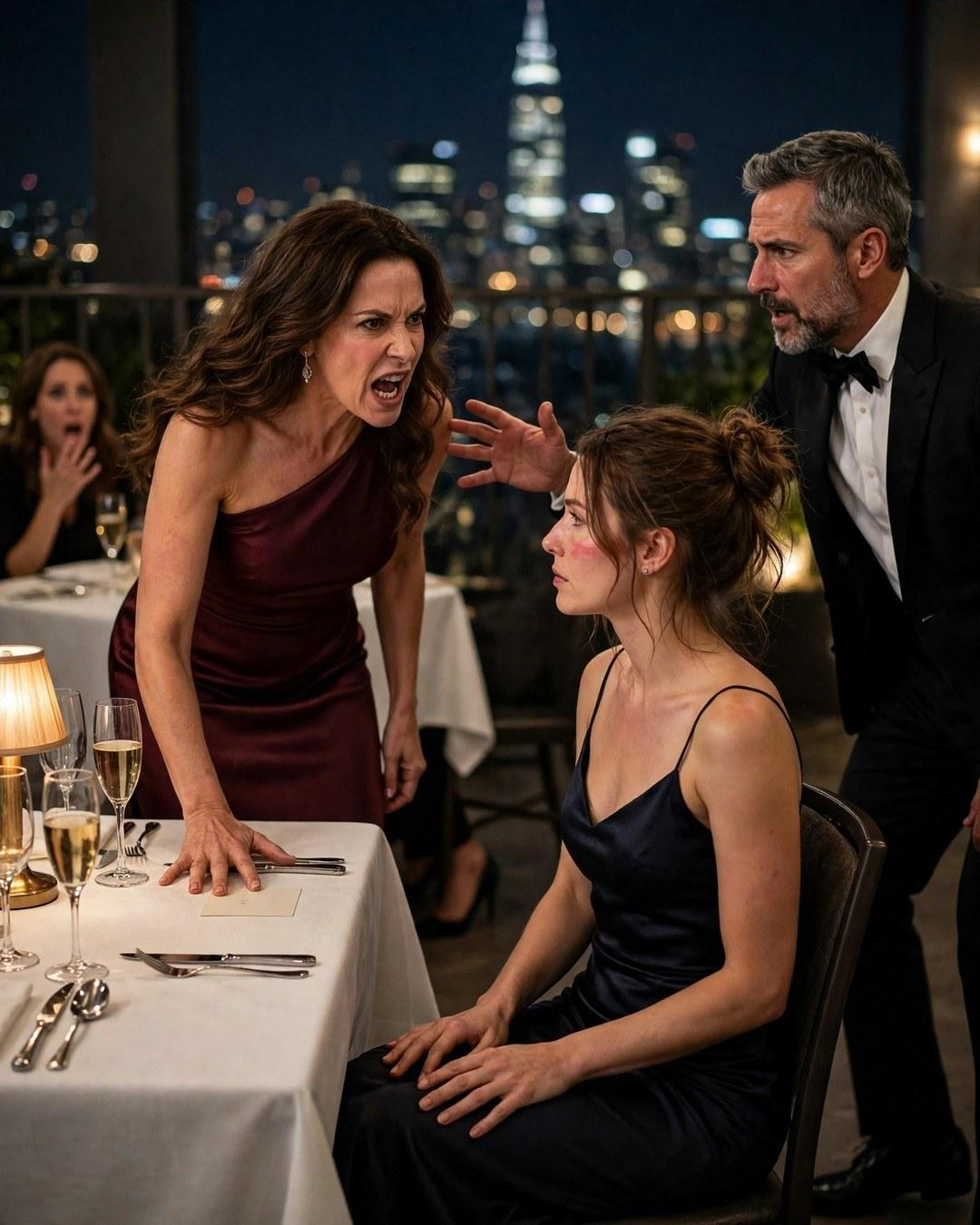
"Who was buried in Caroline's coffin?"
I asked the question before the woman in the dark coat could take another step.
She stopped beneath the restaurant's golden lights.
Victoria Whitmore stood beside me, gripping the back of her chair so tightly that her knuckles had turned white.
The stranger looked at Victoria.
Then at me.
And for one terrible moment, I had the feeling that she was deciding which of us deserved the truth.
"Please," I said. "I've had enough secrets for one night."
The woman lowered her eyes to the photograph in her hand.
"Then you need to understand something first."
Her voice was quiet.
Older than I expected.
But familiar in a way I couldn't explain.
"The woman they buried wasn't Caroline Ashford."
Victoria made a strangled sound.
"Stop."
The stranger looked at her.
"Hello, Victoria."
"No."
Victoria shook her head.
"No, you don't get to walk in here after thirty years and say my name like nothing happened."
The woman didn't move.
"I know."
"Do you?"
Victoria's voice rose.
"Do you know what it was like? Standing beside that coffin? Watching them lower it into the ground? Going home to a house where nobody would say your name?"
The stranger's expression tightened.
"I know more than you think."
Victoria stepped forward.
"Then tell me where my sister is."
The woman looked directly at her.
And said something that made my blood run cold.
"You've been asking the wrong question."
I had spent most of my life believing that answers were supposed to make things clearer.
That was what Eleanor taught me.
When I was little and couldn't understand my homework, she would sit beside me at the kitchen table with a pencil and a cup of tea.
"Start with what you know, sweetheart," she'd say. "Then work toward what you don't."
It was good advice.
For mathematics.
For repairing damaged historical documents.
For almost everything.
But standing in that restaurant, surrounded by people who seemed to recognize one another from a life I had never been allowed to see, I realized something.
Sometimes every answer opened another question.
And sometimes the people holding those answers had spent decades making sure nobody asked.
I looked at the stranger.
She appeared to be in her late fifties.
Her hair was dark brown, streaked with gray, and pulled into a loose knot.
There were fine lines around her mouth and eyes.
She wore a plain black coat over a cream-colored blouse.
Nothing about her suggested wealth.
Her shoes were practical.
Her handbag was worn.
And unlike Victoria, who seemed accustomed to being watched, this woman looked uncomfortable beneath the attention of strangers.
But she wasn't frightened.
That was what struck me.
She had walked into one of Manhattan's most exclusive restaurants, faced a woman who believed her sister was dead, and announced that a thirty-year-old funeral had been a lie.
Yet her hands remained steady.
Except when she looked at me.
Then her fingers trembled.
"Who are you?" I asked.
She swallowed.
"My name is Margaret."
I stopped breathing.
Margaret.
The name Eleanor had whispered during a fever when I was fifteen.
The name Victoria had just connected to the photograph.
The name belonging to the woman whose face looked so much like mine.
I stared at her.
"Margaret what?"
She hesitated.
"Margaret Hale."
I looked down at my photograph.
Then at her.
The resemblance was unmistakable.
The same narrow jaw.
The same dark eyes.
The same slight tilt of the chin.
Time had changed her face.
But it hadn't erased the features.
"You're the woman in the middle."
Margaret nodded.
"Yes."
Victoria looked between us.
"Margaret Hale?"
Her voice was barely audible.
"I thought you were dead too."
Margaret's expression darkened.
"I know."
Victoria took a step backward.
"Richard told me—"
"Richard told you many things."
The words were gentle.
That somehow made them worse.
I looked toward the private hallway.
Richard still hadn't returned.
"Where is he?" I asked.
Margaret followed my gaze.
"Probably trying to find out how much I know."
Victoria's face tightened.
"You can't just come here and accuse my husband of—"
"Victoria."
Margaret's voice remained quiet.
"Your husband identified a body he knew wasn't Caroline's."
The restaurant seemed to tilt.
Victoria stared at her.
"That's impossible."
Margaret reached into her handbag.
She removed a folded document.
The paper looked old.
Not thirty years old, perhaps, but old enough that the corners had softened.
She placed it on the table.
I leaned forward.
It was a photocopy of a medical examiner's report.
The date at the top was October 19, 1996.
Two days after the fire.
Most of the text was difficult to read.
But one line had been circled in red ink.
Identity established through personal effects and identification provided by next of kin.
I read it twice.
"Personal effects?"
Margaret nodded.
"A necklace. A wedding ring. And a watch."
Victoria looked confused.
"Caroline wasn't married."
Margaret turned toward her.
"Exactly."
Silence.
I felt a cold sensation move through my chest.
"Then whose wedding ring was it?"
Margaret looked at me.
"That's one of the things Richard never wanted anyone to ask."
Victoria sat down heavily.
Her face had lost all color.
I watched her stare at the document.
Thirty years.
That was how long she had believed her sister died in a fire.
Thirty years of anniversaries.
Thirty years of birthdays without phone calls.
Thirty years of wondering what Caroline might have become.
And now a woman who had apparently been part of that life was telling her that the entire story had been manufactured.
I almost felt cruel for wanting answers.
Almost.
Then I remembered the red mark on my cheek.
The anonymous messages.
The voice that sounded like Eleanor.
The photograph that had been hidden from me for most of my life.
I had questions too.
And I was finished apologizing for asking them.
"Margaret," I said, "how did you know I was here?"
She looked at me.
"I arranged the invitation."
My stomach tightened.
"You?"
She nodded.
"The reservation. The envelope. The message."
I stared at her.
"Why didn't you just contact me?"
"Because Richard would have found out."
"He found out anyway."
"Yes."
She glanced toward the hallway.
"But not soon enough to stop you from seeing Victoria."
Victoria looked up.
"You wanted us to meet?"
Margaret nodded.
"Claire needed to see your reaction to the photograph."
I frowned.
"Why?"
"Because you wouldn't have believed me otherwise."
"Believed what?"
Margaret hesitated.
Then looked at Victoria.
"That she didn't know."
Victoria's expression changed.
"Didn't know what?"
Margaret didn't answer.
I felt anger rise.
"No."
Both women looked at me.
"No more talking around me."
I placed my photograph on the table.
"People keep saying things that sound important and then refusing to explain them. I've been slapped, threatened, and told that my mother may still be alive. I want one complete answer."
Margaret lowered her eyes.
"You're right."
"Then start with the photograph."
She looked at it.
For a long moment, she said nothing.
Then she pulled out the second photograph she had brought.
She placed it beside mine.
The two pictures were identical.
Same three women.
Same baby.
Same summer afternoon.
But Margaret's photograph was in better condition.
The colors were clearer.
The edges hadn't browned as badly.
And across the bottom, in faded blue ink, someone had written:
August 18, 1996. The last summer we were all together.
Below that was another line.
Three names.
Caroline. Margaret. Victoria.
I stared at the handwriting.
It was the same as the invitation.
"Caroline wrote this?"
Margaret nodded.
"Yes."
I looked at her.
"Then Caroline wrote the invitation too?"
Margaret's expression changed.
"No."
I frowned.
"But the handwriting—"
"I copied it."
I stared at her.
"What?"
"Caroline taught me how to imitate her handwriting when we were young."
"Why?"
Margaret gave a sad smile.
"Because she thought it was funny."
Victoria looked up sharply.
"She used to do that."
Margaret nodded.
"She'd write ridiculous notes and leave them around the house. Little jokes. Fake invitations. Messages from imaginary admirers."
Victoria's eyes filled with tears.
"I remember."
For one brief moment, the two women looked at each other without suspicion.
They were remembering the same person.
The same laughter.
The same ordinary details that survive long after someone disappears.
Then Victoria looked away.
"Why would you use her handwriting now?"
Margaret's expression hardened.
"Because Richard would recognize it."
I felt a chill.
"You wanted to frighten him."
"Yes."
"Did you send him the photograph of the coffin?"
Margaret nodded.
"And the message about checking inside?"
"Yes."
Victoria stared at her.
"That was cruel."
Margaret looked at her.
"Not nearly as cruel as what he did."
I sat down.
My legs suddenly felt weak.
Margaret remained standing.
Victoria looked at the photograph.
And I looked at the three women who had somehow become the center of my life.
"Tell me about that day," I said.
Margaret glanced at Victoria.
Then sat across from me.
"It was a Sunday."
She touched the edge of the photograph.
"Caroline had asked us to meet at the summer house. She said she had something important to tell us."
"What?"
Margaret hesitated.
"She never got the chance."
I looked at Victoria.
"Why not?"
Victoria swallowed.
"Richard arrived."
Margaret nodded.
"He wasn't supposed to be there."
"Why?"
"Because Caroline didn't trust him."
Victoria flinched.
"That's not true."
Margaret looked at her.
"Victoria, you know it is."
"No."
"Caroline begged you not to marry him."
Victoria's face tightened.
"She didn't understand him."
Margaret said nothing.
That silence seemed to hurt Victoria more than an argument would have.
I looked at Margaret.
"What happened when Richard arrived?"
"He was angry."
"About what?"
"Something Caroline had discovered."
My heart quickened.
"What did she discover?"
Margaret looked toward the windows.
"At the time, I didn't know."
"And now?"
She looked back at me.
"Now I know enough to understand why she was frightened."
I waited.
But Margaret didn't continue.
I felt my patience slipping.
"Please."
She took a breath.
"Caroline had found documents connecting Richard to a company that was moving money through several private trusts."
I frowned.
"What kind of company?"
"A holding company."
"Was it illegal?"
"Not by itself."
"But?"
Margaret looked at Victoria.
"Some of the accounts were connected to people who didn't know they existed."
Victoria stared.
"What does that mean?"
"It means Richard was using other people's names."
I remembered the bank statement.
The monthly payments.
The law firm that handled Eleanor's estate.
"Harrison, Cole & Mercer?"
Margaret turned toward me.
Her expression changed.
"Where did you hear that name?"
I pointed to the statement Victoria had shown me.
Margaret picked it up.
She read the recipient information.
Then closed her eyes.
"Oh, Eleanor."
I leaned forward.
"You knew she was receiving money?"
Margaret nodded slowly.
"Not at first."
"Why was Richard paying her?"
Margaret looked at me.
"To make sure she stayed quiet."
I stared at her.
"About what?"
She looked down at the photograph.
"About you."
For a moment, I couldn't speak.
The restaurant sounds seemed far away.
A glass being set down.
A chair moving.
Someone laughing nervously near the bar.
Ordinary noises.
Completely wrong for the moment.
"Me?"
Margaret nodded.
I looked at Victoria.
She seemed just as confused.
"Why would Richard pay Eleanor to keep quiet about me?"
Margaret folded her hands.
"Because Eleanor knew where you came from."
My throat tightened.
"Then tell me."
She looked at me for a long time.
"Claire, I need you to understand that the people involved made decisions they believed would protect you."
I shook my head.
"No."
She stopped.
"Don't do that."
"Do what?"
"Tell me people lied because they loved me."
Margaret's eyes filled with tears.
I continued.
"Eleanor loved me. I know she did. But she also kept something from me for twenty-seven years. And now you're telling me other people helped her do it."
I swallowed.
"I deserve to know what happened."
Margaret nodded.
"Yes."
She took a slow breath.
"Then let's start with the baby."
Victoria looked up.
Her expression changed.
I felt my pulse quicken.
"The baby in the photograph?"
Margaret nodded.
"Yes."
I looked at Victoria.
"She said the baby was hers."
Margaret's face tightened.
"She was."
Victoria closed her eyes.
"But I was told she died."
Margaret nodded.
"I know."
I stared at them.
"Then why does everyone keep acting like that baby is connected to me?"
Margaret looked at Victoria.
Then back at me.
"Because that photograph was taken on the day Caroline made a promise."
"What promise?"
"That she would protect both children."
I stopped breathing.
"Both?"
Margaret nodded.
"Victoria's baby wasn't the only child involved."
I looked at the photograph again.
Three women.
One baby.
But Margaret had said both children.
"Where was the other child?"
She touched the image.
"Not in the picture."
"Why?"
"Because Eleanor was holding her."
I stared at her.
"Eleanor took the photograph?"
Margaret nodded.
"Yes."
My heart hammered.
"Who was the other baby?"
Margaret looked directly at me.
"You."
I had spent years wondering why Eleanor kept that photograph.
Now I understood part of it.
She had been there.
Not just someone who found the picture later.
Not just a woman who happened to know the people in it.
She had been standing behind the camera.
Holding me.
I looked at Margaret.
"How old was I?"
"Only a few weeks."
I frowned.
"That doesn't make sense."
"Why?"
"Because my birthday is in March."
Margaret's face changed.
Victoria looked at me.
"What year?"
"1999."
Silence.
Margaret closed her eyes.
I felt something cold settle in my stomach.
"That's wrong, isn't it?"
She didn't answer.
I looked at Victoria.
She was staring at me.
Then at Margaret.
"Claire," Margaret said gently, "the date on your birth certificate isn't your real birthday."
I felt the room shift.
"No."
"I'm sorry."
"No."
I shook my head.
"That's not possible."
Margaret reached toward me.
I pulled away.
"Don't."
She stopped.
I stared at the photograph.
August 1996.
If I had been a newborn then, I wasn't twenty-seven.
I was thirty.
Thirty.
The number felt impossible.
I thought of every birthday Eleanor had celebrated with me.
Every cake.
Every candle.
Every school form.
Every official document.
All of it built around a date that might have been invented.
"Why would Eleanor lie about my age?"
Margaret swallowed.
"Because changing your birth year made you harder to find."
"Who was looking for me?"
She glanced toward the hallway.
I followed her gaze.
Richard.
Of course.
But something still didn't fit.
"If Richard knew Eleanor had me, why would she need to hide?"
Margaret looked at the bank statement.
"Because knowing where someone is isn't the same as knowing who they are."
I frowned.
"What does that mean?"
She leaned closer.
"Richard believed Eleanor had taken a child away from the summer house. He didn't know which child."
I stared at her.
Victoria's face went white.
Margaret continued.
"There were two baby girls that summer. One belonged to Victoria. The other belonged to someone Richard had never been allowed to meet."
I felt my breath catch.
"Who?"
Margaret looked at me.
And for the first time since she entered the restaurant, her voice broke.
"That's what Caroline died trying to protect."
Victoria stood abruptly.
"No."
Margaret looked up.
"Victoria—"
"No. I remember the hospital."
Her hands were shaking.
"I remember holding my daughter."
Margaret nodded.
"I know."
"I remember the nurse."
"Yes."
"I remember Richard telling me there had been complications."
Margaret said nothing.
Victoria's voice rose.
"He told me she stopped breathing."
I watched her face.
She looked as though she were reliving the moment.
Not remembering it.
Reliving it.
"He told me the doctors did everything they could."
Margaret's eyes filled with tears.
"Victoria, I'm sorry."
Victoria shook her head.
"No."
She looked at me.
Then at the photograph.
Then back at Margaret.
"Are you telling me my daughter didn't die?"
Margaret hesitated.
"I'm telling you the records were altered."
Victoria pressed her hand against her chest.
"Who altered them?"
Margaret looked toward the hallway.
I felt anger rise.
"Richard?"
She didn't answer.
But she didn't need to.
Victoria suddenly grabbed her handbag.
"I'm going to find him."
Margaret stood.
"Don't."
"Get out of my way."
"Victoria, please."
"My husband told me my daughter was dead."
Her voice cracked.
"Do you understand what that means?"
Margaret stepped closer.
"Yes."
"No, you don't."
Victoria's eyes filled with tears.
"I spent years visiting a grave that didn't even have a body beneath it."
I stared at her.
"A grave?"
She nodded.
"A small memorial. My parents arranged it."
My stomach tightened.
"Did you ever see your daughter's body?"
Victoria closed her eyes.
"No."
Margaret looked away.
And something about that movement made me realize she knew more than she was saying.
"Margaret," I said.
She looked at me.
"Did you know Victoria's daughter was alive?"
Her face tightened.
"I knew she had been taken from the hospital."
Victoria made a broken sound.
"Taken?"
Margaret nodded.
"Yes."
"By whom?"
Margaret swallowed.
"I never saw the person who carried her out."
I looked at her.
"But you know who arranged it."
She lowered her eyes.
"Yes."
Victoria stepped toward her.
"Tell me."
Margaret looked at me.
Then at Victoria.
And whispered, "Caroline."
The word landed between us.
Caroline.
The sister Victoria had mourned.
The woman Richard claimed had died in a fire.
The woman whose handwriting had brought me to this restaurant.
I stared at Margaret.
"Caroline took Victoria's baby?"
Margaret nodded slowly.
"She believed the child was in danger."
"From whom?"
Margaret hesitated.
"Richard."
Victoria shook her head.
"No. He loved our daughter."
Margaret looked at her.
"Did he?"
Victoria opened her mouth.
Then stopped.
I watched the question settle into her expression.
It was cruel.
But necessary.
"Why would Richard want his own child gone?" I asked.
Margaret looked down.
"Because the child wasn't his."
Silence.
Victoria stared at her.
"What?"
Margaret's face changed.
She looked suddenly frightened.
"I shouldn't have said that."
Victoria stepped closer.
"Say it again."
Margaret shook her head.
"Victoria—"
"Say it."
Margaret looked at me.
Then back at her.
"Richard knew the baby wasn't biologically his."
Victoria's face went completely still.
For several seconds, she didn't speak.
Then she said, "That's impossible."
Margaret looked away.
Victoria shook her head.
"No. Richard and I were married."
"I know."
"He was my husband."
"I know."
Victoria's voice broke.
"Then how could the baby not be his?"
Margaret didn't answer.
I felt a growing sense of dread.
There were too many lies.
Too many missing pieces.
And every time I thought I understood the story, someone revealed another layer.
"Margaret," I said quietly, "was Victoria's daughter adopted?"
She looked at me.
Her expression softened.
"That's one of the questions we need to answer."
I frowned.
"You don't know?"
"I know what Caroline told me."
"Which was?"
Margaret hesitated.
"That the baby had to disappear before Richard could use her."
Victoria looked confused.
"Use her for what?"
Margaret looked toward the bank statement.
"Money."
I thought about the private trusts.
The false names.
The monthly payments.
The documents Caroline had discovered.
Suddenly, the pieces began forming a picture.
Not a complete picture.
But enough to frighten me.
"Richard was using children to move money?"
Margaret shook her head.
"Not exactly."
"Then explain."
She took a breath.
"Victoria's father controlled several family trusts. Some were intended for his daughters. Others were meant for future grandchildren."
Victoria stared.
"I know about the trusts."
Margaret nodded.
"But you didn't know Richard had been changing the beneficiaries."
Victoria went pale.
"What?"
"He was moving assets into accounts he could control."
I looked at the bank statement.
"Using children's names?"
Margaret nodded.
"Yes."
Victoria sat down.
Her expression was empty.
I had seen that look before.
People who discovered that their entire understanding of a relationship had been built on carefully selected information.
I felt a strange mixture of anger and pity.
Richard hadn't simply lied about money.
He had apparently lied about a child.
About a death.
About a family.
And perhaps about me.
"Why didn't Caroline go to the police?" I asked.
Margaret gave a bitter smile.
"She tried."
I stared at her.
"What happened?"
"Her complaint disappeared."
"How?"
"Someone convinced the authorities she was unstable."
Victoria looked up.
"That's what Richard told me."
Margaret nodded.
"He said Caroline was imagining things."
Victoria closed her eyes.
"He said she needed help."
"And you believed him."
Victoria didn't answer.
Margaret looked down.
"I'm not blaming you."
Victoria gave a short, broken laugh.
"Maybe you should."
I watched her.
She had entered my life as an angry stranger who believed I was trying to steal her husband.
Now she was sitting across from me, discovering that her husband might have stolen far more than her trust.
I didn't know whether to comfort her.
Or demand more answers.
So I did neither.
I looked at Margaret.
"Where is Caroline now?"
She went still.
"Claire—"
"You said she wasn't buried in that coffin."
"Yes."
"Then where is she?"
Margaret looked toward the restaurant entrance.
For the first time, she seemed genuinely afraid.
"I don't know."
I stared at her.
"You don't know?"
"No."
"Then how can you be sure she's alive?"
Margaret reached into her handbag.
She removed a small envelope.
Not cream-colored like the invitation.
Brown.
Ordinary.
Worn around the edges.
She placed it on the table.
"Because I received this three weeks ago."
I looked at it.
"From Caroline?"
Margaret nodded.
"At least, I believe so."
I opened the envelope.
Inside was a single sheet of paper.
There were no long explanations.
No addresses.
No signatures.
Just one sentence.
The girls are old enough to know what happened.
I read it twice.
The girls.
Plural.
I looked at Margaret.
"Who are the girls?"
She didn't answer.
I felt my heart pounding.
"Margaret."
She closed her eyes.
Then whispered, "You and Victoria's daughter."
My phone vibrated.
Natalie.
I'm downstairs. Where are you?
I stared at the message.
For one second, I wanted to leave.
To walk out of that restaurant.
Get into Natalie's car.
Go home.
Lock my door.
And pretend the night had never happened.
But I knew that was impossible.
I had spent twenty-seven years believing one version of my life.
Now I didn't even know how old I was.
I didn't know who my mother was.
I didn't know why Eleanor had hidden me.
And I didn't know whether the woman who had just entered the restaurant was telling me the truth.
I typed a quick reply.
Stay downstairs. Don't come up yet.
Then I looked at Margaret.
"Did you call me earlier?"
She frowned.
"What?"
"The phone call. The woman who sounded like Eleanor."
Margaret shook her head.
"No."
My stomach tightened.
"You didn't?"
"No."
"Then who did?"
She looked confused.
"What phone call?"
I stared at her.
I explained.
The waiter.
The black phone.
The voice.
The warning.
The words that had sounded exactly like Eleanor Bennett.
Margaret listened without interrupting.
When I finished, her face had gone pale.
"Claire," she said quietly, "Eleanor is dead."
"I know."
"Then someone is using her voice."
I felt cold.
"Why?"
Margaret shook her head.
"I don't know."
Victoria looked toward the hallway.
"Richard."
Margaret followed her gaze.
"Possibly."
But I wasn't convinced.
The voice had warned me not to trust Richard.
It had told me my mother was alive.
It had known the date of the fire.
Why would Richard arrange a call that made him look guilty?
Unless he wanted me to believe someone else was controlling the situation.
I looked at the photograph again.
Three women.
One baby.
Another baby outside the frame.
A fire.
A closed coffin.
A missing sister.
A missing daughter.
And Eleanor Bennett, the woman who had raised me, standing behind the camera.
I suddenly remembered something.
Something small.
Something I had forgotten for years.
When I was seventeen, Eleanor had taken me to a storage facility outside Philadelphia.
She told me we were collecting Christmas decorations.
But instead of decorations, she removed a wooden box.
It was small.
Dark brown.
With a brass lock.
I had asked what was inside.
She told me it belonged to an old friend.
Then she put it in the trunk of her car.
I never saw it again.
At least, I thought I hadn't.
But when Eleanor died, her attorney gave me a list of belongings that had been removed from her apartment.
Furniture.
Clothing.
Books.
A sewing machine.
And one item listed simply as:
Wooden keepsake box, contents unknown.
I had never received that box.
I looked at Margaret.
"Did Eleanor keep a wooden box?"
She froze.
"What kind of box?"
"Small. Dark wood. Brass lock."
Her face changed.
"Where did you see it?"
"Years ago."
She leaned forward.
"Claire, listen to me. Did Eleanor ever give you a key?"
I frowned.
"A key?"
"Small. Brass. Possibly attached to a chain."
My heart began pounding.
I reached toward my necklace.
I had worn it for years.
A thin silver chain.
A tiny brass key.
Eleanor had given it to me on my eighteenth birthday.
She told me it was a family keepsake.
I had never known what it opened.
Margaret stared at the key.
Her face went completely white.
"Oh, Caroline."
I looked at her.
"What?"
She reached toward the necklace.
Then stopped herself.
"Claire, that key..."
Her voice broke.
"That key belonged to Caroline."
I couldn't breathe.
I looked down at it.
For years, I had worn it without thinking.
Through college.
Through heartbreak.
Through Eleanor's funeral.
Through every ordinary day of my life.
And now Margaret was telling me it belonged to a woman who had supposedly died thirty years ago.
"What does it open?" I whispered.
Margaret looked toward the elevator.
Then back at me.
"A box containing the original birth records."
My heart stopped.
"Mine?"
She nodded.
"And the other girl's."
I stared at her.
"Where is it?"
Margaret swallowed.
"That depends."
"On what?"
"On whether Eleanor followed the instructions Caroline left her."
I leaned closer.
"What instructions?"
Margaret opened her mouth.
But before she could answer, Victoria's phone began ringing.
She looked at the screen.
Her expression changed.
"Richard."
I stared at her.
"Answer it."
She hesitated.
Then accepted the call and put it on speaker.
"Richard?"
His voice came through immediately.
"Victoria, where are you?"
She frowned.
"At the restaurant. Where are you?"
A pause.
Then Richard said, "Listen carefully. Don't let Claire leave with Margaret."
I looked at Margaret.
Her expression hardened.
Victoria swallowed.
"Why?"
Richard's breathing sounded uneven.
"Because Margaret Hale is not who she says she is."
Silence.
I felt my stomach tighten.
Victoria looked at Margaret.
"What are you talking about?"
Richard spoke again.
"Margaret Hale died in 1996."
Margaret didn't move.
I stared at her.
Richard continued.
"I've just received the original death certificate."
Victoria's hand began trembling.
"Richard, stop."
"I'm sending you a photograph."
Her phone vibrated.
A message appeared.
Victoria opened it.
I leaned closer.
The document showed a woman's name.
Margaret Elaine Hale.
Date of death: October 17, 1996.
Cause of death: Thermal injuries sustained in a residential fire.
I stared at the screen.
The same date.
The same fire.
The same woman standing in front of me.
I slowly looked up.
Margaret's face was pale.
But she didn't look surprised.
She looked devastated.
"Margaret?" I whispered.
She closed her eyes.
Richard's voice came through the phone again.
"Victoria, get away from her."
Margaret opened her eyes.
Then looked directly at me.
"Claire, there's something I should have told you before I came here."
I couldn't move.
"What?"
She reached into her coat pocket.
And removed a folded document.
It was yellowed with age.
The edges were cracked.
Across the top were the words:
Certificate of Live Birth.
She unfolded it slowly.
My eyes moved toward the mother's name.
Margaret held the document out.
"Claire, before you read this, you need to understand why Eleanor changed your identity."
I reached for the paper.
My fingers touched the edge.
Then I saw the name written beneath the words Mother's Maiden Name.
I stopped breathing.
Because it wasn't Caroline Ashford.
It wasn't Margaret Hale.
And it wasn't Eleanor Bennett.
It was a name I had seen somewhere before.
A name connected to the Whitmore family.
I looked up.
"Margaret..."
She was crying now.
"Who is this woman?"
Margaret opened her mouth.
But before she could answer, the elevator doors behind her slid open.
Richard Whitmore stepped out.
He wasn't alone.
Beside him stood a gray-haired man carrying a black leather briefcase.
Richard pointed directly at the birth certificate in my hand.
Then he turned to the man beside him.
"That's the document."
The gray-haired man reached into his briefcase.
And said:
"Miss Bennett, I'm here to tell you why your mother was never supposed to be identified."






Comments 0