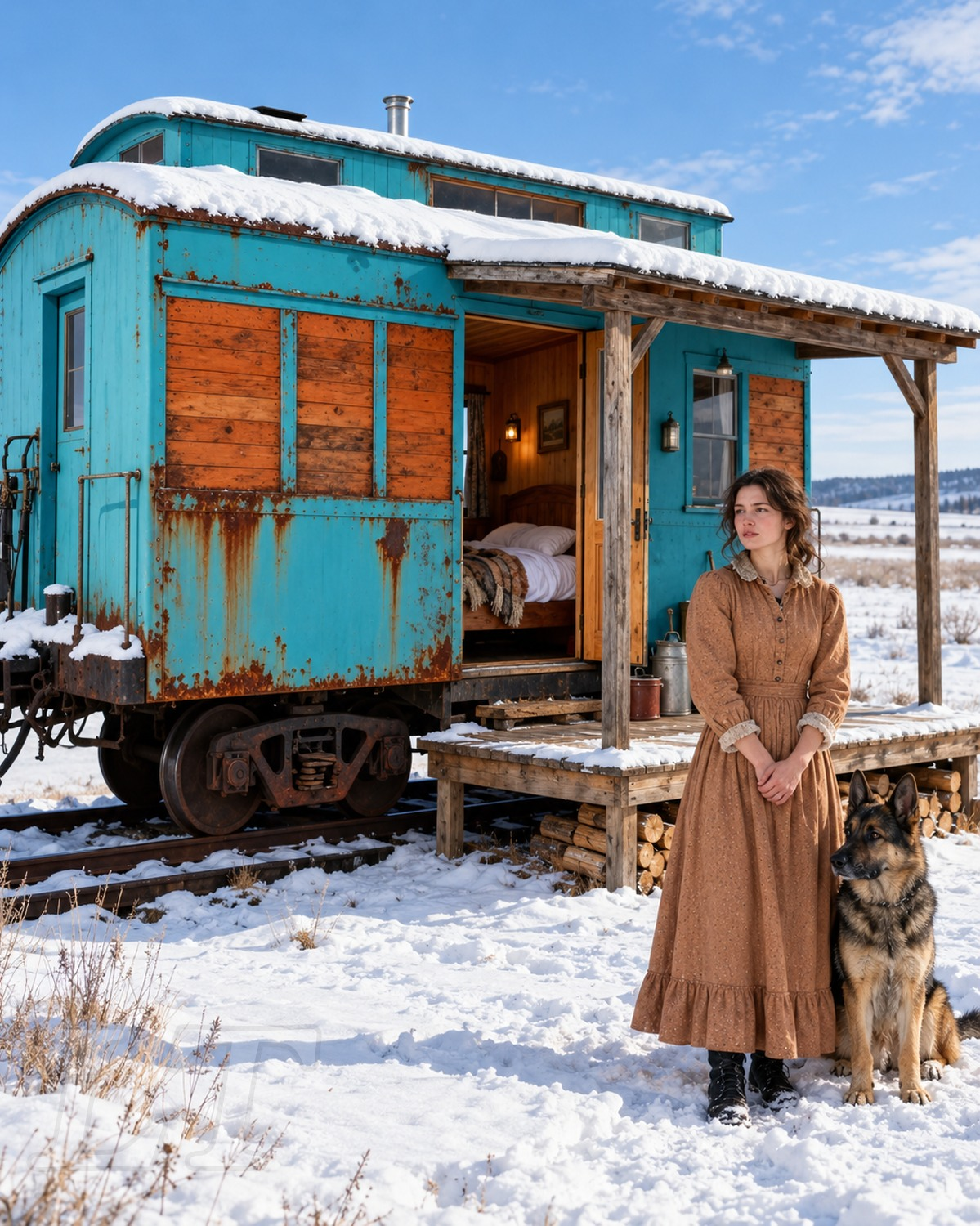
The footprints were still there when Margaret opened the railway car door.
She stood on the wooden step, holding her lantern in one hand.
Kaiser moved past her and lowered his nose toward the snow.
He sniffed once.
Then again.
His ears became alert.
"Easy, boy."
Margaret examined the footprints.
They were large.
A man's boots.
The person had approached the unfinished bedroom wall, stood there for some time, and then walked away.
There were no footprints leading toward the settlement.
They disappeared behind the railway car.
Margaret felt a small knot tighten in her stomach.
She looked toward the surrounding mountains.
Nothing moved.
Only the distant tops of the pine trees swayed in the wind.
She returned inside and closed the heavy door.
"Perhaps Miller came back," she murmured.
Kaiser gave a quiet whine.
Margaret placed the lantern on a wooden crate.
"Whatever it was, we have work to do."
She refused to let fear consume another morning.
There was too much to accomplish.
The first challenge was the floor.
The original iron flooring was dangerously cold. Even with thick blankets, sleeping directly above it would allow the cold to drain warmth from her body throughout the night.
Margaret understood that simply placing rugs over the metal would not solve the problem.
She needed separation.
She began by arranging the smooth river stones she had collected along the lower framework.
Above them, she planned to install a wooden support structure with enough space to reduce direct contact between the sleeping area and the iron floor.
She carefully selected the strongest boards.
Some were warped.
Others had rusty nails that needed removing.
She worked with a hammer, a small pry bar, and an old handsaw.
By midday, her fingers were aching.
Kaiser lay nearby, watching every movement.
Margaret stopped to drink water.
"You know, Thomas used to say I was terrible with a hammer."
Kaiser tilted his head.
"He was wrong, of course."
She smiled briefly.
Then she picked up the hammer again.
For the next several hours, she worked on the raised platform.
The first section came together.
Then the second.
She checked the boards for movement and reinforced the weakest joints.
She did not want to discover a structural problem after the room was finished.
By sunset, the platform was complete.
It was not beautiful.
But it was sturdy.
Margaret stepped onto it.
The boards creaked slightly.
She shifted her weight from one foot to the other.
They held.
"One problem solved."
Kaiser wagged his tail.
She rewarded him with a small piece of dried meat.
The next morning, Margaret began collecting pine needles.
The mountainside was covered with them beneath the trees.
She gathered only the driest material, avoiding anything damp or moldy.
She filled several sacks.
Then she returned to the railway car and packed the material into the spaces between the wooden framework.
The work was slow.
Her hands moved constantly.
She pressed the insulation into place, checked for gaps, and added another layer wherever necessary.
She also used pieces of old wool.
Thomas had once explained that insulation worked best when it reduced the movement of cold air.
Margaret remembered his words.
She had listened to him for years without realizing how much she would eventually need that knowledge.
By the fourth afternoon, the inner partition was beginning to resemble a real wall.
She stood back and examined it.
Eight feet of wooden shelter inside forty feet of iron.
A little room inside a forgotten railway car.
It was an unusual idea.
Perhaps even a foolish one.
But it was hers.
She began working on the ceiling next.
Cold air could enter through the upper sections, and she knew that the roof would need careful attention.
She inspected every joint.
She repaired loose boards.
She packed dry insulation into the spaces behind the inner ceiling.
Then she covered the surface with another layer of wood.
The result was thicker than she had originally planned.
But she preferred to spend an extra day building properly rather than discover a dangerous weakness during the first storm.
On the sixth day, Sarah arrived.
She was a kindhearted woman in her late thirties who lived in the mining settlement with her husband.
Unlike Miller, Sarah rarely mocked anyone.
She had occasionally exchanged greetings with Margaret at the supply store.
That afternoon, she appeared at the railway car carrying a covered pot.
"Margaret?"
Margaret emerged from the inner room.
"Sarah. What a pleasant surprise."
"I brought you something."
She held out the pot.
"Stew. There's more than enough."
Margaret accepted it gratefully.
"That's very kind."
Sarah stepped inside.
Then she stopped.
Her eyes moved across the wooden partition, the raised floor, and the piles of carefully arranged materials.
"What have you done?"
"Made some progress."
Sarah approached the partition and touched the insulation.
"Is this your bedroom?"
"Eventually."
Sarah looked around.
"Margaret, you're building a bedroom inside a railway car."
"That's the idea."
"But the entire thing is made of iron."
"I know."
Sarah turned toward the outer wall.
"When the temperature drops, that metal will become freezing."
Margaret nodded.
"That's why I'm separating the bedroom from it."
Sarah looked at the wooden structure again.
For a moment, she seemed impressed.
Then concern returned to her face.
"What about the stove?"
"I have one."
"Where will the smoke go?"
"Through a chimney pipe."
"And ventilation?"
Margaret pointed toward a protected opening she had begun preparing.
"I've been working on that, too."
Sarah did not look reassured.
"Please don't take this the wrong way, but I think you're underestimating how dangerous this could be."
Margaret placed the stew on a crate.
"I appreciate your concern."
"I'm serious."
"So am I."
Sarah lowered her voice.
"You could come stay at the settlement. Nobody would turn you away."
Margaret looked at her.
There was genuine kindness in Sarah's eyes.
That made the decision harder.
But Margaret remembered the previous winter.
She remembered Thomas struggling to breathe while the fireplace slowly lost its heat.
She remembered waking in the middle of the night to discover that the fire had gone out.
She remembered the helplessness.
"I've spent too much of my life waiting for circumstances to improve," Margaret said. "I want to build something that gives me a little control over what happens next."
Sarah looked down.
Then she noticed the small wooden bed frame leaning against the wall.
"You've even built a bed."
"Thomas would have liked it."
Sarah glanced at her.
Margaret's expression softened.
"He used to repair railway equipment. He taught me quite a bit about heat and insulation."
Sarah gently touched her arm.
"I'm sorry."
Margaret nodded.
For a few seconds, neither woman spoke.
Then Sarah uncovered the stew.
"At least promise me you'll eat something warm tonight."
Margaret smiled.
"I promise."
Sarah remained for another half hour.
Before leaving, she looked once more at the unfinished room.
"I hope you know what you're doing."
"So do I."
Sarah laughed softly.
Then she stepped outside.
Margaret watched her descend the hill.
She was grateful for the visit.
But Sarah's questions had reminded her of something important.
A warm room was not enough.
She needed to make it safe.
The next day, she focused entirely on the stove.
It was a small salvaged tin stove that Thomas had once helped her repair.
Its surface was scratched, and one side had a slight dent.
But the firebox remained intact.
Margaret positioned it on a suitable noncombustible hearth, away from the wooden walls.
She checked the available chimney pipe and inspected every section for damage.
She understood that smoke and carbon monoxide could become deadly in a confined space.
The chimney needed a reliable draft.
The exhaust needed to leave the car safely.
Fresh air needed to enter.
She refused to take shortcuts.
Over several days, she adjusted the pipe arrangement and tested the stove under careful supervision.
She checked for smoke leaks.
She monitored the ventilation.
She inspected the surrounding materials for signs of overheating.
Whenever something seemed wrong, she stopped and corrected it.
Kaiser remained close.
Sometimes he slept beneath the unfinished bed.
Sometimes he followed her around the room.
And sometimes he sat beside the door, looking toward the mountains.
Margaret noticed that behavior more than once.
But she assumed he was simply reacting to the unfamiliar noises of the abandoned railway yard.
By the end of the week, the inner bedroom was almost complete.
Margaret placed her wool blankets on the narrow bed.
She arranged her trunk beside it.
She hung a small lantern from a wooden hook.
Then she brought in the folded scarf that had belonged to Thomas.
She placed it carefully beneath her pillow.
The room was small.
There was barely enough space to move comfortably.
But it felt different from the enormous freezing railway car.
The wooden walls made the space feel protected.
The floor no longer radiated the same bitter cold.
And when she closed the inner door, the wind became quieter.
Margaret stood in the center of the room.
She listened.
For the first time since arriving, she could hear the soft ticking of the stove rather than the constant metallic complaints of the freight car.
She touched the wooden wall.
Then she looked at Kaiser.
"We're getting somewhere."
The dog approached and pressed his head against her hand.
Margaret knelt beside him.
"We might actually make it through winter."
Outside, the afternoon sky had begun turning gray.
A cold wind moved across the unfinished railway tracks.
Far below, the mining settlement continued with its ordinary routines.
Nobody yet understood how quickly those routines were about to disappear.
And nobody, least of all Margaret, knew that Miller had begun asking questions about the railway car's construction.
Because the previous evening, he had seen something through the open door.
He had seen the stove.
He had seen the wooden partition.
And he had seen the warm light inside.
For the first time, he wondered whether the widow might actually succeed.
But he was not the only person watching.
That night, after Margaret extinguished her lantern, Kaiser suddenly lifted his head.
He stared toward the rear wall.
Then he stood.
A low growl escaped his throat.
Margaret opened her eyes.
"What is it?"
The dog walked toward the wooden partition.
He sniffed along its lower edge.
Then he scratched once.
Twice.
Margaret sat up.
She reached for her lantern.
And when she pulled the blanket away from the wall, she discovered a thin line of fresh moisture running beneath the wooden floor.
It was coming from somewhere inside the railway car.
And the water was not coming from the roof.
Hết phần 1. The next installment continues directly with Chapter 3, preserving the original timeline and the unresolved mystery.






Comments 0