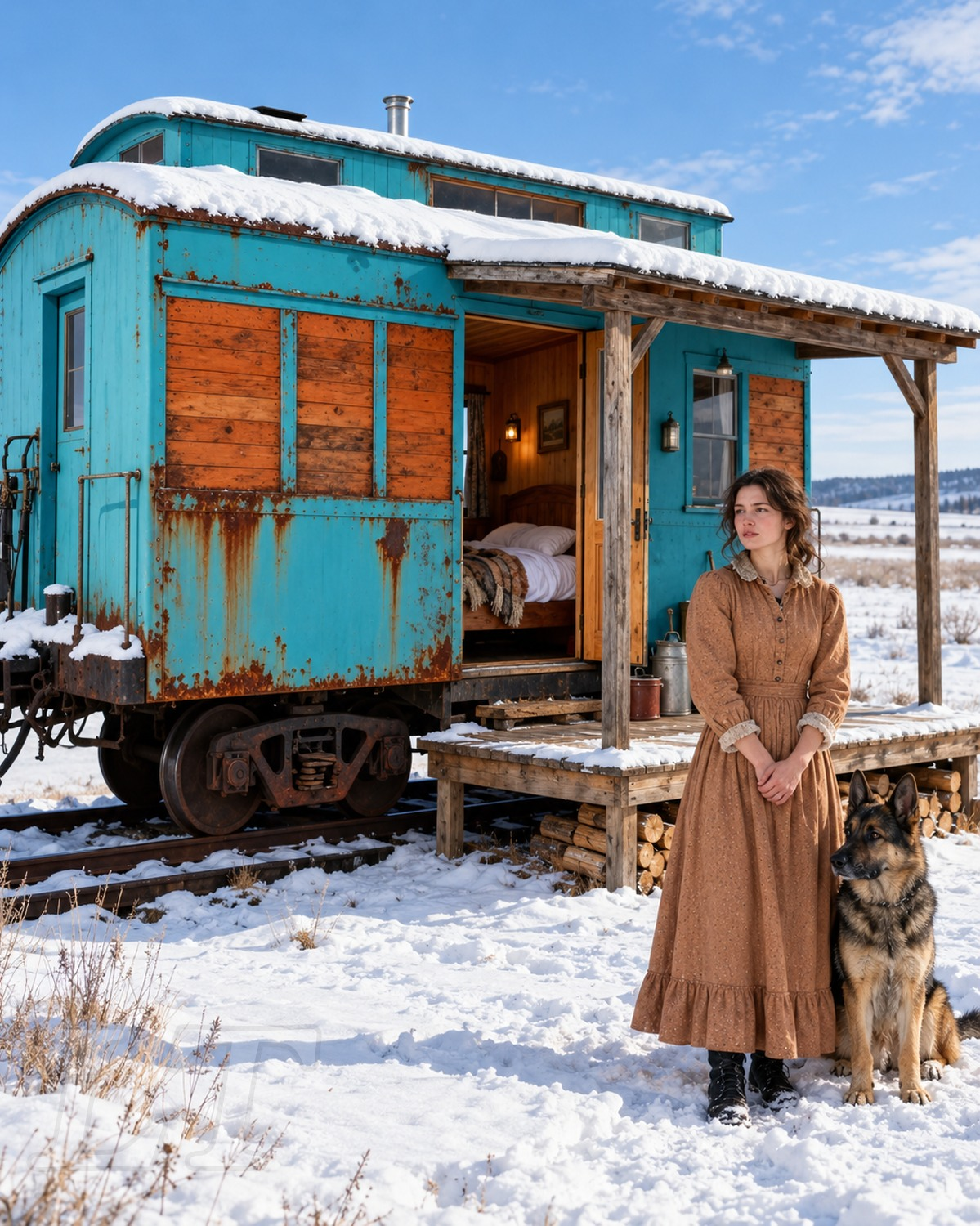
Kaiser slammed both front paws against the railway car door.
"Stop, Kaiser! Something is out there!"
Margaret Gable dropped the lantern she was holding.
The old iron door shook violently.
A man outside was calling her name.
But Margaret had not yet realized that the voice belonged to someone who had laughed at her just days earlier.
And the man was not alone.
Three months earlier, Margaret Gable had stood beside an abandoned railway track with a sack of stones cutting into her bleeding hands.
She was forty-four years old.
Her husband was dead.
Her savings were nearly gone.
And the only property she could call her own was a battered wooden trunk containing two dresses, several blankets, a handful of tools, and a small collection of letters.
Beside her stood Kaiser, a large German Shepherd with black-and-tan fur and intelligent brown eyes.
The dog had been her husband's companion long before he became hers.
Since her husband's death, Kaiser had rarely left her side.
That morning, the two of them were standing beside a forty-foot railway freight car that the railroad company had abandoned after its construction project collapsed.
The car was an ugly thing.
Its turquoise iron walls were covered with rust. Several wooden panels had rotted away. The wheels rested on unfinished tracks, and the massive sliding door made an awful metallic shriek whenever the wind moved against it.
Snow from the previous night remained trapped along the roof.
There was no fireplace.
No proper insulation.
No running water.
No comfortable place to sleep.
To the miners living three miles below, the abandoned railway car was nothing more than a rusting piece of industrial waste.
To Margaret, it was an opportunity.
She lowered her sack of stones and rubbed her aching fingers.
"Well, Kaiser," she whispered. "This is home."
The dog looked up at her.
His tail moved once.
Margaret smiled faintly.
It was the first time she had called somewhere home since her husband died.
The previous spring had taken nearly everything from her.
Her husband, Thomas, had become ill during a particularly harsh season. His condition worsened quickly, and by the time Margaret understood how serious it was, there was little she could do.
She had spent the final weeks beside his bed, holding his hand and listening to him talk about things they would do when he recovered.
They never happened.
After his funeral, Margaret sold what little furniture they owned to pay outstanding debts.
She refused to beg distant relatives for help.
She had no children, no nearby family, and no reliable source of income.
For a while, she considered taking work in the mining settlement.
But the available jobs paid almost nothing, and the crowded bunkhouse offered little privacy.
She had spent her entire married life helping Thomas repair equipment, maintain their home, and survive winters in the mountains.
She knew how to use tools.
She knew how to build.
Most importantly, she knew that a person did not need a beautiful house to survive.
They needed a safe place.
And she intended to make one.
The first person to discover her plan was Miller, a broad-shouldered miner in his early fifties who had worked in the settlement for more than a decade.
He was known for speaking loudly, laughing even louder, and treating his opinions as if they were laws.
That afternoon, Miller approached with three other miners.
He stopped when he noticed Margaret carrying another sack of stones toward the freight car.
"Mrs. Gable!"
Margaret turned.
"Good afternoon, Miller."
He pointed at the railway car.
"Tell me you're not serious."
"About what?"
"Living in that thing."
Margaret placed the sack on the ground.
"That's exactly what I intend to do."
The miners exchanged glances.
One of them laughed.
Miller walked closer and struck the rusty iron wall with his knuckles.
The metal produced a hollow, unpleasant sound.
"Listen to that. You hear it?"
Margaret said nothing.
"That's iron. When winter comes, this place will become colder than a grave."
"I know."
"Then why are you wasting your time?"
Margaret looked at the unfinished tracks beneath her feet.
"Because it's available, and I have a plan."
Miller laughed.
"A plan?"
He gestured toward the open countryside.
"There's a proper bunkhouse down there. Timber walls. A fireplace. A roof that doesn't leak. You could have a bed tonight if you stopped being stubborn."
Margaret appreciated that he had offered.
But she knew the bunkhouse was overcrowded.
She also knew that its residents depended on a single communal fireplace.
During her husband's final winter, she had learned how quickly a fire could disappear.
A person could spend hours feeding flames and still wake up freezing.
She did not want to spend the rest of her life depending on someone else to decide when she deserved warmth.
"Thank you," she said. "But I'll manage here."
Miller stared at her.
"You're going to die in that iron coffin."
The other men laughed again.
Margaret picked up her sack.
"Perhaps."
She turned toward the freight car.
Then she added something that made Miller stop smiling.
"But at least I'll die trying to build something of my own."
For several seconds, nobody spoke.
Then Miller shook his head and walked away.
"Some people can't be helped."
Margaret pretended not to hear him.
She had more important things to do.
That evening, she entered the railway car carrying the stones.
Kaiser followed.
Inside, the space was enormous compared with anything she could afford.
Forty feet of cold iron stretched from one end to the other.
The floor was made of metal plates that had absorbed the day's freezing temperatures.
A few discarded wooden boards lay near the wall.
There were rusted hooks, broken pieces of equipment, and a small collection of railroad supplies left behind by the construction workers.
Margaret placed her trunk near the far end.
She lit her lantern.
The warm glow revealed the enormous task ahead.
She would need to create a room inside the railway car.
Not a room that simply looked comfortable.
A room that could remain warm even when the outside temperature dropped dangerously low.
She remembered something Thomas had once told her.
He had spent years repairing railway equipment, and he understood how metal transferred heat.
One evening, while Margaret had been complaining about her freezing feet, he had placed a heated stone inside a folded blanket.
"Fire gives you warmth," he had explained. "But the real trick is persuading that warmth to stay."
At the time, she had laughed.
Now those words had become the foundation of her survival plan.
Margaret knelt beside the wooden boards and examined them.
She needed more timber.
She needed insulation.
She needed dry earth, stones, and enough materials to create a barrier between herself and the freezing iron.
She also needed a safe heating arrangement.
A poorly installed stove could fill the small bedroom with smoke or carbon monoxide.
She understood that the project carried risks.
But she believed those risks could be managed with careful construction, proper ventilation, and regular inspection.
She took out her notebook.
Thomas had given it to her several years earlier.
Its cover was worn, and several pages contained his rough drawings of railway repairs.
On the final blank page, Margaret began writing.
Floor.
Walls.
Insulation.
Bed.
Stove.
Ventilation.
She paused.
Then she added one final word.
Survive.
Kaiser rested his head beside her knee.
Margaret ran her fingers through his thick fur.
"We'll need a great deal of help," she whispered.
The dog blinked.
"Unfortunately, I think we're the only ones who can provide it."
Outside, the mountain wind moved across the abandoned tracks.
Margaret looked toward the distant settlement.
Smoke rose from the cabins.
People were eating dinner.
Children were probably sitting near fireplaces.
Somewhere, someone was laughing.
For a moment, she wondered whether Miller might be right.
Perhaps she was being foolish.
Perhaps there was no way to make an abandoned iron railway car comfortable enough to survive the Sierra Nevada winter.
Then she looked at the notebook in her hands.
She remembered Thomas.
She remembered the long nights when they had repaired broken equipment together.
She remembered how he had never treated a difficult problem as an impossible one.
Margaret closed the notebook.
"No," she said quietly. "We're going to do this."
The following morning, she began.
Before sunrise, she walked down to a dry creek bed and collected smooth stones.
She carried them uphill one sack at a time.
When her hands became too cold, she wrapped them in wool.
When her back began to ache, she rested beside the tracks.
When she felt too tired to continue, Kaiser nudged her elbow.
By noon, she had collected enough stones to begin preparing the area beneath the future bedroom.
She returned to the freight car and arranged them in a neat pile.
Then she walked farther down the hill to look for discarded timber.
She found several old boards behind a storage shed and asked the owner whether she could take them.
He agreed, provided she carried them herself.
Margaret thanked him.
By evening, she had hauled six boards uphill.
Her shoulders hurt.
Her knees trembled.
But the railway car was beginning to change.
The following day, she started measuring the rear section.
She decided that she did not need all forty feet.
She needed eight feet of protected living space.
The remaining area could hold firewood, tools, supplies, and materials.
She marked the position of the future partition.
Then she began sorting the available timber.
Some pieces were too rotten.
Others were strong enough to reuse.
She placed the usable boards in one pile and the damaged pieces in another.
Kaiser watched her work with remarkable patience.
Occasionally, he picked up a stick and carried it toward her.
Margaret accepted each one as though it were an important contribution.
"Thank you, sir."
His tail wagged.
By the end of the third day, Margaret had begun building the framework of the inner room.
She worked slowly, checking each measurement twice.
The partition would need several layers.
The wooden frame would support the structure.
Dry pine needles and wool would provide insulation.
A second inner layer would help reduce drafts.
She also planned to raise the floor above the freezing steel.
She had not yet solved every problem.
But she was making progress.
On the fourth afternoon, Miller returned.
This time he was carrying a wooden crate.
He stopped at the entrance and looked inside.
Margaret was kneeling beside the unfinished partition.
"What are you doing now?"
"Building."
"I can see that."
He stepped over a loose board.
His eyes moved across the piles of stones, discarded timber, and wool.
Then he noticed the small raised section of flooring.
He frowned.
"What is that supposed to be?"
"The beginning of my bedroom."
Miller laughed.
"Your bedroom?"
Margaret nodded.
"Eight feet of protected space."
He looked at the framework.
Then he glanced at the enormous iron walls surrounding it.
"You really believe a few boards and some old wool are going to protect you from a mountain winter?"
Margaret picked up her hammer.
"I'm not asking you to believe anything."
Miller stared at her.
For some reason, that answer irritated him more than her refusal to accept help.
He placed the crate on the floor.
"What's that?"
"Scraps from the storage yard. I thought you might use them."
Margaret looked inside.
There were several pieces of canvas and a few old wooden strips.
She looked up.
"Thank you."
Miller shrugged.
"Don't thank me. I just don't want to explain to the railroad company why a widow froze to death in their abandoned equipment."
He turned toward the door.
Before leaving, he glanced back.
"Christmas is coming, Mrs. Gable. I wouldn't put too much faith in that little construction project."
Margaret looked at him.
"Then perhaps you should visit after the first snowfall."
Miller laughed.
"We'll see."
He walked away.
Margaret waited until his footsteps disappeared.
Then she returned to work.
That evening, she placed the canvas near the wall and began inspecting it for holes.
Some sections were damaged.
Others could be repaired.
She folded the usable pieces and set them aside.
She would need every advantage she could find.
As night settled over the mountains, Margaret lit her lantern and sat beside Kaiser.
The unfinished bedroom looked nothing like a home yet.
But she could imagine it.
A warm bed.
A protected floor.
A small stove.
A place where she could sleep without waking to the cold biting through her blankets.
For the first time in months, she felt that the future might contain something other than loss.
She reached into her trunk and removed one of Thomas's old wool scarves.
It still carried a faint trace of the soap he had used.
Margaret held it against her face.
"I hope you would understand," she whispered.
Kaiser rested his head on her lap.
She folded the scarf carefully and placed it beside her bedroll.
Then she closed the notebook.
Tomorrow, she would begin insulating the floor.
She had no idea how many more days of work remained.
She had no idea how severe the coming winter would become.
And she certainly did not know that the people laughing at her railway car would soon be desperate to enter it.
But somewhere below the mountain, a man had already begun watching her construction with a very different expression.
Miller had returned to the settlement.
And he had just told someone that Margaret Gable might have found a way to survive the winter without them.
The person listening to him did not laugh.
Instead, he asked one question.
"How much room does she have inside that car?"
Miller hesitated.
Then he answered.
"Not enough for anyone but herself and that dog."
The man looked toward the dark mountain.
"Then we'd better hope she never changes her mind."
That night, Margaret slept beside Kaiser in the cold railway car.
She dreamed of warmth.
She dreamed of Thomas.
And she dreamed that someone was standing outside her door, holding a lantern.
But when she woke before sunrise, there was no lantern.
Only a fresh set of footprints in the snow.
They led directly to the unfinished bedroom wall.
And stopped.






Comments 0