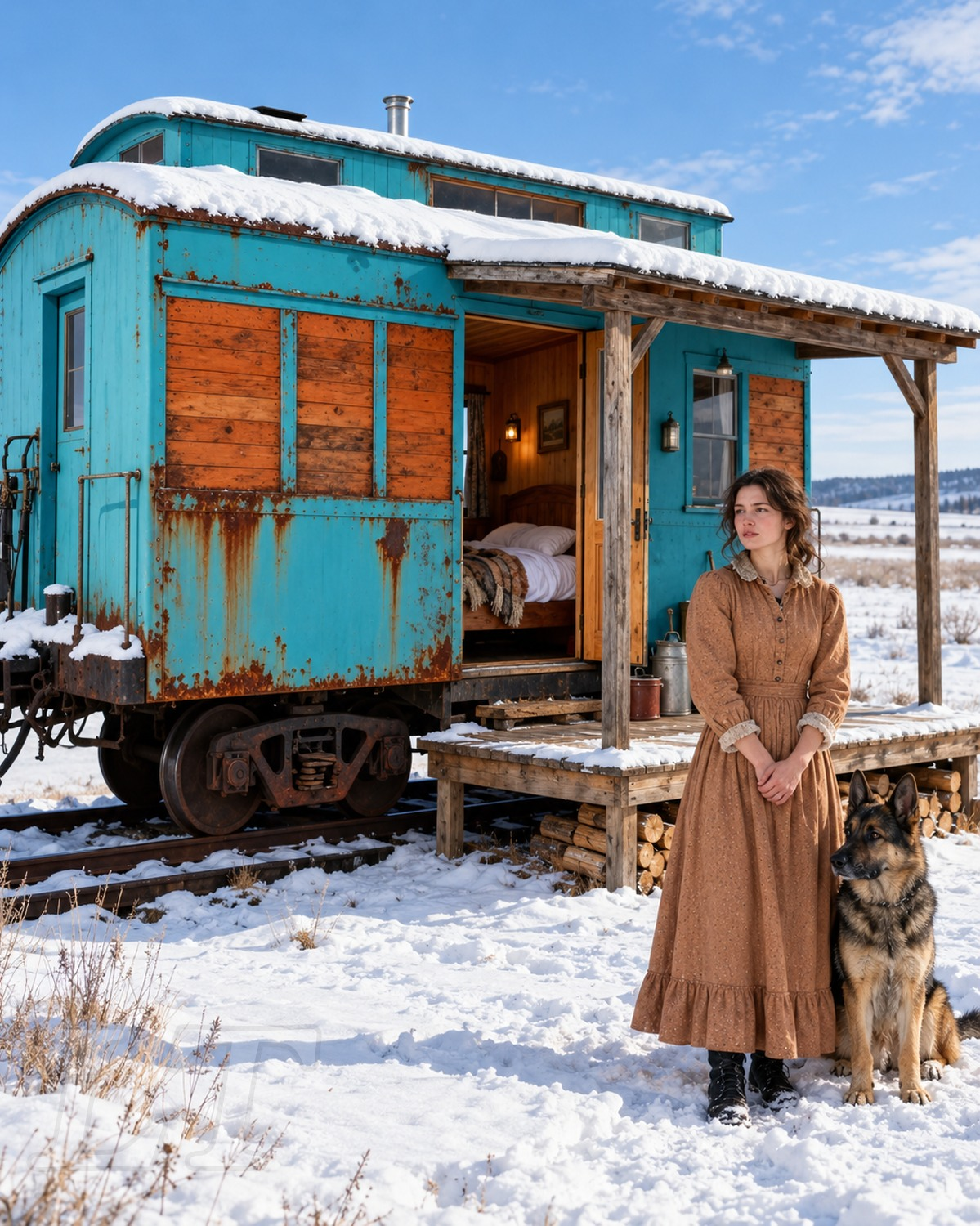
Margaret pulled the blanket away from the wooden wall.
A thin line of water had appeared beneath the floorboards.
"Kaiser, stay back."
The German Shepherd lowered his head and sniffed the narrow gap.
Then he scratched the wood again.
Margaret reached for her lantern and moved closer.
The water was cold.
Not ordinary moisture from the air.
It was moving.
A tiny stream slipped beneath the wooden platform and disappeared toward the rear of the railway car.
Margaret frowned.
There had been no rain for days.
The roof was covered with snow, but she had carefully inspected the ceiling before completing the bedroom.
She knew there were no obvious leaks.
So where was the water coming from?
She picked up the lantern and examined the floor.
The wooden boards appeared dry everywhere except along one narrow section near the rear wall.
She pressed her palm against the surface.
Cold.
Much colder than the surrounding floor.
She withdrew her hand.
"That's strange."
Kaiser gave a quiet growl.
Margaret looked at him.
"Do you smell something?"
The dog sniffed again, then moved toward the corner.
He lowered his nose almost to the floor and began following the damp line.
Margaret watched him carefully.
She had learned to trust Kaiser's instincts.
During Thomas's final winter, the dog had once alerted them to smoke coming from a damaged section of their chimney.
Thomas had initially dismissed the warning.
Kaiser had refused to leave the fireplace.
When Thomas finally investigated, he discovered that a small piece of wood had begun smoldering behind the stonework.
The dog had prevented a disaster.
Margaret remembered that night.
She reached for the small hammer resting beside her trunk.
"All right, boy. Let's see what you've found."
She began removing the nearest floorboard.
The first nail resisted.
She adjusted the angle of the hammer and pulled again.
The wood lifted slightly.
A second pull loosened it.
Margaret placed the board beside the bed.
Beneath it was a layer of dry earth and ash.
She moved the lantern closer.
At first, everything looked normal.
Then she noticed something unusual.
The earth beneath the wooden floor had darkened.
A narrow channel ran through it.
Water was traveling along the channel, moving toward the rear of the freight car.
Margaret crouched.
She touched the damp soil with one finger.
It was freezing.
She looked toward the exterior iron wall.
The railway car had been abandoned for months.
The construction crew had left behind sections of unfinished track, broken timber, and several drainage trenches.
She knew the surrounding ground sloped toward the lower valley.
Perhaps water from melting snow had found its way beneath the railway car.
But there was something else.
The channel appeared too regular to be natural.
Margaret moved closer.
She brushed away a small amount of soil.
A flat wooden surface appeared beneath the dirt.
She stared at it.
Then she carefully removed more earth.
The wood was old.
Very old.
It ran parallel to the railway car's floor and disappeared beneath the rear wall.
Margaret felt a growing uneasiness.
"Why would anyone put a board down there?"
Kaiser sniffed the exposed surface.
Then he moved backward.
His ears flattened.
Margaret stopped working.
The dog was not frightened easily.
She examined the wooden surface again.
A small metal object was partially buried near its edge.
She brushed away the remaining dirt.
It was a rusted iron ring.
Margaret stared at it.
The ring appeared to be attached to a rectangular wooden panel.
She pulled gently.
Nothing happened.
She tried again.
The panel shifted slightly.
A hollow sound came from underneath.
Margaret froze.
She placed the lantern beside her and listened.
There was something below the floor.
Not a voice.
Not an animal.
Just a faint, steady movement.
Water.
She looked toward the door.
Then back at the iron ring.
Her first instinct was to cover the opening and investigate in daylight.
But she had already discovered enough to know that ignoring the water would be dangerous.
If it continued flowing beneath the raised floor, the insulation could become wet.
Wet insulation would lose much of its effectiveness.
The wooden supports could eventually rot.
And if the water froze, it could create additional problems.
She needed to understand what was happening.
Margaret took a deep breath.
Then she pulled the ring.
The panel lifted approximately an inch.
A blast of cold air escaped through the opening.
Kaiser barked.
Margaret instinctively leaned backward.
The smell reached her a moment later.
Damp earth.
Old wood.
And something metallic.
She lowered the lantern toward the opening.
There was darkness beneath the floor.
She could make out a narrow space extending beneath the railway car.
The water was flowing through it.
Margaret could not see how far it went.
She lowered herself onto one knee.
"Well, that's something Thomas never mentioned."
Kaiser stood beside her.
His attention remained fixed on the opening.
Margaret decided not to enter.
She had no idea how stable the structure was, and she had no intention of risking a fall into an unknown space.
Instead, she used a long piece of timber to examine the area.
The wood touched something solid.
She moved it slowly.
Then she felt a sudden drop.
The timber disappeared several inches farther than expected.
Margaret pulled it back.
A small amount of loose soil fell into the opening.
She watched it disappear.
There was more space beneath the railway car than she had imagined.
The discovery made her uneasy.
But it also gave her a possible explanation.
Perhaps the construction workers had built a drainage channel beneath the tracks.
Perhaps the abandoned railway car had been positioned over an old service trench.
If so, the water might be traveling through a drainage system that had become blocked.
Margaret closed the panel.
She placed a heavy wooden crate over it.
Then she examined the surrounding floor.
The dampness had spread slightly.
She would need to keep the bedroom dry until she could determine the source.
She removed the affected insulation from the exposed section and placed it somewhere warm and dry.
Then she laid several clean cloths along the edge to monitor the moisture.
She made a note in Thomas's old notebook.
Water beneath the rear floor. Possible drainage channel. Investigate in daylight.
After closing the notebook, she looked at Kaiser.
"You've earned your dinner."
The dog wagged his tail.
Margaret gave him a piece of dried meat.
But she did not sleep particularly well that night.
Every few hours, she woke and checked the floor.
The water continued moving.
It never became a flood.
It never stopped.
And sometime before dawn, she heard a faint metallic sound beneath the wooden platform.
Three short taps.
Then silence.
Margaret sat up.
Kaiser was already standing.
His ears pointed toward the rear wall.
She waited.
Nothing happened.
Eventually, she lay down again.
But she kept the lantern within reach.
The following morning, Margaret went outside to inspect the railway car.
The storm had not yet arrived, but the temperature had dropped noticeably.
The surrounding mountains were covered with fresh snow.
She walked along the exterior wall, examining the ground.
Near the rear wheels, she discovered a narrow depression in the snow.
It appeared to follow the direction of the tracks.
She knelt and brushed away the loose snow.
Beneath it was a patch of frozen earth.
A little farther along, she found another.
Then another.
She stood and followed the line toward the hillside.
The depressions continued until they disappeared beneath a pile of discarded railway timber.
Margaret returned to the freight car and fetched a shovel.
She began clearing the debris.
It was difficult work.
The timber had been buried beneath years of dirt and accumulated rubbish.
Some pieces were rotten.
Others were surprisingly heavy.
She removed them one at a time.
After nearly an hour, she uncovered a narrow stone-lined channel.
Margaret stopped.
It was a drainage trench.
The stones had been arranged carefully.
She brushed away the snow and examined the opening.
A small stream of water passed beneath the frozen surface.
The trench extended toward the abandoned railway car.
Now she understood.
The railway workers had constructed the drainage channel to carry water away from the unfinished track.
But something had happened to it.
Near the freight car, the channel narrowed.
A collection of broken timber and compacted earth blocked part of the opening.
Water was finding another route.
And that route passed directly beneath her bedroom.
Margaret looked toward the hillside.
If the drainage system became completely blocked during the coming storm, water could accumulate beneath the railway car.
The freezing temperatures might turn the problem into something much worse.
She returned inside.
Kaiser followed.
Margaret opened her notebook and studied the rough drawings Thomas had made years earlier.
She had learned enough from him to understand the basic principles of drainage.
Water needed somewhere to go.
If the original route was blocked, it would find another.
She would need to clear the trench before the snow became too deep.
But she could not do it alone with the materials she currently had.
She needed a shovel, a stronger pry bar, and possibly help moving the larger timber.
Margaret looked toward the settlement.
She disliked asking for assistance.
But this was not a matter of pride.
It was a matter of safety.
She put on her coat and prepared to leave.
Before stepping outside, she filled Kaiser's bowl and checked the stove.
Then she looked around the bedroom.
The little room was finally beginning to feel like a home.
She had spent days building it.
Every board had been measured.
Every layer of insulation had been placed carefully.
She could not allow an unexpected drainage problem to destroy it.
"I'll be back before dark," she told Kaiser.
The dog stood near the entrance.
Margaret touched his head.
"Keep an eye on the place."
She descended the hill.
The mining settlement was unusually busy that morning.
Several men were unloading supplies near the general store.
A blacksmith was repairing a damaged wagon wheel.
Two women were carrying baskets between the cabins.
Smoke rose from the chimneys.
Margaret walked toward the store and found Miller standing outside.
He was speaking with another miner.
When he noticed her, he stopped.
"Mrs. Gable."
"Good morning, Miller."
He looked at the shovel in her hand.
"Something wrong with your little house?"
Margaret did not appreciate the tone.
"I've discovered a drainage problem beneath the railway car."
Miller raised his eyebrows.
"Drainage?"
"An old trench appears to run beneath the tracks. It's partially blocked, and water is finding its way beneath the floor."
He laughed.
"Well, I'll be damned. You found yourself a river."
Margaret ignored the remark.
"I need a stronger pry bar and perhaps another shovel."
Miller looked toward the settlement.
"Why don't you just come down and stay in the bunkhouse?"
"Because I intend to repair the problem."
He shook his head.
"That place is more trouble than it's worth."
Margaret tightened her grip on the shovel.
"It won't repair itself."
The miner standing beside Miller gave a quiet chuckle.
Miller looked at him.
Then he turned back toward Margaret.
"Fine. There's a pry bar behind the blacksmith's shed. Take it if you want."
"Thank you."
"Don't say I didn't warn you."
Margaret walked toward the shed.
As she passed the general store, Sarah stepped outside.
"Margaret!"
She hurried over.
"I heard you were having trouble."
Margaret explained what she had discovered.
Sarah's expression became serious.
"Water beneath the railway car?"
"Yes."
"That doesn't sound good."
"It isn't ideal."
Sarah looked toward the mountains.
"Have you seen the sky?"
Margaret glanced upward.
The clouds had thickened.
A dark band stretched across the western horizon.
"I've been watching it."
"They say another storm is coming."
"How soon?"
"Nobody knows. The men at the mine think it could arrive within the next few days."
Margaret felt a sudden urgency.
She needed to clear the drainage trench before then.
Sarah studied her face.
"Do you want me to come help?"
Margaret hesitated.
She did not want to involve Sarah in a dangerous construction problem.
But another pair of hands would make the work much easier.
"If you have time."
Sarah nodded.
"I'll bring my husband."
Margaret looked at her gratefully.
"Thank you."
Sarah smiled.
"Don't thank me yet. He'll complain the entire way up the hill."
Margaret laughed.
For the first time that morning, the tension eased.
She collected the pry bar and returned to the railway car.
By noon, Sarah and her husband arrived.
His name was Daniel.
He was a quiet man in his early forties who worked repairing mining equipment.
Unlike Miller, he preferred examining a problem before discussing whether it could be solved.
Margaret showed him the drainage trench.
He crouched beside the opening.
After several minutes, he examined the stones.
"Whoever built this knew what he was doing."
"Can it be cleared?"
Daniel nodded.
"Probably. But the blockage is farther inside than I expected."
He pointed toward a section of frozen earth.
"We'll need to remove the timber first."
Margaret brought the pry bar.
Daniel worked while Margaret cleared the smaller debris.
Sarah carried the loose pieces away.
Kaiser remained near the entrance, watching them.
The work was difficult.
Some of the old timber had become trapped beneath the frozen ground.
Daniel used the pry bar to lift one section.
Margaret pulled the other end.
The wood shifted.
Then it broke apart.
Beneath it was a layer of compacted earth.
Daniel frowned.
"That's odd."
"What?"
He brushed away the dirt.
A second wooden surface appeared.
Unlike the drainage trench, this piece was smooth and carefully fitted.
Daniel looked at Margaret.
"Have you seen this before?"
Margaret shook her head.
They cleared more soil.
A rectangular wooden structure gradually emerged.
It appeared to be some kind of access cover.
Daniel examined its edges.
"Looks like an inspection hatch."
Margaret knelt beside him.
"An inspection hatch for what?"
He shrugged.
"Could be an old maintenance chamber."
Margaret looked toward the freight car.
The hatch was directly beneath the rear section.
The same area where she had discovered the water.
Daniel pushed against it.
It did not move.
He tried the iron ring.
The cover shifted slightly.
Then he stopped.
"Hold on."
He pointed toward the far edge.
Something was attached to the wood.
A length of rusted chain.
Margaret brushed away the remaining dirt.
The chain disappeared beneath the hatch.
She followed it with her eyes.
"Why would someone chain it shut?"
Daniel did not answer immediately.
He examined the lock.
It was old.
But it had not simply rusted into place.
The metal had been secured deliberately.
Sarah stepped closer.
"Perhaps it was meant to keep people out."
Margaret looked at the chain.
"Or something in."
Nobody laughed.
For several seconds, the only sound was the wind moving through the nearby trees.
Daniel stood.
"We shouldn't force it today. We need to understand what's underneath before opening anything."
Margaret agreed.
She had no intention of taking unnecessary risks.
They returned to the drainage trench.
Daniel helped clear the remaining blockage.
By late afternoon, the water was beginning to move through the original channel again.
Margaret watched carefully.
The stream beneath the ground became smaller.
The dampness near the bedroom floor would take time to disappear, but the immediate problem appeared manageable.
She thanked Daniel and Sarah.
Daniel wiped his hands.
"You should keep checking that channel."
"I will."
"And don't store anything valuable directly against the rear wall until you're certain the ground is dry."
Margaret nodded.
Sarah looked at the railway car.
"You really have built something remarkable here."
Margaret smiled.
"It's still a work in progress."
"Everything is."
Sarah hugged her before leaving.
Daniel followed her down the hill.
Margaret watched them disappear.
Then she turned toward the railway car.
Kaiser was standing near the entrance.
His body was stiff.
His attention was fixed on the rear section.
Margaret frowned.
"What's wrong now?"
The dog did not move.
She stepped inside.
The bedroom was warm.
The stove was burning steadily.
The floor appeared dry.
Everything looked normal.
But Kaiser walked toward the rear wall and stopped beside the place where the wooden panel had been exposed the previous night.
He sniffed.
Then he began scratching.
Margaret placed the lantern on the floor.
"Kaiser, no."
He continued.
She knelt and examined the boards.
At first, she noticed nothing.
Then she saw a narrow mark along the edge.
A fresh scratch.
Someone had disturbed the wood.
Margaret touched it.
The mark was not old.
It exposed pale timber beneath the darker surface.
She looked toward the entrance.
She had not left the railway car open.
Daniel and Sarah had been working outside.
Nobody had entered the bedroom.
At least, nobody she had seen.
Margaret slowly lifted the edge of the wooden cover.
It moved more easily than before.
Beneath it, the old iron ring was visible.
She stared at it.
Then she heard something.
A faint scraping sound.
Not from the drainage trench outside.
From directly underneath her bedroom.
She held her breath.
The sound stopped.
Kaiser stepped backward.
His ears flattened.
Margaret slowly lowered the cover.
She stood and walked toward the outer door.
For a moment, she considered going to find Daniel.
But something made her hesitate.
The sound had not come from the drainage channel.
It had come from beneath the railway car itself.
She looked toward the rear wall.
Then she noticed something else.
The old wooden partition had shifted slightly.
A thin line of darkness appeared between two boards.
Margaret approached.
She touched the edge.
The wood moved.
Behind it was a narrow space.
Not insulation.
Not empty framing.
A concealed gap extending deeper into the structure.
She reached for her lantern.
Then she heard a familiar metallic tapping.
Three short knocks.
The same sound she had heard during the night.
This time, it was louder.
And it came from beneath the bedroom floor.
Margaret stepped backward.
Kaiser moved in front of her.
His teeth showed.
The tapping stopped.
Then something scraped slowly across the underside of the wooden floor.
Margaret's hand tightened around the lantern.
She stared at the narrow opening behind the partition.
A small object suddenly pushed through the gap.
It fell onto the floor.
Margaret looked down.
It was a folded piece of paper.
The edges were yellow with age.
A dark stain covered one corner.
She picked it up carefully.
The paper smelled of damp earth and rust.
There was handwriting on the outside.
Margaret recognized the name immediately.
It was written in Thomas's unmistakable handwriting.
Her husband's name was beneath it.
And on the reverse side, someone had written five words:
DO NOT OPEN THE LOWER DOOR.
Margaret stopped breathing.
She turned the paper over.
Before she could read the rest, Kaiser suddenly lunged toward the rear wall.
The entire railway car shuddered.
A heavy metallic object moved beneath the floor.
Then a man's voice came from somewhere underneath her bedroom.
"Mrs. Gable?"
Margaret's lantern slipped in her hand.
The voice spoke again.
This time, it sounded closer.
"Margaret... are you in there?"
And then the man said something that made her blood run cold.
"Your husband told me you'd come back."






Comments 0