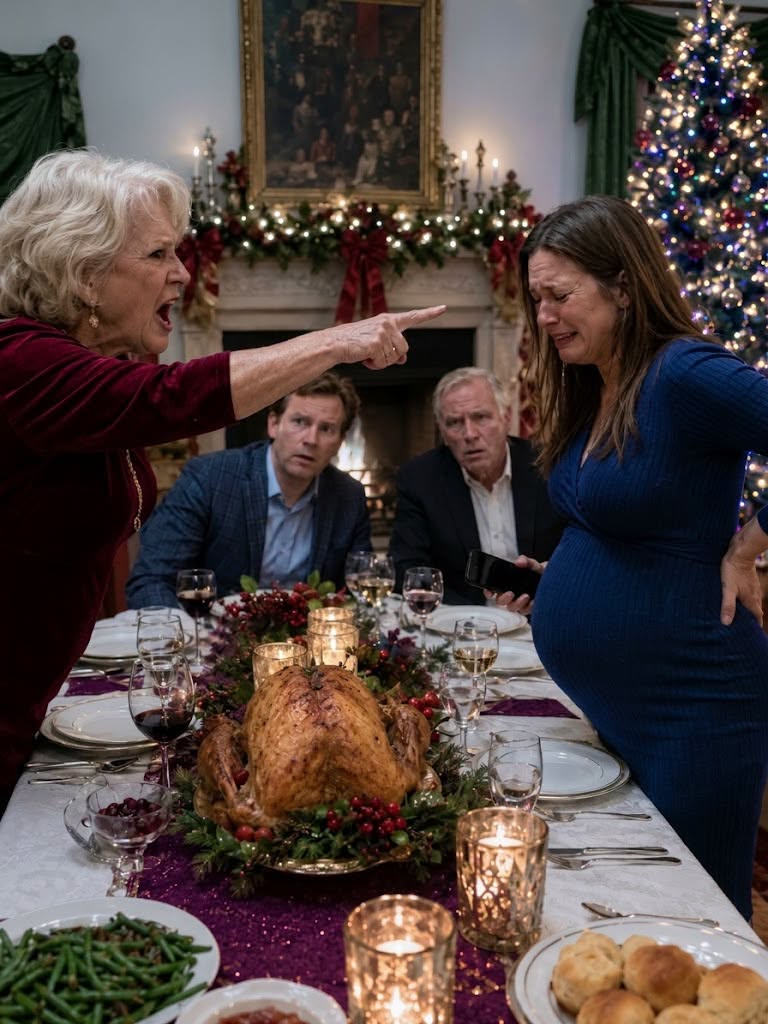
"Don't let her in," my father said.
His voice was quiet, but the woman standing outside my hospital room stopped pushing the door.
For one terrible second, I thought it was Margaret Whitmore.
Then I heard the voice again.
"Claire, please. It's Meredith."
I froze.
Meredith Lawson.
The woman who had managed Margaret's household for almost eleven years.
The woman who knew where every expensive serving dish was kept, which guests Margaret secretly disliked, and exactly how many glasses of wine Thomas needed before he started speaking about his career as though he owned the entire legal profession.
Meredith had always been kind to me.
But kindness in Margaret's house came with consequences.
And Meredith had a mortgage, two teenage sons, and a job she couldn't afford to lose.
I looked at my father.
"Let her in."
Dad studied my face.
"Are you sure?"
I nodded.
He opened the door.
Meredith stood in the hallway wearing a long black winter coat over a plain gray sweater. Her dark hair was pulled into a loose bun, and she was holding a small brown envelope against her chest.
She looked frightened.
Not uncomfortable.
Not embarrassed.
Frightened.
The moment she saw me lying in the hospital bed, her eyes filled with tears.
"Oh, Claire."
She stepped forward, then stopped.
"I'm so sorry."
I stared at her.
"For what?"
She looked at my father.
Then toward the hallway.
"Because I heard what they said to you tonight."
My throat tightened.
"You were there?"
She nodded.
"I was in the service hallway. Margaret told me to stay out of sight while Jonathan Mercer was visiting."
Of course she had.
Margaret loved employing people.
She simply hated reminding her guests that those people existed.
Meredith's hands trembled around the envelope.
"And I heard something else after the ambulance left."
My father closed the door.
"What did you hear?"
Meredith swallowed.
"Thomas and his mother were arguing in the library."
I felt my heartbeat quicken.
"About me?"
She shook her head.
"About your father."
I had known Meredith since my first Christmas with the Whitmores.
Back then, she had quietly slipped me a plate of food after Margaret insisted I help clear the dining room before eating.
"Sit in the pantry," she whispered. "I'll tell her you're checking the inventory."
I had laughed.
It seemed ridiculous that two grown women had to hide a plate of turkey from someone who owned three houses.
But Meredith hadn't laughed.
She had simply said, "Mrs. Whitmore doesn't like being challenged."
Over the years, I learned that Meredith knew more about the family than anyone.
She knew Margaret's charitable donations were often announced before the checks were written.
She knew Thomas's father had left behind debts that Margaret never discussed.
She knew the Whitmore family fortune wasn't nearly as large as people assumed.
And she knew which arguments happened behind closed doors.
But she almost never spoke about them.
That was why seeing her in my hospital room at four-thirty in the morning frightened me more than Margaret's shouting ever had.
Something had finally become serious enough to make Meredith break her silence.
"Please sit down," I said.
She shook her head.
"I can't stay long."
My father gestured toward the chair.
"Mrs. Lawson, you're not required to tell us anything you're uncomfortable sharing."
She looked at him.
"I know who you are."
Dad nodded.
"Then you also know I can't promise you any special protection because of my position."
"I don't want special treatment."
Her voice cracked.
"I just don't want another woman hurt because I kept my mouth shut."
The room became silent.
I looked at the envelope.
"Meredith, what happened?"
She took a breath.
"After you left, Mrs. Whitmore told everyone dinner would continue."
I stared at her.
"Continue?"
She nodded.
"The turkey was still on the table. The candles were burning. Jonathan and Richard were standing near the fireplace."
I imagined the room.
The beautiful Christmas tree.
The expensive crystal glasses.
The empty chair beside Thomas.
My chair.
"Margaret told them you had become overwhelmed," Meredith continued. "She said pregnancy made you emotional and that you had exaggerated a minor discomfort."
I closed my eyes.
Even after the ambulance.
Even after my father called.
She had continued.
"Jonathan didn't accept that," Meredith said.
I opened my eyes.
"What did he say?"
"He asked why a woman who was seven months pregnant had been expected to serve dinner all evening."
My chest tightened.
Meredith looked down.
"Mrs. Whitmore told him it was a family tradition."
I gave a small, bitter laugh.
"A family tradition."
"Yes."
"And Thomas?"
Meredith's expression darkened.
"He told Jonathan that you liked taking care of everyone."
I stared at her.
For a moment, I couldn't speak.
I had spent ten hours cooking.
My back had been burning.
My ankles had swollen until my shoes barely fit.
And Thomas had told his colleague that I enjoyed it.
Meredith continued.
"Then Richard asked Thomas something."
"What?"
She looked directly at me.
"He asked whether Thomas had ever actually watched you enjoy any of it."
I didn't know what to say.
Richard Whitmore had always seemed like a quiet man.
He attended family holidays, complimented the food, and rarely involved himself in arguments.
I had assumed his silence meant agreement.
But apparently, I had been wrong.
"What did Thomas say?" I asked.
Meredith shook her head.
"Nothing at first."
She paused.
"Then he said Richard didn't understand how marriage worked."
I looked toward my father.
His expression remained serious.
Meredith continued.
"Richard told him that he had been married for forty-two years, and he understood enough to know that a pregnant woman shouldn't have to beg for a chair."
My eyes filled with tears.
It was such a small thing.
A chair.
One empty chair.
Yet somehow, that chair had become the clearest symbol of everything wrong with my marriage.
Meredith rubbed her hands together.
"Margaret became furious. She told Richard that nobody had the right to judge how she ran her home."
I could almost hear her.
The sharp voice.
The offended dignity.
The certainty that being challenged was worse than being cruel.
"Richard told her it wasn't her home that concerned him," Meredith said.
I looked up.
"What concerned him?"
"You."
I swallowed.
Meredith's eyes softened.
"He said he'd watched you carry food all evening while Thomas sat drinking wine. He said he'd seen you holding your back and struggling to stand. And he said he regretted not speaking sooner."
I covered my mouth.
For months, I had wondered whether anyone noticed.
Whether the humiliation was visible.
Whether I was imagining how badly I was being treated.
Now I knew.
People had seen it.
They had simply remained silent.
Until Christmas night.
"Meredith," my father said, "you mentioned an argument in the library."
She nodded.
"Yes."
Her expression changed.
"After Jonathan left, Thomas took Margaret into the library. He was furious."
"About my father?" I asked.
"Yes."
She hesitated.
"He said she'd promised everything was under control."
I stared at her.
"What was under control?"
"I don't know."
"Did she answer?"
Meredith nodded slowly.
"She told him he needed to stop panicking because the firm hadn't made its decision yet."
My father's expression sharpened.
"Did they mention a client?"
Meredith looked at him.
"Westbridge."
The word seemed to settle heavily between us.
I felt my stomach tighten.
"Westbridge Development Group?"
"Yes."
Meredith gripped the envelope.
"Thomas said something about a presentation and a photograph. He told Margaret that if the wrong people saw the original file, his career would be finished."
I looked at Dad.
He remained silent.
"What original file?" I asked.
Meredith shook her head.
"I don't know."
Then she looked down at the envelope.
"But I think this might help."
She held it out.
I hesitated.
My father spoke first.
"Mrs. Lawson, where did you get that?"
Meredith looked embarrassed.
"Mrs. Whitmore asked me to throw away some papers after the argument."
Dad's expression became cautious.
"Did she tell you what they were?"
"No. She handed me a stack from the library desk and told me to put them in the outside recycling bin."
"Did you read them?"
"Not at first."
She swallowed.
"One page slipped onto the floor. I saw Claire's name."
I stared at her.
"My name?"
Meredith nodded.
"Then I saw the words family relationship and judicial access."
My father took a slow breath.
"Mrs. Lawson, if those papers belong to the firm or contain confidential information, we need to be careful about how they're handled."
"I understand."
She looked at me.
"I didn't know what else to do."
Dad nodded.
"Keep the originals intact. Don't make copies or send photographs. An attorney can help determine the proper way to preserve and disclose them."
Meredith looked relieved.
Then she placed the envelope on the chair beside my bed.
"I haven't opened it again."
I stared at it.
Something about that small brown envelope frightened me.
It was ordinary.
The kind of envelope used for receipts, grocery lists, and household paperwork.
But my name was inside.
And apparently, so was a part of my husband's life I knew nothing about.
Before we could discuss it further, the nurse entered.
She checked my blood pressure and the monitor.
"How are you feeling, Claire?"
"Tired."
"Any worsening pain?"
"Not worse."
She nodded.
"The doctor will be back shortly. We'd like you to keep resting."
Her eyes moved toward Meredith.
"Would you like your visitor to stay?"
I looked at Meredith.
She was already standing.
"I should go."
"Meredith—"
She shook her head.
"Mrs. Whitmore will notice if I'm gone too long."
My chest tightened.
"You're going back there?"
"It's my job."
I stared at her.
She gave me a sad smile.
"Not everyone has somewhere else to go, Claire."
I wanted to tell her that she deserved better.
But I knew how empty those words could sound when they came from someone who didn't have to worry about losing a paycheck.
Instead, I reached for her hand.
"Thank you."
Her eyes filled.
"I should have said something sooner."
I shook my head.
"You said something tonight."
She squeezed my hand.
Then she leaned closer.
"Claire, there's one more thing."
I looked up.
"Yes?"
Her voice dropped.
"Thomas asked Margaret whether she'd told you about November eighteenth."
My heart began pounding.
"The day someone entered my father's house?"
Meredith nodded.
"She said no."
I swallowed.
"What else?"
Meredith glanced toward the door.
"Thomas told her that if you ever found out what happened that day, you would never forgive him."
She released my hand.
Then she left.
I watched the door close.
And for several seconds, I couldn't move.
My father sat beside me.
Neither of us touched the envelope.
I looked at him.
"Dad, what happened on November eighteenth?"
He shook his head.
"I don't know."
"Margaret was at your house."
"The security image appears to show her there."
"Thomas's car was there."
"Yes."
"And now Meredith says they were arguing about that date."
Dad nodded.
I stared at the envelope.
"How much more do we need?"
He looked at me carefully.
"Enough to know what actually happened."
I exhaled.
"You sound like you're in court."
A faint, sad smile crossed his face.
"Sometimes that's the only way I know how to keep fear from making decisions for me."
I looked down.
"I'm scared."
"I know."
"What if Thomas married me because of you?"
Dad didn't answer immediately.
Then he said, "Claire, I can't tell you what was in his heart when he married you."
I swallowed.
"But I can tell you something else."
I looked up.
"Whatever his reasons were, they don't determine your worth."
Tears slid down my cheeks.
I wanted to believe him.
But the possibility that my marriage had been built on something other than love was beginning to feel unbearable.
At six-thirty in the morning, Dr. Collins returned.
She reviewed the overnight monitoring and explained that Lily's heartbeat remained reassuring.
My contractions had become less frequent.
The examinations had not shown evidence of active preterm labor, but she wanted to observe me a little longer before deciding whether I could safely go home.
I nodded.
"Can I eat?"
The doctor smiled.
"Yes. Let's get you some breakfast."
I almost cried from relief.
A nurse brought toast, scrambled eggs, fruit, and tea.
Nothing fancy.
No crystal glasses.
No silver serving trays.
No elaborate Christmas decorations.
Just food.
Warm food.
Placed in front of me by someone who expected nothing in return.
I picked up my fork.
Then stopped.
Dad noticed.
"What's wrong?"
I looked at the plate.
"I haven't eaten a real meal since yesterday morning."
His face changed.
He looked away for a moment.
When he turned back, his eyes were wet.
"Eat, sweetheart."
So I did.
And I realized that I had spent years treating my own needs like inconveniences.
Hunger.
Fatigue.
Pain.
Sadness.
I had learned to postpone all of them.
But my daughter was coming.
And I couldn't teach Lily to value herself if I continued demonstrating that love meant disappearing.
At eight, Jonathan called.
I answered while Dad stepped into the hallway.
"Claire?"
"Hi."
"How are you feeling?"
"Better. The doctors are still monitoring me."
He exhaled.
"I'm glad."
There was a pause.
Then he said, "I need to apologize."
I frowned.
"For what?"
"For last night."
"Jonathan, you didn't do anything."
"That's not true."
His voice sounded strained.
"I watched Margaret humiliate you. I watched Thomas ignore you. And I waited too long to say something."
I looked down at my blanket.
"You eventually did."
"After you were already in pain."
I didn't know what to say.
Jonathan continued.
"At the firm, we talk constantly about integrity. Professional responsibility. Doing the right thing when it's difficult."
He gave a humorless laugh.
"And last night, I sat at a Christmas table while a pregnant woman was treated like a servant because I didn't want to offend my colleague."
I closed my eyes.
"Jonathan—"
"No. I need you to hear this."
His voice became firm.
"What happened was wrong. And I saw it."
The words settled over me.
For three years, I had been told I was too sensitive.
Too emotional.
Too demanding.
Now someone who had nothing to gain from defending me was telling me that what I experienced was real.
"Thank you," I whispered.
He hesitated.
"There's something else."
My stomach tightened.
"What?"
"Richard called me this morning."
I frowned.
"Richard?"
"Yes. He wanted to know whether you were okay."
"That's kind of him."
"He also asked whether I remembered exactly what Margaret said at dinner."
I sat straighter.
"Why?"
Jonathan paused.
"Because he's worried Thomas and Margaret are going to claim the whole thing never happened."
I stared at the wall.
Of course they were.
I could already imagine Margaret telling relatives that I had overreacted.
Thomas explaining that pregnancy hormones made me difficult.
Both of them insisting that everyone had misunderstood.
Jonathan continued.
"Richard says he's willing to tell the truth about what he witnessed."
My throat tightened.
"He said that?"
"Yes."
I closed my eyes.
Two men had sat at that table.
Two men had watched me being humiliated.
And now both were willing to acknowledge what happened.
It didn't erase the cruelty.
But it meant I wasn't alone with my memory anymore.
After the call, I found my father near the nurses' station.
He was speaking quietly with a hospital social worker.
When he saw me approaching in a wheelchair pushed by a nurse, he ended the conversation and came over.
"Everything okay?"
I nodded.
"Jonathan called."
Dad listened while I explained.
Then he said, "It's good that people are willing to be truthful."
I looked at him.
"Do you think Thomas will try to deny everything?"
Dad considered.
"I think people sometimes protect themselves by rewriting events."
I gave a small laugh.
"That's practically the Whitmore family motto."
He smiled faintly.
Then his expression became serious.
"Claire, there's something we should discuss."
I looked at him.
"What?"
"Where you want to stay when you're discharged."
I hesitated.
He continued.
"You can stay at my house. There's plenty of room. We can arrange whatever help you need."
I looked down at my stomach.
"And Thomas?"
"That's your decision."
I swallowed.
"I don't want him near me right now."
Dad nodded.
"Then we'll respect that."
The simplicity of his answer almost overwhelmed me.
No argument.
No guilt.
No lecture about marriage.
Just respect.
I looked at him.
"Dad, I think I need to talk to a lawyer."
He nodded.
"I think that would be sensible."
I swallowed.
"Not because I've decided to divorce him."
"I understand."
"Because I need to know what my options are."
Dad squeezed my shoulder.
"Exactly."
By ten that morning, my phone had accumulated seventeen messages from Thomas.
The first few sounded concerned.
How are you feeling?
Please call me.
I love you.
Then the tone changed.
Your father is making this worse.
We need to handle this privately.
You can't keep shutting me out.
Then came the one that made my stomach turn.
Do you realize what this could do to my career?
I stared at it.
There it was.
The truth beneath every carefully worded apology.
His career.
Not my health.
Not Lily.
Not the fact that his mother had called me a servant.
His career.
I typed a response.
I'm safe. The doctors are monitoring me. I need time and space. Please stop contacting me for now.
I read it twice.
Then sent it.
He called immediately.
I declined.
He called again.
I declined again.
Then a message appeared.
Claire, if you don't answer, I'm coming to the hospital.
I felt my chest tighten.
I showed Dad.
He read it.
Then looked at me.
"Do you want him here?"
"No."
"Then tell the nurses."
I nodded.
A few minutes later, the nurse confirmed that visitors would need my approval.
It was such a small boundary.
But it felt enormous.
At eleven, Richard Whitmore called.
I had never spoken to him privately before.
He usually communicated through Thomas or Margaret.
I answered cautiously.
"Hello?"
"Claire, it's Richard."
"Hi."
"I hope I'm not disturbing you."
"No. It's okay."
He cleared his throat.
"Jonathan told me you're still in the hospital."
"Yes. The baby's doing okay so far."
"Thank God."
His voice shook slightly.
Then he said, "Claire, I owe you an apology."
I closed my eyes.
"Richard—"
"No. Please let me finish."
I waited.
"I've attended enough Whitmore dinners to know how Margaret treats you."
My throat tightened.
"I told myself it wasn't my place to interfere."
He paused.
"That was cowardly."
I stared at the window.
Richard continued.
"When my wife was alive, she used to tell me that silence can be a form of agreement."
I remembered his wife, Eleanor.
She had died two years earlier.
She had always been kind to me.
"She was right," Richard said.
I wiped my eyes.
"Thank you."
"There's something else."
I sat straighter.
"What?"
"After you left last night, Margaret tried to convince Jonathan and me that you had exaggerated everything."
I nodded.
"Jonathan mentioned that."
"She also said something about your father."
My stomach tightened.
"What?"
Richard hesitated.
"She said the Bennett family had no idea how much they owed the Whitmores."
I froze.
"What does that mean?"
"I don't know."
"Did Thomas say anything?"
Richard exhaled.
"He told her to be quiet."
I stared at the phone.
"Richard, did she explain?"
"No. But she seemed furious that Thomas had stopped her."
I looked toward the door.
Dad was speaking with a nurse.
Richard continued.
"Claire, I've known Margaret for nearly forty years. She's proud. Controlling. And very good at making people feel indebted to her."
I swallowed.
"But last night was different."
"How?"
His voice dropped.
"She looked frightened."
After the call, I sat quietly for a long time.
Margaret had said my family owed the Whitmores.
Why?
My father had never depended on them financially.
He had never asked them for favors.
As far as I knew, he barely knew Margaret before my wedding.
The idea made no sense.
Unless Margaret was referring to something else.
Something connected to November eighteenth.
Something connected to Westbridge.
Something connected to the document in my father's study.
I looked at the brown envelope Meredith had brought.
It was now secured among my belongings, untouched.
I wanted to open it.
Desperately.
But Dad had been clear.
If it contained confidential firm material or evidence of wrongdoing, we needed to preserve it properly.
I understood.
I just hated waiting.
Shortly after noon, the hospital social worker visited again.
Her name was Angela.
She spoke gently and asked whether I felt safe returning home.
I told her the truth.
I wasn't sure.
She asked whether Thomas had ever threatened me.
I remembered the way he had leaned toward me at Christmas dinner.
The way he had said, If you ruin this night for me, I swear—
He hadn't finished the sentence.
But I had understood the warning.
"Sometimes," I said quietly, "he makes me feel like disagreeing with him will have consequences."
Angela nodded.
She didn't tell me what to do.
She explained that emotional abuse and coercive control could exist without physical violence.
She discussed safety planning, support resources, and ways to document concerning behavior.
I listened.
Then I asked a question that had been sitting inside me for months.
"Can someone love you and still treat you badly?"
Angela looked at me.
"People can have complicated feelings. But love doesn't excuse harmful behavior."
I stared at my hands.
"What if they apologize?"
"Then you can consider whether their actions actually change."
I nodded.
It sounded so simple.
But it wasn't.
Because I had spent three years accepting apologies that were really requests to forget.
At two in the afternoon, Dr. Collins returned with encouraging news.
The contractions had settled.
Lily's monitoring remained reassuring.
My examinations had not shown signs of active preterm labor.
If everything remained stable, I could likely be discharged later that day with clear instructions about rest, hydration, follow-up care, and warning symptoms.
I nearly cried.
"She's okay?"
"Everything we're seeing right now is reassuring," the doctor said. "But please take any new symptoms seriously."
I nodded.
"I will."
And I meant it.
For the first time in months, I was going to listen to my body.
Not Margaret.
Not Thomas.
Not the expectations of a family that had confused obedience with love.
At three, Dad returned with a small overnight bag.
He had asked a trusted family friend to collect a few of my belongings from my house.
Comfortable clothes.
My prenatal vitamins.
A phone charger.
My favorite blue sweater.
I held it against my chest.
It smelled like home.
Not the Whitmore mansion.
Not the house Thomas and I shared.
Home as I remembered it.
A place where I could be tired without apologizing.
Dad sat beside me.
"Ready to come stay with me?"
I nodded.
"Yes."
He smiled.
"Good."
Then his phone rang.
He glanced at the screen.
His expression changed.
"Excuse me a moment."
He stepped into the hallway.
I watched through the glass as he listened.
His posture became rigid.
He said very little.
Then he ended the call and returned.
"Dad?"
He closed the door.
"That was the court's administrative security officer."
My heart began pounding.
"What happened?"
"The preliminary review has identified another access event at my house."
I stared at him.
"Another one?"
He nodded.
"Earlier than November eighteenth."
I felt cold.
"When?"
"Three days before your wedding."
I stopped breathing.
Three days before my wedding.
Before Thomas and I exchanged vows.
Before I became Claire Whitmore.
Before I believed I was marrying a man who loved me for who I was.
I looked at Dad.
"Who entered?"
He hesitated.
"The security team is still verifying the records."
I gripped the blanket.
"But they found something?"
Dad nodded.
"A visitor log entry."
My throat tightened.
"Whose name?"
He looked at me for a long moment.
Then he said, "Claire, I need you to prepare yourself."
My phone vibrated.
A new message appeared from an unknown number.
I opened it.
There was a photograph attached.
It showed Thomas standing outside my father's house.
Three days before our wedding.
Beside him stood Margaret.
And between them was a woman I had never seen before.
She was holding a folder.
The photograph had been taken from across the street.
Beneath it was a single sentence.
Ask your husband why he met with the woman who prepared your marriage agreement.
I stared at the screen.
My hands began shaking.
Marriage agreement?
I had never signed a marriage agreement.
I had never even discussed one.
Then another message arrived.
The document you signed wasn't what you thought it was.
I looked at Dad.
He was staring at my phone.
And before either of us could speak, a third message appeared.
This one contained a scanned signature.
My signature.
Dated three days before my wedding.
Beneath it was a document title I had never seen.
CONFIDENTIAL MARITAL PROPERTY AND BENEFICIAL INTEREST AGREEMENT
I felt the room tilt.
I enlarged the image.
My name appeared on the first page.
Thomas's name appeared beneath it.
And in the section labeled Third-Party Beneficiary, someone had typed a name.
I moved my finger toward the screen.
The page shifted.
The name came into view.
It was—






Comments 0