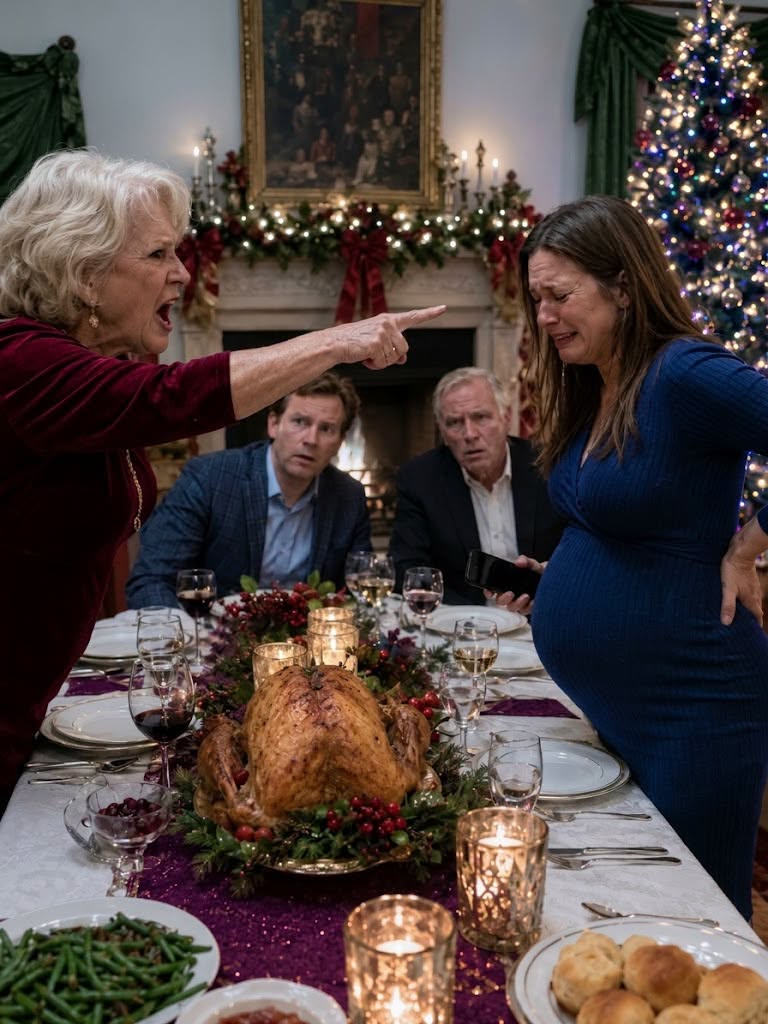
"Get back in the kitchen!" Margaret Whitmore shouted, pointing at my pregnant stomach.
My father, the Chief Justice, was calling the phone hidden inside my apron.
On the screen, beneath his name, was the message I had sent hours earlier: Call me when you can.
That call was no longer about Christmas dinner.
I was seven months pregnant when my husband finally showed me exactly how little I mattered to him.
And it happened in front of a roasted turkey, three witnesses, and a Christmas tree that probably cost more than my first car.
My name is Claire Whitmore.
At twenty-eight years old, I thought I understood the difference between a difficult marriage and an unhappy one.
I was wrong.
There is a particular kind of loneliness that comes from standing in a room full of people who know you're suffering and watching every single one of them decide that your suffering is inconvenient.
That was how I spent Christmas Day.
By five o'clock that morning, I had already been standing in my mother-in-law's kitchen for nearly an hour.
Margaret Whitmore had given me a list of everything she expected for dinner.
Not a suggestion.
Not a request.
A list.
Twenty-three separate items, written in her immaculate handwriting on expensive cream stationery.
At the top, she had written:
Christmas Dinner — Presentation Is Everything.
Underneath were the turkey, cranberry sauce, roasted vegetables, mashed potatoes, green beans, glazed carrots, dinner rolls, two pies, and enough additional dishes to feed twice the number of people expected.
There was no mention of who would help prepare any of it.
There never was.
Margaret believed that a good wife demonstrated her worth through service.
She believed a wealthy man's wife should be beautiful enough to impress his colleagues, quiet enough not to interrupt him, and useful enough to make his life effortless.
And she had spent the past three years making certain I understood those expectations.
"Claire, the silver needs polishing again," she announced shortly after six.
I was standing beside the oven, peeling potatoes.
My ankles were already beginning to ache.
"I polished it last night," I said.
Margaret examined a serving spoon as though searching for evidence of a crime.
"Then perhaps you should have done it properly."
She placed the spoon on the counter.
I looked at the potatoes.
Then at the spoon.
Then at the clock.
"Of course," I said.
That was the phrase I had learned to use whenever arguing would cost more energy than obeying.
Of course.
Certainly.
I'll take care of it.
I'm sorry.
Those four responses had become the soundtrack of my marriage.
At seven months pregnant, I was carrying a daughter who seemed determined to practice gymnastics against my ribs.
Her name was going to be Lily.
I had chosen it during my second trimester, sitting alone in the nursery of the house Thomas and I shared.
Thomas had barely looked up from his laptop when I suggested it.
"Fine," he had said. "As long as Mother doesn't hate it."
I should have understood something then.
Maybe I did.
Maybe understanding and admitting are two different things.
By eight that morning, the turkey was roasting, the pies were cooling, and I had begun preparing the vegetables.
Margaret appeared in the doorway wearing a silk dressing gown.
She held a cup of coffee.
"Thomas has an important guest coming tonight," she reminded me.
"I know."
"Jonathan Mercer. He's a senior associate at the firm."
"I remember."
"Thomas is being considered for a major promotion. Jonathan's opinion matters."
I set down the knife.
"Margaret, I know tonight is important."
She looked at me.
"Then I hope you won't spend the evening complaining about being tired."
I glanced down at my stomach.
"I haven't complained."
"Not yet."
She sipped her coffee.
"Pregnancy isn't an illness, Claire. Women have been having babies for thousands of years."
I wanted to tell her that women had also been dying from pregnancy complications for thousands of years.
Instead, I returned to chopping carrots.
Margaret watched for another moment.
"Try not to look so miserable when the guests arrive."
Then she left.
I stood alone in the kitchen, listening to her heels disappear down the hallway.
Lily kicked.
I rested my hand against my stomach.
"Just a little longer, sweetheart," I whispered.
I had been saying that to both of us for months.
When I met Thomas Whitmore, he was not the man who would eventually tell me to stand in a kitchen while carrying his child.
At least, I didn't think he was.
He was charming.
Ambitious.
Funny in a quiet, intelligent way.
We met at a charity fundraiser in Washington, D.C., when I was twenty-four.
I was working in nonprofit administration, helping coordinate legal assistance programs for low-income families.
Thomas was a young attorney with a promising career.
He wore an expensive suit and seemed uncomfortable among the donors and politicians.
I remember finding that refreshing.
He approached me near the dessert table.
"Is it terrible that I've been here two hours and still don't understand what half these people are talking about?"
I laughed.
"Only half?"
He smiled.
That was how it began.
He asked about my work.
He listened when I answered.
He remembered small things.
My favorite coffee.
The fact that I hated carnations.
The name of the elderly woman who had raised me after school while my parents worked.
For months, he made me feel seen.
And I loved him for it.
My father was cautious.
He always was.
"Ambition isn't a character flaw," he told me after meeting Thomas. "But watch what a person is willing to sacrifice to satisfy it."
At the time, I thought he was being overprotective.
My father was a man who chose his words carefully.
He had spent his professional life in courtrooms, listening to people explain why their actions were justified.
He had developed a talent for noticing what people avoided saying.
But he never ordered me to make a decision.
He simply asked questions.
"Does Thomas respect your work?"
"Of course."
"Does he respect your boundaries?"
"Yes."
"And when you disagree?"
I had smiled.
"We talk about it."
My father nodded.
"Good. Keep talking."
I wish I had understood why he said that.
There was something else Thomas didn't know when we met.
Something I had deliberately kept private.
My father was the Chief Justice of our state's highest court.
His name was Daniel Bennett.
For decades, he had built a reputation as a careful, independent jurist.
Newspapers wrote about him.
Law students studied his opinions.
Politicians occasionally criticized his decisions.
But at home, he was simply Dad.
The man who burned pancakes on Sunday mornings.
The man who cried when I graduated college.
The man who kept a photograph of my mother on his desk long after she died.
He had never encouraged me to use his position for personal advantage.
In fact, he had taught me the opposite.
"Your name should open doors because of what you've done," he told me once. "Not because of what I've done."
I believed him.
So when I began dating Thomas, I introduced myself as Claire Bennett.
I told him my father worked in the legal profession.
That was true.
I told him he was a judge.
Also true.
But Thomas never asked which court.
He assumed my father was a retired local judge living a quiet life.
And I never corrected him.
At first, the omission felt harmless.
Then it became convenient.
When Margaret began making comments about my supposedly ordinary background, I wanted to see whether Thomas would defend me without knowing my father's title.
When she called my career "a nice little hobby," I wanted to see whether he would remind her that my work mattered.
When she suggested I was fortunate to marry into the Whitmore family, I wanted to hear him say that he was fortunate too.
Sometimes he did.
At the beginning.
Then less often.
Eventually, not at all.
I kept waiting for the man I married to return.
And while I waited, I made myself smaller.
At ten that Christmas morning, Thomas entered the kitchen wearing a charcoal-gray suit.
He looked handsome.
He always did.
His dark blond hair was neatly combed, his shoes polished, his tie perfectly knotted.
He smelled like expensive cologne.
I was standing beside the stove with a damp dish towel over one shoulder.
"Morning," I said.
He glanced at the clock.
"Is everything on schedule?"
I looked at him.
"Good morning to you too."
He frowned.
"Claire, please. I'm already stressed."
I swallowed my response.
"The turkey's in the oven. Everything should be ready."
"Good."
He opened the refrigerator.
"Jonathan will be here at six. Mother wants dinner served by six-thirty."
"I know."
He selected a bottle of sparkling water.
Then his eyes moved toward my swollen feet.
For one hopeful second, I thought he might ask how I was feeling.
Instead, he said, "Are you wearing those shoes tonight?"
I looked down at my beige flats.
"They're the only ones that fit."
"Mother bought you those heels."
"Thomas, my feet are swollen."
He sighed.
"Fine. Just make sure the rest of your outfit looks presentable."
I stared at him.
"Thomas."
"What?"
"I've been awake since four-thirty."
"And?"
"My back is hurting. I barely slept last night."
He checked his phone.
"Then take a break when you finish."
"When I finish?"
He looked up.
"Claire, what do you want me to say?"
I wanted him to say that I mattered.
I wanted him to put down his phone.
I wanted him to see his pregnant wife standing in a kitchen surrounded by food she had prepared for people who would never thank her.
But I was too tired to explain something that should not have required explanation.
"Nothing," I said.
He nodded.
"Good. I don't need drama today."
Then he walked away.
By noon, my lower back had begun to burn.
I sat on a small stool near the pantry for less than three minutes before Margaret found me.
"Claire?"
I looked up.
"The vegetables won't prepare themselves."
"I just needed a moment."
Her eyes moved toward my stomach.
"You're carrying a baby, not a refrigerator."
I stood.
The sudden movement made my vision blur.
I caught the counter.
Margaret noticed.
For one brief moment, something like concern crossed her face.
Then it disappeared.
"Drink some water," she said. "And don't faint on my floor."
She left before I could answer.
I remained beside the counter until the dizziness passed.
That was when I took out my phone.
I opened my father's messages.
Our last conversation had been the previous evening.
Merry Christmas Eve, sweetheart. Call me tomorrow when you have time.
I had answered:
Love you, Dad. I'll try.
Now I stared at his name.
I thought about telling him everything.
The comments.
The humiliation.
The way Thomas had changed.
The fact that I was beginning to dread hearing my husband's car in the driveway.
But I could already imagine Dad's voice.
He would ask whether I was safe.
He would ask whether I wanted him to come.
And if I told him the truth, I would have to admit that the marriage I had defended for three years was becoming something I no longer recognized.
So I typed five words.
Call me when you can.
Then I put the phone away.
At three in the afternoon, I finally managed to eat two crackers.
Margaret had rejected the first batch of dinner rolls because they were "too brown."
She complained that the cranberry sauce was too tart.
She insisted I rearrange the white roses on the dining table because one arrangement was slightly taller than the others.
By four-thirty, my ankles had swollen so badly that my shoes felt tight.
I could barely bend forward.
Every time I straightened my back, a hot pain traveled down my spine.
I tried to convince myself it was normal.
Pregnancy was uncomfortable.
My doctor had warned me about back pain.
But this felt different.
There was a tightening low in my abdomen that came and went.
Not constant.
Not unbearable.
Just enough to make me pause and hold the counter.
I checked the time.
I told myself I would rest after dinner.
Then I felt Lily kick hard against my hand.
"Almost done," I whispered.
I didn't believe myself anymore.
The guests arrived shortly after six.
Jonathan Mercer was the first.
He was a thoughtful-looking man in his early forties, wearing a dark olive blazer and a cream shirt.
He brought a bottle of wine and a small wrapped gift for Margaret.
Behind him came an older family acquaintance, Richard Whitmore, a distant cousin of Thomas's father.
Richard was sixty-eight, with neatly combed white hair and a quiet manner.
He shook my hand carefully.
"Claire, you look tired."
I smiled.
"Long day."
He glanced at my stomach.
"When's the little one due?"
"March."
"Not long now."
"No," I said. "Not long."
His expression softened.
"Make sure you take care of yourself."
It was the first genuinely kind thing anyone had said to me all day.
I nearly cried.
Instead, I thanked him and returned to the kitchen.
Through the doorway, I heard Thomas laughing with Jonathan.
They were discussing a major client.
Something about a development company and a complicated regulatory dispute.
I didn't pay much attention.
Thomas rarely discussed his cases with me anymore.
He said it was easier to keep work and home separate.
I had once admired that boundary.
Lately, it felt more like another locked door.
At six-thirty, I carried the turkey into the dining room.
It was golden brown.
Perfectly cooked.
I had basted it every thirty minutes for hours.
Margaret examined it.
"Finally."
That was all she said.
No thank you.
No acknowledgment.
Just finally.
I placed the platter in the center of the table.
The room looked beautiful.
Candles glowed beside the fireplace.
A towering Christmas tree sparkled with warm lights and gold ornaments.
Red ribbons hung from the mantel.
Crystal glasses reflected the flames.
The long table was covered in white linen, silver cutlery, and dishes I had spent the entire day preparing.
It looked like a holiday advertisement.
Except the woman who had created it was standing at the edge of the room, trying not to collapse.
Thomas raised his glass.
"To family," he said.
Everyone smiled.
I stood beside the doorway.
Nobody noticed that I wasn't holding a glass.
Dinner began.
Margaret asked for the gravy.
Then more rolls.
Then another serving spoon.
Then the cranberry sauce.
I carried everything back and forth.
Thomas sat near the head of the table.
Jonathan sat across from him.
Richard sat beside the fireplace.
Margaret occupied her usual place, watching me as though she were supervising a poorly trained employee.
I had set a place for myself beside Thomas.
A white plate.
A folded napkin.
A crystal glass.
For a while, I kept looking at that empty chair.
I imagined sitting down.
Eating a warm meal.
Resting my feet.
Feeling Lily move while I listened to the conversation.
Such ordinary things.
Such impossible things.
"Claire," Margaret called.
I turned.
"The cranberry sauce."
I carried it to the table.
My hands were trembling.
I placed the dish beside Thomas.
He didn't look up.
"About time," Margaret muttered.
I took a breath.
"Thomas?"
He continued cutting his turkey.
"Yes?"
"My back hurts a lot."
He sighed.
I could hear the impatience before he even spoke.
"Claire."
"Can I sit for a minute?"
He finally looked at me.
Not with concern.
With embarrassment.
"Please don't do this."
I blinked.
"Do what?"
"Make a scene."
Jonathan stopped moving his fork.
Richard looked up.
I lowered my voice.
"I'm not making a scene. I'm just tired."
Thomas glanced toward Jonathan.
Then back at me.
"Just listen to my mother. We'll talk later."
Something inside me sank.
I looked at the empty chair beside him.
My chair.
The one place at that table where I was supposed to belong.
Slowly, I reached for it.
The wooden legs scraped across the polished floor.
The sound was surprisingly loud.
Margaret's hand slammed against the table.
"What do you think you're doing?"
I froze.
"I need to sit down."
Her face tightened.
"Excuse me?"
"Just for a minute."
She stood.
Her midnight-purple velvet dress caught the candlelight.
Pearls glimmered at her ears.
She looked every inch the wealthy, respectable woman she wanted the world to believe she was.
Then she pointed directly at my face.
"Servants don't sit with the family."
The room went silent.
I stared at her.
For a moment, I genuinely thought I had misheard.
"What?"
"You heard me."
She pointed toward the kitchen.
"You can eat when we're finished. Standing up, if necessary. It's good for the baby."
My mouth opened.
Nothing came out.
I looked at Thomas.
Surely he would say something.
Surely this was the moment when even he would realize his mother had gone too far.
He lifted his wineglass.
"Claire, stop embarrassing me."
I felt the words more sharply than the pain in my back.
"Thomas—"
"Just do what my mother says."
Jonathan slowly placed his fork beside his plate.
Richard's expression hardened.
Nobody spoke.
Margaret folded her arms.
"Well?"
I stood there with one hand on the chair.
Seven months pregnant.
Hungry.
Exhausted.
Surrounded by food I had cooked.
And suddenly I understood that the empty chair had never really been meant for me.
It was part of the decoration.
Like the flowers.
Like the candles.
Like the smiling wife Thomas wanted people to see.
The first serious cramp hit before I could move.
It tightened across my lower abdomen so suddenly that I grabbed the chair with both hands.
My breath caught.
I bent forward.
"Claire?"
Jonathan's voice sounded distant.
I tried to answer.
Another wave of pain moved through my stomach.
I pressed my hand against Lily.
Something was wrong.
I knew it.
Not because I understood medicine.
Because I understood my own body.
And this was not ordinary discomfort.
"I think I need my doctor," I whispered.
Thomas leaned toward me.
His smile was tight.
"Not tonight."
I stared at him.
"What?"
"Jonathan is here. Mother has spent weeks planning this dinner."
I almost laughed.
Margaret had spent weeks planning.
I had spent the entire day cooking.
But Thomas continued.
"Go clean yourself up and finish serving."
Jonathan looked at him.
"Thomas, perhaps she should—"
"She's fine," Thomas interrupted.
He said it so quickly that I wondered whether he had been waiting for someone to question him.
Margaret clicked her tongue.
"And you've spilled sauce on the tablecloth."
I looked down.
A few drops of gravy had splashed from the spoon I was holding.
My hand was shaking.
Margaret pointed at the stain.
"Look what you've done."
I stared at the small brown marks.
Something about them seemed absurd.
Ten hours of work.
A perfectly cooked turkey.
A beautiful table.
A daughter moving inside me.
And the most important thing in Margaret Whitmore's world was a stain on white linen.
I placed the spoon down.
Carefully.
Very carefully.
Then I straightened.
The pain was still there.
But something else had changed.
I was no longer waiting for Thomas to defend me.
I had finally stopped expecting him to.
My phone vibrated.
At first, I barely noticed.
Then it vibrated again.
The sound came from the pocket of my apron.
Margaret frowned.
"Now what?"
I reached for it.
"Someone's calling."
"Then answer it in the kitchen. We don't need your family drama."
I looked at the screen.
DAD.
For a moment, I couldn't breathe.
I had forgotten the message.
Forgotten that I had asked him to call.
But he hadn't forgotten me.
He never did.
I looked at Thomas.
He was staring at me with obvious irritation.
"Claire, go."
I nodded.
Not because I agreed.
Not because I was afraid.
Because there was nothing left to say to him.
I turned toward the pantry.
Behind me, Margaret muttered something about ungrateful women.
Thomas began apologizing to Jonathan.
"She's been emotional lately," I heard him say. "You know how pregnancy can be."
I kept walking.
My hand was pressed against my stomach.
My phone continued vibrating.
I reached the pantry doorway and leaned against the frame.
Then I answered.
"Dad."
One word.
That was all I managed.
My voice broke.
And my father heard it.
He always did.
"Claire?"
His voice changed immediately.
"What happened?"
I closed my eyes.
For three years, I had hidden the worst parts of my marriage from him.
I had defended Thomas.
Excused Margaret.
Smiled through family dinners.
Pretended I was happy.
And now, standing in a pantry with swollen ankles and a baby pressing painfully against my ribs, I realized I didn't have the strength to pretend anymore.
"Dad," I whispered, "I think something's wrong with the baby."
There was a pause.
Not hesitation.
The kind of silence that comes when someone is choosing the most important words first.
"Are you bleeding?"
"No."
"Are you having pain?"
"Yes."
"How often?"
"I don't know. It's been happening for a while."
"Claire, listen carefully. You need medical attention now. Do not wait for dinner to end."
I pressed my hand harder against my stomach.
"I know."
"Where's Thomas?"
I swallowed.
"In the dining room."
"Put him on the phone."
I looked toward the doorway.
I could hear Margaret laughing.
Thomas was discussing his promotion again.
The normal sounds of a Christmas dinner continued as though nothing had happened.
"Dad, I don't want to cause trouble."
His response came immediately.
"Your health is not trouble."
Tears slid down my face.
"I know."
"Then tell me what's happening."
I took a shaky breath.
And for the first time in my marriage, I told my father the truth.
Not all of it.
Not yet.
Just enough.
I told him I had been cooking since five that morning.
I told him I hadn't eaten.
I told him Margaret wouldn't let me sit down.
I told him Thomas had ordered me to finish serving.
And finally, in a voice so quiet I could barely hear myself, I repeated Margaret's words.
"She said servants don't sit with the family."
My father didn't speak.
For several seconds, the line remained silent.
I wondered whether the call had dropped.
"Dad?"
"I'm here."
His voice was different now.
Calm.
Controlled.
Almost frighteningly quiet.
"Claire, I want you to listen to me."
I gripped the shelf.
"Okay."
"You're going to get medical care. Right now. I'll help arrange it. If the pain is severe or you're feeling faint, call emergency services. Do not drive yourself."
I nodded even though he couldn't see me.
"Okay."
"And Claire?"
"Yes?"
"You're not going to spend another minute asking permission to protect yourself or my granddaughter."
I began crying again.
Not because I was frightened.
Because someone had finally said what I needed to hear.
I mattered.
My daughter mattered.
We did not have to earn the right to be safe.
Footsteps sounded behind me.
I turned.
Thomas stood in the pantry doorway.
His expression was cold.
"Who are you talking to?"
I wiped my cheek.
"My father."
He frowned.
"Why?"
I stared at him.
"Because I need help."
He glanced toward the dining room.
"Claire, this is getting ridiculous."
I said nothing.
He lowered his voice.
"Jonathan is starting to ask questions."
I looked at him.
For the first time that evening, I saw him clearly.
Not the charming attorney I had married.
Not the man who had once brought me coffee during late nights at work.
Just a frightened, ambitious person who cared more about being admired than being decent.
"My stomach hurts," I said.
He sighed.
"Then lie down after dinner."
I looked at the phone.
My father had heard him.
I knew because the line was still open.
"Thomas," I said quietly, "I need to go to the hospital."
His expression changed.
"Absolutely not."
The words were so immediate that even he seemed surprised by them.
"Jonathan is here," he continued. "Mother has guests. You cannot just walk out."
I watched him.
Then I did something I hadn't done in a very long time.
I stopped explaining.
I simply raised the phone.
"My father wants to speak to you."
Thomas looked annoyed.
"Claire, I don't have time to talk to your father."
I held the phone out.
He stared at it.
Then he took it with an irritated sigh.
"Mr. Bennett, I'm sorry about this. Claire's having a difficult day, and—"
He stopped.
Whatever my father said was too quiet for me to hear.
Thomas's expression shifted.
First irritation.
Then confusion.
Then something else.
He straightened.
"Excuse me?"
I watched his fingers tighten around the phone.
"Yes, sir. I understand, but—"
Another pause.
Thomas glanced at me.
For the first time all evening, there was uncertainty in his eyes.
Then he said something I had never heard him say to my father before.
"Your Honor?"
My stomach tightened again.
I reached for the shelf.
Thomas looked at me.
Then at the phone.
Then back at me.
"Wait," he whispered.
His face had begun to lose color.
From the dining room, Margaret called his name.
"Thomas! Jonathan is waiting!"
He didn't answer.
He was staring at the phone as though it had become something dangerous.
And then my father said something that made Thomas step backward.
Thomas slowly lowered the phone.
He looked directly at me.
"Claire..."
His voice was barely audible.
"Who exactly is your father?"
Before I could answer, Margaret appeared behind him.
"What is taking so long?"
Thomas turned toward her.
His lips parted.
But no words came out.
My phone was still in his hand.
And from its speaker, my father's calm voice said:
"Thomas, before you say another word, there's something you need to understand about the man you've been calling Mr. Bennett."
Thomas froze.
My father continued.
"My full name is Daniel Bennett. And the court I preside over is—"






Comments 0