"The Supreme Court of this state."
My father's voice came through the phone with the same quiet authority I had heard all my life.
Thomas stopped breathing.
At least, that was what it looked like.
His mouth remained slightly open, his fingers tightened around my phone, and the color slowly disappeared from his face.
Margaret stood behind him in the pantry doorway, looking annoyed.
"What Supreme Court?" she demanded.
Thomas didn't answer.
My father continued.
"I am Chief Justice Daniel Bennett. Now, Thomas, I believe my daughter told you she was experiencing abdominal pain. Why is she still standing in your mother's kitchen?"
The silence that followed was extraordinary.
For three years, I had watched Thomas dominate conversations with confidence. He was a talented attorney, the kind of man who could turn an uncomfortable question into an opportunity to demonstrate how intelligent he was.
He always knew what to say.
But standing in that pantry, holding my phone, he seemed incapable of producing a single complete sentence.
"Chief Justice Bennett?" he finally whispered.
"Yes."
Thomas swallowed.
"Sir, I—I wasn't aware—"
"That my daughter was in pain?"
"No, sir. I mean, I wasn't aware that you were—"
"My professional position is not relevant to whether your wife deserves medical attention."
I watched Thomas flinch.
My father rarely raised his voice. He didn't need to.
He had spent decades learning that a carefully chosen sentence could carry more weight than a hundred shouted accusations.
"Claire needs to be evaluated immediately," Dad continued. "I'm asking you to return her phone and make sure she can leave safely."
Thomas looked at me.
For the first time that evening, his expression contained something resembling concern.
But I knew him well enough to recognize the difference.
He wasn't suddenly worried about my health.
He was worried about who had heard him dismiss it.
"Of course," he said quickly. "Absolutely. I was just about to take her."
I stared at him.
That was a lie.
A complete, effortless lie.
Less than two minutes earlier, he had told me I couldn't leave because Jonathan was waiting.
Now he was pretending he had been preparing to drive me himself.
My father didn't argue.
"Put Claire back on the phone."
Thomas handed it to me immediately.
His fingers brushed mine.
They were cold.
"Dad?"
"I'm here, sweetheart. Can you walk?"
"I think so."
"Are you still having cramps?"
"Yes."
"Then don't wait. If you're feeling faint or the pain is severe, call emergency services. I'm arranging to meet you at the hospital."
I closed my eyes.
"Okay."
"And Claire?"
"Yes?"
"You don't need anyone's permission."
I pressed my lips together.
Those words almost broke me.
Because until that moment, I hadn't realized how thoroughly I had trained myself to ask permission for things that should never have required it.
Permission to sit.
Permission to eat.
Permission to rest.
Permission to protect my own child.
"I love you, Dad," I whispered.
"I love you too. Now go."
I ended the call.
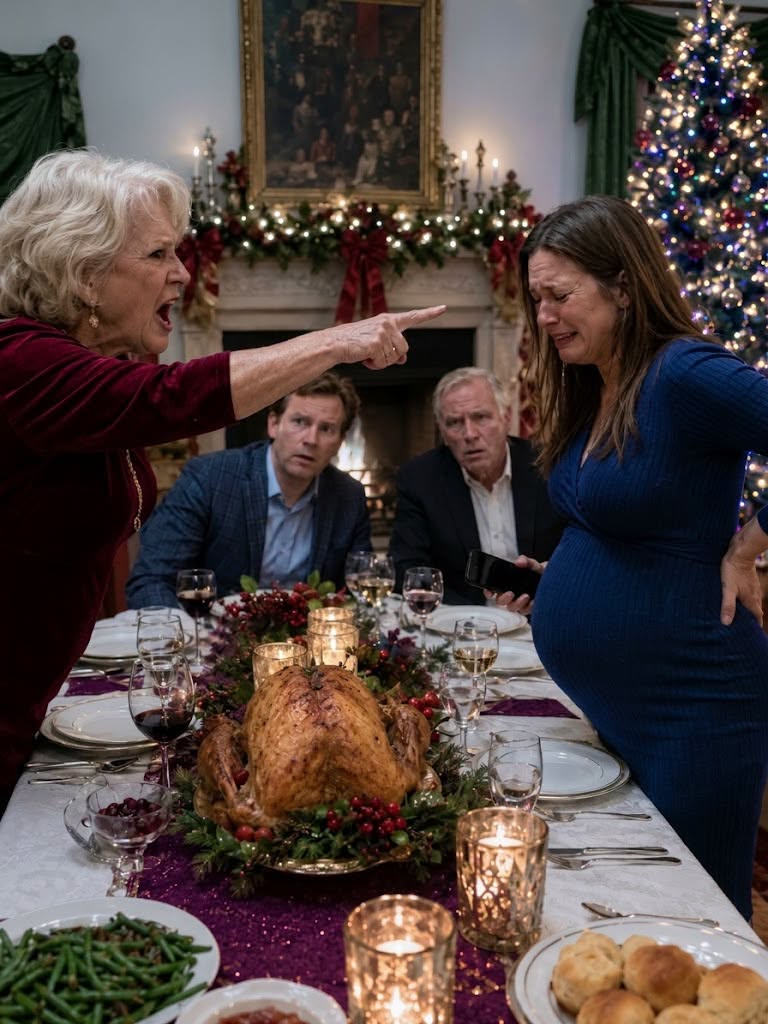
And when I looked up, Margaret was staring at me as though I had committed an unforgivable offense.
"That was completely inappropriate," she said.
I blinked.
"What?"
"Calling your father to interfere in a private family matter."
Thomas turned sharply.
"Mother."
She ignored him.
"I don't care whether he's a judge or the President of the United States. You do not invite outsiders into this house to lecture my son."
I looked at her.
Something about the word outsiders struck me.
My father was an outsider.
But Jonathan Mercer, a colleague Thomas had invited to impress, was apparently family enough to deserve my exhaustion.
"Margaret," I said quietly, "I'm going to the hospital."
She folded her arms.
"Over a little backache?"
Thomas stepped between us.
"Mother, stop."
She stared at him.
"Excuse me?"
"Just stop talking."
It was the first time I had heard Thomas challenge his mother in months.
And it had nothing to do with me.
He was terrified.
Margaret seemed to recognize that something had changed, although she hadn't yet understood what.
"Thomas, what is going on?"
He glanced toward the dining room.
"Not here."
"Don't you take that tone with me."
"Mother."
His voice sharpened.
"Please."
She looked from him to me.
Then her expression changed.
Not to remorse.
To calculation.
"Claire," she said, suddenly softening her voice, "darling, if you're feeling unwell, of course you should see a doctor."
I almost laughed.
Five minutes earlier, I had been a servant who wasn't allowed to sit.
Now I was darling.
The transformation was so quick that it made my stomach turn.
"You should have told us it was serious," she added.
I stared at her.
"I did."
She waved a hand.
"Well, you know how emotional pregnancy can make women. Sometimes it's difficult to tell what's truly urgent."
Thomas said nothing.
I looked at him.
He looked away.
And that was when I understood something important.
My father's title had frightened them.
But it hadn't changed them.
I took one step toward the hallway.
Another cramp struck.
This one was sharper.
I bent forward, catching the pantry doorframe with my hand.
"Claire!"
Thomas reached for me.
I instinctively pulled away.
The movement surprised both of us.
His hand remained suspended between us.
"Don't," I whispered.
He looked wounded.
As though my refusal to accept his help was somehow more cruel than everything he had done that evening.
"Claire, I'm trying to help."
"Then call an ambulance."
He hesitated.
Only for a second.
But I saw it.
"An ambulance?" he repeated.
"Yes."
"Wouldn't it be easier if I drove you?"
I stared at him.
"Thomas, I'm having cramps. I feel dizzy. I haven't eaten all day."
He looked toward the dining room again.
I knew what he was thinking.
An ambulance arriving at his mother's expensive house on Christmas night would attract attention.
Neighbors might notice.
Jonathan would ask questions.
People might talk.
Even now, his first instinct was to protect appearances.
I took out my phone.
"I'll call."
That finally moved him.
"No, I'll do it."
He pulled his phone from his pocket and called emergency services.
His voice became crisp and professional.
"My wife is seven months pregnant. She's experiencing abdominal pain and dizziness."
He paused to answer the operator's questions.
Then he looked at me.
"How far apart are the cramps?"
"I don't know."
He repeated that information.
I leaned against the wall while he continued speaking.
Margaret stood nearby, visibly irritated by the interruption to her evening.
"Do they really need to send someone?" she whispered.
Thomas covered the phone.
"Mother, please."
She fell silent.
For once.
Jonathan appeared at the end of the hallway.
"Is everything all right?"
Thomas straightened immediately.
"Claire isn't feeling well. We're getting her checked out."
Jonathan looked at me.
His expression changed when he saw my face.
"Claire, you look pale."
"I don't feel very good."
He stepped closer.
"Would you like to sit down?"
Such a simple question.
Such an ordinary act of kindness.
I nearly cried again.
"Yes," I whispered.
Jonathan pulled a small upholstered chair from the hallway alcove and positioned it behind me.
I sat carefully.
The relief was immediate.
My back stopped screaming.
My swollen feet no longer had to carry my weight.
I placed both hands over my stomach.
Lily moved beneath my palms.
"Thank you," I said.
Jonathan nodded.
"Of course."
Thomas watched us.
Something uncomfortable crossed his face.
I wondered whether he realized that a man who barely knew me had shown more concern in thirty seconds than my husband had shown all day.
Richard appeared behind Jonathan.
"What's happened?"
"Claire's having some pain," Jonathan explained.
Richard looked at Thomas.
"Has someone called for help?"
"Yes," Thomas said.
"Good."
Richard turned toward me.
"My daughter had complications during her second pregnancy. Don't take chances with these things."
I nodded.
Margaret appeared behind the men.
"Everyone is making this sound far more dramatic than it is."
Richard looked at her.
For the first time that evening, his gentle expression disappeared.
"Margaret, perhaps you should stop talking."
Her mouth fell open.
Jonathan looked down.
Thomas closed his eyes.
And I sat there, holding my stomach, wondering how many years I had spent believing Margaret's authority was something nobody could challenge.
Apparently, it only required someone willing to do it.
The ambulance arrived twelve minutes later.
I remember the sound of the doorbell.
The cold air entering the hallway.
The paramedic kneeling in front of me.
Her name was Sarah.
She had kind brown eyes and a voice that made me feel safe.
"Hi, Claire. I'm Sarah. Can you tell me what's going on?"
I explained the cramps.
The dizziness.
The back pain.
The fact that I had been standing most of the day.
She asked about bleeding, fluid leakage, and Lily's movements.
I answered as carefully as I could.
Then she checked my vital signs.
Her expression remained professional.
But she looked toward her partner.
"We should get her evaluated."
Thomas stepped forward.
"I'll follow in my car."
Sarah nodded.
"That's fine."
Margaret hovered near the doorway.
"Will she be home tonight?"
Nobody answered immediately.
Sarah looked at her.
"That depends on what the doctors find."
Margaret frowned.
"We have guests."
I looked at her.
Even Sarah seemed momentarily surprised.
Then the paramedic turned back to me.
"Claire, let's focus on you and the baby."
Those words became the first real relief I had felt all day.
Not because the pain had stopped.
But because someone had finally decided that my health mattered more than dinner.
As they helped me onto the stretcher, Thomas leaned close.
"Claire, we need to talk."
I looked at him.
"About what?"
He lowered his voice.
"Your father."
I almost couldn't believe it.
I was being placed on a stretcher because of pregnancy complications, and he wanted to discuss my father's job.
"Not now."
"Why didn't you tell me?"
I stared at him.
"Thomas."
"Three years, Claire. We've been married three years."
Sarah adjusted the blanket over my legs.
"Sir, we need to move."
Thomas ignored her.
"Do you understand how embarrassing this is?"
I looked at him.
And something inside me went completely still.
"Embarrassing?"
He lowered his voice further.
"Finding out my wife is the Chief Justice's daughter in front of my mother? Yes, Claire. That's embarrassing."
I watched his face.
I had spent years searching for evidence that the man I loved still existed somewhere beneath his ambition.
But at that moment, I couldn't find him.
"Thomas," I said quietly, "I'm going to the hospital because something might be wrong with our daughter."
He blinked.
I continued.
"And you're worried about being embarrassed."
For the first time, he had no answer.
Sarah stepped between us.
"We're leaving now."
And just like that, I was moving toward the front door.
Away from the candles.
Away from the turkey.
Away from the beautiful table where I had never been allowed to sit.
The ambulance ride felt longer than it probably was.
Sarah monitored me while her partner drove.
She asked about my medical history.
My prenatal appointments.
Whether I had experienced similar pain before.
I answered between cramps.
She explained that abdominal pain during pregnancy could have several causes and that the hospital would need to evaluate me.
I tried to focus on her voice.
But my mind kept returning to Thomas.
Not the man who had refused to let me leave.
The man who had once held my hand during our wedding vows.
I remembered standing across from him in a small garden ceremony.
He had promised to love me in sickness and health.
He had cried when he said it.
Real tears.
I had believed every word.
Now I wondered whether he had believed them too.
Maybe people didn't always become cruel overnight.
Maybe cruelty grew quietly.
One dismissed complaint.
One ignored boundary.
One apology that never came.
Until the day you found yourself seven months pregnant, being told you couldn't sit at your own family's Christmas dinner.
I turned my face toward the ambulance window.
The city lights blurred through my tears.
Sarah noticed.
"Are you frightened?"
I nodded.
"For the baby."
She rested a hand briefly on my shoulder.
"We're getting you checked. You're doing the right thing."
I closed my eyes.
For the first time that day, I allowed myself to believe it.
At the hospital, everything moved quickly.
A nurse took me to the maternity assessment unit.
They checked my vital signs.
Attached monitors to track Lily's heartbeat and my uterine activity.
Asked me questions about the pain.
I answered honestly.
Yes, I had been on my feet for hours.
No, I hadn't eaten a proper meal.
Yes, I had been drinking water, but probably not enough.
Yes, I had been under stress.
A great deal of stress.
The nurse looked at me.
"Has anyone been hurting you?"
The question startled me.
"No."
She paused.
"Has anyone been making you feel unsafe?"
I opened my mouth.
Then closed it.
What was the correct answer?
Thomas had never hit me.
Margaret had never physically attacked me.
But I had spent years afraid of disappointing them.
Afraid of saying the wrong thing.
Afraid of becoming the problem.
"I don't know," I whispered.
The nurse didn't push.
She simply nodded.
"Okay. We can talk about that later if you want."
Then she adjusted the monitor.
A steady rhythm filled the room.
Lily's heartbeat.
I stared at the screen.
And began crying.
Not quietly this time.
I cried because I was frightened.
Because I was exhausted.
Because I had spent the entire day serving people who had treated me like furniture.
And because, beneath all of it, I was terrified that my daughter might pay the price for my silence.
My father arrived before Thomas.
I heard his voice outside the room.
"Claire Bennett?"
Then the curtain moved.
And there he was.
Daniel Bennett.
Chief Justice.
The man whose photograph appeared in legal journals and newspapers.
The man attorneys addressed with respect.
The man who had spent decades listening to the most complicated arguments in our state's courtrooms.
He was wearing a dark winter coat over a gray sweater.
His silver hair was slightly disheveled.
He looked like he had left his house in a hurry.
The moment he saw me, his face changed.
He wasn't a judge anymore.
He was my dad.
"Oh, sweetheart."
He crossed the room.
I reached for him.
And he wrapped his arms around me as carefully as he could.
I buried my face against his chest.
"I'm sorry," I whispered.
He pulled back.
"For what?"
"For worrying you."
His expression tightened.
"Claire."
I looked at him.
"Don't apologize for needing your father."
That broke me all over again.
He held my hand while I cried.
He didn't ask about Thomas.
He didn't ask about Margaret.
He didn't demand explanations.
He simply stayed.
And for the first time in months, I felt safe enough to stop pretending.
The doctor arrived shortly afterward.
Her name was Dr. Rebecca Collins.
She was calm and direct.
She explained that the monitoring showed uterine irritability and contractions that needed further observation.
They would check for signs of preterm labor and evaluate whether dehydration or physical exhaustion might be contributing.
I listened carefully.
Dad sat beside me.
He asked only medical questions relevant to my care.
Nothing about his position.
Nothing about special treatment.
He didn't introduce himself as Chief Justice.
He was simply the worried father of a pregnant woman.
Dr. Collins looked at me.
"Claire, I want you to understand something. Stress and exhaustion are not things you should ignore, especially when you're having symptoms like these."
I nodded.
"We need to monitor you and make sure your cervix isn't changing. We'll also assess your hydration and how the baby is doing."
"Is she okay?" I whispered.
"The heartbeat is reassuring right now."
I exhaled.
"But we need more information before we can say everything is fine."
I nodded again.
Dad squeezed my hand.
"One step at a time."
The doctor left to arrange further evaluation.
I looked at the monitor.
Lily's heartbeat continued.
Strong.
Steady.
The most beautiful sound I had ever heard.
Thomas arrived forty minutes later.
He entered carrying a large bouquet of white roses.
I stared at them.
White roses.
Margaret's favorite.
Not mine.
Thomas approached the bed with an expression of carefully arranged concern.
"Claire."
I said nothing.
He looked at Dad.
"Chief Justice Bennett."
My father stood.
"Thomas."
The two men shook hands.
It was the most uncomfortable handshake I had ever witnessed.
Thomas attempted a smile.
"I'm so glad you could come."
Dad didn't return it.
"How is my daughter?"
Thomas glanced at me.
"We're still waiting on the doctors."
Dad looked at him.
"I asked how she's doing."
Thomas hesitated.
I answered for myself.
"I'm tired. And scared."
My father nodded.
Then he turned back to Thomas.
"She told me what happened at dinner."
Thomas's smile disappeared.
"Sir, I think there's been a misunderstanding."
I closed my eyes.
There it was.
The phrase I had heard a hundred times.
A misunderstanding.
Whenever Margaret insulted me, it was a misunderstanding.
Whenever Thomas dismissed my feelings, it was a misunderstanding.
Whenever I cried, I was being too sensitive.
And whenever I finally objected, I had misunderstood their intentions.
Dad folded his hands.
"Then explain."
Thomas glanced at me.
"Claire was overwhelmed. Mother was stressed. Everyone said things they didn't mean."
I opened my eyes.
"Margaret meant exactly what she said."
Thomas looked at me.
"Claire, please."
"No."
The word surprised him.
It surprised me too.
I sat a little straighter.
"She told me servants don't sit with the family."
Dad remained silent.
Thomas shifted.
"She was frustrated."
"And you told me to obey her."
"That's not—"
"You told me not to embarrass you."
He stopped.
I watched him struggle to find a version of the evening that made him look reasonable.
Then he turned toward my father.
"Sir, with all due respect, marriage is complicated."
Dad nodded once.
"Yes. It is."
Thomas seemed encouraged.
"Exactly."
"But whether a pregnant woman in pain deserves medical care isn't complicated."
Thomas looked down.
The silence stretched.
Then Dad said something that made my husband visibly uncomfortable.
"Thomas, I don't need to know every disagreement you've had with my daughter. But I do need to know whether she's safe."
Thomas's face hardened.
"Of course she's safe."
I looked at him.
And for the first time, I didn't rush to agree.
A nurse entered to check my monitors.
Thomas stepped aside.
Dad remained near the bed.
The nurse asked whether I wanted visitors to stay.
I looked at my father.
Then at Thomas.
"I'd like my dad to stay."
Thomas blinked.
"And me?"
I hesitated.
The room went quiet.
I could feel the old instinct rising.
The instinct to smooth things over.
To avoid conflict.
To reassure him.
But I was tired.
So tired.
"I need some space," I said.
Thomas stared at me.
"Claire, I'm your husband."
"I know."
"Then why are you treating me like a stranger?"
I looked at the white roses in his hand.
He had brought flowers.
He had changed his voice.
He had called my father Your Honor.
But he still hadn't asked me what I needed.
"Because tonight," I whispered, "you acted like one."
His expression shifted.
For a moment, I thought he might apologize.
Really apologize.
Without excuses.
Without blaming his mother.
Without turning my pain into an inconvenience.
Instead, he looked toward Dad.
"Are you encouraging this?"
My father's face became very still.
"Thomas, my daughter just told you she needs space."
"With respect, sir, this is between my wife and me."
Dad nodded.
"Then listen to your wife."
Thomas's jaw tightened.
He looked at me again.
"Fine."
He placed the flowers on a nearby chair.
"I'll wait outside."
Then he left.
The door closed behind him.
I stared at it.
My father sat down.
Neither of us spoke for a long time.
After the next examination, Dr. Collins returned with cautious but encouraging news.
Lily's heartbeat remained reassuring.
The initial evaluation had not shown clear evidence of active preterm labor, although the contractions meant they wanted to continue monitoring me.
I was being given fluids and allowed to rest.
The doctor explained the warning signs that would require immediate attention.
She also wanted me to avoid prolonged standing and overexertion while they assessed the situation.
I listened to every word.
Dad took notes.
He had always done that.
Even when I was little.
At doctor's appointments.
Parent-teacher conferences.
College orientation.
He believed important information deserved attention.
When Dr. Collins left, he looked at me.
"You're not going back to that house tonight."
I swallowed.
"Dad—"
"Not because I'm ordering you. Because I want you somewhere you can rest, and you have options."
I looked down.
"I don't know what to do."
He nodded.
"Then you don't have to decide tonight."
I stared at him.
He continued.
"You can stay with me. You can go home with support. You can take time to think. Whatever you choose, I'll help you make sure you're safe."
I began crying again.
He handed me a tissue.
"Claire, look at me."
I did.
"You don't owe anyone a marriage at the cost of your dignity."
I pressed the tissue against my eyes.
"I loved him."
"I know."
"I still do. I think."
Dad's expression softened.
"Love doesn't always disappear when someone hurts us."
I nodded.
"But that doesn't mean we have to keep letting them."
He squeezed my hand.
And for a moment, I felt like a little girl again.
Not helpless.
Just loved.
It was nearly midnight when Jonathan Mercer appeared outside my hospital room.
I recognized his voice before I saw him.
"Is Claire Whitmore here?"
Dad stood.
Jonathan entered slowly.
He was no longer wearing his blazer.
His cream shirt was wrinkled.
He looked exhausted.
"Claire," he said. "I'm sorry to come so late."
I stared at him.
"Jonathan?"
He glanced at Dad.
Then back at me.
"I wanted to make sure you were okay."
"I'm being monitored. The baby seems okay so far."
Relief crossed his face.
"Thank God."
He looked toward the hallway.
Then lowered his voice.
"There's something else."
Dad remained silent.
Jonathan shifted his weight.
"I've worked with Thomas for six years."
I waited.
"He's ambitious. Everyone knows that. But tonight..." He stopped.
I looked at him.
"What?"
Jonathan rubbed his forehead.
"I've never seen him behave like that toward you."
I gave a small, bitter smile.
"Then you haven't spent much time at his mother's house."
He looked ashamed.
"Maybe not."
For a moment, nobody spoke.
Then Jonathan glanced toward the door again.
"Claire, I don't know how much you know about Thomas's promotion."
I frowned.
"Not much."
Jonathan nodded slowly.
"That's what I thought."
Dad looked at him.
"Mr. Mercer, if this concerns confidential client information, you should be careful."
Jonathan met his eyes.
"I understand."
Something about his expression made my stomach tighten.
He wasn't simply uncomfortable.
He was frightened.
"Jonathan," I whispered, "what's going on?"
He looked at me.
Then at my father.
"Thomas told everyone at the firm that his wife came from an ordinary family with no political or judicial connections."
I stared at him.
"That's true. I never told him about Dad's position."
Jonathan nodded.
"Yes. But there's something you need to understand."
He paused.
"Thomas has been pursuing a partnership opportunity involving a client whose case may eventually reach the state's highest court."
Dad's expression changed.
Not dramatically.
Just enough for me to notice.
Jonathan continued carefully.
"I don't know whether Thomas has done anything improper. I'm not accusing him of that. But he's been making some unusual claims about his access to influential people."
My throat tightened.
"What kind of claims?"
Jonathan looked toward the hallway.
"I heard something tonight after you left."
Dad straightened.
"What did you hear?"
Jonathan hesitated.
Then he reached into his pocket.
He took out his phone.
"I wasn't sure whether to show you this."
He unlocked the screen.
His hand was trembling slightly.
"Thomas sent a message to one of the firm's managing partners about twenty minutes after he learned who your father was."
I stared at the phone.
Jonathan looked directly at me.
"Claire, I think your husband is already trying to use your father's position to save his career."
I felt the room tilt.
Dad's expression became unreadable.
Jonathan turned the screen toward us.
At the top was Thomas's name.
Beneath it was a message.
And the first sentence made my blood run cold.
I just discovered something about my wife's family that changes our entire strategy.
Jonathan swallowed.
"There's another message underneath it."
He moved his thumb toward the screen.
Then stopped.
His eyes widened.
A new notification had appeared.
It was from Thomas.
Jonathan read the first few words.
His face went white.
He looked at my father.
Then at me.
"Claire," he whispered, "your husband just sent them a photograph of something he should never have had."
He turned the phone toward me.
I leaned forward.
And there, attached to Thomas's message, was a photograph of a sealed document bearing my father's official court insignia.
Underneath it, Thomas had written:
This is the document I told you about. Once they see what's inside—






Comments 0