"And I know why your mother was afraid of Peter Harlan."
Rebecca Ellis stood outside my father's front door, holding a sealed envelope against her chest.
For a moment, I couldn't move.
I had spent weeks searching for answers in financial records, recordings, photographs, and documents bearing signatures I didn't recognize.
Now the woman my mother had trusted with her most important secrets was standing on our doorstep.
And she had come to tell me the truth.
My father stood beside me.
"Claire, we'll verify everything before letting her inside."
I nodded.
After everything that had happened, neither of us took safety for granted.
Dad contacted the security team. Rebecca's identity was confirmed, along with her attorney's knowledge of the visit. Only then did we open the door.
Rebecca stepped inside.
She looked older than I remembered.
Her silver hair was pulled into a neat bun. A faint bruise remained near her temple from the incident at her home.
But her eyes were the same.
Warm.
Kind.
Familiar.
"Claire."
Her voice broke.
I stepped toward her.
She opened her arms.
And suddenly I was crying against the shoulder of a woman who had known my mother better than almost anyone.
"Oh, sweetheart," she whispered. "I'm so sorry it took this long."
I pulled back.
"You came all the way from Vermont?"
She nodded.
"I wanted to look you in the eyes when I told you what Eleanor discovered."
I glanced at the envelope.
"Is that from Mom?"
"Yes."
My heart tightened.
Rebecca looked toward Dad.
"Daniel, I think we should sit down."
We gathered in the living room.
Evelyn joined us by video call so the documents could be handled and preserved appropriately.
Rebecca placed the envelope on the coffee table.
"Your mother asked me to keep this until the financial records could be reviewed safely."
I stared at it.
"Why didn't she tell Dad everything?"
Rebecca looked at him.
"Because Eleanor was concerned that anyone accused of wrongdoing might try to use Daniel's judicial position to discredit her investigation."
Dad nodded slowly.
"That sounds like her."
Rebecca continued.
"She wanted independent accountants and attorneys to establish the facts. She didn't want anyone claiming her husband had used his office to settle a private dispute."
I looked down.
Even years ago, my mother had understood the danger.
Margaret would use anything.
Money.
Reputation.
Family connections.
And eventually, me.
"Who planned my marriage?" I asked.
Rebecca took a breath.
"Peter Harlan first proposed approaching your family through a personal relationship."
I swallowed.
"Thomas."
"Eventually, yes."
Rebecca unfolded a document.
"Your mother discovered that Peter had shared information about Bennett family assets with Margaret Whitmore. She confronted him and demanded an accounting."
I nodded.
"Then what happened?"
"Peter and Margaret began discussing other ways to obtain access."
Rebecca looked at me sadly.
"At first, they hoped Eleanor would approve a financial arrangement directly."
"But Mom refused."
"Absolutely."
I felt tears burn behind my eyes.
Rebecca continued.
"After she refused, Peter suggested that a relationship between the families might eventually accomplish what the proposed agreement couldn't."
I stared at her.
"Through me."
She nodded.
"The memorandum identifies you as a possible future connection."
My chest tightened.
"How old was I?"
"Twenty-four."
The age I had been when Thomas approached me at the charity fundraiser.
Rebecca's expression softened.
"Claire, your mother never knew whether that suggestion would lead to anything. She was seriously ill by then. She focused on protecting the assets and preserving evidence."
I swallowed.
"And Margaret arranged the fundraiser introduction."
"According to the later correspondence, yes."
I looked down at my hands.
For years, I had told people our love story began with a chance meeting.
Thomas had approached me beside the dessert table.
He complimented my laugh.
Asked about the charity.
Told me he admired women who cared about helping others.
I had thought he was different.
Now I knew someone had encouraged him to approach me because of my family.
But one question remained.
"Did Thomas know?"
Rebecca hesitated.
"That's something he has now addressed in his statement to investigators."
I looked up.
"What did he say?"
Her eyes filled with sadness.
"He knew Margaret wanted him to meet you because your family had money and connections."
I closed my eyes.
"He knew before we started dating?"
"Yes."
The room became very quiet.
I felt Dad's hand settle gently over mine.
Rebecca continued.
"Thomas says he didn't initially know the full history of Peter's transactions. But he admits that he understood his mother expected the relationship to benefit the Whitmores."
I swallowed.
"And he married me anyway."
Rebecca nodded.
I stared at the photograph of my mother beside the fireplace.
The truth hurt.
But at least it was finally whole.
Rebecca opened the sealed envelope.
Inside was a letter and a small handwritten inventory of documents.
She handed the letter to me.
I recognized my mother's blue ink immediately.
My darling Claire,
If Rebecca has given you this letter, it means you have encountered people who believe they are entitled to what belongs to you.
My eyes filled.
I cannot choose whom you love. Nor would I want to. Your heart must always remain your own.
I swallowed.
But I want you to understand something I learned through painful experience.
People who demand your obedience in exchange for affection are not offering love. They are offering a bargain.
Tears slid down my cheeks.
You do not have to accept that bargain.
I pressed a hand against my mouth.
Rebecca watched silently.
I continued reading.
I have asked independent professionals to preserve records concerning Peter Harlan and Margaret Whitmore. If those records become important to you someday, let the truth be established properly. Do not allow anyone to turn your father's position into a substitute for evidence.
I glanced at Dad.
His eyes were wet.
Then I read the final paragraph.
Whatever happens, Claire, remember that your life belongs to you.
Not to the people who admire your family.
Not to the people who want your money.
Not even to the people who say they love you.
You deserve a home where you can sit down, eat when you're hungry, speak when you're hurt, and be loved without permission.
I began sobbing.
Dad wrapped his arms around me.
Rebecca reached for my hand.
And I realized my mother had somehow given me exactly what I needed.
Not a secret fortune.
Not a powerful connection.
Not revenge.
Permission to stop begging for love.
Over the following weeks, the final pieces of the financial investigation came together.
The original records from Rebecca, the documents recovered from Peter's leather case, and Vanessa's communications provided investigators with a clearer picture of the scheme.
The full hospital recording was also recovered.
My mother had confronted Margaret, Peter, and Richard about transfers involving charitable and private investment funds.
She had revoked Peter's authority over her accounts and demanded that independent counsel review the records.
The disputed authorization bearing my father's signature had not been signed by him. An examination of the original document and supporting records established that the signature had been reproduced without his consent.
Vanessa Cole had prepared the false supporting materials.
Peter had arranged for their use.
Margaret had approved the transactions intended to benefit her companies.
And Thomas had authorized the payment for Vanessa's impersonation of me during the lender verification.
The woman who had pretended to be me had been Vanessa all along.
Her comment about Lily had not referred to any legitimate right over my daughter.
It referred to Margaret's plan to pressure me into signing additional financial documents after the birth, when they expected I would be exhausted, financially dependent, and reluctant to disrupt my marriage.
They had mistaken motherhood for weakness.
They had mistaken my love for Thomas for permanent obedience.
And they had mistaken my silence for consent.
The anonymous messages were eventually traced to two sources.
Laura Mitchell had sent the early warnings after discovering the verification irregularities and fearing the evidence would disappear.
Later messages, including the photographs and incomplete revelations, had come from a former Northbridge records contractor who had preserved copies of correspondence and was frightened of being identified.
Both cooperated with investigators through counsel.
The dramatic fragments had frightened me, but the underlying evidence was finally examined in full.
No mysterious sender remained.
No hidden document was left unexplained.
The case no longer depended on anonymous accusations.
It depended on records, witnesses, and admissions.
Three months later, the civil court issued its final decision concerning the disputed marital agreement and guarantee.
I sat beside Evelyn as the judge explained the findings.
The evidence did not establish that I had knowingly agreed to the marital property arrangement or authorized the eight-million-dollar guarantee.
The documents could not be enforced against me.
The purported obligations were declared invalid as to my assets.
I closed my eyes.
For the first time since Christmas, I felt the weight of those eight million dollars lift from my shoulders.
Evelyn squeezed my hand.
"It's done," she whispered.
I began crying.
Not loudly.
Not dramatically.
Just quietly, with relief.
The lender pursued its claims against the parties and entities actually responsible for the financing.
The related investigations resulted in charges against Peter, Vanessa, and Margaret.
Their cases proceeded separately.
Vanessa cooperated and entered a guilty plea to offenses arising from the fraudulent verification and supporting documents.
Peter pleaded guilty to financial crimes involving falsified records and unauthorized transfers.
Margaret contested the allegations for months before entering a negotiated guilty plea supported by the accounting records and witness testimony. She received a custodial sentence and financial penalties, and her remaining assets became subject to lawful creditor and restitution proceedings.
Whitmore Heritage Holdings lost control of several heavily leveraged properties.
The mansion was sold.
The expensive furniture disappeared into an estate sale.
The imported chandeliers came down.
The dining room where Margaret had ordered me to stand became an empty room in a house she no longer owned.
I never visited it again.
I didn't need to.
The home had never represented the family I wanted.
Only the family I had tried too hard to please.
Thomas faced his own consequences.
His law firm terminated his employment.
Professional disciplinary proceedings followed.
He surrendered his license to practice law under the applicable disciplinary process.
He also entered a guilty plea relating to his role in the fraudulent verification and received a sentence that included court-supervised conditions, financial penalties, and community service.
His cooperation helped investigators reconstruct the transactions, but it did not erase his responsibility.
One afternoon, after the criminal proceedings had concluded, he asked through our attorneys whether I would speak with him.
I agreed to a brief conversation in Evelyn's office.
I wanted closure.
Not reconciliation.
Thomas stood when I entered.
He looked different.
His expensive suits were gone.
He wore a simple gray sweater and dark trousers.
His face was thinner.
His eyes were tired.
"Claire."
I sat across from him.
"Thomas."
For a moment, neither of us spoke.
Then he looked at my stomach.
"How are you feeling?"
"Good."
He nodded.
"And Lily?"
"Healthy."
His eyes filled.
"I'm glad."
I waited.
He took a shaky breath.
"I've spent months trying to understand why I did what I did."
I looked at him.
"And?"
He swallowed.
"Because I wanted everything."
I remained silent.
"The partnership. Mother's approval. The money. The reputation."
His voice broke.
"And you."
I looked down.
Thomas continued.
"I told myself I could keep all of it if I just avoided asking questions."
I met his eyes.
"You didn't avoid asking questions, Thomas. You helped them."
He nodded.
"I know."
Tears ran down his face.
"I know that now."
I felt sadness.
Deep sadness.
But not the old urge to rescue him from his own choices.
He looked at me.
"Did you ever believe I loved you?"
I swallowed.
"Yes."
He closed his eyes.
"I did."
I took a slow breath.
"Maybe you did, in the way you understood love."
He looked up.
"But you loved your mother's approval more than you respected me."
His face crumpled.
I continued.
"And when you had to choose between protecting me and protecting your future, you chose yourself."
He didn't argue.
There was nothing left to argue about.
Our divorce was finalized after the financial issues had been resolved.
The court approved a fair division of the marital property, excluding the obligations improperly attributed to me.
My inheritance remained protected.
My father's assets were never used to settle the Whitmores' debts.
And Lily's future was addressed separately, through arrangements focused on her welfare.
Thomas accepted a structured parenting plan that began with supervised contact and provided for later review based on his conduct, compliance, and Lily's needs.
I didn't want my daughter to grow up believing that people were beyond redemption.
But I also refused to make her safety depend on promises.
Thomas would have the opportunity to become a responsible father.
He would not be given the power to repeat his mother's mistakes.
Margaret had no independent right to interfere in Lily's life.
Her attempts to use my daughter as leverage became part of the documented history considered when appropriate boundaries were established.
I was no longer afraid to say no.
Meredith found a new job.
A family-owned hospitality company hired her to oversee its guest services department.
She called me on her first day.
"Claire, they gave me an office."
I laughed.
"Of course they did."
"No, you don't understand."
Her voice shook.
"I've spent eleven years eating lunch in the laundry room."
My chest tightened.
"And now?"
"Now I have a desk. A window. And a chair with my name on it."
I smiled through tears.
"Meredith, you deserve that."
She laughed.
"Apparently, I do."
Laura Mitchell also found her way forward.
With independent legal advice, she cooperated with the investigation and resolved the issues surrounding her retention and disclosure of the verification recording.
She later accepted a compliance position at another financial institution.
When she called to tell me, I thanked her.
"You helped protect my daughter."
Laura was quiet for a moment.
Then she said, "You helped me remember why I chose this profession."
Richard continued cooperating with investigators.
He accepted responsibility for his earlier silence and the consequences of his own involvement.
I didn't invite him into my daily life.
But when he sent a letter acknowledging the harm he had allowed, I read it.
And I kept it.
Not because everything was forgiven.
Because sometimes the truth mattered even when reconciliation wasn't possible.
Rebecca returned to Vermont.
We spoke every Sunday.
She told me stories about my mother that I had never heard.
How she once drove three hours to help a friend move.
How she cried during old movies.
How she could never resist buying flowers at the grocery store.
And how, when she was angry, she became very quiet.
I smiled whenever Rebecca said that.
Apparently, I had inherited more from my mother than her eyes.
Lily arrived on a rainy morning in March.
Three weeks before her due date.
The contractions began just after sunrise.
At first, I thought they were the familiar tightening I'd experienced during pregnancy.
But they grew stronger.
More regular.
Dad drove me to the hospital while I called my obstetrician.
By the time we arrived, I was frightened and excited and laughing between contractions because Dad had somehow packed three different phone chargers but forgotten his own coat.
"You've prepared for everything except the weather," I told him.
He looked down at his shirt.
"I've survived worse."
I laughed.
Then another contraction came.
And I stopped laughing.
Hours later, after a long and exhausting labor, I heard the most beautiful sound in the world.
A baby's cry.
"She's here," the doctor said.
I began sobbing.
They placed Lily against my chest.
She was warm.
Tiny.
Perfect.
Her dark hair was damp against her head.
Her little fingers opened and closed.
I stared at her face.
"Hi, sweetheart."
She made a small sound.
I laughed through tears.
"I'm your mommy."
I kissed her forehead.
"I've been waiting for you."
When Dad entered the room, he stopped beside the bed.
His eyes filled immediately.
"Oh, Claire."
I smiled.
"Come meet your granddaughter."
He approached slowly.
I placed Lily in his arms.
He looked down at her.
And the man who had spent decades delivering judgments in courtrooms suddenly seemed unable to find a single word.
Finally, he whispered, "Hello, Lily."
She opened her eyes.
Dad began crying.
I laughed softly.
"Chief Justice Bennett, are you crying?"
He looked at me.
"Absolutely."
Then he kissed Lily's forehead.
And I knew that my daughter had entered a world where she would never have to wonder whether she was wanted.
The months that followed were not always easy.
Lily cried at three in the morning.
She refused to sleep unless someone held her.
She developed an impressive talent for spitting up on freshly washed clothes.
I learned to function on very little sleep.
I learned that motherhood could be beautiful and exhausting in the same hour.
I also learned to ask for help.
Dad became an expert at warming bottles.
Rebecca visited for two weeks and taught me how to soothe Lily when she was overtired.
Meredith brought homemade soup.
Evelyn sent flowers.
Laura mailed a tiny knitted hat.
And one afternoon, Jonathan Mercer stopped by with a gift basket and a card.
For Lily. May she always know her worth.
I cried when I read it.
Because the people who helped me rebuild my life had not asked for anything in return.
They simply showed up.
I eventually returned to work in nonprofit legal aid administration.
At first, only part-time.
Then gradually, as Lily grew older, I took on more responsibility.
I helped develop a program connecting women facing financial coercion with independent legal and financial resources.
I didn't tell every client my story.
I didn't need to.
But when someone sat across from me, frightened and embarrassed because she had trusted the wrong person, I understood.
I understood how difficult it was to admit that someone you loved had used your trust against you.
I understood how frightening documents could become when your name appeared on obligations you didn't recognize.
And I understood that leaving a harmful relationship was rarely one dramatic decision.
Sometimes it was a hundred small decisions.
One after another.
Until you could finally breathe.
That December, nearly one year after the Christmas dinner that changed my life, Dad asked whether I wanted to host the holiday at our house.
I looked at Lily.
She was nine months old, sitting on the living room rug and trying to pull the ribbon off a stuffed reindeer.
I smiled.
"Yes."
Dad raised an eyebrow.
"Are you sure?"
"Absolutely."
He looked amused.
"How many people?"
I thought about it.
"Rebecca. Meredith and her boys. Evelyn, if she's free. Jonathan. Laura."
Dad nodded.
"And anyone else?"
I looked at Lily.
She smiled at me with two tiny teeth.
I laughed.
"I think that's enough."
We spent the next week decorating.
Not perfectly.
Not extravagantly.
There were no imported chandeliers.
No crystal centerpieces.
No elaborate seating arrangements.
Just warm lights.
Fresh greenery.
A small Christmas tree.
And a dining table big enough for everyone.
On Christmas morning, I woke to the sound of Lily babbling in her crib.
I picked her up.
She reached for my hair.
"Good morning, sweetheart."
She laughed.
I kissed her cheek.
"Merry Christmas."
Downstairs, Dad was making pancakes.
He had flour on his sweater.
The kitchen smelled like coffee and cinnamon.
I stood in the doorway holding Lily.
For a moment, I simply watched him.
Then he turned.
"Good morning, ladies."
Lily squealed.
Dad smiled.
"Someone's excited."
I laughed.
"She's excited about everything."
He walked over and kissed her forehead.
Then he looked at me.
"You okay?"
I nodded.
"Better than okay."
And I meant it.
By five that afternoon, the house was full.
Rebecca arrived carrying homemade cranberry bread.
Meredith brought her sons and a dish of roasted vegetables.
Jonathan appeared with an enormous chocolate cake.
Laura brought flowers.
Evelyn arrived last, apologizing because she'd been finishing a call with a client.
I hugged her.
"You're here. That's what matters."
She smiled.
"Wouldn't miss it."
We gathered in the dining room.
The table was covered with food.
Turkey.
Mashed potatoes.
Green beans.
Fresh bread.
Cranberry sauce.
And a beautiful little cake Rebecca had made for Lily.
I stood beside the table holding my daughter.
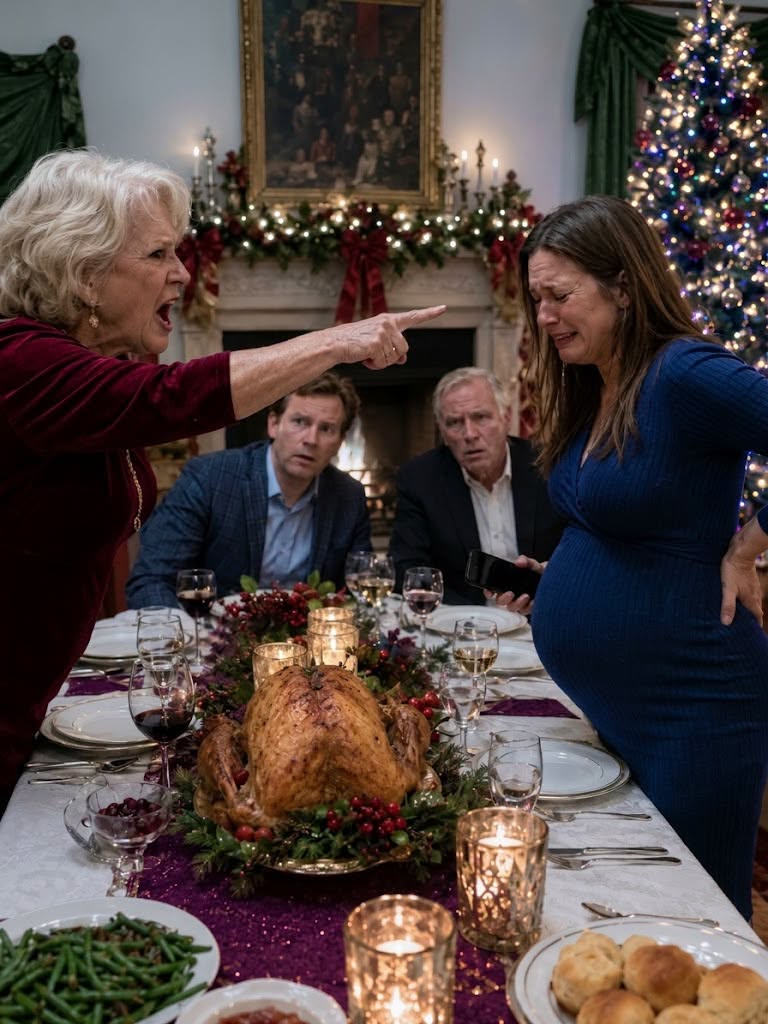
For a moment, I remembered the previous Christmas.
Margaret's voice.
Servants don't sit with the family.
Thomas looking away.
The dizziness.
The humiliation.
The terrible feeling that I had somehow become invisible.
I looked around the room.
Rebecca was laughing with Meredith.
Jonathan was helping Dad pour water.
Laura was arranging extra plates.
Evelyn was pulling out a chair for one of Meredith's sons.
Nobody was waiting for permission to be kind.
Nobody was measuring anyone's worth.
Nobody was afraid to speak.
Dad noticed me standing.
"Claire?"
I looked at him.
He smiled.
"Your dinner's getting cold."
I laughed.
"I know."
He pulled out a chair.
"Then come sit."
I looked at the empty place beside him.
A place prepared for me.
Not because I had earned it.
Not because I had married into the right family.
Not because my father was a Chief Justice.
Simply because I belonged there.
I sat down.
Lily settled into her high chair beside me.
Dad raised his glass.
"To family."
Everyone lifted their glasses.
Then Rebecca smiled.
"To the people who choose to show up."
Meredith nodded.
"And to knowing when to leave a table where you're not welcome."
We laughed.
I felt tears fill my eyes.
Dad looked at me.
"Claire, would you like to say something?"
I looked around the room.
At the people who had stood beside me.
At the people who had told the truth.
At the people who had helped me build a life I once believed was impossible.
Then I looked at Lily.
She was happily banging a spoon against her tray.
I smiled.
"Last Christmas, I thought losing my marriage meant losing my family."
The room grew quiet.
I continued.
"I thought I had failed because I couldn't make people love me the way I wanted them to."
I swallowed.
"But this year taught me something."
I looked at Dad.
Then Rebecca.
Then everyone else.
"Family isn't a place where you have to make yourself smaller to belong."
My voice trembled.
"It's where people make room for you."
Rebecca wiped her eyes.
Dad smiled.
I looked at Lily.
"And I promise my daughter will always have that."
I raised my glass.
"To a home where everyone has a seat."
Everyone smiled.
"To family," Dad said.
We began eating.
The room filled with conversation.
Laughter.
The sound of silverware against plates.
Lily dropped her spoon.
Dad picked it up.
She dropped it again.
Everyone laughed.
And for the first time in years, Christmas dinner felt exactly the way I had always imagined it should.
Warm.
Ordinary.
Safe.
Later that evening, after everyone had gone home, I carried Lily upstairs.
She was sleepy.
Her little head rested against my shoulder.
I changed her into soft pajamas and settled into the rocking chair beside her crib.
Outside, snow drifted past the window.
The Christmas lights glowed softly downstairs.
I looked at the photograph of my mother on the dresser.
"Mom," I whispered, "we made it."
Lily stirred.
I kissed her forehead.
I thought about everything that had happened.
The documents.
The courtroom.
The betrayal.
The fear.
The long nights when I wondered whether I would ever feel safe again.
Then I looked at my daughter.
Her tiny fingers curled around mine.
I smiled.
"You know something, Lily?"
She opened her eyes.
I leaned closer.
"One day, when you're old enough, I'll tell you about your grandmother Eleanor."
I glanced at the photograph.
"She was brave. She was kind. And she believed nobody should ever have to beg for respect."
Lily made a sleepy sound.
I laughed softly.
"And I'll tell you about Grandpa Daniel, who loves you more than all the Christmas cookies in the world."
I kissed her cheek.
"But most of all, I'll tell you that you never have to earn your place in this family."
I held her close.
"You're already home."
When Lily finally fell asleep, I placed her gently in the crib.
Then I went downstairs.
Dad was clearing the last dishes from the table.
I stopped in the doorway.
"Need help?"
He looked up.
"No. Go relax."
I smiled.
"Dad, I can carry a plate."
He laughed.
"I know you can."
I walked over and picked up two glasses.
Together, we finished cleaning the kitchen.
No orders.
No humiliation.
No one standing hungry while everyone else ate.
Just a father and daughter sharing an ordinary moment.
When we finished, Dad turned off the kitchen lights.
I looked toward the dining room.
The chairs were pushed neatly beneath the table.
Lily's high chair stood beside mine.
A small ribbon from one of her gifts lay forgotten near the centerpiece.
I picked it up.
Then smiled.
One year ago, I had stood beside another Christmas table, believing that love meant enduring whatever people demanded of me.
Tonight, I knew better.
I had my daughter.
My father.
My mother's memory.
Friends who had become family.
A home filled with laughter.
And a future that belonged to me.
Dad placed an arm around my shoulders.
"Merry Christmas, sweetheart."
I leaned against him.
"Merry Christmas, Dad."
Then we walked upstairs together, leaving the dining room warm and quiet behind us.
Every chair was waiting for the next time we gathered.
And every person who came through our door would know they were welcome.






Comments 0