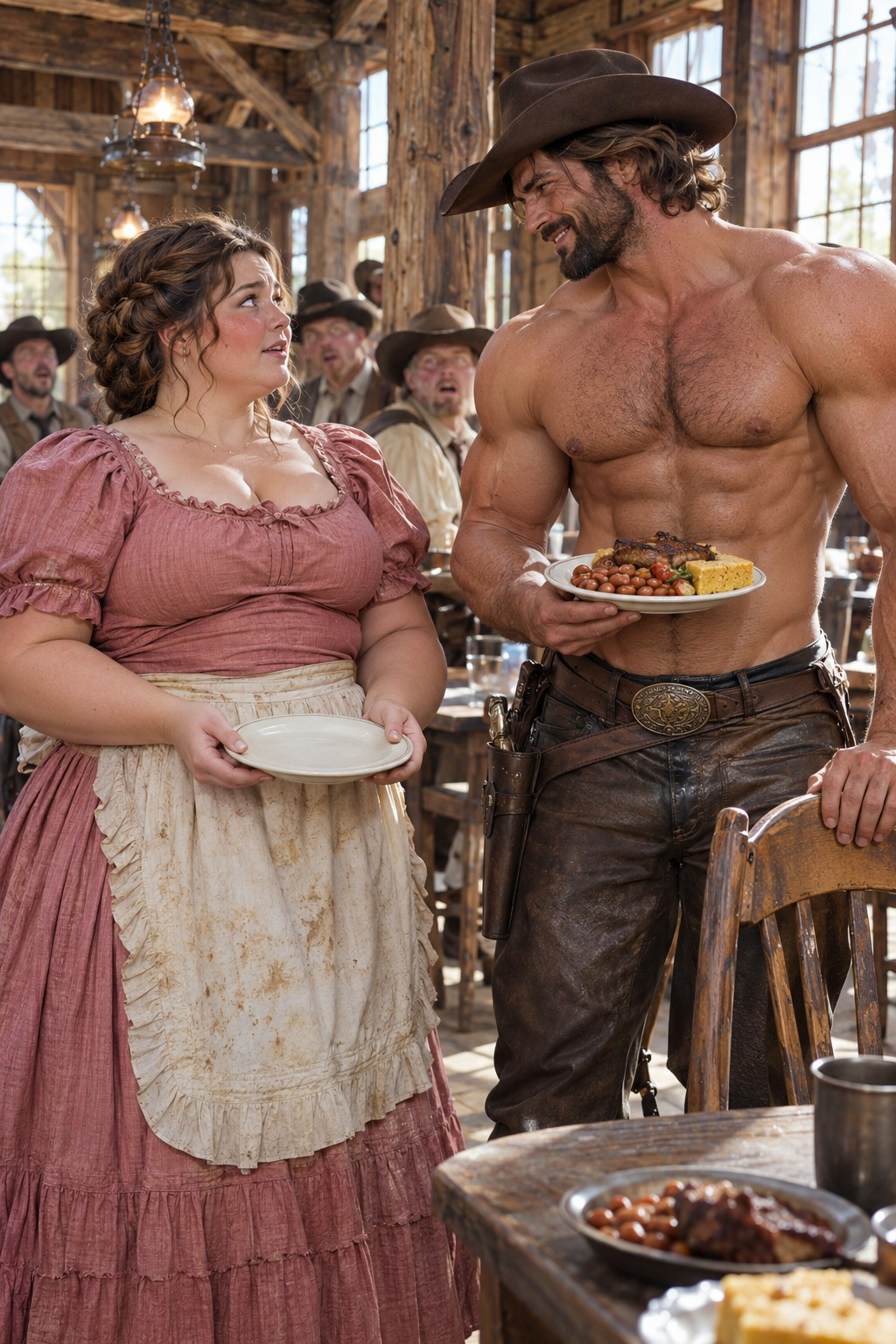
Graham stepped between Curtis and the kitchen table.
“She hasn't stolen anything.”
Curtis raised his eyebrows.
“Did I ask you?”
“No.”
“Then perhaps you should remember that you're an employee.”
Graham remained where he was.
“So is she.”
Curtis glanced at Mabel.
“Put the food down.”
Mabel started to obey.
Graham shook his head.
“Finish your supper.”
The two men looked at each other.
Curtis had spent most of his adult life surrounded by people who obeyed him. He was accustomed to workers lowering their eyes, removing their hats, and apologizing whenever he entered a room.
Graham did none of those things.
His quiet refusal seemed to disturb Curtis more than an argument would have.
“You've been here less than a day,” Curtis said.
“That's right.”
“And you're already interfering with ranch business.”
“Sharing my supper isn't ranch business.”
“It is when you're feeding someone who has no permission to eat it.”
Graham glanced down at his plate.
“Are you telling me I don't own the supper you gave me?”
Curtis opened his mouth.
Then closed it.
Mabel watched helplessly.
She wanted Graham to stop.
She wanted Curtis to leave.
Most of all, she wanted to disappear before the situation became something she couldn't repair.
Curtis adjusted his expensive vest.
“We'll discuss this with my uncle tomorrow.”
“Fine.”
“And you, Miss Whitaker, had better remember who pays your wages.”
Mabel nodded.
Curtis left.
His footsteps disappeared down the hallway.
Graham turned toward her.
“Sit back down.”
“I can't.”
“Your food's getting cold.”
“Don't you understand what you've done?”
Her voice cracked.
Graham's expression softened.
“He was going to accuse you whether I spoke or not.”
“You don't know these people.”
“No,” he admitted. “But I'm learning.”
Mabel sank into the chair.
She looked at the food, suddenly unable to swallow.
Graham waited.
He didn't offer empty promises.
He didn't tell her everything would be fine.
Instead, he picked up the water pitcher and refilled her cup.
That small gesture steadied her more than any speech could have.
“Why did you come here?” she asked.
“Needed work.”
“There's work everywhere.”
“Not everywhere pays thirty-five dollars a month.”
Mabel stared at him.
“Thirty-five?”
Graham nodded.
She looked down at her folded wage statement.
He understood immediately.
“What did they promise you?”
“Twenty.”
“And what do you actually receive?”
“Sometimes twelve. Sometimes less.”
Graham leaned against the table.
“How long?”
“Almost two years.”
For a moment, neither spoke.
Then Graham asked a question nobody had ever asked her.
“Have you kept the statements?”
Mabel nodded.
“Every one.”
“Good.”
She frowned.
“Why?”
“Because a man can argue with your memory. Paper's harder to argue with.”
Mabel had never considered that.
She kept the statements because her mother had taught her never to throw away financial records.
They were stored inside a wooden sewing box beneath her bed.
She had regarded them as reminders of failure.
Graham seemed to regard them as something else entirely.
Evidence.
He pulled a second chair toward the table.
“Tell me about the supplies.”
Mabel hesitated.
“What about them?”
“Do you order them?”
“No. Mr. Curtis handles that.”
“Do you receive them?”
“Sometimes. Usually the wagon stops at the main barn first.”
“And then?”
“The boys bring whatever Mr. Curtis tells them to bring.”
Graham nodded slowly.
“Do you count everything?”
“I have to. Otherwise I can't plan the meals.”
“Does anyone check your count?”
“Mrs. Vale says that's unnecessary.”
Graham looked toward the flour bin.
“How much flour do you have?”
“Enough for breakfast and perhaps tomorrow's dinner.”
“For twenty-three men?”
“Twenty-four now.”
He almost smiled.
Mabel didn't.
She was thinking about the bread she would have to make before sunrise.
She would need to stretch the remaining flour with cornmeal again.
Graham noticed a folded paper resting beside the bin.
“What about that?”
Mabel followed his gaze.
“A freight receipt. One of the boys left it there yesterday.”
“May I?”
She nodded.
He unfolded it.
His eyes moved across the handwritten quantities.
Salt.
Coffee.
Sugar.
Dried apples.
Flour.
He stopped.
“Mabel, this says twelve sacks of flour were delivered yesterday.”
She looked up.
“Only seven came into my kitchen.”
Graham read the number again.
“Twelve.”
“Yes.”
“And you're certain you received seven?”
“I counted them myself.”
He slowly turned the receipt over.
“Then I need to ask you something. Who signs for the deliveries before you see them?”
Mabel opened her mouth.
Then stopped.
She suddenly remembered a name.
Not because she had seen it on yesterday's receipt.
Because she had seen it somewhere else.
Three months earlier, a freight wagon had arrived during a thunderstorm.
The driver had taken shelter in the kitchen while waiting for Curtis.
He was an older man with a gray mustache and a damaged left hand.
Mabel had given him coffee.
While he drank, he complained about the delivery arrangements.
“Never seen a ranch that makes receiving flour so complicated,” he had muttered.
She remembered asking what he meant.
The driver had laughed.
“Mr. Vale wants everything signed by his nephew. Then the nephew wants another signature for the goods that go into town.”
At the time, Mabel hadn't understood.
She had been too busy preparing supper.
But now she remembered the second name the driver had mentioned.
Elias Mercer.
The owner of Willow Creek's general store.
“Mabel?”
Graham's voice brought her back.
She looked toward the doorway.
“There's another name.”
“Whose?”
“Elias Mercer.”
Graham's expression became serious.
“The storekeeper?”
“You know him?”
“I passed his store this morning.”
Mabel explained the conversation with the freight driver.
When she finished, Graham folded the receipt.
“Does Mercer supply the ranch?”
“Sometimes. But most of our flour comes directly from a mill in Helena.”
“Then why would he sign for it?”
“I don't know.”
Graham looked toward the window.
Outside, the last sunlight was disappearing behind the mountains.
“Maybe somebody's selling flour that the ranch already paid for.”
Mabel shook her head.
“That wouldn't make sense.”
“Why not?”
“Mr. Vale would notice.”
“Unless he already knows.”
The possibility frightened her.
Silas Vale was a powerful man.
He served on the county livestock association.
He employed nearly thirty workers.
The sheriff attended his Christmas dinners.
Mabel couldn't imagine accusing him of anything.
“Please don't say that,” she whispered.
Graham looked at her.
“I'm not accusing anybody yet.”
“But you think—”
“I think twelve sacks were delivered and seven reached your kitchen. I think someone should explain the other five.”
He placed the receipt on the table.
“And I think you shouldn't be paying for them.”
Mabel stared at the paper.
For nearly two years, she had believed she was somehow responsible for the ranch's missing supplies.
She had questioned her own arithmetic.
She had blamed herself for mistakes she couldn't remember making.
She had gone hungry to compensate for shortages she didn't understand.
Now, for the first time, another explanation existed.
Someone might have been taking the supplies before they reached her.
And charging her for the loss.
The thought made her feel sick.
Graham noticed.
“That's enough for tonight.”
He pushed the plate toward her.
“Eat.”
This time, she obeyed without arguing.
When she finished, Graham helped carry the remaining dishes to the sink.
Mabel protested.
He ignored her.
Together, they cleared the kitchen.
He dried plates while she washed them.
He stacked bowls while she wiped the counters.
The work that usually took her another hour was finished in twenty minutes.
She couldn't remember the last time someone had helped her without expecting anything in return.
When Graham finally prepared to leave, he pointed toward the receipt.
“Keep that somewhere safe.”
Mabel folded it into her apron pocket.
“I will.”
“And those wage statements.”
She nodded.
He paused at the doorway.
“Good night, Mabel.”
“Good night, Mr. Boon.”
“Graham.”
She smiled faintly.
“Good night, Graham.”
He disappeared into the darkness.
Mabel extinguished the kitchen lanterns and walked toward her small room behind the laundry shed.
For the first time in months, her stomach was full.
But her mind wouldn't rest.
She unlocked her door and stepped inside.
The room contained a narrow bed, a washstand, a wooden trunk, and a small shelf holding her mother's Bible.
She lit a candle.
Then she knelt beside the bed and reached for her sewing box.
It wasn't there.
She checked beneath the blanket.
Behind the trunk.
Under the washstand.
Nothing.
Her pulse quickened.
She had left the box beneath her bed that morning.
She was certain.
Mabel turned toward the door.
A folded piece of paper had been pushed underneath it.
She picked it up.
The handwriting was unfamiliar.
There were only seven words.
Stop counting things that don't belong to you.






Comments 0