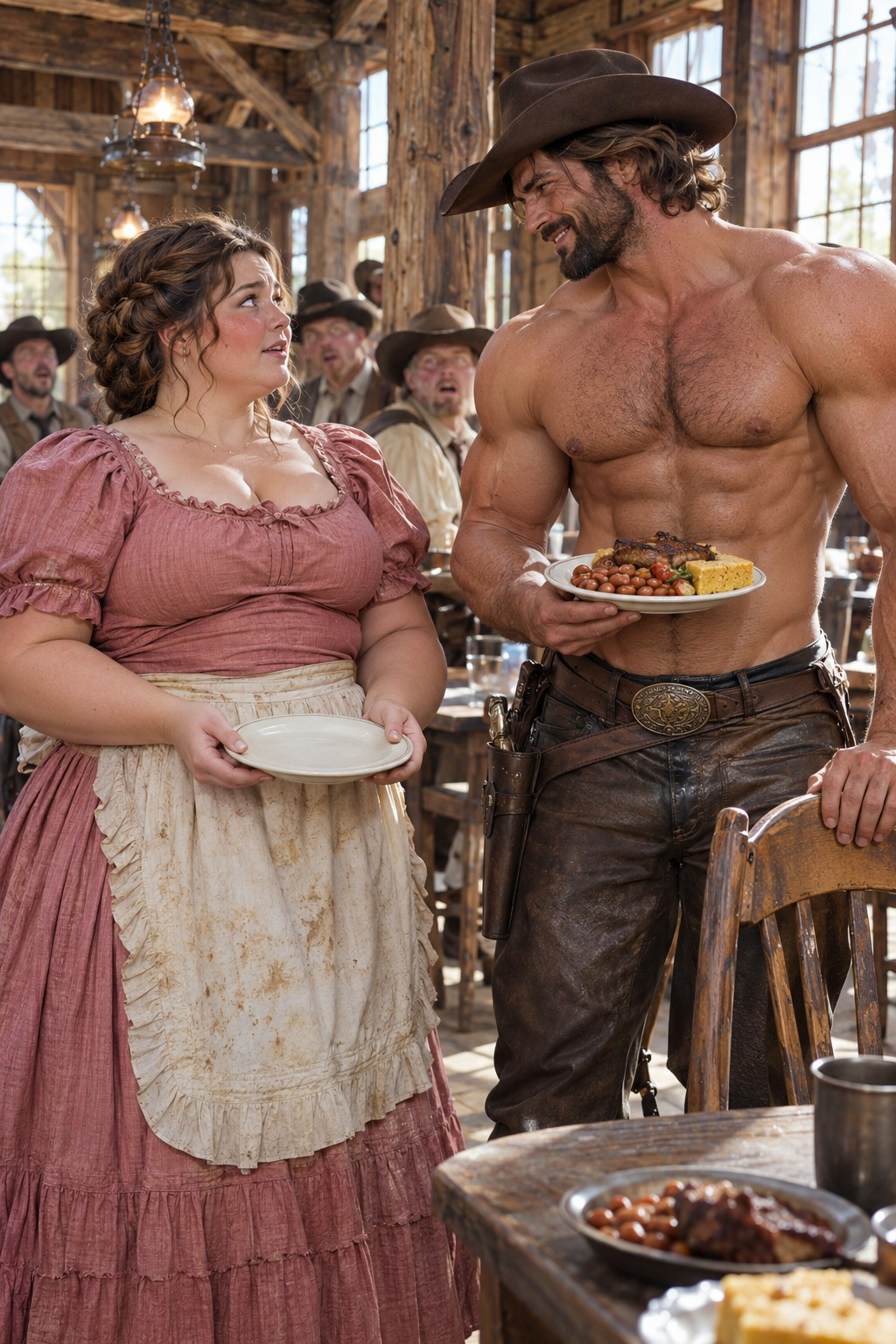
Mabel Whitaker caught a falling dinner plate as Martha Vale shouted, “Put that down!”
The ranch owner's wife snatched a folded wage statement from her apron.
Three words appeared beside another deduction.
Unaccounted kitchen supplies.
Mabel wasn't being paid to cook anymore.
She was paying for someone else's crime.
She didn't know that yet.
All she knew was that her stomach hurt, her feet were swollen, and she had been standing beside a hot iron stove since four that morning.
Fourteen hours.
Fourteen hours of kneading dough, peeling potatoes, roasting beef, boiling beans, washing dishes, and carrying heavy pots across a kitchen that became unbearably hot before noon.
And now she couldn't even eat the leftovers.
“You fed every man on this ranch, and now you expect us to feed you too?” Martha demanded.
Mabel looked down at the small piece of cornbread and the spoonful of beans on her plate.
“It's just leftovers, ma'am.”
“Leftovers cost money.”
“Yes, ma'am.”
“Put that plate down.”
Mabel obeyed.
She placed the plate beside the sink and folded her hands against her stained apron so Martha wouldn't notice how badly they were shaking.
From the dining hall came the laughter of twenty-three cowboys enjoying their supper.
Someone asked for another helping of beef.
Another man complained that his coffee had grown cold.
Mabel turned toward the stove.
“Don't forget the dishes,” Martha said.
“I won't.”
“And I expect breakfast ready before five tomorrow.”
“Yes, ma'am.”
Martha walked away without another word.
For several seconds, Mabel remained perfectly still.
Then she picked up the coffee pot and returned to work.
Black Ridge Ranch occupied nearly four thousand acres of grazing land outside the small Montana town of Willow Creek. Its cattle were known throughout the territory, and its owners enjoyed a reputation for generosity whenever wealthy visitors came calling.
Silas Vale wore expensive suits to church.
Martha donated blankets to the annual Christmas charity.
Their names appeared regularly in the local newspaper.
But nobody who visited Black Ridge for Sunday dinner ever saw what happened inside its kitchen after the guests went home.
Mabel had worked there for nearly two years.
She had arrived with a carpetbag, three dresses, a handwritten recommendation from her previous employer, and twenty-seven dollars sewn into the lining of her coat.
Her mother had died the previous winter.
Her father had been gone for eleven years.
There was no family waiting to take her in, no husband to provide for her, and no property she could sell.
The position at Black Ridge had seemed like an answer to her prayers.
Silas promised her twenty dollars a month, lodging, and meals.
The lodging turned out to be a narrow room behind the laundry shed.
The meals gradually disappeared.
And the twenty dollars became eighteen.
Then fifteen.
Then eleven.
Every month brought a different explanation.
Broken dishes.
Excessive firewood.
Missing supplies.
Kitchen waste.
Mabel had protested once.
Silas had leaned across his enormous mahogany desk and smiled.
“Miss Whitaker, there are women in this territory who would work for half what I pay you.”
She had understood the warning.
After that, she stopped asking questions.
She learned to make soup from bones that other cooks would have discarded. She stretched flour with cornmeal when deliveries arrived short. She repaired her own apron and sharpened her own knives.
She did everything possible to avoid giving the Vales another excuse to take her wages.
Nothing worked.
That evening, while carrying a fresh pot of coffee into the dining hall, Mabel heard a familiar voice.
“Careful, boys. Don't let the cook see you wasting anything. She might charge us for it.”
Several men laughed.
The speaker was Curtis Vale, the owners' twenty-six-year-old nephew and the ranch's supply manager.
He sat with his boots stretched beneath the table, his expensive vest unbuttoned and a silver pocket watch hanging from his waistcoat.
Mabel said nothing.
She filled his cup.
Curtis caught her wrist.
“What's wrong with you tonight?”
“Nothing, sir.”
“You look miserable.”
“I'm only tired.”
“Then sleep faster.”
More laughter followed.
Mabel gently withdrew her hand and moved toward the next table.
She had nearly reached it when a deep voice interrupted the conversation.
“That's enough.”
The laughter stopped.
At the far end of the table sat a man Mabel had never seen before.
He was enormous.
His shoulders strained the seams of his faded work shirt, and his weathered brown hat rested beside a plate of untouched food.
His beard was thick, his hands rough, and his expression remarkably calm.
Curtis turned toward him.
“Excuse me?”
“You heard me.”
The stranger didn't raise his voice.
He didn't need to.
Curtis studied him for a moment before forcing a smile.
“New man thinks he's important.”
The stranger picked up his coffee.
“New man thinks supper ought to come without insulting the woman who cooked it.”
Nobody laughed this time.
Mabel stared at him.
Then she quickly lowered her eyes and returned to the kitchen.
Her heart was beating much too fast.
She wasn't accustomed to anyone defending her.
Especially not a stranger.
She discovered his name twenty minutes later when the ranch foreman entered the kitchen looking for another loaf of bread.
“That's Graham Boon,” the foreman explained when Mabel cautiously asked about the new cowboy. “Hired him this morning. Best recommendation I've seen in fifteen years.”
“Where's he from?”
“Wyoming, mostly. Worked cattle all over the territory. Doesn't talk much about himself.”
Mabel wrapped the bread in a clean cloth.
“He seems different.”
The foreman chuckled.
“Different enough that Curtis already dislikes him.”
After the foreman left, Mabel pressed a hand against her stomach.
She hadn't eaten since the previous evening.
She poured herself a cup of water and drank slowly.
It helped for approximately thirty seconds.
Then the hunger returned.
She was scraping a roasting pan when someone appeared in the kitchen doorway.
It was Graham.
He held two empty dinner plates.
“Where do these go?”
Mabel hurried forward.
“Oh, you don't have to bring those back, sir.”
“Didn't ask whether I had to.”
He glanced toward the sink.
“Here?”
“Yes.”
He placed them carefully beside the others.
Then he looked around the kitchen.
The enormous stove.
The stacked dishes.
The empty flour bin.
The single wooden chair tucked beneath the preparation table.
Finally, he looked at Mabel.
“Where's your supper?”
She froze.
“I already ate.”
Graham glanced toward the dining hall.
“No, ma'am. You didn't.”
Mabel's face warmed.
“I'm perfectly fine.”
“I didn't ask if you were fine.”
She tightened her grip on the dishcloth.
“Please, sir. I have work to finish.”
Graham studied her for another moment.
Then he nodded.
“All right.”
He left without another word.
Mabel released a breath.
Kindness was dangerous at Black Ridge.
It attracted attention.
And attention almost always resulted in punishment.
She remembered a stable boy named Tommy who had once brought her an apple after discovering she had missed breakfast.
Martha caught him.
The boy spent the following Saturday cleaning manure from every stall in the barn.
Mabel lost fifty cents from her wages.
She never accepted another apple.
By seven-thirty, most of the cowboys had returned to the bunkhouse.
The dining hall emptied.
Mabel gathered the remaining dishes and began washing them in a basin of increasingly gray water.
Her back ached.
Her fingers were cracked from soap and heat.
Twice, she stopped because the room seemed to tilt beneath her feet.
She was reaching for another plate when she heard a chair scrape across the wooden floor.
Graham had returned.
This time, he carried his supper.
Roasted beef, beans, vegetables, and a generous square of cornbread.
He placed the plate on the back table.
Then he pulled out the chair.
“Sit down, Mabel. We're sharing.”
She stared at him.
“I can't.”
“Why not?”
“Mrs. Vale doesn't allow it.”
“Doesn't allow what?”
Mabel swallowed.
“Eating food meant for the men.”
Graham looked at the plate.
“It's my supper.”
“Yes.”
“Then I reckon I can decide what happens to it.”
She glanced toward the doorway.
“If she finds out—”
Graham's expression changed.
Not dramatically.
Just enough for Mabel to notice the sudden tension in his jaw.
“Does she punish you for eating?”
Mabel looked away.
That was answer enough.
Graham broke the cornbread in half.
He placed one piece on a clean plate and added beef and beans.
“Sit.”
His voice was gentle.
Mabel hesitated.
Then her knees seemed to make the decision for her.
She sat.
The first bite nearly brought her to tears.
She tried to eat slowly, but her hunger betrayed her.
Graham pretended not to notice.
He poured two cups of water and leaned against the table.
For the first time in months, Mabel ate without someone reminding her what she supposedly owed.
“Thank you,” she whispered.
Graham nodded.
“You're welcome.”
She took another bite.
Then he noticed the folded wage statement lying beside her apron.
“What's that?”
Mabel quickly covered it.
“Nothing important.”
He didn't reach for it.
“More trouble?”
She hesitated before handing him the paper.
Graham read it.
His eyes narrowed.
“Eight dollars deducted?”
“Kitchen waste.”
“What kind of waste?”
“I don't know.”
“Did you ask?”
“Mr. Vale says I should be grateful to have employment.”
Graham looked at the nearly empty shelves.
Then at the flour bin.
Then at the carefully saved scraps of food beside the stove.
Nothing about the kitchen suggested waste.
Everything suggested a woman who had been forced to survive on less than she needed.
He returned the statement.
Mabel folded it carefully.
“You shouldn't concern yourself with my problems.”
“Why not?”
“Because people who do usually end up with problems of their own.”
Before Graham could answer, footsteps sounded outside.
Mabel stood so quickly that the chair nearly toppled.
She grabbed the plate.
Graham caught the chair and steadied it.
The kitchen door opened.
Curtis Vale stood on the threshold.
His eyes moved from Graham to Mabel.
Then to the supper plate in her hands.
“Well,” he said slowly. “Isn't this interesting?”
Mabel's face went pale.
Curtis smiled.
“I wonder what Uncle Silas will say when he finds out what you've been stealing.”






Comments 0