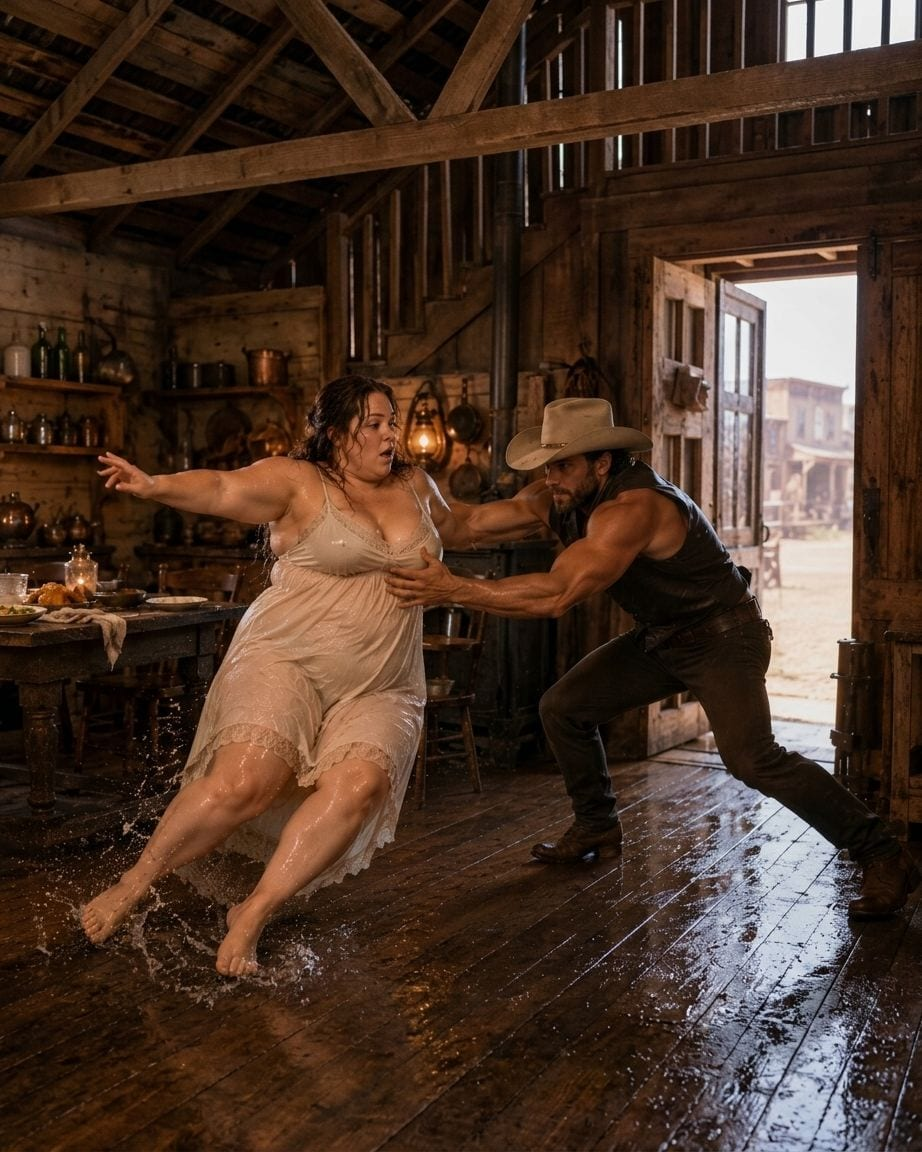
“Don't you dare call me that in this house.”
Margaret Callaway's voice cut through the hallway.
Sheriff Cole Harland turned toward the staircase.
The stranger in the dark blue coat held a folded document in his gloved hand. Across its yellowed surface was a name Margaret had spent three years trying to escape.
Margaret Whitcomb.
But beneath that name was something far more troubling.
A red official seal.
And the word WANTED.
Cole immediately stepped between them.
Nobody moved.
For several seconds, the only sound came from the clock ticking in the sitting room.
Then the stranger smiled.
“Well,” he said. “I see you haven't lost your manners, Margaret.”
Margaret stood halfway down the staircase, one hand resting against the wooden railing.
Her face had gone pale.
Not with fear.
With recognition.
The kind that came when a person discovered that something terrible had followed them across hundreds of miles.
“Who are you?” Cole demanded.
The stranger turned toward him.
“Edwin Mercer. Private investigator.”
He reached into his coat.
Cole's hand moved instinctively toward his holstered revolver.
“Slowly.”
Mercer stopped.
“Easy, Sheriff. I'm only reaching for identification.”
“Then use two fingers.”
Mercer obeyed.
He withdrew a small leather wallet and opened it.
Inside was a printed card bearing the name of a private inquiry office in St. Louis.
Cole examined it without touching it.
“What business brings you into my house?”
Mercer glanced toward Margaret.
“I'm looking for a woman who disappeared three years ago.”
Margaret descended another step.
“I didn't disappear.”
Mercer smiled again.
“That's a matter of interpretation.”
“I left.”
“Without permission.”
The words changed something in Cole's expression.
He turned slowly toward Mercer.
“Permission from whom?”
Mercer hesitated.
“Her husband.”
Margaret's hand tightened on the railing.
Cole looked up at her.
She met his eyes.
There was no attempt to deny what had been said.
But there was something else in her expression.
A warning.
Not to trust the man standing beside him.
Cole turned back.
“You'd better explain yourself.”
Mercer unfolded the document.
“Margaret Whitcomb. Married to Thomas Whitcomb of Missouri. Reported missing following an unfortunate domestic incident involving certain valuables.”
Margaret gave a short, humorless breath.
“Is that what he calls it now?”
Mercer's eyes hardened.
“Mr. Whitcomb has been remarkably patient.”
“Thomas Whitcomb has never been patient a day in his life.”
“Margaret.”
“Don't.”
Her voice remained quiet.
But the word carried enough force to silence him.
Cole watched the exchange carefully.
He had spent years learning to recognize the difference between a person hiding guilt and a person hiding pain.
Margaret was hiding something.
That much was obvious.
But he was no longer certain it was what Mercer claimed.
“Let me see that document,” Cole said.
Mercer handed it over reluctantly.
Cole read the first page.
Then the second.
His expression grew colder.
“This isn't a warrant.”
“It's a notice.”
“From a private agency.”
“Working in cooperation with interested parties.”
Cole looked up.
“Interested parties aren't the law.”
Mercer shifted his weight.
“Sheriff, I think you misunderstand the seriousness of the situation.”
“No,” Cole said. “I understand it perfectly.”
He folded the document.
“You've entered my house, accused my employee of a crime, and presented a private notice as though it gives you authority to take her somewhere.”
Mercer's smile vanished.
“Your employee?”
“Yes.”
“Surely you don't intend to employ a woman under false pretenses.”
Cole glanced toward Margaret.
She was watching him with an expression he could not read.
He turned back.
“That's between her and me.”
Mercer stepped closer.
“Sheriff Harland, Thomas Whitcomb is a man of considerable influence.”
Cole did not move.
“That's unfortunate for him.”
“Perhaps you should consider—”
“I've considered enough.”
Cole handed back the document.
“You can leave.”
Mercer stared.
“You're making a mistake.”
“Then it'll be mine to make.”
For the first time, the stranger's composure slipped.
He looked past Cole toward Margaret.
“This isn't finished.”
Margaret descended the remaining steps.
“No,” she said. “I suppose it isn't.”
Mercer pulled on his gloves.
“You know what happens when he loses patience.”
Margaret's expression did not change.
But Cole noticed her fingers curl tightly against her skirt.
Mercer noticed too.
He seemed satisfied.
Then he placed his hat on his head and walked toward the door.
At the threshold, he paused.
“One more thing, Sheriff.”
Cole waited.
Mercer looked directly at him.
“Ask her what happened to the money.”
Then he stepped outside.
Cole shut the door.
The sound echoed through the house.
Margaret remained beside the staircase.
Cole stood with his hand on the door latch.
Neither spoke.
At last, Margaret said, “You should have let him finish.”
Cole turned.
“He'd said enough.”
“You don't know what he's talking about.”
“No.”
“You don't know who I am.”
“I know your name is Margaret Callaway.”
“That isn't the name I was born with.”
“Most married women change their names.”
She looked away.
Cole removed his hat and placed it on the hook.
He could see that her breathing was controlled only through considerable effort.
“Would you like to sit down?”
“No.”
“Some coffee?”
“No.”
He nodded.
“All right.”
Margaret looked at him sharply.
“That's all?”
“What else would you like me to say?”
“Aren't you going to question me?”
“Would you answer?”
She opened her mouth.
Then closed it.
Cole waited.
Finally, she said, “Not everything.”
“Then there's no sense asking everything.”
He walked toward the kitchen.
Margaret watched him go.
She had expected anger.
Suspicion.
Perhaps immediate dismissal.
She had spent three years preparing herself for the moment someone recognized her.
In every version she imagined, the result was the same.
Doors closed.
Voices changed.
People who had treated her kindly began looking at her as though kindness had been a mistake.
But Cole Harland had done something she had not prepared for.
He had believed that she deserved to be heard before she was judged.
That frightened her almost as much as Mercer had.
Because it made her want to trust him.
And trust was a luxury she could no longer afford.
Cole was pouring coffee when Margaret entered the kitchen.
She stopped beside the table.
“I owe you an explanation.”
Cole set down the pot.
“You don't owe me your entire history.”
“I lied about my name.”
“You told me Margaret Callaway.”
“That was my mother's maiden name.”
“Then it belongs to you.”
Margaret looked at him.
He pulled out a chair.
This time, she sat.
For a while, she watched the steam rising from her cup.
Then she spoke.
“I married Thomas Whitcomb when I was twenty-six.”
Cole sat across from her.
“He owned a supply business outside St. Louis. Lumber, hardware, farming equipment. He had money. A respectable name. Friends in places where friends could make inconvenient problems disappear.”
She paused.
“At first, he was kind.”
Cole said nothing.
“Or I thought he was. He bought flowers. Took me to dinners. Told everyone how fortunate he was to have me.”
Her fingers tightened around the cup.
“Then he began correcting things.”
“What things?”
“How I spoke. How I dressed. How much food I ate. Whether I laughed too loudly.”
Cole's jaw tightened.
“He said I embarrassed him because I didn't look like the women his business partners married.”
Margaret stared into her coffee.
“He wanted me smaller.”
Cole waited.
“Not just physically. In every possible way.”
Her voice remained steady.
“He didn't want a wife who had opinions. He wanted someone who would thank him for allowing her to exist in his house.”
Cole thought of the newspaper on his desk.
You wrote efficient. Not invisible.
The words suddenly meant something different.
“What happened?” he asked.
Margaret took a breath.
“I learned that agreeing with him didn't make him kinder.”
Cole felt something cold settle in his chest.
She continued.
“One evening, he accused me of stealing money from his office.”
“Had you?”
“No.”
“Did he believe you?”
“He didn't care whether I was innocent.”
She looked up.
“He wanted me frightened enough to stop contradicting him.”
Cole's expression darkened.
“Did he hurt you?”
Margaret's eyes moved toward the window.
For several seconds, she said nothing.
Then she answered.
“Yes.”
The word was barely audible.
Cole looked down at his hands.
He had seen enough violence during his years as sheriff to recognize the terrible simplicity of that answer.
He also understood that asking for details would serve his curiosity more than her safety.
So he didn't.
Margaret continued.
“The next morning, I packed what I could carry. I took money from a small account I'd kept before our marriage. Money I'd earned myself.”
“And left?”
“Yes.”
“Where did you go?”
“Anywhere he wasn't.”
She gave a bitter little laugh.
“Turns out that's harder than it sounds when a man has money.”
Cole leaned back.
“Mercer claims you stole from him.”
“Thomas claims whatever is useful.”
“Can you prove the money was yours?”
“I had records.”
“Had?”
“They disappeared.”
Cole studied her.
“Who took them?”
Margaret's expression changed.
“I don't know.”
He knew she was withholding something.
But he also knew she had already told him more than she intended.
He stood.
“Mercer doesn't have a warrant. He can't force you to leave.”
“Thomas doesn't always use the law.”
Cole looked at her.
“Then he'll discover I'm not particularly fond of men who operate outside it.”
Margaret's eyes filled with something she quickly concealed.
“You shouldn't involve yourself.”
“He came to my house.”
“He came for me.”
“And threatened you under my roof.”
Cole's voice remained quiet.
“That makes it my concern.”
Margaret looked away.
She had heard men promise protection before.
Thomas had promised it during their courtship.
He had said she would never have to worry about anything again.
She had eventually learned that some promises were simply another way of claiming ownership.
But Cole's words felt different.
He had not asked for gratitude.
He had not demanded obedience.
He had simply drawn a line.
And Margaret did not know what to do with that.
The rest of the afternoon passed slowly.
Cole returned to the sheriff's office.
Margaret remained at the house.
She cleaned the pantry shelves, repaired a loose cabinet hinge, and began preparing bread for the following morning.
But every ordinary sound made her pause.
A wagon passing outside.
Footsteps on the porch.
A gust of wind rattling the shutters.
Twice, she checked the front door.
Once, she climbed the stairs and stood outside Eleanor's room.
The blue thread was still hidden in her apron pocket.
She took it out.
Held it against the light.
Then examined the scratches beneath the door again.
They were unmistakably recent.
Something had been moved.
Perhaps a trunk.
Perhaps a piece of furniture.
But why would Cole move anything inside a room he seemed unable to enter?
And why had she found a thread matching Mercer's coat?
She remembered his expression when Cole told him to leave.
Not anger.
Calculation.
The realization unsettled her.
Mercer had not seemed surprised to find her there.
He had seemed pleased.
As though discovering her location had been only the first part of his assignment.
Margaret turned toward the staircase.
For a moment, she considered opening Eleanor's door.
Then she remembered Cole's face when he spoke about his sister.
She stepped away.
Some boundaries deserved respect.
Even when crossing them might provide answers.
At the sheriff's office, Cole Harland was having a difficult afternoon.
Harold Denny had returned to complain about the fence.
A ranch hand had reported a missing saddle.
And Walt Greer had arrived carrying a newspaper and an expression that suggested he knew something interesting.
Cole disliked that expression.
“Afternoon,” Walt said.
“Is it?”
Walt settled into the chair opposite the desk.
“Heard you've got yourself a housekeeper.”
Cole continued writing.
“News travels.”
“Especially when it's worth repeating.”
“Is there a reason you're here?”
Walt leaned forward.
“Clara Whitmore saw a stranger asking questions about her.”
Cole's pen stopped.
“What stranger?”
“Tall fellow. Blue coat. St. Louis accent.”
Cole slowly raised his eyes.
“What questions?”
“Where she'd been staying. Whether she had relatives nearby. How long she'd been in town.”
Cole set down his pen.
“When?”
“This morning.”
“Before he came to my house?”
Walt frowned.
“I suppose so.”
Cole leaned back.
Mercer had claimed to be searching for Margaret.
Yet he had known enough to arrive at Cole's house almost immediately after she began working there.
That meant someone had been watching her.
Or someone in town had told him exactly where to find her.
“Did Clara answer?”
Walt shrugged.
“You know Clara.”
Cole did.
Clara Whitmore considered private information a public resource.
“Anything else?”
Walt hesitated.
“There was something peculiar.”
Cole waited.
“The fellow asked whether the upstairs rooms in your house were occupied.”
Cole became very still.
“What?”
Walt nodded.
“Clara thought it strange too. She said she didn't know. He asked whether your sister's old room was still closed.”
Cole stared at him.
The office clock ticked.
Walt shifted uncomfortably.
“Cole?”
“Did he say why?”
“No.”
“Did Clara tell him anything?”
“Only that nobody had been in Eleanor's room since—”
Walt stopped.
Cole's expression had changed.
Not dramatically.
But enough.
“Since she died,” Cole finished.
Walt lowered his eyes.
“I'm sorry.”
Cole stood.
“Where's the stranger now?”
“Last I heard, he was staying at the boardinghouse.”
Cole reached for his coat.
“Keep this between us.”
Walt nodded.
But as Cole moved toward the door, the editor called after him.
“Cole.”
He turned.
Walt looked troubled.
“There's something else.”
“What?”
“That man wasn't the first stranger asking about your house.”
Cole felt his stomach tighten.
“Who was?”
Walt shook his head.
“I don't know. But someone came through town last week asking whether the Harland place was still standing.”
Cole stared.
“Last week?”
“Yes.”
“Before Margaret arrived?”
Walt nodded.
Cole said nothing.
He walked out.
By the time Cole returned home, darkness had begun settling over Harland Creek.
He found Margaret in the kitchen, kneading bread dough.
She looked up when he entered.
“Dinner's nearly ready.”
He removed his hat.
“Did Mercer say anything about Eleanor?”
Margaret's hands stopped.
“Your sister?”
“Yes.”
“No.”
“Did he ask about the house?”
She hesitated.
“Not while I was present.”
Cole studied her.
“Has anyone else been here?”
“No.”
“Anyone near the property?”
“Not that I saw.”
He nodded.
Margaret wiped her hands on a cloth.
“Sheriff, what's wrong?”
Cole looked toward the staircase.
“Someone's been asking questions about Eleanor's room.”
Margaret felt the blood drain from her face.
She thought of the blue thread.
The scratches.
The door.
“Who?”
“Mercer.”
Her stomach tightened.
“Why?”
“I intend to find out.”
Cole moved toward the hallway.
Margaret stepped in front of him.
“Wait.”
He stopped.
She reached into her apron pocket.
Then placed the dark blue thread in his hand.
“I found this upstairs.”
Cole examined it.
“Where?”
“Outside Eleanor's room.”
His expression hardened.
“When?”
“This morning. Before Mercer came.”
Cole looked at her.
“Why didn't you tell me?”
“I wasn't certain it meant anything.”
“And now?”
Margaret swallowed.
“Now I think someone has been inside that room.”
Cole stared at the thread.
For a moment, he seemed unable to move.
Then he walked toward the staircase.
Margaret followed.
Eleanor's room stood at the end of the hallway.
Cole stopped before the door.
His hand hovered near the knob.
Margaret watched his face.
She had never seen him look so uncertain.
Not when Mercer threatened him.
Not when she challenged him in his office.
But standing before this ordinary wooden door, the sheriff seemed suddenly younger.
And terribly alone.
“You don't have to do this tonight,” she said.
Cole shook his head.
“If someone's been in there, I need to know.”
He took a key from his pocket.
Margaret noticed his fingers trembling.
He inserted it into the lock.
Turned it.
Then slowly opened the door.
The room smelled of cedar and dust.
A narrow bed stood against the wall.
A faded quilt covered it.
Beside the window sat a small writing desk.
Books lined a shelf.
A porcelain pitcher rested on the washstand.
Everything appeared untouched.
Cole stood in the doorway.
For a moment, Margaret thought he might turn away.
Instead, he stepped inside.
She followed at a respectful distance.
He looked around.
His eyes moved from the bed to the desk.
Then to the wardrobe.
Something in his expression changed.
“What is it?” Margaret whispered.
Cole pointed toward the floor.
“There used to be a trunk here.”
Margaret looked down.
Four rectangular marks remained in the dust.
“Was it large?”
“Yes.”
“What was inside?”
Cole swallowed.
“Eleanor's letters. Her journals. Some family papers.”
He crossed toward the empty space.
Then stopped.
“The trunk was locked.”
Margaret felt a chill.
“Who had the key?”
“Only me.”
“Are you certain?”
Cole looked at her.
“Yes.”
Margaret glanced toward the door.
The scratches beneath it suddenly made sense.
Someone had dragged the trunk out.
But why?
And how?
Cole moved toward the writing desk.
He opened the top drawer.
Empty.
The second.
Empty.
Then the third.
His face went pale.
Margaret stepped closer.
“What?”
Cole reached into the drawer.
He lifted out a small folded piece of paper.
It had been placed carefully beneath the wooden divider.
He unfolded it.
Margaret watched his expression.
Whatever he read seemed to take the strength from his body.
“Sheriff?”
He did not answer.
“Cole?”
It was the first time she had used his given name.
He looked at her.
His eyes were filled with something she had not seen before.
Fear.
Not for himself.
For something he had only just begun to understand.
He handed her the paper.
Margaret read the first line.
Then the second.
Her breath caught.
The handwriting was delicate.
Feminine.
And the message was dated three days before Eleanor Harland's death.
Cole, if anything happens to me, don't believe what they tell you.
Margaret looked up.
Cole stood motionless beside the desk.
She continued reading.
The papers in my trunk explain everything. I was wrong to trust him. I thought he was helping us, but I know now what he intends to do.
Margaret's fingers tightened.
The final sentence had been underlined twice.
If a man named Thomas Whitcomb ever comes to Harland Creek, do not let him inside this house.
Margaret stopped breathing.
Cole looked at her.
“Thomas Whitcomb,” he said slowly.
“Your husband.”
Margaret shook her head.
“No.”
Cole's voice was barely audible.
“Eleanor knew him.”
“No,” Margaret repeated.
But this time, she was not denying it.
She was trying to understand how it could possibly be true.
Cole took the paper from her trembling hands.
He stared at his sister's handwriting.
Then he looked toward the empty space where the trunk had stood.
For two years, he had believed Eleanor died from a fever.
A terrible illness.
A tragedy without a villain.
But now there was a letter.
A warning.
A name.
And a missing trunk.
Margaret backed toward the door.
“Cole, there's something you need to know.”
He turned.
She looked at the letter.
Then at him.
“Thomas once told me he had business in a town called Harland Creek.”
Cole's expression changed.
“When?”
“Before I left him.”
“What kind of business?”
“He never explained.”
She swallowed.
“But he told me something else.”
Cole waited.
Margaret's voice dropped.
“He said there was a sheriff in that town who owed him a debt.”
The room fell silent.
Cole stared at her.
Then he slowly looked toward Eleanor's bed.
His sister's quilt lay perfectly folded.
Her books remained on the shelf.
Her perfume bottle still stood beside the washstand.
But the one thing that might have explained her death was gone.
And somewhere in Harland Creek, a man wearing a blue coat knew far more about Eleanor Harland than he had admitted.
They returned downstairs without speaking.
Margaret prepared supper mechanically.
Cole sat at the kitchen table with Eleanor's letter before him.
He read it again.
Then again.
Each time, his expression grew more troubled.
Margaret placed a bowl of stew in front of him.
He did not touch it.
“Cole.”
He looked up.
“You need to eat.”
“Not hungry.”
“I know.”
She sat across from him.
“But you'll need your strength if you're going to find out what happened.”
He stared at her.
For a long moment, he seemed ready to argue.
Then he picked up his spoon.
Margaret watched him take a few bites.
It was a small victory.
But she understood something important.
This man had spent years believing that silence was the only way to survive grief.
Now the silence had been broken.
And what waited beneath it was far more dangerous than either of them had imagined.
After supper, Cole folded Eleanor's letter and placed it inside his coat.
“I'll speak to Mercer tomorrow.”
Margaret shook her head.
“He won't tell you anything.”
“He might.”
“Thomas doesn't hire men who tell the truth.”
Cole looked toward the window.
“Then I'll give him a reason to reconsider.”
Margaret stood.
“Don't underestimate him.”
Cole met her eyes.
“I won't.”
For a moment, neither moved.
Then Margaret said quietly, “I'm sorry.”
“For what?”
“For bringing this into your house.”
Cole looked at her.
“You didn't bring Eleanor's letter here.”
“But Thomas—”
“Thomas Whitcomb was involved in my sister's life before you ever came to Harland Creek.”
Margaret fell silent.
Cole continued.
“And if he had something to do with what happened to her, I would have needed to know sooner or later.”
His voice softened.
“You may have given me the first chance I've had to find the truth.”
Margaret looked down.
She had spent three years believing her past could only destroy whatever peace she found.
Now she was beginning to understand that her past and Cole's might be connected in ways neither could yet see.
That night, Margaret lay awake in her upstairs room.
The house creaked around her.
The wind pressed against the shutters.
Downstairs, she could hear Cole moving through the sitting room.
He was not sleeping either.
She turned toward her traveling bag.
The envelope tied with blue ribbon lay beneath her spare clothes.
She took it out.
Her hands trembled.
For three years, she had carried it everywhere.
She had never shown it to anyone.
Not because she was ashamed.
Because the last person who had seen its contents had disappeared.
Margaret untied the ribbon.
Inside was a letter.
A bank receipt.
And a small photograph.
She held the photograph beneath the lamplight.
It showed Thomas Whitcomb standing beside two other men outside a warehouse.
One was unfamiliar.
The other wore a dark coat and a broad-brimmed hat.
Margaret had studied the photograph countless times.
But tonight, after seeing Eleanor's warning, she noticed something she had overlooked.
On the wall behind the men was a painted business sign.
HARLAND CREEK FREIGHT & STORAGE.
Margaret's heart began pounding.
She turned the photograph over.
There was writing on the back.
Three words.
Eleanor knows everything.
Margaret stared at them.
Then she heard a sound.
A soft knock.
Not at her bedroom door.
At the front entrance downstairs.
She froze.
Another knock followed.
Three slow taps.
Then silence.
Margaret carefully returned the photograph to the envelope.
She rose from the bed and moved toward her door.
Below, she heard Cole's footsteps crossing the hallway.
The front door opened.
A man's voice spoke.
Low.
Urgent.
“Sheriff, I found something you need to see.”
Margaret recognized the voice.
Walt Greer.
She moved toward the staircase.
Then she heard Walt say something that stopped her cold.
“The missing trunk turned up behind the newspaper office.”
Cole said nothing.
Walt continued.
“But that's not the worst part.”
Margaret gripped the railing.
“Someone was inside when we found it.”
A floorboard creaked beneath her foot.
Downstairs, Walt lowered his voice.
“And Sheriff, the person inside says Eleanor Harland didn't die of fever.”
Margaret took another step.
Then Walt spoke the name of the person they had found.
“It's Thomas Whitcomb's former bookkeeper.”
Cole reached for the door handle.
Before he could open it wider, the man outside suddenly shouted.
“Sheriff! Don't let her come downstairs!”
Margaret froze.
A second voice rose from the darkness.
A voice she knew.
A voice she had prayed never to hear again.
“Margaret, I know what you took from my office.”
Then something heavy struck the front door.
Cole drew his revolver.
And from the other side of the wood, someone whispered:
“Open it, Sheriff. Your sister's killer is standing right behind me.”






Comments 0