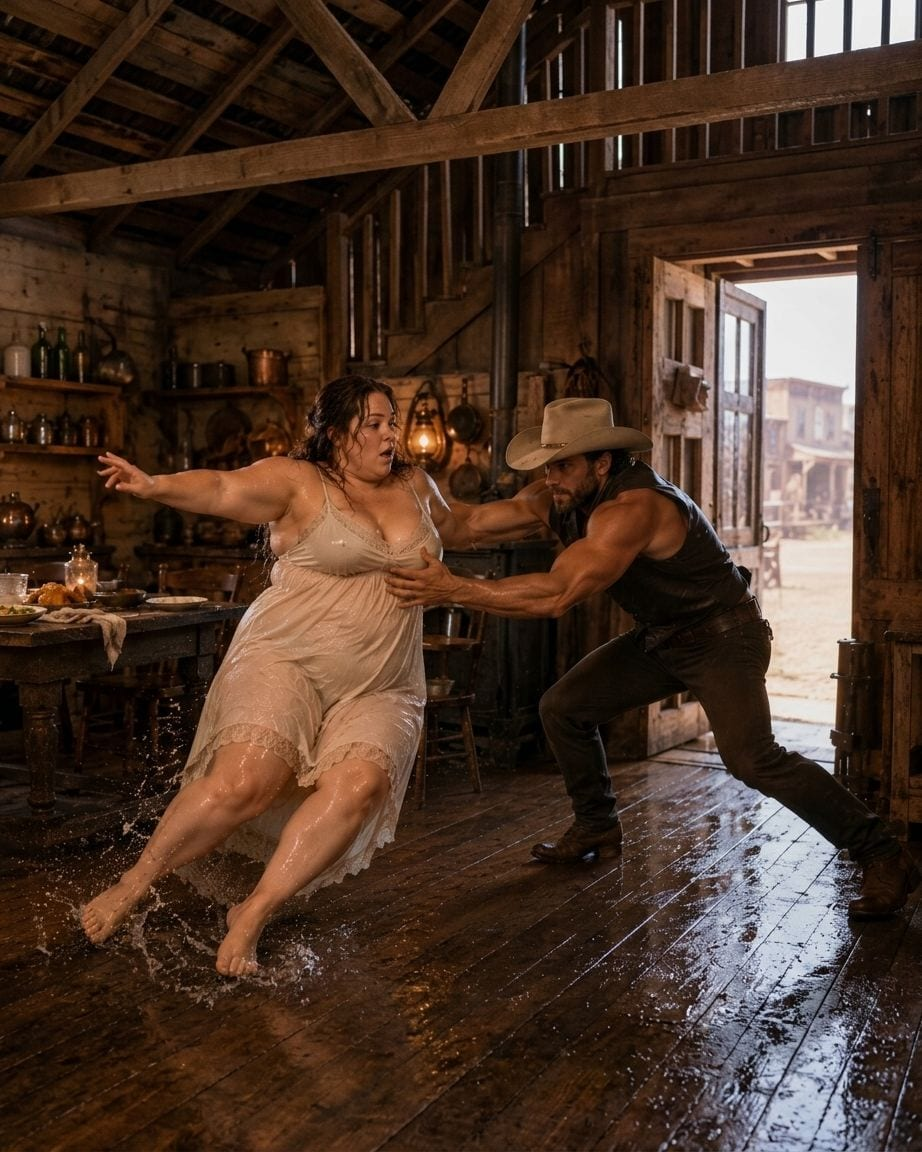
“Get away from that door, Margaret!”
Sheriff Cole Harland's command rang through the darkened hallway.
Margaret stopped halfway down the staircase.
Below her, Cole stood with his revolver drawn, facing the front entrance. Walt Greer was pressed against the doorframe, his face drained of color.
And outside, a man was laughing.
Not loudly.
Not wildly.
It was a low, familiar laugh that made Margaret's stomach turn.
She had heard it across dinner tables, inside expensive hotel rooms, and through locked bedroom doors.
Thomas Whitcomb.
Her husband.
The man she had spent three years trying to escape.
“Margaret,” the voice called again. “Don't make this more difficult than it needs to be.”
Cole's eyes moved toward the staircase.
“Stay where you are.”
Margaret gripped the railing.
“That's him.”
“I gathered that.”
“You don't understand.”
“Then help me understand after I make certain nobody gets killed on my porch.”
Outside, Walt's companion groaned.
Something scraped against the wooden boards.
Cole moved closer to the entrance, keeping his body behind the wall.
“Whitcomb!” he called. “This is Sheriff Harland. Step away from my door.”
A pause.
Then the answer came.
“Sheriff, I believe we have a mutual interest in resolving this unfortunate misunderstanding.”
Cole's expression hardened.
“You have ten seconds to explain why you're standing outside my house in the middle of the night.”
“I'm here for my wife.”
“She isn't going anywhere with you.”
A brief silence followed.
Then Thomas laughed again.
“You've known her two days, Sheriff. I've known her fifteen years.”
Cole glanced toward Margaret.
Her face was pale, but her eyes remained fixed on the door.
“Then you ought to know better than to come here uninvited,” Cole said.
Walt suddenly leaned toward him.
“Cole,” he whispered. “There's blood on the porch.”
Cole looked down.
A dark stain was spreading beneath the threshold.
The injured man outside groaned again.
“Who's hurt?” Cole demanded.
Thomas answered calmly.
“Someone who should have learned to keep his mouth shut.”
Margaret felt the blood leave her face.
The voice was unmistakable.
Thomas sounded exactly as he had sounded on the evening she fled their house.
Perfectly controlled.
Almost pleasant.
That was when he was most dangerous.
Cole tightened his grip on the revolver.
“Whitcomb, move away from the injured man.”
“I suggest you listen carefully, Sheriff.”
“I'm finished listening.”
A sharp metallic click sounded outside.
Walt flinched.
Cole's expression changed.
He recognized the sound of a revolver being cocked.
“Put the weapon down,” he ordered.
Thomas gave a weary sigh.
“You frontier lawmen do love issuing commands.”
Cole stepped closer to the doorway.
“And men like you mistake patience for weakness.”
Then he did something Margaret had not expected.
He lowered his voice.
“Walt, take the back passage. Go around the house and see whether there's another man outside.”
Walt nodded.
He moved silently toward the kitchen.
Margaret watched him disappear.
Cole kept his eyes on the door.
“Whitcomb, I'm opening this door. If you're holding a gun, you put it on the porch before I do.”
Thomas said nothing.
Cole waited.
Then came the sound of metal striking wood.
“Happy now, Sheriff?”
“Step back.”
Cole slowly opened the door.
Cold air rushed into the hallway.
Thomas Whitcomb stood beneath the porch lantern.
He was a handsome man in his late forties, with neatly combed silver-brown hair and a dark wool coat that looked expensive enough to purchase half the buildings on Main Street.
His leather gloves were spotless.
His boots were polished.
And his expression was one of mild irritation, as though he had been inconvenienced by an incompetent servant.
Beside him, a thin man lay slumped against the porch railing.
Blood stained the man's shoulder.
A leather satchel rested near his feet.
Cole immediately recognized the injured man was still conscious.
“Who is he?”
Thomas glanced down.
“An unfortunate associate.”
The injured man lifted his head.
“Sheriff,” he whispered. “Don't believe—”
Thomas moved toward him.
Cole raised his revolver.
“Stay where you are.”
Thomas stopped.
For the first time, his pleasant expression disappeared.
Cole stepped onto the porch.
“Hands where I can see them.”
Thomas slowly raised both hands.
“You're making a serious mistake.”
“Then it'll be my second one tonight.”
Cole crouched beside the injured man.
“What happened?”
The man struggled to speak.
“Mercer.”
Cole's eyes narrowed.
“Edwin Mercer?”
The man nodded weakly.
“He took the trunk.”
Margaret heard every word from the staircase.
She descended another step.
Thomas looked past Cole and saw her.
His face changed instantly.
There it was.
The expression she remembered.
Possession disguised as affection.
“Margaret.”
She stopped.
“Thomas.”
He smiled.
“My dear, you've caused quite a commotion.”
She said nothing.
“I've been worried sick.”
Margaret's fingers tightened around the railing.
“You sent a man to threaten me.”
“I sent someone to bring you home.”
“I don't have a home with you.”
Thomas sighed.
“Still stubborn.”
Cole stood.
“That's enough.”
Thomas turned toward him.
“Sheriff, I appreciate your concern, but this is a private marital matter.”
“Not when a wounded man is bleeding on my porch.”
Thomas glanced at the injured man.
“An accident.”
Cole looked at the blood.
“Funny how accidents keep happening around you.”
Thomas's eyes hardened.
For one brief moment, Margaret saw the mask slip.
Then it returned.
“I'd be careful about making accusations, Sheriff.”
Cole stepped closer.
“And I'd be careful about making threats.”
The two men stood facing each other.
One wore a sheriff's badge.
The other wore the confidence of a man who believed money could purchase every badge in the country.
Margaret understood something then.
Thomas had expected Cole to be intimidated.
He had expected questions about business connections and influential friends.
He had expected the sheriff to recognize the advantage of cooperating.
Instead, Cole was looking at him as though he were simply another troublesome man standing on the wrong porch.
Thomas was not accustomed to that.
And Margaret knew he would not forgive it.
Walt returned moments later with two neighbors who had heard the disturbance.
Cole ordered them to carry the injured man into the sitting room.
Thomas protested.
“He belongs in my custody.”
Cole turned.
“Your custody?”
“He worked for me.”
“People aren't property, Whitcomb.”
Thomas's jaw tightened.
Margaret watched him carefully.
That sentence had struck a nerve.
Cole directed the neighbors toward the sofa.
The injured man was conscious but weak.
His shoulder wound appeared serious, though the bleeding had slowed.
“Walt,” Cole said, “fetch Doctor Bellamy.”
Walt hurried out.
Thomas remained near the doorway.
Cole pointed toward a chair.
“Sit.”
Thomas looked offended.
“I beg your pardon?”
“You heard me.”
“I don't take orders from—”
“Sit down, or I'll put you in a cell until morning.”
Thomas stared at him.
Then, very slowly, he sat.
Margaret almost smiled.
Almost.
But she knew better than to mistake temporary obedience for surrender.
Thomas had always been most dangerous after someone embarrassed him.
Cole approached the injured man.
“What's your name?”
“Samuel Price.”
“Occupation?”
“Bookkeeper.”
“For Whitcomb?”
Samuel nodded.
Margaret moved closer.
She recognized the name.
Thomas had employed a bookkeeper named Samuel Price during the final year of their marriage.
She had never met him.
But she remembered hearing Thomas complain about him.
Too curious.
Too particular.
A man who thinks numbers are more important than loyalty.
Samuel looked toward Margaret.
His eyes widened.
“Mrs. Whitcomb.”
She knelt beside the sofa.
“Mr. Price.”
His breathing was shallow.
“I tried to find you.”
Margaret frowned.
“Why?”
Samuel looked toward Thomas.
Fear crossed his face.
Cole noticed.
He moved between them.
“Speak to me,” he said.
Samuel swallowed.
“The accounts.”
“What accounts?”
“The freight company.”
Cole felt a chill.
“Harland Creek Freight and Storage?”
Samuel's eyes widened.
“You know?”
Cole did not answer.
Margaret looked at him.
The name had appeared on the back of the photograph she had hidden upstairs.
Samuel struggled to sit.
Cole gently pressed a hand against his uninjured shoulder.
“Don't move.”
Samuel's voice became urgent.
“Your sister found the missing payments.”
Cole froze.
Margaret saw it happen.
His entire body became still.
“What did you say?”
Samuel looked directly at him.
“Eleanor Harland.”
The room seemed to lose its air.
“She found the missing payments,” Samuel repeated.
Cole's voice was barely audible.
“What payments?”
Samuel opened his mouth.
But before he could answer, Thomas spoke from across the room.
“Samuel has been unwell for some time.”
Cole turned slowly.
Thomas continued.
“He has a history of confusion. Particularly when he's under stress.”
Samuel tried to rise.
“That's a lie.”
Thomas smiled sadly.
“You see?”
Cole walked toward him.
“Another word, Whitcomb, and I'll remove you from this room.”
Thomas looked up.
“You cannot silence me.”
Cole leaned down.
“Watch me.”
For the first time that evening, Thomas said nothing.
Doctor Bellamy arrived twenty minutes later.
He was a short, gray-haired man who had delivered half the children in Harland Creek and buried more patients than he cared to remember.
He examined Samuel's shoulder beneath the kitchen lamp.
“Bullet passed through,” he announced.
Cole looked toward Thomas.
Thomas spread his hands.
“An unfortunate disagreement.”
Doctor Bellamy frowned.
“People generally disagree without shooting one another.”
Margaret handed him clean cloths.
The doctor glanced at her.
“You must be Miss Callaway.”
“Yes.”
“Good work with the bandages.”
“Thank you.”
He studied her for a moment.
Then returned to Samuel.
Cole watched the exchange.
It was a small thing.
But he noticed how naturally Margaret moved when someone needed help.
She did not ask whether the work belonged to her.
She simply did it.
When the doctor finished, Samuel was pale but stable.
“He needs rest,” Bellamy said. “And no excitement.”
Cole glanced toward Thomas.
“Then we'd better remove the excitement.”
Thomas stood.
“I've been patient long enough.”
Cole faced him.
“You're coming with me.”
Thomas's expression changed.
“Where?”
“The sheriff's office.”
“On what charge?”
“Suspicion of assault, threats involving a firearm, and whatever else Mr. Price tells me once he's able.”
Thomas laughed.
“You have no proof I shot him.”
“Then you'll have an opportunity to explain.”
Thomas stepped closer.
“You have no idea who you're dealing with.”
Cole looked him straight in the eyes.
“A man who came to my house armed, threatened my employee, and brought a wounded witness to my doorstep.”
He paused.
“That's enough to start with.”
Thomas's face reddened.
Margaret had seen that expression before.
She instinctively stepped backward.
Cole noticed.
His gaze moved briefly toward her.
Then returned to Thomas.
“Hands behind your back.”
Thomas stared.
“You cannot be serious.”
Cole took out his handcuffs.
“Try me.”
For several seconds, Thomas seemed ready to resist.
Then he slowly turned.
Cole secured the cuffs.
The metallic click echoed through the sitting room.
Margaret stood motionless.
Three years earlier, she had fled a house where Thomas controlled everything.
Now she watched him being led away by a man who refused to recognize his authority.
She should have felt triumphant.
Instead, she felt frightened.
Because Thomas had not looked defeated.
As Cole escorted him toward the door, Thomas turned his head.
His eyes found Margaret.
And he smiled.
“You always did choose the wrong men, my dear.”
Cole pushed him toward the porch.
“Keep walking.”
Thomas laughed softly.
Then he said something that made Margaret's blood run cold.
“Ask your sheriff what happened to the last woman who trusted him.”
Cole stopped.
For one terrible moment, his face changed.
Thomas noticed.
His smile widened.
“Ah,” he whispered. “So you do remember.”
Cole opened the door.
“Outside.”
The two men disappeared into the night.
Margaret remained standing beside the sofa.
Samuel Price watched her.
Then he whispered, “He's trying to turn you against the sheriff.”
She looked down.
“Why?”
Samuel swallowed.
“Because he knows what Eleanor left behind.”
It was nearly midnight when Cole returned.
The house was quiet.
Doctor Bellamy had gone home after arranging to return in the morning.
Samuel slept on the sofa.
Margaret sat at the kitchen table with a cup of tea that had long since gone cold.
Cole entered without speaking.
He removed his coat.
Hung his hat.
Then stood beside the stove.
Margaret watched him.
“Is Thomas locked up?”
“Yes.”
“Will he stay there?”
“Until I can determine what happened.”
She nodded.
Cole poured himself coffee.
His hands were steady.
But Margaret could see the exhaustion in his face.
“You should sleep,” she said.
“So should you.”
“I'm not tired.”
He looked at her.
Neither believed the other.
Cole sat across from her.
For a long time, they listened to the stove.
Then Margaret asked the question that had been troubling her.
“What did Thomas mean?”
Cole's expression closed.
“About what?”
“The last woman who trusted you.”
He looked down.
Margaret waited.
Finally, he said, “Eleanor.”
She swallowed.
“Your sister?”
“Yes.”
“Why would he say that?”
Cole stared at the table.
“Because I failed her.”
Margaret felt something tighten in her chest.
“You didn't cause her illness.”
Cole's eyes lifted.
“Didn't I?”
She frowned.
He looked toward the sitting room.
“Eleanor came to me three days before she died.”
Margaret remained silent.
“She was frightened. Said she'd discovered something involving freight shipments and missing money.”
Cole's voice grew quieter.
“She wanted me to investigate.”
“What did you do?”
“I told her to stop worrying.”
Margaret's heart sank.
“She was ill. Feverish. I thought she was confused.”
He swallowed.
“She kept insisting someone was watching the house.”
Margaret remembered the letter.
Don't believe what they tell you.
Cole rubbed a hand across his face.
“I told her to rest.”
Margaret watched him.
“She asked me to stay home that night.”
His voice broke slightly.
“I had a prisoner transfer scheduled. I told her I'd be back by morning.”
He stared at his hands.
“When I returned, she was barely conscious.”
Margaret said nothing.
“She died two days later.”
The clock ticked.
Cole's eyes remained fixed on the table.
“I spent two years telling myself it was fever.”
Margaret reached toward him.
Then stopped.
She did not know whether he wanted to be touched.
Instead, she said quietly, “You believed what the doctor told you.”
“I should have listened to her.”
“Yes,” Margaret said.
Cole looked up sharply.
She held his gaze.
“You should have.”
The honesty startled him.
Most people tried to soften his guilt.
Margaret did not.
But neither did she use it against him.
She continued.
“And now you have another chance to listen.”
Cole stared at her.
“Eleanor may have left you the truth,” she said. “Samuel may know where it is. But you won't help her by punishing yourself instead of finding out what happened.”
Cole slowly looked away.
Margaret stood.
She took his untouched coffee and replaced it with fresh tea.
Then she returned to her chair.
For several minutes, neither spoke.
Finally, Cole whispered, “She used to sit there.”
Margaret looked down.
The chair beneath her was old.
Its wooden arms had been polished smooth by years of use.
“Eleanor?”
He nodded.
“She liked this side of the table. Said the morning light was better.”
Margaret looked toward the window.
The glass reflected only darkness.
Cole continued.
“She used to read the newspaper aloud while I ate breakfast.”
A faint, painful smile touched his mouth.
“She'd read the advertisements in ridiculous voices. Especially the ones looking for wives.”
Margaret smiled slightly.
“She sounds like she was entertaining.”
“She was.”
His smile disappeared.
“After she died, I couldn't stand looking at the chair.”
Margaret looked at him.
“Why didn't you move it?”
Cole considered the question.
Then he answered.
“Because I couldn't stand the thought of it being gone either.”
Margaret felt her throat tighten.
She understood that kind of grief.
The kind that made ordinary objects unbearable.
A cup.
A coat.
A chair.
Things that had once been useful suddenly became evidence of everything missing.
She looked at the empty place beside Cole.
Then back at him.
“Would you rather I sit somewhere else?”
He shook his head immediately.
“No.”
The answer surprised them both.
Cole looked at the chair.
Then at Margaret.
“No,” he repeated more quietly. “I think she'd like you sitting there.”
Margaret lowered her eyes.
For the first time in years, she felt the strange warmth of being welcomed without being claimed.
The following morning, Harland Creek woke to scandal.
By eight o'clock, everyone knew Thomas Whitcomb had been arrested.
By nine, half the town believed Margaret had stolen a fortune.
By ten, the other half believed she had bewitched the sheriff.
Clara Whitmore was responsible for most of the embellishments.
She stood inside Belcher's hardware store, speaking loudly enough for customers outside to hear.
“I always said the arrangement was improper.”
Mrs. Caldwell nodded.
“A strange woman living alone with the sheriff.”
“And now her husband arrives!”
Clara pressed a hand to her chest.
“Imagine the embarrassment.”
At that moment, Margaret entered the store.
The conversation stopped.
She carried a small shopping list.
Her expression remained composed.
“Good morning, Mr. Belcher.”
The shopkeeper cleared his throat.
“Morning, Miss Callaway.”
“I need nails, lamp oil, and a replacement hinge.”
He nodded.
Clara stepped forward.
“Mrs. Whitcomb, isn't it?”
Margaret turned.
“Miss Callaway.”
Clara smiled thinly.
“I'm afraid the town has learned otherwise.”
Margaret looked at her steadily.
“Then the town has been busy.”
Several customers lowered their eyes.
Clara's smile tightened.
“A woman's reputation is a delicate thing.”
“So I've been told.”
“Especially when she's living under another man's roof.”
Margaret placed her list on the counter.
“Mrs. Whitmore, are you concerned about my reputation or disappointed that I haven't asked your permission to have one?”
Someone coughed.
Mr. Belcher suddenly became very interested in a box of nails.
Clara's face reddened.
“I beg your pardon?”
“You've been discussing my life since I entered this town.”
Margaret's voice remained calm.
“If you have a question, ask it directly.”
Clara straightened.
“Very well. Are you a married woman?”
Margaret looked at her.
“Yes.”
A murmur moved through the shop.
Clara smiled triumphantly.
“And does your husband know you're living with Sheriff Harland?”
Margaret's expression did not change.
“He does.”
“Then surely you understand how this looks.”
Margaret took a slow breath.
“I understand exactly how it looks to people who prefer gossip to facts.”
Clara stepped closer.
“A respectable woman would return to her husband.”
The room went silent.
Margaret looked at her for a long moment.
Then she said, “A respectable woman does not owe her safety to a man who has made her afraid.”
Clara's smile disappeared.
Margaret continued.
“I left my husband because staying was dangerous. I work for Sheriff Harland because I need employment. Neither fact requires your approval.”
No one spoke.
She turned back toward the counter.
“Mr. Belcher, the nails, please.”
The shopkeeper quietly filled her order.
But Margaret knew the conversation would not end there.
Women like Clara Whitmore rarely forgave being contradicted in public.
Especially by someone they had already decided was beneath them.
At the sheriff's office, Cole was discovering that Thomas Whitcomb had friends in unexpected places.
A telegram had arrived from the county seat.
Then another.
Both requested clarification regarding Thomas's detention.
A third warned that influential businessmen were concerned about the treatment of a respected Missouri merchant.
Cole read the messages without expression.
Deputy Aaron Pike stood beside the desk.
“What do you want me to do?”
“File them.”
“All three?”
“Yes.”
Pike hesitated.
“Sheriff, these people sound important.”
Cole looked up.
“So does everyone when they're trying to frighten somebody.”
Pike nodded.
Then he lowered his voice.
“There's another problem.”
Cole waited.
“Someone paid the jailer's assistant twenty dollars to leave the rear door unlocked.”
Cole's expression hardened.
“Who?”
“He won't say.”
“Where is he?”
“Outside.”
Cole stood.
“Bring him in.”
Pike hesitated again.
“Sheriff?”
“What?”
“The money was wrapped in a note.”
Cole held out his hand.
Pike gave him a folded piece of paper.
Cole opened it.
There were only six words.
The sheriff's sister should have listened.
Cole stared at the message.
Then slowly folded it.
“Lock down the jail.”
Pike nodded.
“And Aaron?”
“Yes, Sheriff?”
“Don't let Whitcomb speak privately to anyone.”
Pike hurried away.
Cole remained standing behind his desk.
For two years, he had believed his sister's death was a tragedy.
Now it was beginning to look like a warning.
And someone wanted him to understand that the warning had never expired.
Back at the house, Margaret found Samuel Price sitting upright on the sofa.
His face was pale.
But his eyes were clear.
“You shouldn't be moving,” she said.
“I've spent enough time lying down.”
She brought him tea.
He accepted it gratefully.
For a while, they sat in silence.
Then Samuel looked toward the staircase.
“Has the sheriff opened Eleanor's room?”
Margaret froze.
“How do you know about that room?”
Samuel lowered his cup.
“Because Eleanor hid something there.”
Margaret sat slowly.
“What?”
Samuel looked toward the front door.
“Before she died, she sent me a letter.”
Margaret leaned forward.
“What did it say?”
“That she had discovered Thomas was using freight shipments to move money through false accounts.”
Margaret frowned.
“Money from where?”
“Several places. Ranchers. Merchants. Investors who believed they were purchasing shares in legitimate transportation contracts.”
Samuel swallowed.
“Eleanor found records showing the same shipments being charged three times.”
Margaret stared.
“Why would she be involved?”
“Because she helped keep the books for the Harland Creek freight office.”
Margaret remembered the photograph.
The sign.
The men standing outside the warehouse.
She felt a chill.
“Did Thomas know she discovered the fraud?”
Samuel nodded.
“Yes.”
“Did he threaten her?”
Samuel looked away.
“I don't know what he said to her.”
Margaret waited.
“But I know what happened after she wrote to me.”
“What?”
Samuel's voice dropped.
“The company doctor visited her.”
Margaret felt her heart stop.
“Doctor Bellamy?”
“No.”
Samuel shook his head.
“A man from St. Louis.”
“Who?”
“Doctor Nathaniel Voss.”
Margaret recognized the name.
She had heard Thomas mention him before.
A physician who attended private business gatherings.
A man who traveled frequently.
A man who always seemed to know which questions should remain unanswered.
Samuel watched her expression.
“You know him.”
Margaret nodded slowly.
“He treated me once.”
Samuel leaned forward.
“When?”
“Three years ago.”
“What happened?”
Margaret looked toward the kitchen.
Her hands had begun trembling.
“Thomas said I was exhausted. That I needed rest.”
Samuel's expression darkened.
“And?”
“He gave me medicine.”
“What kind?”
“I don't know.”
Samuel closed his eyes.
Margaret felt suddenly cold.
“What are you thinking?”
Samuel opened his eyes.
“I'm thinking Eleanor wasn't the only woman Doctor Voss treated.”
The room fell silent.
Margaret stared at him.
For three years, she had carried memories of her marriage that never quite fit together.
Days she could not remember.
Conversations Thomas claimed had happened.
Documents bearing her signature that she had no recollection of signing.
She had believed the confusion was caused by fear.
By exhaustion.
By the strain of living with a man who constantly questioned her judgment.
But now another possibility was taking shape.
And it terrified her.
That evening, Cole returned home to find Margaret waiting at the kitchen table.
Samuel had fallen asleep again.
The house smelled of fresh bread.
But Margaret had not prepared supper.
Cole noticed immediately.
“Something happened.”
She nodded.
He sat across from her.
“Tell me.”
Margaret looked at him.
“Samuel knows about Doctor Voss.”
Cole frowned.
“Who?”
“A physician from St. Louis.”
She explained what Samuel had said.
The freight accounts.
The letters.
The visits to Eleanor.
The medicine Thomas had once given her.
Cole listened without interrupting.
When she finished, his expression was grim.
“I need to speak to Bellamy.”
Margaret nodded.
“And I need to show you something.”
She reached beneath her shawl.
Then placed the envelope tied with blue ribbon on the table.
Cole looked at it.
“What is that?”
“Something I took when I left Thomas.”
She untied the ribbon.
Inside were the bank receipt, the letter, and the photograph.
Cole picked up the photograph.
His eyes narrowed.
He recognized the freight office.
Then he looked at the men.
One was Thomas Whitcomb.
Another was unfamiliar.
But the third—
Cole stopped breathing.
Margaret noticed.
“What?”
He brought the photograph closer to the lamp.
His face drained of color.
“Where did you get this?”
“Thomas kept it in his office.”
Cole stared.
“Who is that man?”
Margaret pointed.
“Which one?”
“The one on the right.”
She looked.
“I don't know.”
Cole's hand tightened around the photograph.
Margaret leaned forward.
“Cole?”
He looked at her.
For a moment, he seemed unable to speak.
Then he whispered, “That's the man who told me Eleanor had died.”
Margaret felt the room tilt.
“What?”
Cole stared at the photograph.
“He came to the jail the morning I returned from the prisoner transfer.”
His voice shook.
“He said Eleanor was gravely ill. That I needed to come home.”
Margaret swallowed.
“Was he a doctor?”
Cole shook his head.
“No.”
“Then who was he?”
Cole looked up.
His eyes were filled with disbelief.
“He told me he was a freight company representative.”
Margaret stared at the photograph.
The man wore a dark coat.
A broad-brimmed hat.
And a small silver pin shaped like a horseshoe.
She had seen that pin before.
Not in St. Louis.
Not in Thomas's office.
But here.
In Harland Creek.
That very morning.
On the coat of a man standing outside Belcher's hardware store.
A man who had watched her walk past.
A man who had followed her halfway home.
Margaret stood so suddenly her chair scraped against the floor.
“Cole.”
He looked up.
“I saw him today.”
Cole rose.
“Where?”
“On Main Street.”
“Are you certain?”
“Yes.”
Cole reached for his coat.
Margaret grabbed his arm.
“Wait.”
He stopped.
She looked toward the sitting room.
Samuel was still asleep.
Then she looked at the window.
Outside, darkness had settled over the yard.
“Someone followed me home,” she whispered.
Cole's expression hardened.
“Why didn't you tell me?”
“I didn't know who he was.”
A sound came from outside.
Both turned.
A soft scrape.
Then another.
Cole moved toward the window.
Margaret remained beside the table.
He pulled the curtain aside.
The yard was empty.
But the gate stood open.
And fresh footprints crossed the snow toward the back of the house.
Cole reached for his revolver.
“Stay here.”
Margaret caught his sleeve.
“Don't go alone.”
He looked at her.
For a moment, he seemed ready to argue.
Then he nodded.
“Wake Samuel. Lock the doors. I'll be back in a minute.”
He moved toward the back entrance.
Margaret watched him disappear.
Then she hurried into the sitting room.
Samuel was awake.
And staring at the front window.
His face had gone white.
“Mrs. Callaway,” he whispered.
Margaret stopped.
“What is it?”
Samuel pointed toward the glass.
A shadow moved beyond the curtain.
Then a hand appeared.
Someone pressed a folded piece of paper against the window.
Margaret stepped closer.
On the paper were four words written in dark ink.
THE CHAIR IS EMPTY.
Her stomach tightened.
She turned toward the kitchen.
Cole was outside.
The back door stood open.
And upstairs, directly above her, came the unmistakable sound of footsteps.
Slow.
Heavy.
Deliberate.
Margaret looked toward the staircase.
Eleanor's bedroom door creaked.
Then a man's voice called softly from the darkness above.
“Margaret Callaway.”
She froze.
The voice continued.
“Your husband told me you'd come looking for the truth.”
Margaret reached for the lamp.
The footsteps stopped.
Then the man whispered:
“Before you wake the sheriff, you should know who really signed Eleanor Harland's death certificate.”
A door slammed upstairs.
Margaret ran toward the staircase.
At the top, Eleanor's bedroom stood open.
The room was dark.
But someone had placed a fresh envelope on the empty chair beside the bed.
Across the front, written in Eleanor's unmistakable handwriting, were five words.
FOR THE WOMAN COLE TRUSTS.
Margaret stepped inside.
She reached for the envelope.
It was already open.
And inside was a photograph of Cole Harland standing beside Thomas Whitcomb—dated two days before Eleanor died.






Comments 0