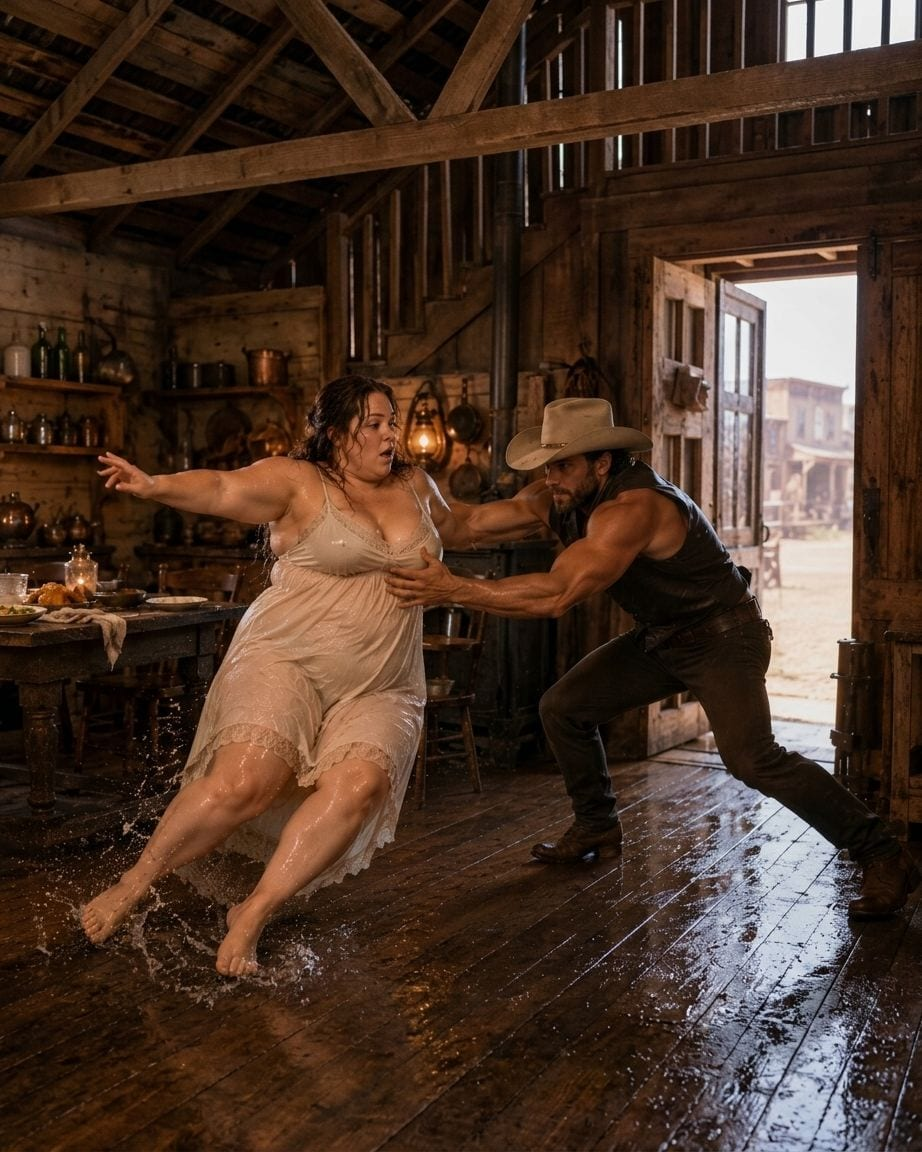
“Take one more step, Sheriff, and I'll cut her throat.”
Thomas Whitcomb stood at the top of the staircase with a knife pressed against Rebecca Callaway's neck.
The elderly woman trembled in his grip.
Blood stained the collar of her gray dress.
Margaret stood at the bottom of the stairs, unable to breathe.
Her mother.
The woman she had mourned for twelve years.
The woman whose voice had haunted her dreams.
She was alive.
And the man who had stolen so much of Margaret's life was threatening to take her away again.
Cole Harland raised his revolver.
“Let her go, Thomas.”
Thomas laughed.
“You really are a remarkable fool, Harland.”
Deputy Pike stood near the front door, his own weapon drawn.
Thomas glanced toward him.
“And you, Deputy. Put that gun away.”
Pike did not move.
The knife pressed harder against Rebecca's throat.
She whimpered.
Margaret stepped forward.
“Thomas.”
He looked at her.
“Ah. There she is.”
His smile was almost affectionate.
“Come upstairs, darling.”
Cole moved between them.
“No.”
Thomas tightened his grip.
Rebecca cried out.
Margaret caught Cole's arm.
“Wait.”
He turned toward her.
She could see the fear in his eyes.
Not for himself.
For her.
For the woman at the top of the stairs.
For the possibility that another person might die inside this house while he stood helplessly below.
Margaret understood what this moment was doing to him.
Eleanor had died upstairs.
Now Thomas had chosen that same room deliberately.
He wanted Cole to remember.
He wanted him frightened.
And he wanted Margaret to believe that obedience was the only way to save someone she loved.
She looked up at her husband.
“What do you want?”
Thomas smiled.
“That's a much better question.”
“Answer it.”
“The documents. Eleanor's witness register. Every copy.”
Margaret shook her head.
“You know I don't have them.”
“Then tell your sheriff to retrieve them.”
Cole's expression hardened.
“Those records are already with the territorial inspector.”
For the first time, Thomas's smile faltered.
Margaret noticed.
So did Cole.
Thomas recovered quickly.
“Then perhaps Inspector Ashford would prefer a quiet arrangement.”
Cole lowered his revolver slightly.
“It's too late for arrangements.”
Thomas stared at him.
Cole continued.
“Joseph Larkin is alive. Sarah Bennett is prepared to testify. Your freight contracts have been recovered. Judge Caldwell and Silas Harland are in custody.”
Thomas's face darkened.
“Lies.”
“And Doctor Voss has agreed to provide his medical records in exchange for consideration at trial.”
That last statement struck Thomas like a blow.
His eyes widened.
“Voss wouldn't dare.”
Cole's voice remained steady.
“He already has.”
Margaret looked toward Rebecca.
Her mother's eyes were fixed on her.
There was fear in them.
But something else too.
Recognition.
And a desperate attempt to communicate.
Rebecca slowly moved her right hand.
Her fingers brushed the railing.
Once.
Twice.
Then she pointed downward.
Margaret followed the movement.
The stair runner had come loose near the upper landing.
Beneath it, she could see the edge of a narrow wooden panel.
Eleanor's house was full of concealed spaces.
Margaret remembered the servants' passage.
The hidden kitchen compartment.
The old construction plans Cole had shown her.
And suddenly she understood.
There was another way upstairs.
“Thomas,” Margaret said, “you've won.”
Cole turned sharply.
But she kept her eyes on her husband.
Thomas smiled.
“Have I?”
“You have my mother.”
“Yes.”
“You have me standing here.”
“Also true.”
She took one careful breath.
“Then you don't need the knife.”
Thomas laughed softly.
“Oh, Margaret. You never did understand how negotiations work.”
She looked down.
The gesture was deliberate.
She had learned long ago that Thomas became careless when he believed someone had surrendered.
“I'll come upstairs,” she whispered.
Cole caught her wrist.
“Margaret.”
She looked at him.
For one brief moment, their eyes met.
She squeezed his hand.
Three times.
The signal they had used at the warehouse when words were too dangerous.
Trust me.
Cole's expression changed.
Only slightly.
But enough.
He released her.
Margaret looked toward Thomas.
“Let my mother come down first.”
Thomas shook his head.
“No.”
“Then let her sit.”
He hesitated.
“She can barely stand.”
Thomas glanced at Rebecca.
The elderly woman's knees were trembling.
He sighed impatiently.
“Very well.”
He pushed her toward the top step.
Rebecca stumbled.
Margaret gasped.
Thomas caught her by the shoulder.
“Careful.”
Cole's revolver rose.
Thomas pressed the knife against Rebecca again.
“Don't.”
Cole froze.
Margaret took another step toward the staircase.
“Thomas, please.”
He looked at her.
For a moment, he seemed almost pleased by the sound of her pleading.
Then he said, “Come to me.”
Margaret placed one foot on the first stair.
Then another.
Cole watched her.
Pike remained motionless near the entrance.
The house was silent except for the ticking clock in the sitting room.
Margaret climbed slowly.
At the fourth step, she stopped.
“Thomas?”
He frowned.
“What now?”
She looked at Rebecca.
Then back at him.
“Did you ever love me?”
The question surprised him.
For a moment, his expression softened.
“Of course.”
Margaret shook her head.
“No.”
His face hardened.
She continued.
“You loved having someone who was afraid to leave.”
Thomas's jaw tightened.
“Margaret—”
“You loved deciding what I could wear. Where I could go. Whom I could speak to.”
He stared.
“You loved making me apologize for things I hadn't done.”
“Enough.”
Margaret climbed another step.
“And when I finally escaped, you couldn't bear the thought that I might be happy without you.”
Thomas's face turned red.
“I said enough!”
He lunged forward.
Exactly as she had hoped.
His grip loosened.
Rebecca dropped.
Not backward.
Sideways.
Toward the railing.
Margaret caught her mother's arm.
At the same instant, Cole shouted.
“Now!”
A narrow panel beside the upper landing burst open.
Daniel Harland emerged from the servants' passage.
He seized Thomas's knife hand.
Thomas screamed.
The blade struck the wooden railing.
Cole charged up the stairs.
Margaret pulled Rebecca down onto the steps.
Thomas struggled wildly.
Daniel's wounded shoulder gave way.
He stumbled.
Thomas twisted free.
Then Cole reached him.
The two men collided against the landing wall.
Thomas raised the knife.
Cole caught his wrist.
For one terrible moment, the blade hovered between them.
Then Cole drove Thomas's hand against the banister.
Once.
Twice.
The knife fell.
It clattered down the stairs.
Pike caught Thomas from behind.
Cole seized his other arm.
Together, they forced him to the floor.
Thomas shouted.
Threatened.
Cursed.
Then the handcuffs clicked shut.
And the house became silent.
Margaret sat on the staircase with her mother in her arms.
Rebecca was crying.
So was Margaret.
For several moments, neither could speak.
Then Rebecca touched her daughter's face.
“My little girl.”
Margaret closed her eyes.
She remembered those hands.
The way they had brushed hair from her forehead when she was sick.
The way they had held hers while teaching her to sew.
The way they had smelled of soap and fresh bread.
“Mother.”
Rebecca began sobbing.
“I tried to find you.”
Margaret pulled back.
“What?”
Rebecca nodded.
“After they took me away, I tried.”
Margaret stared.
“Who took you?”
“Thomas.”
The word came out like a confession.
Rebecca swallowed.
“He found out I had discovered something about his business.”
Margaret felt cold.
“What?”
“Women were disappearing from the boardinghouses near the freight yards. Some were widows. Some were young mothers. They were promised work, then transported under false names.”
Margaret remembered Eleanor's records.
The black crosses.
The forged contracts.
The missing families.
Rebecca continued.
“I wrote to the authorities. Thomas intercepted the letters.”
Her voice broke.
“He told me that if I didn't cooperate, he'd hurt you.”
Margaret closed her eyes.
For twelve years, she had believed her mother had died.
For twelve years, Rebecca had believed silence was the only way to keep her daughter alive.
Margaret held her tighter.
“I'm here now.”
Rebecca nodded against her shoulder.
“I know.”
Margaret kissed her hair.
“And you're never going back to them.”
Cole stood at the bottom of the stairs.
Thomas Whitcomb was being taken toward the front door by Deputy Pike.
His face was bruised.
His coat torn.
But his expression remained arrogant.
He looked toward Margaret.
“You think this is finished?”
She lifted her head.
Thomas smiled coldly.
“I'm still your husband.”
Margaret stood slowly.
Rebecca remained seated beside Daniel.
Cole watched as Margaret descended the stairs.
Thomas straightened.
“That's right. Come here.”
Margaret stopped before him.
For years, those words had been enough to make her obey.
Now she looked at the man who had stolen her freedom.
And felt nothing resembling love.
Only the clear understanding that he had never possessed the right to control her.
“You were my husband,” she said.
Thomas's smile faltered.
“You signed the marriage certificate.”
“Yes.”
“And that makes you mine.”
Margaret shook her head.
“No.”
Her voice was calm.
“Marriage isn't ownership.”
Thomas's expression darkened.
“You'll regret speaking to me this way.”
Margaret stepped closer.
“No, Thomas.”
She looked directly into his eyes.
“I regret the years I spent believing you.”
He stared.
Margaret continued.
“You can threaten me. You can lie about me. You can invent whatever story helps you sleep at night.”
She took a breath.
“But you will never make me afraid of leaving you again.”
Thomas opened his mouth.
Nothing came out.
Pike tightened his grip on the prisoner's arm.
“Time to go.”
Thomas struggled.
Pike pushed him toward the door.
The cold winter air rushed inside.
Then the door closed.
And Thomas Whitcomb was gone from Margaret's home.
For the last time.
Three days later, Territorial Inspector Henry Ashford convened a formal hearing in Harland Creek.
He had arrived with two investigators, a court clerk, and a territorial marshal whose authority did not depend on Judge Caldwell.
The hearing lasted four days.
Witnesses filled the courthouse.
Joseph Larkin testified about the freight company's fraudulent contracts and his imprisonment.
Sarah Bennett described the locked medical facility where she had been forced to impersonate Eleanor Harland.
Rebecca Callaway testified about the women who had disappeared and the false death certificate used to conceal her confinement.
Doctor Voss, facing charges of unlawful detention, falsifying medical records, and conspiracy, surrendered his treatment books and admitted that he had administered dangerous sedatives under orders from Thomas Whitcomb and Silas Harland.
Daniel Harland testified about the forged property documents and his own participation in the freight operation.
He did not ask to be excused.
He did not pretend innocence.
He told the court exactly what he had done.
And exactly what he had failed to do.
Arthur Harland, still weak but recovering, confirmed that his brother had arranged his disappearance eleven years earlier and used forged signatures to control the family estate.
Finally, Cole testified about Eleanor.
He spoke quietly.
He described her warnings.
Her courage.
Her refusal to ignore the suffering of people she had never met.
He told the court about the night she died.
And for the first time, he did not blame himself.
He blamed the men who had chosen to harm her.
Inspector Ashford listened without interruption.
When Cole finished, the courtroom remained silent.
Then Ashford stood.
“The evidence establishes a criminal enterprise that operated under the protection of officials entrusted with enforcing the law.”
He looked toward Thomas, Caldwell, Silas, and Voss.
“Those protections end here.”
The prisoners were transferred to territorial custody under armed escort.
The judge's local orders against Cole and Margaret were set aside pending formal review.
The accusation that Margaret had murdered Joseph Larkin was dismissed.
Joseph himself had testified that he was alive.
No forged confession could survive that truth.
And the investigation into the freight company expanded beyond Harland Creek.
The months that followed brought more difficult work.
The surviving laborers had to be found.
The fraudulent contracts had to be canceled.
Families separated by the freight company had to be reunited.
Some had lost years.
Some had lost homes.
Some had lost people they loved.
No verdict could restore everything.
But the evidence Eleanor had preserved made it possible to begin repairing what could still be repaired.
The territorial court eventually convicted Thomas Whitcomb of conspiracy, unlawful confinement, fraud, and offenses connected to the coercive labor scheme.
Silas Harland was convicted for his leadership of the enterprise, the abduction of Arthur Harland, and his role in Eleanor's death.
Judge Caldwell was convicted of corruption, obstruction of justice, and conspiracy.
Doctor Voss was convicted for his part in the unlawful confinement and abuse of patients.
All four received lengthy prison sentences.
Daniel faced the consequences of his own earlier actions.
Because he had participated in the financial fraud, he was not simply forgiven by the court.
His testimony, his cooperation in recovering the evidence, and his efforts to save the witnesses were considered at sentencing.
He received a lesser sentence involving supervised service and restitution.
He accepted it without complaint.
When Cole visited him afterward, Daniel stood awkwardly beside the courthouse steps.
“I don't deserve your forgiveness,” he said.
Cole studied his brother.
“No.”
Daniel lowered his eyes.
Cole continued.
“But I don't intend to spend the rest of my life hating you.”
Daniel looked up.
His eyes filled with tears.
Cole held out his hand.
Daniel took it.
For a moment, they stood together in silence.
Then Cole pulled his brother into an embrace.
And Daniel began to cry.
Margaret's marriage was formally annulled after the court established that Thomas had procured her consent through fraud and coercion and had used falsified documents throughout their marriage.
The decision did not erase the years she had lost.
But it restored something Thomas had spent years trying to take from her.
Her right to decide what happened next.
She walked out of the courthouse holding the certified papers.
Cole waited beside the steps.
He wore his sheriff's badge again.
The territorial review had confirmed that Caldwell's attempted removal had been unlawful.
Cole had been reinstated.
Yet when Margaret approached, he did not look at the badge.
He looked at her face.
“Well?” he asked.
Margaret held up the papers.
“I'm free.”
Cole smiled.
A slow, beautiful smile.
“Then I suppose congratulations are in order.”
She laughed.
“Yes, Sheriff. I believe they are.”
He stepped closer.
“Margaret?”
“Yes?”
He took her hand.
“Would you walk with me?”
She smiled.
“Anywhere.”
They walked through Harland Creek beneath a bright spring sky.
The snow had begun melting along the rooftops.
Water ran through the gutters.
The streets were muddy.
Children shouted near the schoolhouse.
And the town that had once treated Margaret like a scandal now greeted her by name.
Mr. Alderman waved from the dry-goods store.
Walt Greer called from the newspaper office.
Clara Whitmore stood outside the church carrying a basket of flowers.
When she saw Margaret, she approached.
“Miss Callaway.”
Margaret smiled politely.
“Mrs. Whitmore.”
Clara hesitated.
Then held out the basket.
“For your mother.”
Margaret looked surprised.
Clara's eyes filled with tears.
“I know flowers don't undo what I said.”
“No,” Margaret answered gently. “They don't.”
Clara nodded.
“But I'd like to do better.”
Margaret studied her.
Then accepted the basket.
“Then do better.”
Clara smiled through tears.
“I will.”
Margaret continued walking beside Cole.
After a moment, he glanced toward her.
“You've become rather popular.”
She raised an eyebrow.
“I thought you preferred a quiet house.”
“I did.”
“And now?”
Cole smiled.
“Now I find I prefer a lively one.”
Margaret laughed.
He squeezed her hand.
Rebecca Callaway recovered slowly.
Doctor Bellamy supervised her treatment while she regained strength after years of sedation and confinement.
Some days were difficult.
Some memories returned painfully.
But she was safe.
She spent her mornings helping Margaret in the kitchen.
She taught Anna Bell an old bread recipe.
She told Lucy Bennett stories beside the fire.
And she sat at the table where Cole had once eaten alone.
Sarah and Lucy eventually settled in a small cottage near the schoolhouse, supported by restitution funds and help from the town.
Joseph Larkin reunited with Rebecca, his daughter, after years of separation. Together they began rebuilding a life that had been interrupted but not destroyed.
Arthur Harland moved into the family house.
At first, Cole worried that the memories would be too painful.
But his father insisted.
“I spent eleven years dreaming of this place.”
He stood in the kitchen one morning, looking at the repaired windows and freshly painted walls.
“I'd like to spend whatever years I have left living in it.”
Cole nodded.
“Then you will.”
Daniel returned after completing the terms of his sentence.
He did not expect a celebration.
But when he stepped through the front door, Arthur was waiting.
So was Cole.
So was Margaret.
There was an empty chair at the table.
And a plate waiting beside it.
Daniel stared.
Then he sat down.
No one pretended the past had disappeared.
But no one told him he had to face the future alone.
One evening in early May, Cole found Margaret upstairs in Eleanor's room.
The curtains were open.
Sunlight spilled across the floor.
Fresh flowers stood beside the bed.
The old trunk had been restored.
Eleanor's journals were arranged neatly on the desk.
Margaret stood beside the window, holding a small framed photograph.
Cole stopped in the doorway.
“Everything all right?”
She turned.
“Yes.”
He entered.
For a moment, he looked around.
He had avoided this room for more than two years.
Now it no longer felt like a place where life had ended.
It felt like a place where someone remarkable had once lived.
Margaret held out the photograph.
Eleanor stood beside Arthur and Daniel, laughing at something outside the frame.
Cole took it.
He smiled sadly.
“She hated having her picture taken.”
Margaret laughed softly.
“Then why does she look so happy?”
“Because Daniel had just fallen into the horse trough.”
Margaret laughed harder.
Cole smiled.
Then his expression grew thoughtful.
“I wish she'd met you.”
Margaret looked at him.
“She did, in a way.”
Cole frowned.
Margaret gestured toward the journals.
“Through everything she left behind.”
He nodded slowly.
Margaret stepped closer.
“She knew you were a good man, Cole.”
His eyes filled with tears.
“She knew you would help someone who needed it.”
He looked down.
Margaret touched his cheek.
“And she was right.”
Cole closed his eyes.
For years, he had believed that Eleanor's death was proof of his failure.
Now he understood something different.
His sister had trusted him.
Not because he was perfect.
Not because he could prevent every tragedy.
But because she knew he would keep trying to do what was right.
He opened his eyes.
“Thank you.”
Margaret smiled.
“For what?”
“For coming to my door that day.”
She laughed softly.
“You were rather unfriendly.”
“I was.”
“And the house was filthy.”
“It was.”
“And you looked as though you hadn't eaten a proper meal in six months.”
Cole smiled.
“Probably hadn't.”
Margaret shook her head.
“Terrible employer.”
He took her hand.
“Would you consider giving me another chance?”
She looked at him.
“What kind of chance?”
Cole reached into his coat.
Margaret stopped breathing.
He withdrew a small velvet box.
Her eyes widened.
“Cole.”
He opened it.
Inside lay a simple gold ring.
No enormous stone.
No extravagant decoration.
Just a delicate band engraved with tiny leaves.
Cole looked at her.
“I know you've spent years being told what your life should be.”
Margaret's eyes filled with tears.
“I know you've had promises used against you.”
He swallowed.
“And I know I can't promise that nothing difficult will ever happen again.”
She smiled through tears.
Cole continued.
“But I can promise you this.”
He took her hand.
“I will never ask you to make yourself smaller so I can feel important.”
Margaret began crying.
“I will never use fear to keep you beside me.”
His voice trembled.
“And when life becomes difficult, I will stand with you. Not above you. Not in front of you. Beside you.”
He lowered himself onto one knee.
“Margaret Callaway, would you marry me?”
She laughed through her tears.
“Cole Harland, you're going to ruin your good shoulder.”
He smiled.
“Probably.”
She knelt beside him.
Then wrapped her arms around his neck.
“Yes.”
Cole froze.
Margaret kissed him.
“Yes, I'll marry you.”
He laughed.
A full, joyful laugh.
Then he slipped the ring onto her finger.
And held her as though he had finally found the place he belonged.
They married in June.
The ceremony took place in the small church at the center of Harland Creek.
Rebecca walked Margaret down the aisle.
Arthur stood beside Cole.
Daniel served as his brother's witness.
Walt Greer wore a suit that was slightly too tight.
Deputy Pike tried unsuccessfully to hide his tears.
Sarah Bennett sat beside Lucy in the front pew.
Clara Whitmore had helped arrange the flowers.
And Doctor Bellamy smiled throughout the ceremony.
Margaret wore a simple cream-colored dress.
It had been made by hand.
Rebecca had sewn the sleeves.
Anna had embroidered the collar.
And Margaret had stitched the final hem herself.
When she entered the church, Cole forgot to breathe.
She looked beautiful.
Not because she had changed her shape.
Not because she had become someone different.
But because she stood before him completely herself.
Strong.
Warm.
Unashamed.
Her copper-red hair was pinned beneath a small veil.
Her green eyes shone with happiness.
And when she reached him, she smiled.
“Hello, Sheriff.”
Cole laughed softly.
“Hello, Margaret.”
The minister began.
Their vows were simple.
They promised honesty.
Kindness.
Faithfulness.
And the courage to face difficult days together.
When Cole placed the ring on her finger, his hand trembled.
Margaret squeezed it.
When the minister pronounced them husband and wife, Cole kissed her.
The church erupted in applause.
Outside, bells rang.
Children scattered flower petals.
Walt shouted that the entire town expected a celebration.
And Margaret laughed so hard that she had to hold Cole's arm to steady herself.
That evening, the Harland house was filled with people.
Music drifted through the open windows.
The kitchen smelled of roasted chicken, fresh bread, and apple pie.
Arthur sat near the fireplace telling stories about Cole's childhood.
Daniel helped Walt move tables into the yard.
Rebecca danced with Lucy.
Anna carried plates of cake.
And Cole stood in the doorway watching his wife.
Margaret noticed him.
She crossed the room.
“Something wrong?”
He shook his head.
“Nothing.”
She studied him.
“You look thoughtful.”
Cole smiled.
“I was remembering the first night you arrived.”
Margaret laughed.
“The snowstorm?”
“Yes.”
“The terrible kitchen?”
“Yes.”
“The sheriff who acted as though smiling might violate some important law?”
Cole chuckled.
“That sounds like him.”
She stepped closer.
“And now?”
He looked around.
At the crowded table.
The open windows.
The laughter.
His father.
His brother.
The woman he loved.
Then he looked at Margaret.
“Now I think I've finally come home.”
Her eyes softened.
She took his hand.
“Good.”
Cole smiled.
“Good?”
“Yes.”
She leaned closer.
“Because I intend to keep you here.”
He laughed.
Then kissed her.
Later, when the guests had gone and the house had grown quiet, Margaret and Cole sat together at the kitchen table.
Two cups of tea rested between them.
A candle burned beside the window.
Outside, the last traces of winter had disappeared from the hills.
The garden was beginning to bloom.
Margaret looked toward the staircase.
Eleanor's room stood open.
The house no longer held its breath around a locked door.
She turned toward Cole.
“Do you miss the quiet?”
He looked at her.
“Not even a little.”
Margaret smiled.
“Good. Because Mother says she's teaching Lucy to make biscuits tomorrow.”
Cole groaned playfully.
“And Daniel promised to repair the barn roof.”
“That sounds dangerous.”
“Extremely.”
She laughed.
Cole reached across the table and took her hand.
For a moment, he studied the wedding ring on her finger.
Then he looked into her eyes.
“Are you happy?”
Margaret considered the question.
She thought about the woman who had arrived in Harland Creek carrying a worn suitcase and a desperate hope for work.
A woman who had learned to survive by being careful.
By speaking softly.
By expecting disappointment.
She thought about the cold house.
The silent sheriff.
The empty chair.
And the first evening when Cole had invited her to sit at his table.
She smiled.
“Yes.”
Cole squeezed her hand.
“Good.”
Margaret leaned closer.
“But there's one thing I want you to understand.”
He raised an eyebrow.
“What's that?”
She looked around the kitchen.
At the polished stove.
The clean windows.
The flowers.
The home they had rebuilt together.
Then she looked at him.
“I didn't come here looking for someone to save me.”
Cole smiled.
“I know.”
“I came because I needed work.”
“I remember.”
“And because I wanted a chance to begin again.”
He nodded.
Margaret's eyes filled with happy tears.
“But somehow, while I was helping you put this house back together, I found something I hadn't expected.”
Cole leaned closer.
“What?”
She touched his cheek.
“A life I don't have to run from.”
Cole kissed her hand.
Then he stood and held out his arm.
“Mrs. Harland?”
Margaret smiled.
“Yes, Sheriff?”
“Would you care to dance?”
She glanced around the quiet kitchen.
“There's no music.”
Cole smiled.
“Then we'll make our own.”
He drew her gently into his arms.
They moved slowly across the wooden floor.
Outside, a warm breeze stirred the curtains.
The candle flickered.
And the old house, once filled with silence and grief, held the soft sound of two people laughing together.
Margaret rested her head against Cole's chest.
He kissed her hair.
Neither needed to speak.
The past had been faced.
The truth had been told.
The guilty had been brought to justice.
Their families were safe.
And the future belonged to them.
When the candle finally burned low, Cole took Margaret's hand and led her upstairs.
The bedroom door closed gently behind them.
Not to hide fear.
Not to keep anyone prisoner.
But because, at last, they had a life that was entirely their own.
And in the house where winter had once seemed endless, love had finally brought spring.






Comments 0