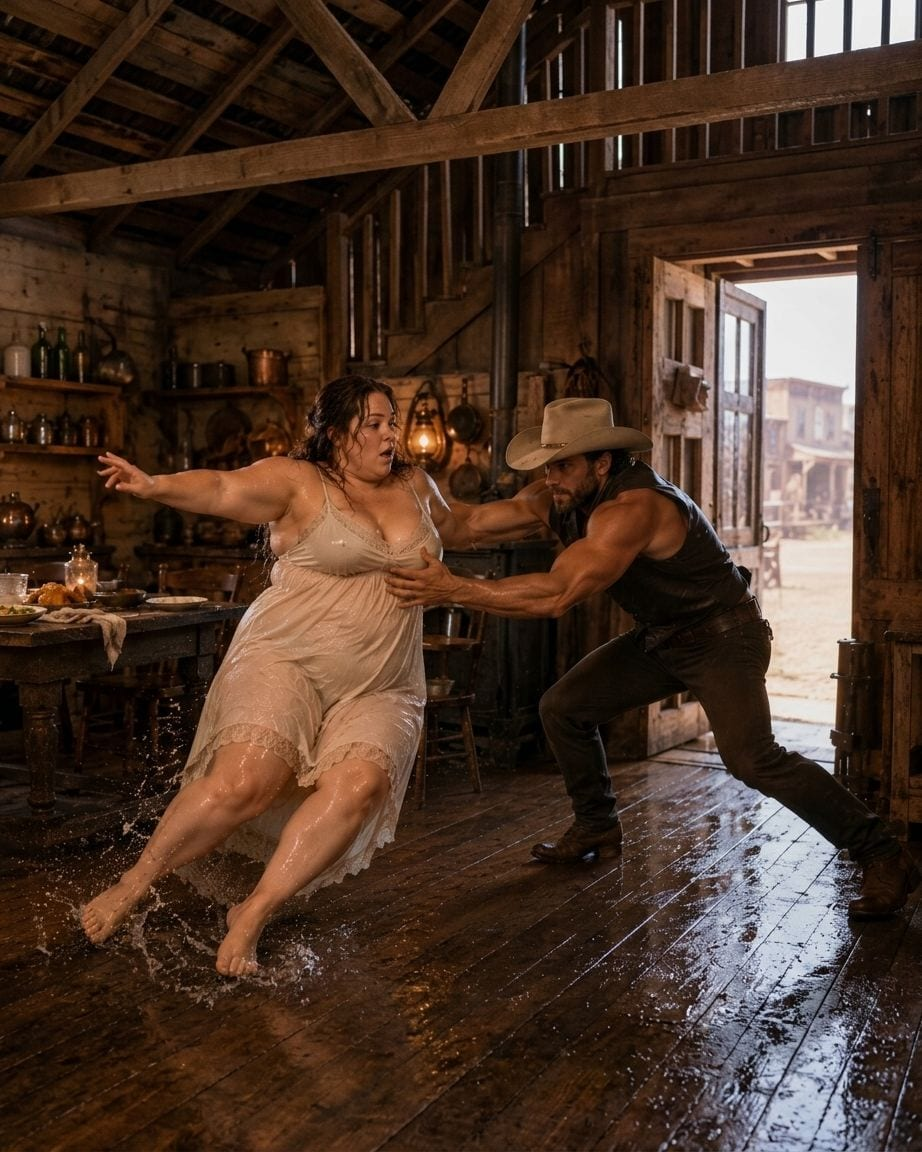
Margaret Callaway slammed a newspaper onto the sheriff's desk.
"You wrote efficient. Not invisible."
Sheriff Cole Harland looked down at the advertisement circled in black ink.
Beneath the printed words, someone had written a single sentence.
I will not disappear for another man's comfort.
Cole realized this was no ordinary job interview.
The coffee in his cup trembled, spilling a dark crescent across the edge of his desk.
For several seconds, neither of them moved.
Cole Harland had faced armed cattle thieves, drunken miners, and men who considered a sheriff's badge an invitation to violence. He had once stood in the middle of Main Street while a furious rancher aimed a shotgun at his chest.
But the woman standing in his doorway had accomplished something none of those men had managed.
She had left him without a single useful word.
"Are you going to say something, Sheriff?" she asked.
Cole slowly placed his pen beside the complaint he had been reading.
"Depends on what you're expecting me to say."
"I'm expecting you to tell me whether the position is still available."
His eyes returned to the newspaper.
"Most people begin by introducing themselves."
"Most employers begin by looking at the person who's speaking to them."
That almost made him smile.
Almost.
Instead, he leaned back in his chair and studied her.
She was a large woman, broad through the shoulders and solidly built, with the kind of strength that came from years of practical work rather than fashionable exercise. Her dark green wool dress had been carefully mended at the cuffs. A gray shawl covered her shoulders, and snow had melted into tiny droplets along its edges.
Copper-red hair was gathered into a practical braid pinned at the back of her head.
Her boots were worn.
Her traveling bag was smaller than he expected.
And her green eyes held absolutely no apology.
"Name?" he asked.
"Margaret Callaway."
"Where are you from?"
"Several places."
"That isn't much of an answer."
"It's the answer I've got."
Cole folded his hands.
"How old are you, Mrs. Callaway?"
"Forty-one. And it's Miss Callaway."
Something in her tone made him recognize the distinction was important.
He nodded.
"All right, Miss Callaway. Have you kept house before?"
"I've cooked for railroad crews, cleaned rooms in boardinghouses, managed supplies for a family of nine, and worked through winters that would make this one look like spring."
She paused.
"I can mend clothes, repair a broken hinge, stretch a sack of flour, and keep a stove burning when the wood is damp."
Cole watched her.
"Anything you can't do?"
"Make a foolish man wise."
The silence that followed was so complete he could hear the clock ticking above the filing cabinet.
Then Margaret added, "But I can usually keep him fed."
Cole looked down before the smile could reach his face.
He had written the advertisement three days earlier.
It had seemed like a simple solution to a practical problem.
His house was falling apart.
Not dramatically.
Not in the way houses collapsed during storms or burned to the ground.
It was falling apart slowly, through neglect.
A loose porch board.
A leaking window.
A stove that needed cleaning.
A pantry filled with food he rarely bothered to cook.
For two winters, he had convinced himself that none of it mattered.
He had survived worse.
A man could live with dust.
A man could eat cold beans.
A man could sleep in his coat when the fire went out.
What he could not easily survive, though he had never admitted it aloud, was returning every evening to a house so quiet that his own footsteps sounded like those of a stranger.
The advertisement had been Walt Greer's idea.
"You need someone in that house, Cole," the newspaper editor had told him.
"I need someone to clean it."
Walt had looked at him over his spectacles.
"That's what I said."
Cole had ignored the implication.
He was good at ignoring implications.
Especially when they concerned his private life.
Now, sitting across from Margaret Callaway, he began to suspect that Walt Greer had been laughing at him for three days.
"The arrangement is for winter only," Cole said.
"I read that."
"Four months. Possibly five."
"I know how long winter lasts."
"Room and board. No wages until spring."
Her expression did not change.
"That was in the advertisement."
"The house isn't particularly comfortable."
"I didn't come looking for a hotel."
"I work long hours."
"Then you'll appreciate having supper ready when you return."
"I prefer quiet."
Margaret considered him.
Then she said, "So do I, Sheriff. But quiet and being ignored are two different things."
The words landed more heavily than he expected.
He looked at her for another moment.
Then he stood.
"Get your bag."
She picked it up immediately.
"Does that mean I have the position?"
"It means I'm showing you the house."
"Fair enough."
She turned toward the door.
Cole reached for his hat.
And for reasons he couldn't explain, he felt as though he had just agreed to something much larger than hiring a housekeeper.
Harland Creek had a population of fewer than nine hundred people, and almost all of them considered themselves entitled to know everyone else's business.
By the time Cole and Margaret crossed Main Street, three shopkeepers had stopped working to watch them.
Two women outside the post office whispered behind gloved hands.
A man standing beside the blacksmith's shop tipped his hat toward Cole, then looked Margaret up and down with poorly concealed curiosity.
Margaret continued walking.
She neither hurried nor lowered her head.
Cole noticed.
"You'll attract attention," he said.
"I seem to have managed that without trying."
"People here talk."
"People everywhere talk."
"Some of them can be unkind."
She glanced at him.
"Are you warning me, Sheriff?"
"I'm explaining the town."
"Then let me explain something in return."
He waited.
"I've spent twenty years earning my living in places where people believed a woman should be grateful simply because someone allowed her through the door."
Her voice remained even.
"I learned a long time ago that gratitude and obedience aren't the same thing."
Cole said nothing.
Margaret looked ahead.
"And I don't intend to confuse them now."
They continued walking.
He found himself watching her from the corner of his eye.
Most strangers arriving in Harland Creek behaved in one of two ways.
They either tried too hard to impress the town, or they acted as though the town was beneath them.
Margaret did neither.
She seemed perfectly willing to let Harland Creek form whatever opinions it pleased.
He wondered what kind of life taught a person to stand so firmly in her own skin.
He also wondered why she carried everything she owned in a single bag.
He did not ask.
Not yet.
The Harland house stood at the northern end of town, beyond the last cluster of shops.
It was a two-story wooden house with a broad porch, a steep roof, and shutters that had once been painted blue.
The paint had faded.
One shutter hung crooked.
A porch step dipped noticeably toward the left.
Cole stopped at the gate.
"There it is."
Margaret studied the house.
He waited for the inevitable expression.
Disappointment.
Concern.
Perhaps regret.
Instead, she said, "That porch step will break someone's ankle."
Cole looked down.
"It's been that way awhile."
"That doesn't improve it."
He opened the gate.
She followed him up the path.
At the front door, he hesitated.
He had not invited anyone inside the house in months.
There were reasons for that.
Reasons he had spent considerable effort refusing to examine.
He unlocked the door.
"After you."
Margaret stepped inside.
The front room smelled of old wood, cold ashes, and furniture that had gone too long without being moved.
A stack of newspapers leaned against an armchair.
A faded blanket lay across the sofa.
Two pairs of boots stood near the fireplace.
On the mantel sat a brass clock that had stopped at twenty minutes past six.
Margaret looked around.
She did not sigh.
She did not criticize.
She simply observed.
Then she asked, "Where's the kitchen?"
Cole pointed toward the back.
She walked there without another word.
He followed.
The kitchen was worse.
A pan sat in the sink.
The stove was cold.
A sack of flour stood open beside the pantry.
Three empty coffee tins occupied the counter.
Margaret opened a cupboard.
Then another.
Then the pantry.
She checked the flour, counted the remaining potatoes, examined the salt pork, and lifted the lid of the wood box.
Cole watched with increasing discomfort.
He had expected a few polite questions.
Instead, she was inspecting his life.
"You've got enough flour for a week," she said.
"Probably."
"Enough coffee for three days."
"I can buy more."
"Not much firewood."
"I know."
"And that stove needs cleaning."
"I know that too."
She turned toward him.
"Then we're off to a promising start."
Cole frowned.
"How do you figure?"
"You know what's wrong. I know how to fix it."
For a moment, he simply stared at her.
Then something unfamiliar moved in his chest.
Not quite amusement.
Not quite relief.
Something between the two.
Margaret removed her shawl.
"Where will I sleep?"
"Upstairs. Second room on the right."
"Does the door lock?"
"Yes."
"From the inside?"
He looked at her.
"Of course."
She held his gaze for a second longer.
Then she nodded.
"Good."
There was something in that single word.
Something heavier than ordinary satisfaction.
Cole recognized it immediately.
He had heard similar tones from witnesses who had survived things they did not want to describe.
He wanted to ask.
Instead, he said, "I'll show you."
The room upstairs was small but clean enough.
A narrow bed stood beneath the window.
There was a washstand, a wooden wardrobe, and a chair with a cracked seat.
Margaret placed her bag on the bed.
She crossed to the window and checked the latch.
Then she examined the lock on the door.
Cole pretended not to notice.
"There's another blanket in the wardrobe," he said.
"Thank you."
"If you need anything—"
"I'll tell you."
He nodded.
Then he stood awkwardly in the doorway.
Margaret turned toward him.
"Was there something else, Sheriff?"
He almost said no.
Instead, he asked, "Why Harland Creek?"
She became very still.
Not frightened.
Not visibly upset.
Simply still.
"I needed work."
"There are bigger towns."
"Yes."
"More opportunities."
"Probably."
"Then why here?"
Margaret looked toward the window.
Beyond the glass, the rooftops of Harland Creek disappeared beneath a pale winter sky.
"Because nobody here knew my name."
Cole waited.
She turned back.
"And I'd like to keep it that way for a little while."
He studied her.
There was no invitation to ask another question.
So he didn't.
"All right," he said.
He stepped away.
Behind him, Margaret quietly closed the door.
A moment later, he heard the lock turn.
Cole stood in the hallway longer than necessary.
Then he went downstairs.
By supper, the kitchen smelled like a place where people actually lived.
Cole had forgotten that a house could smell that way.
Onions simmered in a heavy iron pot.
Fresh biscuits rested beneath a clean cloth.
The stove burned steadily.
The counter had been cleared.
The flour was stored in a sealed tin.
Even the old clock on the mantel had been wound.
He stood in the doorway, watching Margaret move between the stove and the table.
"You did all this today?"
She glanced over her shoulder.
"I had several hours."
"You didn't have to do everything at once."
"I didn't."
He looked around.
It certainly seemed like everything.
She placed a bowl of stew on the table.
"Sit down before it gets cold."
Cole remained standing.
Margaret looked at him.
"Is something wrong?"
He cleared his throat.
"You're giving orders in my kitchen."
She considered that.
Then she looked at the steaming bowl.
"Would you prefer the stew cold?"
He sat.
She placed the biscuits beside him.
He took a bite.
Then another.
The food was simple.
Beef, potatoes, onions, and carrots.
Nothing extravagant.
But it was warm.
Seasoned properly.
Made with care.
He realized he had not eaten a meal like it in months.
Margaret stood at the counter with her own bowl.
Cole noticed.
"There's another chair."
"I can see that."
"Then why aren't you using it?"
She paused.
"Some employers prefer their help to eat separately."
The words made him uncomfortable.
He looked at the empty chair across from him.
Then he pulled it away from the table with his foot.
"Not in this house."
Margaret watched him.
For the first time since entering his office, something softened slightly around her eyes.
Not a smile.
Something quieter.
She carried her bowl to the table.
"All right, Sheriff."
They ate without speaking.
Outside, the wind pressed against the windows.
Inside, the stove crackled.
Cole looked at the woman sitting across from him.
He had expected an employee.
He had expected practical assistance.
He had expected to continue living exactly as before, only with cleaner floors and better food.
Instead, he found himself wondering when the last time had been that someone had sat across from him at this table.
He knew the answer.
Two years.
Three months.
Eleven days.
He hated that he knew it so precisely.
After supper, Margaret washed the dishes while Cole reviewed reports from the office.
He was halfway through a complaint about missing livestock when she spoke.
"Who used to live here?"
His pen stopped.
He did not look up.
"What?"
"This house. Someone lived here with you."
Cole's shoulders tightened.
"Why do you say that?"
"Two sets of dishes in the cupboard. A woman's sewing basket in the sitting room. A second coat hook by the door."
He said nothing.
Margaret dried a plate.
"And the chair across from yours has been polished smooth from use."
Cole slowly closed the report.
"You're observant."
"It's useful in my line of work."
"Some things aren't your concern."
She placed the plate in the cupboard.
"Then I won't ask again."
The simplicity of her response surprised him.
He had expected an apology.
Or an argument.
Instead, she accepted the boundary without surrendering her dignity.
Cole stared at the closed report.
After a long moment, he said, "My sister lived here."
Margaret turned.
He kept his eyes on the table.
"Her name was Eleanor."
The stove crackled.
"She died two winters ago."
Margaret remained silent.
Cole swallowed.
"Fever."
He had not spoken her name aloud in months.
It felt strange.
Like opening a door in a room he had kept locked for years.
Margaret quietly set down the dishcloth.
"I'm sorry."
He nodded once.
"She was twenty-nine."
There was nothing useful to say after that.
He expected Margaret to offer some familiar comfort.
That Eleanor was in a better place.
That time healed everything.
That God had a reason.
People had said all those things after the funeral.
None of them had helped.
But Margaret said something else.
"She must have been loved."
Cole looked up.
Margaret stood beside the sink.
Her expression was serious.
Gentle without pity.
He felt his throat tighten.
"She was."
Margaret nodded.
Then she returned to washing the dishes.
And somehow, that was easier to bear than any consolation he had received in two years.
Later that night, Cole sat alone in the front room.
Margaret had gone upstairs.
The house was quiet.
But it was a different kind of quiet.
The stove was warm.
The dishes were clean.
A lamp burned beside his chair.
Someone else was sleeping beneath the same roof.
He stared at the brass clock on the mantel.
Its hands were moving again.
Tick.
Tick.
Tick.
He remembered Eleanor standing on a chair, trying to wind that very clock while he warned her she would fall.
She had laughed.
"You can't arrest gravity, Cole."
He had told her to get down.
She had stuck out her tongue.
Then she had fallen anyway.
He had caught her.
For a moment, the memory was so vivid that he almost turned toward the kitchen to tell her about it.
Then he remembered.
The room seemed to tilt.
Cole closed his eyes.
He had spent two years avoiding memories because they always ended in the same place.
An empty bedroom.
A doctor shaking his head.
A grave beneath frozen earth.
He pressed his fingers against his forehead.
Upstairs, a floorboard creaked.
Margaret was moving around her room.
Cole listened until the sound stopped.
Then he looked at the clock again.
It was still ticking.
The following morning, Margaret woke before sunrise.
She had slept poorly.
Not because the bed was uncomfortable.
Not because the house was cold.
But because safety was a difficult thing to trust when a person had spent too long without it.
She sat on the edge of the bed, listening.
No footsteps outside her door.
No angry voices.
No drunken laughter.
No demands.
Only the wind.
She looked at her traveling bag.
Inside were two spare dresses, a small sewing kit, a worn Bible, and an envelope tied with faded blue ribbon.
She took out the envelope.
For a long moment, she held it between her hands.
The paper had been opened so many times that its folds were beginning to split.
She knew every word inside.
She wished she didn't.
At last, she returned it to the bag.
Then she dressed and went downstairs.
By six o'clock, the stove was burning.
By six-thirty, biscuits were in the oven.
By seven, coffee was ready.
Cole appeared in the kitchen at seven-fifteen.
His hair was still damp from washing.
His vest hung open.
He stopped when he saw the table.
"You're up early."
"So are you."
"I have work."
"So do I."
He sat.
Margaret poured his coffee.
He watched her move around the kitchen.
There was nothing timid about her.
Nothing uncertain.
Yet she had not disturbed the arrangement of his things.
She had cleaned around his habits rather than trying to replace them.
He appreciated that more than he knew how to express.
"Miss Callaway."
She turned.
"Yes?"
"About last night."
She waited.
He looked at his coffee.
"I don't usually discuss Eleanor."
"I gathered that."
"I'd prefer it stayed between us."
"Of course."
He nodded.
Then, after a pause, he added, "Thank you."
Margaret looked at him.
"For what?"
"For not making a fuss."
Her expression softened.
"Grief isn't a performance, Sheriff."
He stared at her.
She turned back toward the stove.
And once again, Cole Harland found himself without words.
By noon, Margaret had discovered three things.
The kitchen window leaked cold air.
The pantry shelves needed repairing.
And someone had deliberately removed a small brass nameplate from the upstairs bedroom door.
The marks remained in the wood.
Two tiny holes.
A rectangular patch of lighter varnish.
She stood in the hallway, studying them.
Eleanor's room.
She knew it without asking.
Cole had not mentioned which bedroom belonged to his sister.
But the house had told her.
The room across from hers remained closed.
Dust gathered along its threshold.
The doorknob was polished from use long ago, but untouched recently.
Margaret approached it.
She did not reach for the handle.
Instead, she looked at the floor.
A thin line of fresh scratches marked the boards beneath the door.
She frowned.
Fresh scratches.
Not old ones.
Someone had moved something heavy inside that room recently.
She bent closer.
A small piece of dark blue thread had caught on a splinter near the threshold.
Margaret touched it.
The color made her stomach tighten.
She knew that shade of blue.
She had seen it before.
On a coat.
A man's coat.
A man she had hoped never to see again.
She straightened slowly.
For several seconds, she stood motionless in the hallway.
Then she heard the front door open downstairs.
"Miss Callaway?"
Cole's voice.
She quickly stepped away from Eleanor's door.
"Upstairs, Sheriff."
"Someone's here to see you."
Margaret froze.
Her fingers tightened around the piece of blue thread.
"To see me?"
"That's what he says."
The house became terribly quiet.
Then Cole called again.
"Margaret, he says he knows you from before you came to Harland Creek."
She moved toward the staircase.
At the bottom stood Sheriff Cole Harland.
Beside him was a tall stranger wearing a dark blue winter coat.
The stranger slowly removed his hat.
He looked up at Margaret.
And said the one name she had spent three years trying to bury.
"Mrs. Whitcomb."






Comments 0