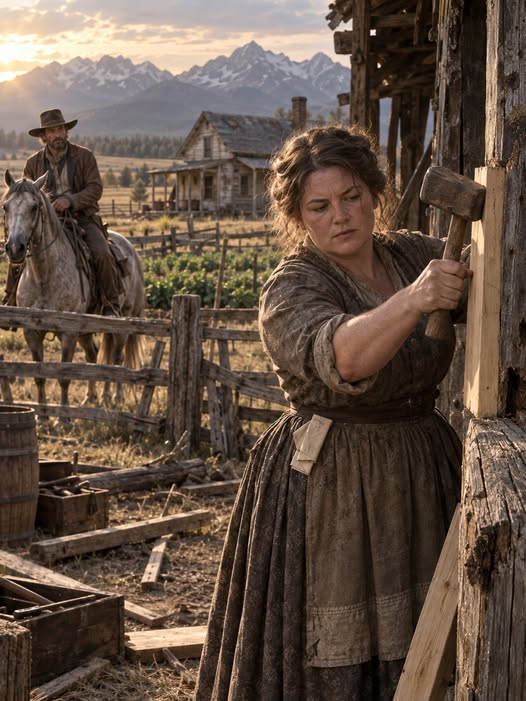
Robert Ames stood outside Eleanor Whitmore's barn holding a document that supposedly proved she did not own the ground beneath her feet.
Eleanor looked at the paper.
Then she looked at him.
"Would you care to explain what you're talking about?"
Robert smiled.
It was the same smile she remembered from their last meeting. Polite enough to impress strangers, confident enough to make the person standing opposite him feel as though they had already lost an argument.
"Certainly. That's why I've come."
Benjamin Carter remained beside Eleanor.
He had not moved toward Robert, but his expression had become noticeably colder.
The second man, who had climbed out of the carriage carrying a leather document case, stepped forward.
He was older, perhaps fifty, with narrow shoulders, a pointed nose, and small spectacles balanced low on his face.
Robert introduced him.
"This is Mr. Silas Whitcomb, a legal representative handling several property matters in Willow Creek."
Eleanor glanced at the document case.
"Several property matters?"
"Among other things," Silas answered.
Robert unfolded the paper.
"The Harker property has an unresolved ownership issue. Your brother purchased the deed from a party whose title may have been defective."
Eleanor looked at him carefully.
"My brother did not purchase this property. He transferred it to me."
"Yes, and that is precisely the problem."
"What problem?"
Robert turned toward Silas.
The older man adjusted his spectacles.
"Miss Whitmore, there appears to have been a prior claim against the southern portion of this property. Depending on the validity of the original transfer, the deed issued to your brother may not convey complete ownership."
Eleanor glanced toward the fields.
Sixty acres.
Her sixty acres.
The farmhouse.
The garden.
The barn she had spent weeks repairing.
She looked back at Robert.
"How long have you known about this?"
Robert folded the document.
"Long enough to understand the situation."
"That isn't an answer."
His smile weakened.
Benjamin finally spoke.
"Show us the original record."
Silas looked toward him.
"Mr. Carter, this is a private legal matter."
"Then it shouldn't trouble you to show the document."
Robert's eyes narrowed.
"Benjamin, I don't believe your involvement is necessary."
"Neither do I. But I'm standing here."
Eleanor almost looked at him.
She stopped herself.
She would not allow Robert to turn this into a conversation between two men while she stood silently beside them.
"This property is in my name," she said. "If there is a problem with the title, I want to see the actual record."
Silas opened his leather case.
He removed several folded papers.
"The county records indicate that the Harker family entered into a financial agreement involving the southern acreage some years ago. The agreement was not properly resolved before the property changed hands."
Eleanor took the paper.
She examined the writing.
There were several names.
A date.
A description of the land.
And a signature that appeared to belong to someone named Samuel Harker.
She read it twice.
"Where is the original?"
Silas cleared his throat.
"This is a certified copy."
"Then where is the original?"
"That is not presently relevant."
"It is relevant to me."
Robert stepped forward.
"Eleanor, you are making this unnecessarily difficult."
She looked at him.
"You're standing on my property telling me I might not own it. I believe difficult is an appropriate response."
Benjamin lowered his head slightly.
Eleanor suspected he was hiding a smile.
Robert did not appreciate the answer.
He glanced at the barn.
"Perhaps we should discuss this somewhere more comfortable."
"No."
"Excuse me?"
"We can discuss it here."
Robert stared at her.
For a moment, his expression suggested he had forgotten that she was capable of refusing him.
Then he recovered.
"Very well. I came because I may be able to offer you a practical solution."
Eleanor folded her arms.
"What solution?"
"Sell the property."
Silence.
She looked at the land.
Then back at him.
"To whom?"
"An interested party."
"Who?"
Robert avoided answering.
"Someone with the resources to resolve the outstanding claim and restore the property."
Eleanor's eyes narrowed.
"Someone who already knows about the claim."
"Of course."
"And wants to purchase the land before the matter becomes public."
Robert's expression hardened.
"That is an unnecessarily suspicious interpretation."
"Is it inaccurate?"
Silas intervened.
"Miss Whitmore, there is no need to make accusations. A sale would protect you from potentially expensive litigation."
Eleanor handed the paper back.
"I'll consider it after I see the original records."
Robert sighed.
"You're making a mistake."
"That is my decision."
He looked at Benjamin.
"Perhaps you can explain to her that this is not a sensible way to handle a legal matter."
Benjamin did not move.
"She's handling it."
Robert's jaw tightened.
He turned toward his carriage.
"Very well. I'll give you until Monday."
"Monday for what?"
"To decide whether you wish to sell."
Eleanor looked at him.
"And if I don't?"
Robert put on his hat.
"Then other arrangements may become necessary."
He climbed into the carriage.
Silas followed.
Before the driver moved, Robert looked through the open window.
"One more thing, Eleanor."
She waited.
"You should remember that people who inherit problems often mistake them for opportunities."
The carriage rolled away.
Eleanor remained beside the gate.
Benjamin watched the road until the dust settled.
Then he turned toward her.
"Are you all right?"
She looked at him.
"Do I look as though I'm about to faint?"
"No."
"Then I'm fine."
Benjamin nodded.
He did not argue.
Eleanor appreciated that more than she could explain.
They returned to the barn.
The wooden box remained beneath the workbench, covered by the cloth Eleanor had placed over it the previous afternoon.
She pulled the cloth away.
Benjamin looked at the faded warning.
"Robert knew about the property claim."
"Apparently."
"Did your brother mention anything about it?"
"No."
"Did he give you any paperwork besides the deed?"
Eleanor shook her head.
"Just the deed."
Benjamin examined the box.
"Then we need to understand what happened here before you make any decision."
Eleanor crossed her arms.
"Do you think Robert is telling the truth?"
"I think there is a reason he came here with a lawyer."
"That isn't the same thing."
"No."
He crouched beside the box.
"Have you tried opening it?"
"The latch is stuck."
Benjamin examined the brass fitting.
"It may need oil."
"I thought so."
He reached into his pocket and produced a small bottle.
Eleanor watched him apply a little oil around the mechanism.
He waited.
Then pressed the latch.
It moved.
The lid opened with a faint creak.
Inside lay several folded papers wrapped in a piece of old cloth.
Eleanor leaned forward.
The top sheet was yellowed and brittle.
She lifted it carefully.
There were several handwritten entries.
Names.
Dates.
Amounts of money.
And repeated references to the southern field.
Benjamin leaned closer.
"That's an old account book."
Eleanor turned another page.
The handwriting changed.
A different person had made the entries.
Some were written in a hurried hand.
Others were neat and precise.
She found a line dated eleven years earlier.
Payment received from W.C. — forty dollars.
Below it was another entry.
Additional payment pending transfer of southern boundary.
Eleanor looked at Benjamin.
"Do you know what W.C. means?"
He shook his head.
"Not yet."
She continued reading.
Several pages had been removed.
The torn edges were uneven.
Someone had deliberately taken them out.
At the bottom of the box lay a folded letter.
It was sealed with an old piece of wax.
The paper had darkened with age.
Eleanor carefully unfolded it.
The writing was difficult to read.
But one sentence remained clear.
If the Whitmores ever come to claim this land, they must be shown the original agreement.
Eleanor read the sentence again.
Then a third time.
Benjamin's expression changed.
"The Whitmores?"
She nodded.
"That's my family name."
He looked toward the farmhouse.
"Whoever wrote this knew your family might eventually acquire the property."
Eleanor felt a strange pressure in her chest.
Her brother had given her the farm because he believed it was worthless.
Robert had arrived almost immediately afterward claiming the title was defective.
And now an old letter suggested that the Harkers had expected the Whitmores to become involved in the property's history.
"There's something else," she whispered.
She turned the paper over.
A name had been written at the bottom.
Samuel Harker.
Beneath it was another line.
Witness: Arthur Whitmore.
Eleanor stopped breathing for a moment.
Arthur Whitmore was her father's name.
She sat down slowly.
Benjamin watched her.
"Your father?"
"Yes."
"Did he ever mention the Harkers?"
"No."
She looked at the signature.
Her father had been dead for six years.
He had never told her that he knew the previous owners of this property.
She turned the letter over again, hoping to find an explanation.
There was nothing.
Benjamin carefully returned the papers to the box.
"We should take these to someone who can examine the records."
"Who?"
He thought for a moment.
"Judge Elias Warren. He lives near the church in Willow Creek. He's handled land disputes for years."
"Would he help me?"
"He's a fair man."
Eleanor looked at the letter.
"Then I want to see him."
Benjamin nodded.
"Tomorrow morning."
That evening, Eleanor barely touched her supper.
She sat at the kitchen table with the deed in front of her.
The lamp illuminated the faded seal.
She had examined it many times since arriving.
Now she noticed something she had overlooked.
The deed described the property as sixty acres, but the boundary wording was unusually specific.
It referenced the southern creek.
The eastern fence.
And an old stone marker near the barn.
She took the letter from the wooden box.
The stone marker.
She remembered seeing one near the southern fence.
It was partly covered by weeds.
She had assumed it was simply an old boundary marker.
Now she wondered whether it had something to do with the missing pages.
She put on her coat and carried a lantern outside.
The night air was cool.
The farmhouse windows glowed behind her.
She walked toward the southern field.
The marker stood near a cluster of trees.
It was a weathered stone, about waist-high, with a narrow groove carved along one side.
Eleanor brushed away the dirt.
There were initials.
S.H.
And below them:
A.W.
She stared.
Arthur Whitmore.
Her father.
She traced the letters with her fingertips.
The stone appeared older than the current fence.
There was a small iron ring embedded in its base.
She pulled gently.
Nothing happened.
She tried again.
The ring moved.
Something beneath the stone made a faint clicking sound.
Eleanor stepped back.
She examined the ground.
There was a narrow seam around the base, almost hidden by grass.
The marker was not simply a stone.
It appeared to be a cover for something buried.
She considered returning for a shovel.
Then heard a branch snap behind her.
She turned sharply.
"Who's there?"
No answer.
The lantern illuminated the trees.
Nothing moved.
She waited.
Then heard the sound again.
This time, it came from the direction of the road.
A horse.
Eleanor turned toward the farmhouse.
A rider was approaching.
She recognized the gray horse before she could see the man's face.
Benjamin dismounted near the fence.
"You shouldn't be out here alone."
Eleanor lowered the lantern.
"I was examining the marker."
He looked at the stone.
Then at her.
"Did you find something?"
She pointed toward the iron ring.
Benjamin crouched.
He examined the ground.
"Interesting."
"You've seen it before?"
"Not like this."
He touched the iron ring.
"Don't pull it yet."
"Why?"
"Because we don't know what's underneath."
Eleanor nodded.
They returned to the farmhouse to retrieve a shovel and a second lantern.
Together, they removed the loose soil around the marker.
It took nearly an hour.
The stone did not move easily.
Eventually, Benjamin found a narrow metal plate beneath the southern edge.
He cleared the dirt.
There was a small keyhole.
Eleanor stared at it.
"A lock?"
"Looks like one."
"Do you have a key?"
Benjamin shook his head.
Eleanor remembered the box.
The brass latch.
The old papers.
She went back inside and returned carrying the wooden container.
She examined its bottom.
There was a small brass key attached to a piece of leather hidden beneath the cloth lining.
She had not noticed it earlier.
Benjamin held out his hand.
Eleanor placed the key in his palm.
He examined it.
"Could fit."
They returned to the stone.
Benjamin inserted the key.
It turned.
A quiet metallic click came from beneath the marker.
He looked at Eleanor.
Then slowly lifted the iron plate.
Underneath was a narrow compartment.
Inside lay a folded document wrapped in oilcloth.
Eleanor carefully removed it.
The paper was dry.
Remarkably well preserved.
She opened it under the lantern.
The first line was written in her father's unmistakable handwriting.
Agreement Between Arthur Whitmore and Samuel Harker.
Eleanor's fingers tightened.
Benjamin leaned closer.
The document continued.
It described a financial arrangement involving the southern acreage.
But the most important section had been underlined.
The land shall remain in the Harker family's possession until the full amount is repaid. No transfer shall be considered valid without the original acknowledgment signed by both parties.
Eleanor read the sentence twice.
Then turned the page.
A signature appeared beneath the agreement.
Samuel Harker.
And beside it—
Arthur Whitmore.
Her father had not merely known the Harkers.
He had entered into a financial agreement with them.
She looked toward Benjamin.
"Why would my father do this?"
He did not answer.
The final page contained a list of payments.
Several had been recorded.
The last entry was dated only a few months before her father's death.
Outstanding balance: forty dollars.
Eleanor stared at the number.
Forty dollars.
That was all.
She looked back toward the farmhouse.
Her brother had given her the land without mentioning the agreement.
Robert had arrived with a lawyer demanding a sale.
And somewhere in the history of the property, her father had left an obligation that had apparently never been resolved.
"Benjamin," she whispered.
He looked at her.
"What?"
"Someone knew about this."
He nodded slowly.
"Yes."
"Someone knew my father had made this agreement."
"Looks that way."
Eleanor examined the signatures again.
Then noticed something strange.
The final payment entry was written in a different hand.
It was dated six years earlier.
The year her father died.
And beneath the amount, someone had added a short note.
Paid in full. Original acknowledgment delivered to the Whitmore family.
Eleanor looked up.
"Where is the acknowledgment?"
Benjamin examined the document.
"It should be attached."
"But it isn't."
They searched the compartment.
Nothing else remained.
Eleanor returned to the farmhouse with the papers.
She placed them on the kitchen table.
Then retrieved the deed.
She compared the dates.
The deed had been issued recently.
The agreement was much older.
If the outstanding amount had been paid, the original acknowledgment should have settled the claim.
But the acknowledgment was missing.
And without it, Robert could continue challenging her ownership.
Benjamin stood beside the table.
"We need to find out who received it."
Eleanor looked at the signature.
"Someone in my family."
"Possibly."
She thought about Thomas.
Her brother had handled the transfer.
He had known the property was neglected.
He had known about the old owners.
But had he known about the agreement?
She did not want to believe he had deliberately hidden something important.
Yet the possibility would not leave her mind.
The next morning, Eleanor and Benjamin rode into Willow Creek.
She had not visited the town since arriving.
She wore her faded teal blouse beneath a dark brown coat, with her auburn hair braided neatly down her back.
Benjamin rode beside her.
People watched them pass.
Several women stood outside the general store.
A man loading barrels paused to examine Eleanor.
She heard someone whisper her name.
Another voice mentioned Benjamin.
She kept her eyes forward.
At the general store, she purchased nails, lamp oil, and a small tin of machine grease.
The shopkeeper, Mr. Daniel Foster, recognized her immediately.
"Miss Whitmore."
"Good morning."
"I heard you've been busy."
"There's plenty to do."
He looked toward Benjamin.
"Mr. Carter."
Benjamin nodded.
"Daniel."
The shopkeeper leaned forward.
"Quite a lot of talk about your new neighbor."
Eleanor placed the nails on the counter.
"Is there?"
"Oh, yes."
"What are people saying?"
Daniel hesitated.
"That you've been offered a fair price for the property."
Eleanor looked at him.
"By whom?"
He lowered his voice.
"Robert Ames."
She exchanged a brief glance with Benjamin.
"Interesting."
Daniel continued.
"Some people think you'd be wise to accept."
"Why?"
"Well, sixty acres is a lot for one person."
Eleanor looked at the nails.
"Then I suppose it's fortunate that I have two hands."
The shopkeeper smiled awkwardly.
Benjamin picked up the supplies.
They left the store.
Outside, two men stood beside a wagon.
One of them was Robert's cousin, Edward Ames.
He looked Eleanor up and down.
"Well, look who's becoming a rancher."
Eleanor continued walking.
Edward stepped into her path.
"How's that old barn treating you?"
"Still standing."
"For now."
Benjamin stopped.
Edward looked at him.
"You're spending a lot of time over there, Carter."
"That's my business."
"People are talking."
"Then perhaps they need more work."
Edward laughed.
"Careful. A man can lose his reputation helping the wrong woman."
Eleanor turned toward him.
"Is that what happened to Robert?"
Edward's smile disappeared.
Benjamin looked down briefly.
Eleanor continued.
"Because I remember him offering me marriage. I also remember declining. If he's still having difficulty accepting the answer, perhaps you should advise him to find another occupation."
Edward's face darkened.
"You think you're clever."
"No. I think I'm finished listening."
She walked past him.
Benjamin followed.
They had almost reached the courthouse when a woman hurried toward them.
She was in her late sixties, wearing a dark wool dress and carrying a leather handbag.
"Miss Whitmore?"
Eleanor stopped.
"Yes?"
The woman looked at Benjamin.
Then back at Eleanor.
"My name is Margaret Harker."
Eleanor felt her stomach tighten.
"Harker?"
The woman nodded.
"My husband was Samuel Harker's nephew. I knew the family who owned your farm."
Eleanor glanced toward Benjamin.
Margaret opened her handbag.
"I heard you found something in the old barn."
Eleanor did not answer immediately.
"Who told you that?"
Margaret's eyes moved toward the street.
"People talk."
She reached into her bag and removed a small envelope.
"I believe this belongs to you."
Eleanor stared at it.
There was a familiar name written across the front.
Arthur Whitmore.
Her father's name.
"Where did you get this?"
Margaret stepped closer.
"My husband kept it for years. He told me never to deliver it unless a Whitmore returned to that property."
Eleanor slowly reached for the envelope.
Margaret did not release it immediately.
Instead, she leaned forward and whispered:
"Before you open it, you need to understand something. Your father did not owe the Harkers forty dollars."
Eleanor froze.
Margaret looked toward the courthouse.
"He was protecting someone."
Then she finally placed the envelope in Eleanor's hand.
Eleanor broke the seal.
The first line was written in her father's handwriting.
To my daughter, Eleanor, if she ever comes to claim the Harker farm...
And beneath it was a sentence that made Benjamin step closer.
"Do not trust the man who tells you the land was never yours."






Comments 0