Eleanor Whitmore snatched the deed from her brother's hand before he could change his mind.
"You should be grateful someone was willing to take you off our hands."
Thomas Whitmore watched her fold the document.
He had expected tears.
He had expected an argument.
He had expected her to ask whether he was truly serious.
Instead, Eleanor slipped the deed into her coat pocket and looked at him with an expression that made him shift uncomfortably in his chair.
"Sixty acres," she said.
Thomas nodded.
"Sixty acres."
"An abandoned farmhouse."
"It's a property."
"A collapsing barn."
"That can be repaired."
"And land nobody has bothered to cultivate in years."
Thomas leaned back.
"Then perhaps you'll finally have something useful to do."
The words settled between them.
For several seconds, neither spoke.
Eleanor stood in the middle of her brother's elegant sitting room, wearing the dark green traveling dress she had chosen that morning. Her brown hair was pinned neatly behind her head, and her hands rested at her sides.
She was twenty-eight years old.
Unmarried.
And, according to the opinions of the people who had spent most of her adult life evaluating her, considerably less desirable than she ought to have been.
Thomas had never said those words quite so plainly before.
He had always preferred softer descriptions.
Difficult.
Unfortunate.
Too particular.
Not especially fortunate in the matter of appearances.
But Eleanor understood what he meant.
This was not a generous gift.
It was an eviction dressed up as an inheritance.
She glanced toward the window.
Her brother's wife, Catherine, stood outside on the veranda, speaking with another woman. Through the glass, Eleanor could see Catherine occasionally glance toward the sitting room.
She wondered how much of the conversation she had heard.
Probably all of it.
Thomas followed her gaze.
"Your sister-in-law needs peace in her own house. You understand that."
"I understand perfectly."
"You cannot stay here forever."
"I wasn't planning to."
"Good."
Thomas looked relieved.
That was almost amusing.
He had spent the last month arranging her future as though she were an inconvenient piece of furniture that needed to be moved before guests arrived.
The matter of Robert Ames had been the final argument.
Robert was a prosperous local businessman with a respectable family and enough money to make several people overlook his unpleasant habits.
He had offered to marry Eleanor.
But there had been conditions.
His mother wanted assurances that Eleanor's family would provide a substantial sum.
Robert himself had suggested that marriage was a practical arrangement, not a romantic one.
He had also made it clear that he expected a wife whose appearance would reflect well upon him.
Eleanor had listened.
Then she had declined.
She remembered the exact expression on Robert's face when she told him.
Not heartbreak.
Offense.
As though she had rejected a privilege she had no right to refuse.
Thomas had been furious.
He had argued that Robert was a sensible choice.
That a woman could not afford to be unreasonable.
That opportunities like that did not arrive twice.
Eleanor had told him she would rather remain unmarried than spend the rest of her life apologizing for the body she occupied.
That had been three days ago.
Now she had sixty acres.
Thomas cleared his throat.
"Robert might still reconsider if you change your attitude."
Eleanor turned toward him.
"Is that why you chose this particular farm?"
Thomas's expression tightened.
"What?"
"Because Robert doesn't want me, and you don't want me here."
"Don't be ridiculous."
"Then why are you giving me property you clearly consider worthless?"
"I'm giving you an opportunity."
"No. You're giving me somewhere to disappear."
Thomas stood.
"That's enough."
Eleanor studied him.
For a moment, she thought about all the years she had spent trying to be the sort of sister who made his life easier.
She had attended his dinners.
Smiled at his friends.
Listened to his opinions about her future.
She had tolerated Catherine's careful little remarks about clothing, manners, and marriage.
She had even allowed Thomas to introduce her to Robert Ames without immediately telling him what she thought of the man.
But something had changed.
Perhaps it was the proposal.
Perhaps it was the humiliation.
Or perhaps she had finally become tired of being grateful for every small kindness that came with a price attached.
"When do you want me gone?" she asked.
Thomas blinked.
"Excuse me?"
"When should I leave?"
He looked toward the door.
"Three days would be reasonable."
Eleanor nodded.
"Then three days it is."
She turned and walked out.
Catherine looked up as Eleanor crossed the veranda.
"Are you all right?"
Eleanor stopped.
Catherine's expression was concerned enough to be convincing.
"Thomas has explained everything," Eleanor replied.
Catherine lowered her voice.
"Perhaps this is for the best."
Eleanor looked at her.
"Perhaps."
She continued toward the stairs.
Behind her, the sitting room door closed.
She did not look back.
Three days later, a borrowed wagon carried Eleanor westward through the Montana countryside.
Her belongings occupied surprisingly little space.
One wooden trunk.
Two crates.
A small collection of kitchen utensils.
Several dresses.
A sewing basket.
Her father's old pocketknife.
And the deed to sixty acres that Thomas had apparently decided were worth less than the cost of keeping his sister comfortable.
The driver was an older man named Mr. Bell.
He had agreed to transport her for a modest fee.
During the journey, he occasionally glanced toward her.
"Never been out that way before?"
"No."
"Not much out there."
"I gathered that."
He chuckled.
"Old Harker place. Nobody's lived there proper for years."
Eleanor watched the countryside move past.
"Why did the previous owners leave?"
"Family troubles, I expect. People don't always leave farms because the land is bad."
"What happened?"
Mr. Bell shrugged.
"Couldn't tell you. The Harkers moved away. After that, nobody wanted the trouble."
Eleanor nodded.
She had learned that asking too many questions about a property people considered worthless rarely produced useful answers.
The wagon continued along the uneven road.
Eventually, the driver pointed toward a distant cluster of buildings.
"That's yours."
Eleanor looked ahead.
Her new home appeared smaller than she remembered from the description in the deed.
The farmhouse stood beyond a sagging fence.
Its porch leaned toward the yard.
Several roof shingles were missing.
One chimney had lost enough stones to make the entire structure look wounded.
The chicken coop was nearly indistinguishable from the surrounding weeds.
And beyond everything stood the barn.
Eleanor stared at it.
The structure leaned slightly to one side.
Not enough to collapse immediately.
Enough to suggest that it had been considering the possibility for years.
Mr. Bell stopped the wagon.
"Well, Miss Whitmore. Here we are."
Eleanor climbed down.
The ground was dry beneath her boots.
She looked toward the farmhouse.
Then the barn.
Then the sixty acres beyond them.
The land stretched farther than she could comfortably see.
Some sections were overgrown.
Others had been neglected so long that the old field boundaries were barely visible.
A narrow creek wound through the southern portion of the property.
There were trees along its banks.
The soil looked dark in places where the weeds had not completely covered it.
Mr. Bell unloaded her trunk and crates.
"Need me to come back for anything?"
"No, thank you."
He looked at the barn.
"Be careful in there."
"I will."
He climbed onto the wagon.
Then he hesitated.
"Your brother said you might not stay long."
Eleanor looked at him.
"Did he?"
"Something about you finding a better arrangement eventually."
She considered that.
Then she looked at the house again.
"I already have an arrangement."
Mr. Bell nodded.
He seemed uncertain whether to wish her luck.
Finally, he tipped his hat.
"Good day, Miss Whitmore."
The wagon rolled away.
Dust rose behind its wheels.
Eleanor stood alone.
For the first time in her life, there was nobody nearby to tell her what she ought to do.
She found that the silence was not nearly as frightening as she had expected.
The farmhouse smelled of dust, old wood, and mice.
Eleanor opened the front door with some difficulty.
The hinges complained.
Inside, the front room contained a broken chair, a narrow table, and a fireplace that needed cleaning.
The kitchen was worse.
The cast-iron stove was covered in rust.
Several cupboards hung crookedly.
A small window had been boarded from the outside.
She walked through the rooms carefully, checking the floorboards before putting her full weight on them.
There were two bedrooms upstairs.
One had a hole in the ceiling.
The other had a window that refused to close.
She returned downstairs and opened the back door.
The pump stood beside the kitchen wall.
It was an old iron mechanism with a wooden handle worn smooth by years of use.
Eleanor gripped it.
Pulled.
Nothing.
She tried again.
A faint mechanical groan came from below.
Still nothing.
She leaned her weight against it.
The handle moved.
A thin stream of brown water coughed into the basin.
Eleanor stepped back.
The water looked unpleasant.
She waited.
Then tried again.
More water emerged.
Cloudy.
Rust-colored.
She continued pumping.
Her shoulder began to ache.
She changed hands.
The water slowly cleared.
After several minutes, it ran almost transparent.
Eleanor bent forward and examined it.
Then she laughed once.
Not because anything was funny.
Because she had expected the first day to be difficult, and apparently the farm had decided to make that expectation a personal challenge.
"All right," she said.
She filled a bucket.
"One thing at a time."
The following morning, Eleanor began making a list.
She wrote it on a sheet of paper from her trunk.
The list was not especially elegant.
It was practical.
Repair the porch.
Fix the pump.
Clean the kitchen.
Secure the chicken coop.
Replace the worst fence sections.
Inspect the barn supports.
Clear the garden.
Examine the southern field.
Determine which tools could be salvaged.
Find out whether the creek could supply water for irrigation.
She looked at the list.
Then she added another item.
11. Do not waste money.
Her available funds were limited.
Thomas had given her the deed but no substantial allowance.
She had enough money to purchase basic supplies and food if she was careful.
That was all.
She would have to make the farm productive before winter.
The thought was intimidating.
But Eleanor had never been particularly good at surrendering to intimidating things.
She began with the porch.
The first board came loose more easily than expected.
The second required a hammer and considerable patience.
By midday, she had removed several rotten sections and discovered that two supporting posts needed replacement.
She marked them.
Then moved to the pump.
She cleaned the mechanism, tightened the loose fittings, and discovered that the handle had a cracked wooden connection.
She would need a replacement.
She made another note.
By afternoon, she had cleaned the kitchen enough to prepare a simple meal.
Bread.
Beans.
A little salted meat.
She ate standing beside the open back door.
Then she walked outside and examined the barn.
Up close, it was worse.
One support had begun to split.
The roof sagged along the western side.
Several boards had pulled loose.
The large doors were difficult to move.
Eleanor stepped inside.
Sunlight filtered through gaps in the timber.
Dust floated in the beams.
She examined the main support.
The wood was soft near the bottom.
A temporary brace might hold it.
A proper replacement would require lumber.
She did not have enough money for that yet.
She touched the damaged timber.
"Not today," she whispered.
Then she went back to the farmhouse.
The first week was harder than Eleanor had anticipated.
Her hands blistered.
Her shoulders ached.
The skin around her fingers became irritated from repeated contact with rough wood.
She learned to wrap her palms before working.
She learned which boards could be lifted alone and which required leverage.
She learned that an old fence could consume an entire afternoon if she tried to repair it without first understanding how it had been constructed.
She also learned that the farm had more useful things than she had initially noticed.
There were several old tools beneath the barn workbench.
A rusted saw.
A pair of pliers.
A small collection of nails.
An old shovel.
The shovel needed sharpening, but its handle was still sound.
She found a wooden crate containing several glass jars.
She cleaned them and placed them in the kitchen.
Behind the farmhouse, the soil was dark and surprisingly rich.
She cleared a small patch.
Then another.
She planted beans, squash, tomatoes, and greens.
It was not much.
But it was something.
Every morning, she woke before sunrise.
Every evening, she returned to the farmhouse with aching muscles and a longer list of unfinished work.
Sometimes she wondered what Thomas would say if he could see her.
She imagined him standing on the porch, looking at her dusty clothes.
Perhaps he would tell her that this was no life for a woman.
Perhaps Catherine would suggest that she return to town.
Perhaps Robert Ames would offer another explanation of why she should have accepted his proposal.
The thoughts no longer hurt as much as they once had.
She had begun to understand something.
People could make assumptions about her all day long.
None of those assumptions would repair a fence.
None would clean a pump.
None would plant a single seed.
The farm did not care what Robert Ames thought of her appearance.
It did not care whether Thomas approved of her decisions.
It required work.
And Eleanor was willing to provide it.
By the third week, the property had begun to change.
The porch no longer sagged as badly.
The pump worked reliably.
The kitchen was clean.
The garden showed its first signs of growth.
Several fence sections had been replaced.
The chicken coop had been repaired enough to make it usable.
The old farmhouse still needed considerable attention, but it no longer looked entirely abandoned.
Eleanor had also begun turning the southern field.
The work was slow.
She used an old plow that required more strength than she possessed comfortably.
Sometimes the soil resisted.
Sometimes the equipment caught on hidden roots.
But she kept going.
On the twenty-first morning, she returned to the barn.
She had finally obtained a few usable pieces of timber from an old stack behind the farmhouse.
They were not ideal.
But they could serve as temporary reinforcement.
She carried one inside.
Positioned it against the damaged support.
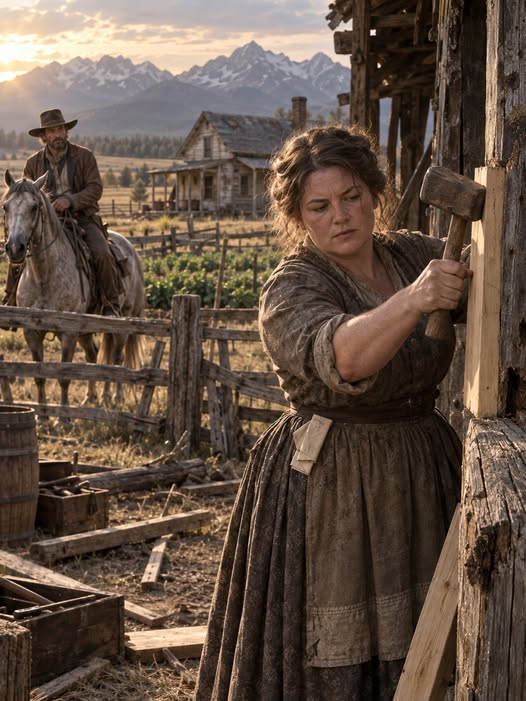
Then reached for the hammer.
The first strike drove the nail halfway.
The second secured it.
She stepped back.
The brace looked better.
Not finished.
But better.
She examined the joint and noticed that the lower section needed additional support.
She placed another piece of wood against the beam.
Then reached for the hammer again.
That was when she heard the sound.
Hoofbeats.
Slow.
Measured.
Approaching from the direction of the road.
Eleanor continued working.
She assumed it was Mr. Bell or someone passing through.
The hoofbeats slowed.
Then stopped.
A man's voice came from outside.
"That splice won't hold through winter."
Eleanor paused.
She lowered the hammer.
Then turned toward the entrance.
A man sat on a gray horse beside the broken fence.
He wore a faded olive-green hat.
His shirt was dusty blue.
A dark brown vest covered his broad shoulders.
His face was weathered by years outdoors, and a neatly trimmed reddish-brown beard framed his jaw.
He looked approximately thirty-five.
His attention was fixed on the barn support.
Eleanor studied him for a moment.
Then looked at the timber.
"I know."
The man appeared slightly surprised.
"It needs a full brace."
"I know that too."
He glanced toward the pile of lumber.
"Don't have enough wood?"
"Not yet."
Something changed in his expression.
It was subtle.
He had apparently expected her to argue.
Instead, she had answered every observation as though she had already considered it.
He touched the brim of his hat.
"Benjamin Carter. Double C Ranch. East of here."
Eleanor rested the hammer against her shoulder.
"Eleanor Whitmore."
He nodded.
Then she added, deliberately:
"I own this farm."
Benjamin looked at her.
For a moment, neither spoke.
Then he glanced toward the farmhouse.
The repaired porch.
The cleared garden.
The new fence posts.
The path leading toward the southern field.
He looked back at her.
"You've done more here in three weeks than the Harkers did in their last three years."
Eleanor straightened.
"Have you been watching me?"
Benjamin paused.
"Passing by."
"That wasn't my question."
For the first time, something almost amused entered his eyes.
"Everyone in Willow Creek said you'd be gone before July."
Eleanor's expression did not change.
"And you wanted to see?"
"If they were right."
She looked at him for several seconds.
Then rested the hammer more comfortably against her shoulder.
Benjamin surveyed the property again.
The barn.
The garden.
The fence.
The fields.
He finally looked directly at her.
"They were wrong."
Eleanor said nothing.
Benjamin touched his hat.
Then turned his horse toward the road.
She watched him ride away.
She did not know whether he was a good man.
She did not know whether his words meant anything.
But she recognized something unusual in the way he had looked at her.
He had not examined her as though she were a problem.
He had examined her work.
And that was a difference she had not experienced in a very long time.
Four days passed.
Eleanor continued working.
She repaired another fence section.
Cleared more weeds.
Finished planting the remaining vegetables.
She also spent several hours examining the barn.
The damaged support was still her greatest concern.
She could keep the structure standing temporarily.
But the proper repair would require several long pieces of sound lumber.
She calculated the cost.
Then calculated it again.
The numbers did not improve.
She was considering whether she could sell one of her father's old possessions when she heard another sound from the road.
This time, the wagon was heavier.
Its wheels made a distinct rumbling noise.
Eleanor stepped out of the barn.
A familiar gray horse appeared beyond the fence.
Benjamin Carter was driving the wagon.
Several long pieces of lumber were stacked behind him.
He slowed near the gate.
Eleanor stared at the load.
Then at him.
Benjamin climbed down.
"Fence needs another pair of hands?"
She looked toward the lumber.
Then back at him.
"What are you doing here?"
"Passing by."
"You were passing by four days ago too."
"Seems to happen."
Eleanor folded her arms.
Benjamin looked toward the barn.
Then back at her.
"North section?"
She hesitated.
"Why?"
He glanced at the wagon.
"Because I brought something that might help."
Eleanor stepped closer.
The lumber was straight.
Dry.
Sound.
Exactly what she needed.
She touched one of the boards.
Then looked at Benjamin.
"I didn't ask you to bring this."
"No."
"I cannot take charity."
Benjamin nodded.
"I understand."
He rested one hand on the wagon.
"Then don't take charity."
Eleanor waited.
He looked toward the barn.
"I need that stack gone."
She stared at him.
For the first time in several weeks, she almost smiled.
It was an absurdly careful lie.
A gift disguised as an inconvenience.
A way of helping without making her feel indebted.
She touched the timber again.
"How much?"
Benjamin shook his head.
"Nothing."
"Then I can't accept it."
"Miss Whitmore, I have more lumber than I need, and you have a barn that needs repairing. I can either leave it sitting in my yard or put it to work."
"That sounds suspiciously like charity."
"Then consider it a practical arrangement."
Eleanor looked at him for a long moment.
Finally, she stepped aside.
"All right."
Benjamin climbed down from the wagon.
Together, they lifted the first timber.
It was heavier than Eleanor expected.
She adjusted her grip.
Benjamin noticed.
"Ready?"
She nodded.
They carried it toward the barn.
Neither spoke.
But as they crossed the yard, Eleanor realized that something had changed.
For the first time since her brother handed her the deed, someone had arrived at her property without telling her what kind of life she ought to live.
And she had no idea that, back in Willow Creek, the man who had first decided she would fail was already preparing to come looking for her.
That man was Robert Ames.






Comments 0