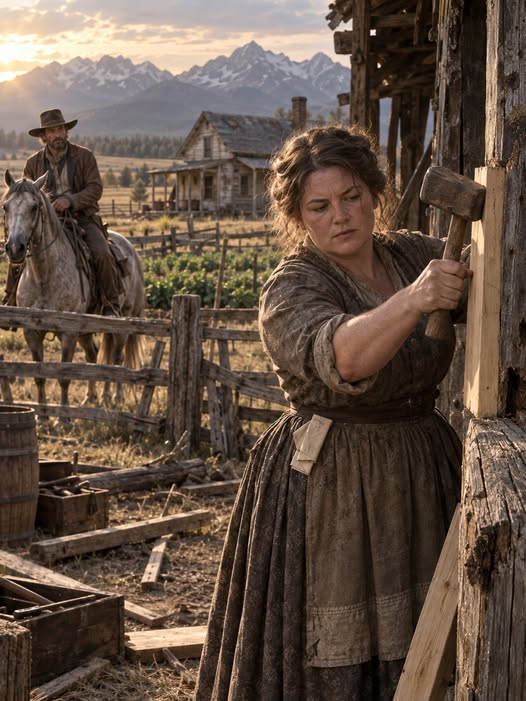
Eleanor Whitmore read the anonymous letter again.
"Come alone before sunset. Bring the photograph. If Benjamin Carter comes with you, the truth about his father will be buried forever."
She lowered the paper.
For several seconds, she simply stood in the kitchen, listening to the ticking of the old clock above the fireplace.
Benjamin's father.
The message had not threatened her property.
It had threatened a man who had done nothing except help her repair a barn.
She looked toward the window.
The road was empty.
The young messenger had already disappeared.
Eleanor returned to the table and placed the letter beside the photograph of Arthur Whitmore and Samuel Harker.
She examined the silver pin worn by the unidentified man standing behind them.
The same circular symbol appeared on the anonymous envelope.
Whoever had sent the message knew about the photograph.
Whoever had sent it also knew Benjamin's family history.
And whoever had sent it expected Eleanor to obey.
She picked up her coat.
Then stopped.
The instructions said to come alone.
That was precisely why she had no intention of trusting them.
Benjamin returned shortly after noon.
He found Eleanor standing beside the farmhouse door, holding the anonymous letter.
He dismounted and immediately noticed her expression.
"Something happened."
Eleanor handed him the paper.
He read it once.
Then again.
His face became still.
"Where did you get this?"
"A messenger brought it."
"Who?"
"He wouldn't tell me."
Benjamin looked at the photograph.
Then at the symbol on the envelope.
For the first time since she had known him, Eleanor saw something approaching genuine alarm in his eyes.
"Do you recognize it?" she asked.
Benjamin did not answer immediately.
He turned the envelope over and examined the wax mark.
"Where have you seen this before?"
"On the county notice Robert gave me."
Benjamin looked up.
"Are you certain?"
"Yes."
He folded the letter.
"Then we have a bigger problem."
"Apparently."
He walked toward the barn, thinking.
Eleanor followed.
"Benjamin, what does this have to do with your father?"
He stopped.
"My father died eleven years ago."
"I know."
"He was involved in several property disputes before he died. Nothing unusual for a rancher who owned land near the creek."
"Did he know Arthur Whitmore?"
Benjamin looked toward the southern field.
"Yes."
Eleanor felt her stomach tighten.
"How well?"
"Well enough to do business together."
She stared at him.
"Why didn't you tell me?"
"Because I didn't know your father was connected to the Harker agreement."
"You knew they knew each other?"
"Yes."
"Then why didn't you mention it when we found the photograph?"
Benjamin looked down.
"Because I didn't recognize the man standing behind them until you showed me the symbol."
Eleanor waited.
He continued.
"That symbol belonged to the old county land committee. My father served on it for several years."
"Was he the man in the photograph?"
Benjamin shook his head.
"No. The man behind your father and Samuel was someone else."
"Who?"
Benjamin hesitated.
"I think it was Judge Warren."
Eleanor looked at him.
"Judge Elias Warren?"
"Before he became a judge, he worked in the county land office."
She remembered Margaret's warning.
Robert was not the only person looking for the papers.
"Then we need to speak to him."
Benjamin nodded.
"But not before we understand why someone wants me kept away."
They spent the afternoon examining the documents.
Benjamin recognized several names in the old account book.
One belonged to his father.
Another belonged to a man named Charles Whitcomb.
The third was a name Eleanor had not seen before.
Nathaniel Ames.
Robert's father.
She placed the account book beside the photograph.
"Your father, my father, Samuel Harker, and Nathaniel Ames were all connected."
Benjamin studied the entries.
"Looks that way."
"Why?"
"That's what we need to find out."
Eleanor turned another page.
Several payments had been recorded over a period of years.
Some were marked with initials.
Others contained short notes.
One entry was especially unusual.
Payment received. Southern boundary secured. Witness: B.C.
Eleanor pointed to it.
"Benjamin Carter?"
He leaned closer.
"My father."
She looked at him.
"Your father witnessed a payment involving my father's land?"
"Apparently."
"Do you have any records from him?"
Benjamin nodded slowly.
"Some. He kept old ranch books in the office at Double C."
"Could they help?"
"Possibly."
He looked toward the road.
"But if someone has been searching for these documents, they may already know what's in them."
Eleanor closed the book.
"Then we should move quickly."
Benjamin looked at her.
"You shouldn't go into town alone."
"I wasn't planning to."
"Good."
She raised an eyebrow.
"Are you giving me instructions now?"
"No. I'm suggesting we avoid walking into a problem without knowing who's waiting."
Eleanor studied him.
Then nodded.
"Fair enough."
They rode to the Double C Ranch shortly before sunset.
Benjamin's property was considerably larger than Eleanor had imagined.
The main house stood on a slight rise overlooking the grazing land.
Several barns and storage buildings occupied the lower ground.
Fences stretched toward the distant hills.
Cattle moved slowly across the open pasture.
A group of ranch hands worked near the eastern enclosure.
When Benjamin approached, one of them raised a hand.
"Afternoon, boss."
Benjamin nodded.
"Evening, Sam."
The man glanced toward Eleanor.
"Miss Whitmore?"
Eleanor returned his greeting.
"Good afternoon."
Sam looked between them.
Then smiled.
"Good to see someone finally getting that old Harker place back on its feet."
Benjamin dismounted.
"Have you seen Mrs. Miller?"
"In the kitchen."
"Tell her we're coming in."
Sam nodded.
Eleanor climbed down.
She looked around.
The ranch was not luxurious.
It was simply well maintained.
The fences were straight.
The buildings were sound.
The equipment was organized.
Nothing appeared neglected.
She understood why Benjamin had spoken about his father's work with such respect.
This was not a property built in a single year.
It was the result of decades of careful labor.
Benjamin noticed her looking.
"My father started with two hundred acres."
"And now you have nine hundred."
"Nine hundred and twenty."
Eleanor smiled slightly.
"An important distinction."
"It is when you're paying taxes."
She laughed.
He opened the front door.
"Come inside."
Mrs. Miller was a sturdy woman in her sixties with silver hair pinned tightly beneath a dark cap.
She looked at Benjamin.
Then at Eleanor.
"Well, you finally brought the young woman home."
Benjamin sighed.
"Afternoon, Mrs. Miller."
She ignored him.
"Miss Whitmore, I've been wanting to meet you."
Eleanor smiled politely.
"Why?"
"Because this one keeps talking about your barn."
Benjamin removed his hat.
"I mentioned a repair."
"You mentioned it three times."
Eleanor glanced at him.
"Three times?"
Mrs. Miller nodded.
"At breakfast, lunch, and supper."
Benjamin looked toward the ceiling.
"Perhaps we should discuss the records."
Mrs. Miller laughed.
"Of course. Important business."
She turned to Eleanor.
"Would you like coffee?"
"That would be lovely."
"Good. Sit down."
Eleanor followed Benjamin into the dining room.
The table was large and solid.
A collection of old photographs hung along the wall.
Several showed Benjamin's father.
One photograph caught Eleanor's attention.
Arthur Whitmore stood beside him.
She walked closer.
The picture was older than the one found in the Harker barn.
Her father looked considerably younger.
He was wearing a dark coat and holding a rolled document.
Benjamin came to stand beside her.
"That's my father, James."
Eleanor looked at the photograph.
"And mine."
"They were friends."
"How long?"
"Years."
Benjamin studied the image.
"They worked together on several projects. Water rights, grazing agreements, road access."
Eleanor looked at him.
"Did your father ever mention the Harker property?"
Benjamin's expression became thoughtful.
"Not directly."
"Then what did he say?"
"That some land was worth more because of what ran beneath it than because of what grew on top."
Eleanor frowned.
"The creek?"
"Possibly."
She looked again at the photograph.
Her father held a rolled document.
James Carter was pointing toward something outside the frame.
There was a third man standing beside them.
His face was partly obscured.
But the silver pin was clearly visible.
The same symbol.
Eleanor touched the photograph.
"That's him."
Benjamin leaned closer.
"Judge Warren."
She nodded.
"Margaret was right. He was involved."
After supper, Benjamin brought out his father's old account books.
They were stored in a wooden cabinet in the ranch office.
Several volumes contained records of cattle sales, equipment purchases, and property transactions.
Benjamin searched through the older volumes.
Eleanor sat beside him, comparing the dates with the Harker papers.
They worked for nearly an hour.
Then Benjamin stopped.
He had found an entry dated eleven years earlier.
The handwriting was his father's.
Meeting with A. Whitmore and S. Harker. Agreement concerning southern creek access. Payment secured through N. Ames.
Eleanor leaned forward.
"Read the next line."
Benjamin turned the page.
J. Carter to retain original acknowledgment until final payment confirmed.
They stared at each other.
"Your father kept the acknowledgment?" Eleanor asked.
Benjamin searched the following pages.
There was another entry.
Document transferred to county office for safekeeping.
Eleanor sat back.
"Which county office?"
Benjamin shook his head.
"The entry doesn't say."
"Can we find out?"
"Perhaps."
He turned another page.
There was a final note.
If anything happens to me, speak to Elias Warren. He knows the full arrangement.
Eleanor looked at him.
"Your father knew something was wrong."
Benjamin nodded slowly.
"Looks like it."
He closed the book.
For several seconds, neither spoke.
Then Benjamin looked at the anonymous letter.
"Someone wants us to believe that the land dispute is about money."
Eleanor met his eyes.
"But it isn't."
"No."
"What is it about?"
Benjamin glanced toward the window.
"The creek."
The next morning, Eleanor returned to her farm alone.
She wanted to inspect the southern boundary.
Benjamin had offered to accompany her, but she had insisted that he attend to his ranch.
He had not argued.
Instead, he gave her a small pocketknife and reminded her to avoid digging near the old marker until they understood what lay beneath it.
Eleanor appreciated the concern.
But she was beginning to understand that the more people tried to protect her from information, the more determined she became to find it herself.
She walked along the creek.
The water moved slowly between the rocks.
Several sections of the bank were overgrown.
There were old wooden stakes near the bend.
She examined them carefully.
One had been marked with the initials S.H.
Another carried a small metal plate.
The plate was almost completely covered in dirt.
She cleaned it with her sleeve.
There was a number.
17.
The same number that appeared on the old property map.
Eleanor walked farther downstream.
Near a cluster of trees, she found a shallow stone structure partly hidden by weeds.
It appeared to be an old water channel.
She crouched.
The stones were carefully arranged.
Someone had built the channel deliberately.
It extended toward the southern field.
She followed it for several yards.
Then noticed a narrow wooden cover.
She lifted it.
Beneath it was a small iron mechanism.
It appeared to control the flow of water.
Eleanor examined the structure.
If the channel still worked, it could irrigate a substantial portion of her land.
But the mechanism was old.
And someone had recently touched it.
There were fresh scratches along the metal.
She looked around.
Nobody was visible.
She returned the cover.
Then heard a voice behind her.
"You're not supposed to be looking at that."
Eleanor turned.
A man stood near the trees.
He wore a brown coat and a dark hat.
His face was unfamiliar.
But his boots were clean.
Too clean for someone who had been walking through the muddy creek bank.
"Who are you?"
The man did not answer.
He looked toward the water channel.
Then back at her.
"Robert Ames told you to stay away from the southern boundary."
Eleanor straightened.
"Robert Ames doesn't tell me where I can walk on my own property."
The man smiled.
"Perhaps you should listen to him anyway."
"Why?"
He stepped closer.
"Because some things are better left buried."
Eleanor felt her pulse quicken.
She looked toward the road.
There was no one nearby.
The man noticed.
"Expecting company?"
"No."
"Good."
He took another step.
Eleanor tightened her grip on the pocketknife.
Then a horse whinnied behind him.
The stranger turned.
Benjamin appeared at the edge of the field.
He was riding fast.
The stranger stepped back.
Benjamin dismounted before the horse had completely stopped.
"Move away from her."
The man looked at Benjamin.
For a moment, neither moved.
Then the stranger turned and walked toward the trees.
Benjamin started after him.
Eleanor caught his arm.
"Don't."
He stopped.
The man disappeared into the woods.
Benjamin looked at her.
"Are you hurt?"
"No."
"What did he want?"
"He told me to stay away from the southern boundary."
Benjamin's expression darkened.
"Did he give you a name?"
"No."
He looked toward the creek.
Then at the mechanism beneath the wooden cover.
"Did you touch this?"
"Only to examine it."
Benjamin crouched.
He inspected the metal fitting.
Then noticed a small piece of paper wedged beneath the mechanism.
He pulled it free.
The paper was damp.
But the writing remained visible.
The water belongs to the Ames family. Remove the channel before the hearing.
Eleanor stared.
"That's impossible."
Benjamin looked at her.
"Why?"
"Because this channel runs through my property."
He examined the message again.
"Someone is trying to destroy evidence."
That afternoon, they went to see Judge Warren.
His house stood beside the church.
It was a modest building with a narrow porch and a garden full of late-season flowers.
Eleanor knocked.
A housekeeper answered.
"May I help you?"
"We're here to see Judge Warren."
"Do you have an appointment?"
Benjamin introduced himself.
The woman recognized his name.
She hesitated.
Then stepped aside.
"Wait here."
They entered a small sitting room.
Several minutes passed.
Then an elderly man appeared.
Judge Elias Warren was in his seventies.
His hair was almost entirely white.
His posture remained straight despite his age.
He wore a dark suit and carried a walking stick.
His eyes moved from Benjamin to Eleanor.
"Miss Whitmore."
Eleanor stood.
"Judge Warren."
He looked at the documents in her hand.
Then at the photograph.
His expression changed.
"Where did you get that?"
"In the old Harker barn."
He took the photograph.
For several seconds, he studied it.
Then returned it.
"Arthur should have destroyed that."
Eleanor felt her stomach tighten.
"Why?"
The judge looked toward Benjamin.
"James Carter never told you?"
Benjamin shook his head.
"No."
Judge Warren closed the sitting room door.
Then turned toward them.
"Because the agreement your fathers made was never simply about the farm."
Eleanor leaned forward.
"Then what was it about?"
The judge rested both hands on his walking stick.
"The water rights beneath the southern creek."
He paused.
"And the man who tried to steal them."
Benjamin's expression hardened.
"Who?"
Judge Warren looked at Eleanor.
Then said quietly:
"Robert Ames's father."
The judge explained that the creek supplied water to several properties in the valley.
The Harker farm occupied a particularly important position.
Its southern channel connected to an underground spring.
The spring had been used for generations.
But its full capacity had never been measured.
When the Ames family began purchasing land nearby, Nathaniel Ames became interested in controlling the water supply.
He wanted exclusive rights.
Samuel Harker refused.
Arthur Whitmore offered to help protect the Harkers.
James Carter provided testimony and records.
Judge Warren had witnessed the agreement.
The arrangement was supposed to guarantee that the water remained available to several neighboring farms.
But Nathaniel Ames had challenged the agreement.
He claimed that the original documents were incomplete.
He also alleged that Arthur Whitmore had never paid the full amount.
The dispute continued for years.
Then Arthur died.
James Carter died shortly afterward.
The original acknowledgment disappeared.
And the entire matter seemed to vanish from public records.
Eleanor listened without interruption.
When the judge finished, she asked one question.
"Why did nobody tell me?"
The old man looked tired.
"Because your father believed the people involved would leave you alone."
"Clearly, they haven't."
"No."
Judge Warren opened a drawer.
He removed a thick folder.
"I kept a copy of the original agreement."
Eleanor leaned forward.
"Do you still have it?"
The judge nodded.
"But there is a problem."
"What problem?"
"The agreement contains an additional clause."
He opened the folder.
There were several pages.
One described the water rights.
Another listed the properties involved.
The final page contained a clause that Eleanor had never seen.
It stated that if the southern channel were deliberately damaged or blocked, the landowner could demand an immediate review of all water rights.
Benjamin looked at the page.
"That's why someone is tampering with the channel."
Judge Warren nodded.
"They want the evidence gone before the hearing."
Eleanor examined the document.
Then noticed something.
The witness signature was missing.
"Where is the signed original?"
The judge looked at her.
"I don't know."
"Who has it?"
He lowered his voice.
"That is what I have been trying to discover."
A knock sounded at the front door.
The housekeeper appeared.
"Judge, there's someone here asking for you."
Warren frowned.
"Who?"
The woman hesitated.
Then looked toward Eleanor.
"It's a man from the county office."
Judge Warren closed the folder.
"Tell him I'll be with him shortly."
The housekeeper nodded and left.
Eleanor glanced at Benjamin.
The judge's expression had become tense.
"Something wrong?" she asked.
He looked toward the door.
"Possibly."
"Who is this man?"
Warren did not answer.
Instead, he stood and walked to the window.
He looked outside.
Then turned back.
"Miss Whitmore, I need you to listen carefully. Do not sign anything Robert Ames gives you. Do not agree to sell. And whatever happens, do not let anyone remove the documents from your possession."
Eleanor nodded.
"I understand."
The judge moved toward the sitting room door.
Then stopped.
"There's something else."
He looked at Benjamin.
"Your father's death was not an accident."
Benjamin went completely still.
Eleanor turned toward him.
"What?"
Judge Warren's voice dropped.
"James Carter was supposed to deliver the original acknowledgment to Arthur Whitmore the night he died."
Benjamin stared at him.
"That isn't possible."
"It is true."
"My father died in a ranch accident."
"That is what the official report says."
Benjamin's face had lost its color.
Judge Warren continued.
"His horse was found near the eastern creek. The saddle had been damaged. The original acknowledgment was never recovered."
Eleanor looked at the old photograph.
The silver pin.
The names.
The missing document.
Everything seemed connected.
Then another knock sounded.
This time, it was louder.
The housekeeper opened the front door.
A man's voice came from the hallway.
"Judge Warren, I have an urgent order from the county office."
The judge looked toward Eleanor.
His expression turned grave.
"That order cannot be genuine."
He moved toward the hallway.
Benjamin followed.
Eleanor gathered the papers.
Then she heard the housekeeper gasp.
A chair scraped across the floor.
And the man from the county office spoke again.
"Judge Warren, step away from the woman."
Eleanor froze.
Because the voice was familiar.
It belonged to the man who had threatened her beside the southern creek.
And now he was standing inside the judge's house, holding a document bearing the county seal.
He looked directly at Eleanor and said, "Miss Whitmore, I'm here to take possession of the original Harker agreement."






Comments 0