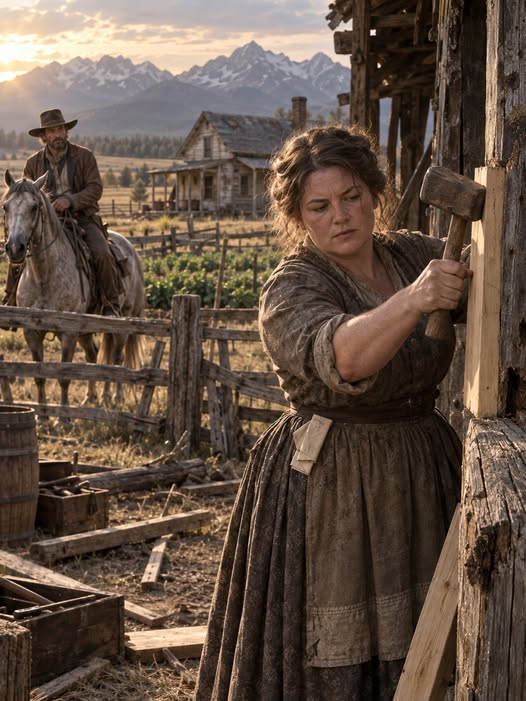
The first thing Eleanor Whitmore noticed was that Benjamin Carter knew how to carry lumber without making a performance of it.
He did not complain about the weight.
He did not announce how much stronger he was.
And he certainly did not tell her to stand aside because the work was too difficult for a woman.
He simply lifted his end of the timber and waited until she had a secure grip.
"Ready?" he asked.
Eleanor nodded.
Together, they carried the long board through the barn entrance.
"Where do you want it?"
"Against that wall. Keep it away from the damaged floorboards."
Benjamin followed her instructions without question.
They lowered the timber onto two wooden supports.
Eleanor stepped back and examined it.
"That should do."
Benjamin looked toward the weakened beam.
"For the temporary brace, perhaps."
"I know it isn't the final repair."
"Good."
She turned toward him.
"Did you expect me to argue?"
"No."
"Then why did you say it?"
Benjamin considered that question.
"Because I've seen people spend money repairing the wrong part of a building. I didn't want you wasting good lumber."
Eleanor studied him.
There was something unusual about the way he spoke.
He did not soften every sentence to protect her feelings, but neither did he seem interested in proving that he knew more than she did.
He was simply discussing a barn.
She found that surprisingly refreshing.
"Well," she said, "if you're going to criticize my repairs, you might as well help me make them better."
Benjamin gave a small nod.
"Fair enough."
They worked through the morning.
Eleanor showed him the damaged support and explained what she had discovered when she inspected the structure.
The lower section had absorbed moisture.
The original joint had weakened.
A temporary brace would distribute some of the weight, but the entire support eventually needed replacing.
Benjamin crouched beside the timber.
"You're right about the moisture."
"I thought so."
"Could have been leaking from the roof for years."
"I found a few soft boards above it."
"Then we should inspect the roof before winter."
Eleanor picked up her hammer.
"That's on my list."
Benjamin glanced at her.
"You keep a list?"
"Several."
"How many?"
"Enough to make me wish I'd never learned to write."
He laughed.
It was brief and genuine.
Eleanor looked at him.
She had not expected the sound.
Benjamin stood and brushed sawdust from his trousers.
"Most people would have started with the house."
"I started with the pump."
"Why?"
"Because I need water."
He nodded.
"Practical."
"I thought so."
She handed him a nail.
He accepted it.
For the next hour, they worked without much conversation.
Benjamin held the timber in position while Eleanor secured the joint.
He checked the alignment.
She adjusted it.
He suggested moving the brace slightly.
She examined the angle and agreed.
There was no argument.
No unnecessary praise.
No awkward attempt to make the morning feel like something other than work.
By the time they finished, the weakened support looked considerably more stable.
Benjamin stepped away.
"That should hold for now."
Eleanor inspected the connection.
"Until we can replace the main post."
"Exactly."
She lowered her hammer.
"Thank you."
He nodded.
"You're welcome."
Then he looked toward the barn entrance.
"Have you eaten?"
Eleanor glanced at the sun.
It was nearly noon.
"Not yet."
"Thought so."
She narrowed her eyes.
"What does that mean?"
"You've been working since I arrived."
"So have you."
"I ate breakfast."
"I did too."
"What did you have?"
She hesitated.
"Coffee."
Benjamin looked at her.
"That's not breakfast."
"It was breakfast this morning."
He shook his head.
Eleanor felt an unexpected urge to defend herself.
"I have food in the house."
"I didn't say you didn't."
"Then what are you suggesting?"
"That you should eat something before you start lifting another piece of timber."
He walked toward the wagon.
Eleanor watched him reach beneath the seat and retrieve a small cloth-wrapped parcel.
He returned and held it out.
She did not take it immediately.
"What is that?"
"Bread. Biscuits. My cook made more than I needed."
"You have a cook?"
"Mrs. Miller. She runs the kitchen better than I run the ranch."
Eleanor glanced at the parcel.
Then at him.
"I can make my own meals."
"I never doubted it."
"Then why bring food?"
Benjamin shrugged.
"Because I brought enough for two people."
She studied his face.
He seemed perfectly comfortable with the explanation.
No expectation.
No suggestion that she owed him anything.
Finally, she accepted the parcel.
"Thank you."
Benjamin nodded toward the farmhouse.
"Coffee?"
"Cold."
"That'll do."
They sat on the farmhouse porch.
Eleanor brought two cups and poured the remaining coffee.
Benjamin accepted his cup and took a seat on the lower step.
He did not complain about the cold drink.
He did not comment on the missing porch boards.
He simply unwrapped one of the biscuits.
Eleanor took a bite.
It was still soft.
For several minutes, they watched the fields.
The ranch looked different from the porch than it did from inside the barn.
The southern field stretched toward the creek.
The fence line followed the uneven boundary of the property.
Beyond it, the neighboring land rolled gently toward the distant mountains.
Benjamin pointed toward the southern section.
"What are you planning to plant there?"
Eleanor followed his gaze.
"Possibly wheat. I haven't decided how much yet."
"How much ground have you turned?"
"Less than I'd like."
"Using the old plow?"
"Yes."
He nodded.
"That's hard work."
"I noticed."
Benjamin smiled slightly.
She continued.
"I've planted beans, squash, tomatoes, and greens near the kitchen. The soil there is good. I want to preserve some grass along the creek in case I eventually keep cattle."
He looked at her.
"Eventually?"
"Not this year."
"Why not?"
"Because I don't have the money to buy cattle, build proper fencing, and repair the barn all at once."
"That's sensible."
Eleanor took another sip of coffee.
"I have sixty acres. I need to decide what sixty acres can reasonably become."
Benjamin considered the land.
"Your soil is better than it looks."
"How can you tell?"
"I've worked this valley for eleven years. The ground near the creek holds moisture, and the upper field has enough drainage for wheat."
Eleanor leaned forward.
"Would corn grow here?"
"Some of it. Depends on the season."
"What about oats?"
"Better chance."
She reached for the small notebook beside her cup.
Benjamin noticed.
"You're writing that down?"
"I intend to remember it."
"Good habit."
She wrote several words.
Then looked up.
"Why are you helping me?"
Benjamin rested his cup against his knee.
"Because I have some experience with farms."
"That's not an answer."
He looked toward her.
For a moment, she thought he might become defensive.
Instead, he appeared to consider the question seriously.
"Because I saw you working on a dangerous building by yourself, and I had lumber sitting unused at home."
"Most people would have ridden past."
"Most people aren't me."
"That's a convenient explanation."
"Is it?"
Eleanor closed the notebook.
"Everyone in town apparently expects me to fail."
Benjamin's expression changed slightly.
He looked toward the road.
"People in Willow Creek talk too much."
"That sounds like something someone says when he doesn't want to admit he listens."
He gave a quiet laugh.
"Perhaps."
"Did you believe them?"
Benjamin looked directly at her.
"No."
"Why?"
"Because I watched you work."
Eleanor waited.
He continued.
"You've repaired the porch, cleared the garden, fixed the pump, and replaced sections of fencing. You've been here three weeks. Most people would spend that long complaining about the condition of the property."
She looked down at her hands.
There were small scratches across her knuckles.
A fresh blister had formed near her thumb.
Benjamin noticed but did not comment.
"You've planned the fields too," he added.
"I've thought about them."
"That's more than most people do."
Eleanor looked at him again.
"This could become a real farm."
Benjamin nodded.
She let the silence sharpen.
"It is a real farm."
His eyes met hers.
For a moment, neither spoke.
Then he answered quietly.
"Yes."
It was a small word.
But Eleanor found herself remembering it.
After lunch, Benjamin helped her unload the remaining lumber.
There were four long boards, several shorter pieces, and a small bundle of wooden stakes.
Eleanor examined the material.
"These are better than I expected."
"I keep a supply for repairs."
"Then you must have a large ranch."
"Large enough to keep me busy."
"How many acres?"
"Just over nine hundred."
Eleanor looked at him.
"Nine hundred?"
"Some of it is grazing land. Some is timber. There's a creek running through the eastern section."
"How many people work for you?"
"Four full-time hands. More during branding and harvest."
She looked toward her own sixty acres.
Then back at him.
"That must be a considerable operation."
"It took years."
He said it without boasting.
Eleanor appreciated that.
"Did you inherit it?"
Benjamin shook his head.
"My father started with two hundred acres. I bought the neighboring property after he died."
"I'm sorry."
He nodded.
"Long time ago."
"Did he teach you the work?"
"Most of it."
Benjamin lifted another board.
"He also taught me that a ranch can look prosperous from the road while falling apart behind the barn."
Eleanor looked toward the old farmhouse.
"That sounds familiar."
"It happens."
They carried the last piece inside.
Benjamin examined the barn again.
"There's something else."
Eleanor turned.
"What?"
"Your west wall."
She looked toward the side of the building.
"What about it?"
"Those boards are pulling away from the frame. You may not notice it from the outside, but the lower section has shifted."
Eleanor walked over.
He pointed toward the corner.
She crouched and examined the joint.
There was a narrow gap.
She pressed against the board.
It moved slightly.
Her stomach tightened.
"How serious?"
"Not immediately dangerous, but I'd repair it before the next strong wind."
Eleanor straightened.
"Another expense."
Benjamin nodded.
"Yes."
She looked at the timber pile.
Then at the barn.
"I suppose I should have expected that."
"Old buildings don't usually reveal all their troubles at once."
"That would be too considerate."
He smiled.
She almost smiled back.
Almost.
By midafternoon, Benjamin was preparing to leave.
Eleanor walked him to the gate.
The gray horse stood patiently beside the wagon.
Benjamin adjusted the reins.
"There's a mill in Willow Creek. They sell decent timber."
"I know where it is."
"Good."
"I'll need to buy more nails."
"They have those too."
She looked at the wagon.
"How much do I owe you for the lumber?"
Benjamin shook his head.
"We discussed that."
"I know what we discussed. I'm asking again."
He rested one hand on the saddle.
"Nothing."
"Benjamin."
"Eleanor."
She folded her arms.
"I don't like owing people."
"Then don't."
"That's not how debts work."
He considered her for a moment.
"All right. When your garden produces more vegetables than you can use, bring some over to the ranch."
She frowned.
"Vegetables?"
"Mrs. Miller says the market vegetables are poor this year."
"That is your price?"
"Seems fair."
Eleanor looked at him suspiciously.
"You have nine hundred acres and four ranch hands. You cannot grow vegetables?"
"We grow cattle."
"That's an incomplete diet."
Benjamin laughed.
"Then perhaps you can help us improve it."
She studied him.
It was another arrangement that allowed her to accept help without feeling purchased.
She finally nodded.
"Fine."
He climbed into the saddle.
"Take care of that west wall."
"I intend to."
"And don't work beneath the damaged roof until you've inspected it."
"I know how to be careful."
"I believe you."
He turned the horse.
Then paused.
"One more thing."
Eleanor looked up.
"What?"
"If anyone in town gives you trouble, don't feel obligated to handle everything alone."
She stiffened.
"I can handle myself."
Benjamin met her eyes.
"I know."
He touched his hat.
"That's why I said you weren't obligated."
Then he rode away.
Eleanor watched him until he disappeared beyond the trees.
She remained by the gate for a while.
Then she returned to the barn.
The next morning, Eleanor discovered that the lumber had attracted attention.
She was repairing a section of the western fence when she heard two women speaking on the road.
Their wagon slowed.
One woman leaned toward the other.
"That's her."
Eleanor continued working.
The wagon stopped.
"Miss Whitmore?"
She looked up.
The speaker was a thin woman wearing a pale yellow bonnet.
The second woman sat beside her, holding a basket.
"Yes?"
"I'm Mrs. Abigail Turner. This is Mrs. Louise Bell."
Eleanor recognized neither name.
Mrs. Turner smiled.
"We heard you had moved into the old Harker property."
"I have."
"Quite an undertaking."
"So I've discovered."
The two women exchanged glances.
Mrs. Bell looked toward the barn.
"Someone has been helping you, I see."
Eleanor rested the hammer against the fence post.
"Benjamin Carter brought some lumber."
Mrs. Turner raised her eyebrows.
"Benjamin?"
"Yes."
"How interesting."
Eleanor said nothing.
Mrs. Bell leaned forward.
"He's a busy man. Doesn't usually have time to visit every struggling property in the valley."
"He wasn't visiting every property. He was helping with a barn repair."
Mrs. Turner smiled again.
"Of course."
There was something in her voice that Eleanor did not like.
She had heard it before.
It was the sound of someone collecting information while pretending to offer conversation.
Mrs. Bell glanced toward the garden.
"Are you planning to live here alone?"
"Yes."
"All year?"
"That's the intention."
Mrs. Turner shook her head sympathetically.
"Well, it must be difficult."
Eleanor looked at her.
"Some things are."
The woman seemed surprised by the answer.
Then she laughed softly.
"Of course. We only mean that a place like this needs a man's attention."
Eleanor picked up her hammer.
"The fence seems to be responding quite well to mine."
Mrs. Bell looked away.
Mrs. Turner tightened her smile.
"You're certainly determined."
"I am."
"Well, we won't keep you."
The wagon moved forward.
But before it disappeared around the bend, Eleanor heard Mrs. Bell say something.
It was not loud.
But the road was quiet.
"Robert Ames will be interested to hear about Benjamin."
Eleanor's hammer stopped halfway to the nail.
She looked after the wagon.
Robert Ames.
His name had followed her farther than she had expected.
That afternoon, Eleanor visited the barn again.
She wanted to inspect the western wall before beginning another repair.
The daylight revealed more damage than she had noticed before.
Several boards had separated from the frame.
The lower section was damp.
There were signs of previous repairs, but the workmanship was poor.
She examined the corner carefully.
Then noticed something unusual.
A narrow wooden panel had been fitted behind the support beam.
It did not match the surrounding boards.
The wood was older.
Darker.
And there was a small iron hook attached near its lower edge.
Eleanor crouched.
She touched the hook.
It moved.
She pulled gently.
The panel shifted less than an inch.
Behind it was darkness.
She leaned closer.
There was a faint smell of old leather and dust.
She tried the hook again.
This time, the panel moved farther.
Something metallic scraped against the wood.
Eleanor stepped back.
She looked toward the barn entrance.
Nobody was there.
She considered leaving it alone.
The barn had enough problems without her investigating every strange piece of timber.
But something about the panel bothered her.
It looked deliberately concealed.
She returned with a lantern.
The light revealed a narrow space behind the wall.
Inside sat a small rectangular wooden box.
It was covered in dust.
A rusted latch held it shut.
Eleanor reached through the opening.
Her fingertips brushed the edge.
She pulled the box toward her.
It caught against something.
She adjusted her grip.
Then lifted it free.
The box was heavier than she expected.
She placed it on the workbench.
The wood was dark and worn.
There were no initials.
No visible markings.
Only a small brass latch.
Eleanor touched it.
It did not open.
She examined the edges.
Then noticed a thin piece of paper wedged beneath the latch.
She carefully pulled it free.
The paper was brittle.
Most of the writing had faded.
But one line remained clear enough to read.
PROPERTY OF THE HARKER FAMILY — NOT TO BE REMOVED.
Eleanor stared at the words.
Why would someone hide a box inside a barn and then write a warning on its exterior?
She turned it over.
There were scratches along the bottom.
Several appeared deliberate.
Like someone had dragged the box across a rough surface.
She tried the latch again.
Nothing.
She would need a small tool.
Perhaps a screwdriver.
She placed the box beneath the workbench and covered it with a cloth.
Then returned to the fence repair.
But her attention had changed.
Every few minutes, she looked toward the workbench.
Benjamin returned the following afternoon.
This time he arrived without a wagon.
He dismounted beside the gate and walked toward the farmhouse carrying a small leather tool bag.
Eleanor was outside cleaning a section of the pump.
She looked up.
"Back again?"
"I found something you might need."
He opened the bag.
Inside was a replacement wooden handle for the pump.
Eleanor stared at it.
"You made that?"
"Had one in the workshop."
She took it carefully.
The size was almost perfect.
"How much?"
Benjamin sighed.
"You're going to ask that every time, aren't you?"
"Probably."
"Then I'll give you the same answer."
She examined the smooth wooden surface.
"This is better than the old one."
"That's the intention."
Eleanor looked at him.
"Thank you."
He nodded.
Then noticed the cloth covering the workbench inside the barn.
"What's that?"
"Something I found."
Benjamin walked toward it.
Eleanor followed.
She pulled the cloth away.
The wooden box sat beneath the bench.
Benjamin stopped.
His expression changed.
It was not dramatic.
But she noticed.
He looked at the brass latch.
Then at the paper beside it.
"Where did you get this?"
"Behind the western support."
He leaned closer.
"Was it hidden?"
"Behind a wooden panel."
Benjamin examined the box without touching it.
"Did you open it?"
"No. The latch is stuck."
He remained silent.
Eleanor watched him.
"Do you recognize it?"
Benjamin straightened slowly.
"I've seen something similar."
"Where?"
He looked toward the old barn.
Then toward the farmhouse.
"At the Harker place, before the family left."
Eleanor felt a small chill.
"What happened to them?"
Benjamin did not answer immediately.
He examined the faded warning again.
Then looked directly at her.
"How much do you know about the people who owned this property?"
"Almost nothing."
He nodded.
"That's probably a problem."
"Why?"
Benjamin glanced toward the road.
His expression had become serious.
"Because the Harkers didn't leave this farm willingly."
Eleanor stared at him.
Before she could ask another question, hoofbeats sounded outside.
Not one horse.
Several.
Benjamin turned toward the entrance.
Eleanor stepped beside him.
A black carriage had stopped beyond the gate.
A man climbed down.
He wore an expensive dark coat and polished boots.
He looked toward the farmhouse.
Then toward the barn.
Benjamin's jaw tightened.
Eleanor recognized the man immediately.
Robert Ames.
He removed his hat.
And called her name.
"Eleanor Whitmore. I believe we need to discuss your future."
Behind him, another man climbed out of the carriage carrying a leather document case.
Benjamin moved slightly closer to Eleanor.
Robert opened the case.
Then removed a folded paper bearing the seal of the county land office.
He held it up and said, "Before you make another repair, Miss Whitmore, you should know that this property may not legally belong to you."






Comments 0