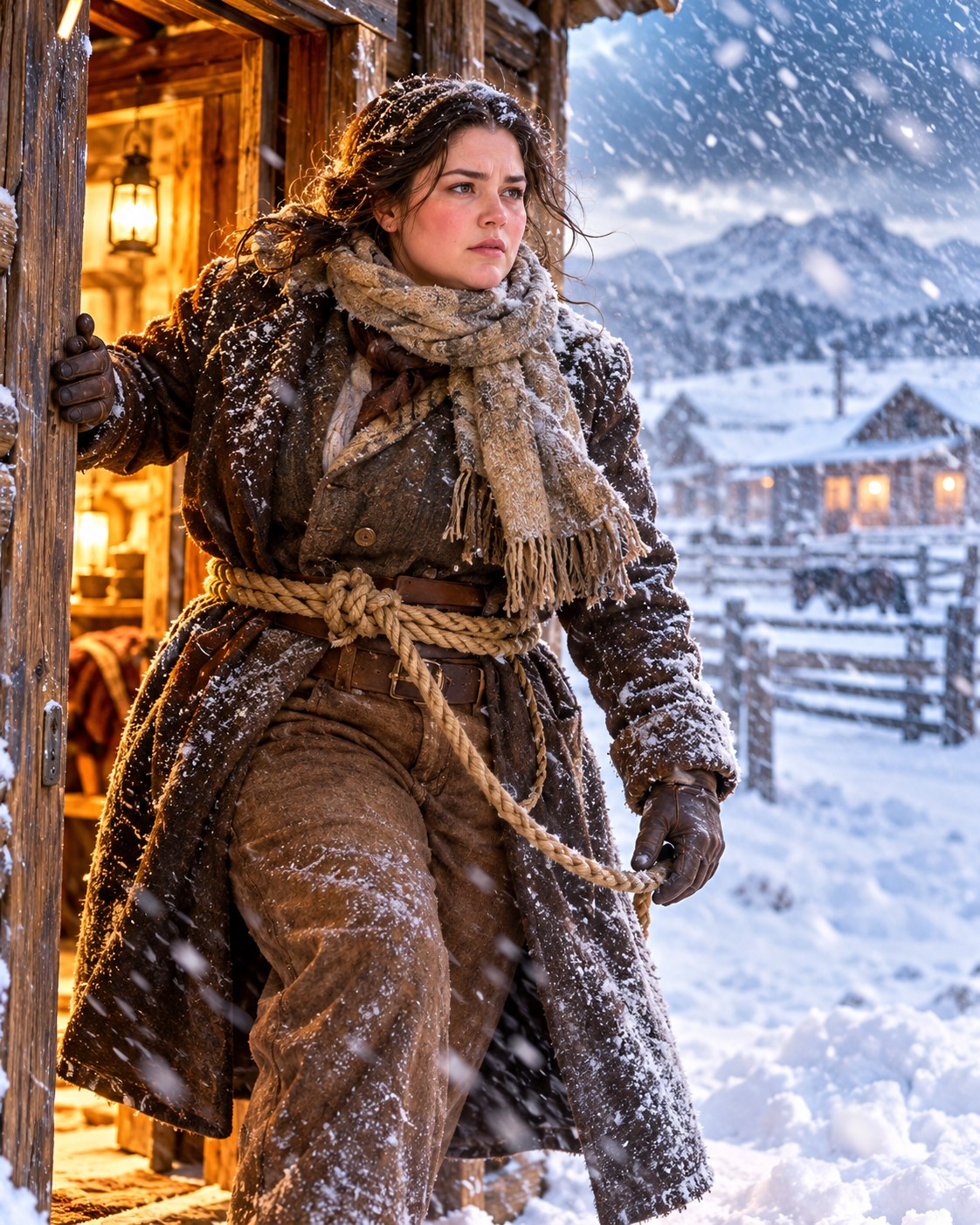
"That envelope belongs to my wife," Calvin Brooks said, blocking the doorway.
The stranger standing on his porch did not move.
"Then perhaps you ought to let her decide whether she wants to open it."
Calvin's fingers tightened around the edge of the door.
It was nearly midnight. A bitter Wyoming wind pushed against the house, carrying the smell of approaching frost. The stranger wore a dark traveling coat, polished boots, and a hat too expensive for a man accustomed to ranch work.
He looked like someone who had stepped off a Chicago train and immediately regretted the journey.
"Who are you?" Calvin demanded.
"Edwin Mercer. Attorney for Arthur Whitcomb."
Calvin's stomach tightened.
Henrietta's father.
The man whose money had saved Broken Spur Ranch.
"What does Whitcomb want now?"
Mercer glanced at the sealed envelope in his hand.
"That is a matter for his daughter."
"She's asleep."
"Then I'll wait."
"You're not waiting in my house."
Mercer studied him.
"Mr. Brooks, I've traveled nearly seventeen hundred miles to deliver this document. I assure you, I'm not leaving because you've decided to be unpleasant."
Calvin took a step forward.
Mercer did not retreat.
Instead, he lowered his voice.
"Your father-in-law instructed me to place this envelope directly into Mrs. Brooks's hands. He was quite specific."
"About what?"
"About not allowing you to intercept it."
For a moment, Calvin could only stare.
Then a quiet voice came from behind him.
"Is something wrong?"
Henrietta stood at the foot of the staircase.
She had changed into a modest blue nightdress beneath a heavy wool dressing gown. Her copper-red hair hung in a loose braid over one shoulder. One hand rested against the banister, while the other held her cane.
She looked exhausted.
The journey had left shadows beneath her eyes, and the strain of standing was already visible in her posture.
Calvin turned.
"Go back to bed."
Henrietta looked past him.
Her expression changed when she recognized the stranger.
"Mr. Mercer?"
The attorney removed his hat.
"Good evening, Miss Whitcomb."
He caught himself.
"Forgive me. Mrs. Brooks."
Henrietta descended the final step.
"What are you doing here?"
"Your father asked me to deliver something."
She looked at the envelope.
For the first time that evening, Calvin saw genuine apprehension cross her face.
"Has something happened to him?"
"No, ma'am. Your father is quite well."
Henrietta released a breath.
Mercer held out the envelope.
"He instructed me to give you this after the marriage ceremony."
Calvin moved aside reluctantly.
Henrietta accepted the letter.
Her father's handwriting was unmistakable.
For Henrietta. Not Calvin.
She stared at those four words.
Arthur Whitcomb had never been sentimental. He rarely wrote to his daughter unless he needed information about household expenses or wanted her to arrange some social obligation.
A private letter delivered by an attorney was unusual.
A private letter delivered in the middle of the night was worse.
"Would you like to sit down?" Mercer asked.
Henrietta nodded.
"Yes. Thank you."
She moved toward the kitchen table.
Calvin watched her carefully.
Each step required concentration. She placed her cane before moving her left foot, then shifted her weight slowly.
He had noticed her difficulty earlier.
He had not realized how much pain she was hiding.
Mercer pulled out a chair.
Henrietta sat with a quiet sigh.
Calvin remained standing.
"Open it," he said.
Henrietta looked up.
"Excuse me?"
"The letter."
"I know what it is."
"Then let's hear what your father has to say."
Mercer's expression hardened.
"Mr. Brooks, this is private correspondence."
Calvin gave a bitter laugh.
"There's nothing private about a marriage bought with five thousand dollars."
Henrietta lowered her eyes.
Mercer looked at her.
"Mrs. Brooks, would you prefer that your husband leave the room?"
The question surprised her.
For a moment, she considered saying yes.
But she had already begun to understand the rules of this house.
Calvin did not want her affection.
He did not want her company.
He certainly did not want secrets.
And Henrietta had no desire to begin her marriage with another argument.
"No," she said quietly. "He may stay."
She broke the seal.
Inside were two folded sheets of paper.
The first was a letter.
The second appeared to be a legal document.
Henrietta unfolded the letter.
Her father's words were brief.
Henrietta,
You have entered an arrangement that should provide the stability you have failed to secure for yourself.
As agreed, five thousand dollars has been transferred to satisfy Mr. Brooks's immediate obligations.
I have also authorized Mr. Mercer to establish a separate account in your name containing fifteen hundred dollars.
This money is not part of the marriage settlement. It is intended for your personal needs and must not be used to pay your husband's debts.
You will receive access to the account upon presentation of the enclosed documentation.
I expect you to conduct yourself respectably and avoid causing embarrassment to the family.
Arthur Whitcomb.
Henrietta read the letter twice.
Fifteen hundred dollars.
Her father had given her money of her own.
It should have felt like kindness.
But even in this final gesture, Arthur had found a way to remind her that she was an embarrassment.
She folded the paper carefully.
Calvin watched her.
"Well?"
Henrietta looked up.
"My father has arranged a personal account for me."
"How much?"
She hesitated.
"Fifteen hundred dollars."
Calvin went still.
Mercer spoke before he could respond.
"The account belongs exclusively to Mrs. Brooks. It is separate from the funds transferred to the bank."
Calvin's eyes narrowed.
"Whitcomb had another fifteen hundred dollars sitting around?"
"Mr. Whitcomb has considerably more than that."
"Then why didn't he use it to settle the rest of my debts?"
Henrietta looked at him.
There it was again.
Not concern for her.
Not curiosity about whether she had been given enough money to care for herself.
Only the ranch.
Always the ranch.
Mercer closed his document case.
"Because, Mr. Brooks, the additional funds were not yours."
Calvin's face darkened.
"You're standing in my house."
"And speaking to a woman whose financial independence I am legally obligated to protect."
Henrietta raised one hand.
"Please."
Both men stopped.
She looked at Mercer.
"Thank you for bringing this."
He inclined his head.
"Your father also asked me to explain the terms."
Henrietta unfolded the second document.
It identified her as the sole beneficiary of the account.
Withdrawals required her signature.
No other person, including her husband, could access the money without her written authorization.
Calvin read over her shoulder.
His expression grew increasingly cold.
Finally, he stepped away.
"Your father certainly knows how to make a man feel trusted."
Mercer answered evenly.
"Your father-in-law knows how to protect an investment."
Henrietta flinched.
The attorney noticed.
For the first time, he seemed embarrassed.
"Forgive me, Mrs. Brooks. That was poorly expressed."
She gave a small nod.
"It's all right."
But it wasn't.
She was tired of hearing people discuss her life as though it were a transaction.
Five thousand dollars for a husband.
Fifteen hundred dollars for her maintenance.
A signed certificate to prove the arrangement was legitimate.
She wondered whether anyone had considered what it might cost her.
Mercer left shortly after midnight.
Before departing, he placed a small leather folder beside Henrietta.
"Your account papers. Keep them somewhere safe."
"I will."
He hesitated.
"Mrs. Brooks, if you ever require legal assistance, you may write to my office."
Calvin stood near the doorway.
"She won't need it."
Mercer ignored him.
"Do you understand?"
Henrietta met his eyes.
"Yes, Mr. Mercer."
The attorney nodded.
Then he was gone.
Calvin shut the door harder than necessary.
For several seconds, neither husband nor wife spoke.
Henrietta began gathering the papers.
Calvin watched her.
"Did you know about the money?"
"No."
"You're telling me your father never mentioned it?"
"That's correct."
He folded his arms.
"Convenient."
Henrietta stopped.
"Are you accusing me of something?"
"I'm asking a question."
"And I've answered it."
Calvin looked toward the leather folder.
"Fifteen hundred dollars could repair the north fence, replace the feed wagon, and buy enough hay to get us through winter."
Henrietta said nothing.
He continued.
"That money could make a difference here."
"I understand."
"Do you?"
She looked up.
Her voice remained quiet.
"Mr. Brooks, I understand that your ranch needs money. I also understand that my father has already provided five thousand dollars to save it."
Calvin's jaw tightened.
"That money settled the bank."
"And the additional money belongs to me."
The words surprised both of them.
Henrietta had not intended to sound defiant.
But she was suddenly very tired.
Calvin stared at her.
"So that's how it's going to be?"
She frowned.
"What do you mean?"
"You've got your own little fortune, and I'm supposed to pretend this place isn't falling apart?"
Henrietta took a slow breath.
"I haven't refused to help."
"Then what are you saying?"
"I'm saying that I would like to understand the ranch's finances before deciding how to use money that has been placed in my care."
Calvin laughed sharply.
"You're going to inspect my books?"
"If necessary."
"You're a city woman."
"Yes."
"You don't know the first thing about ranching."
"No," Henrietta agreed. "But I know something about accounts."
Calvin stared at her.
She held his gaze.
For the first time since the wedding, she did not look away.
Then he shook his head.
"Keep your money."
He turned toward the stairs.
"I don't need charity from my wife."
Henrietta watched him go.
Only after his bedroom door closed did she whisper, "You already accepted it."
The next morning, Henrietta woke before sunrise.
Her body felt as though someone had filled her joints with broken glass.
She lay still for several minutes, waiting for the worst stiffness to ease.
Then she slowly sat up.
She had learned long ago that rushing made the pain worse.
Her left knee was swollen from the journey.
Her hips ached.
Even her fingers felt stiff.
She rubbed her hands together before reaching for the cane beside the bed.
Outside, a rooster crowed.
Somewhere below, a door slammed.
Calvin was already awake.
Henrietta dressed carefully.
She chose a plain gray skirt, a cream blouse, and a dark blue wool cardigan.
She pinned her hair into a practical bun.
Then she made her way downstairs.
The kitchen was empty.
Calvin's plate from the previous night had been left on the table.
A cold cup of coffee stood beside it.
Henrietta looked toward the stove.
The fire had nearly gone out.
She had never managed a ranch stove before.
In Chicago, servants handled such things.
But she had watched the cook often enough to understand the basics.
She opened the iron door, adjusted the damper, and carefully added kindling.
Smoke rolled into her face.
She coughed.
The fire refused to catch.
She tried again.
This time, the kindling ignited.
A small flame appeared.
Henrietta smiled despite herself.
"Well," she murmured, "that's one victory."
By seven o'clock, she had boiled water, made coffee, and prepared a pan of biscuits.
They were better than the previous night's attempt.
She had also discovered that the flour container was nearly empty and the sugar had hardened into a solid lump.
She made a note of both.
Calvin entered just as she was placing breakfast on the table.
He stopped.
"What are you doing?"
"Breakfast."
"I told you not to wait on me."
"I didn't. I was hungry."
He looked at the food.
Then at her.
She gestured toward the chair.
"There's enough for two."
Calvin hesitated.
Finally, he sat.
Henrietta poured coffee.
He tasted it.
His eyebrows lifted slightly.
She noticed.
"Is it too strong?"
"No."
"Too weak?"
"No."
"Then I suppose it's acceptable."
He glanced at her.
For a moment, she thought he might smile.
Instead, he reached for a biscuit.
They ate in silence.
But Calvin finished everything on his plate.
And when he stood, he took one more biscuit from the pan.
Henrietta watched him slip it into his coat pocket.
He noticed her looking.
"What?"
"Nothing."
He cleared his throat.
"I'll be out most of the day."
"Will you return for supper?"
"Probably."
"What time?"
"Depends on the work."
Henrietta nodded.
"I'll keep something warm."
He moved toward the door.
Then stopped.
"Don't go wandering around the property."
She looked up.
"Why?"
"Broken fences. Loose boards. Horses that don't know you. Plenty of ways to get hurt."
"I'll be careful."
"Just stay close to the house."
He left before she could answer.
Henrietta listened to his footsteps cross the porch.
Then she looked around the kitchen.
The dirty windows.
The dusty shelves.
The cracked plaster.
The cupboard doors hanging crookedly from their hinges.
There was more than enough work inside the house to occupy her.
She rolled up her sleeves.
And began.
By noon, Henrietta had washed the kitchen curtains, scrubbed the counters, and organized three cupboards.
Her back ached.
Her knees throbbed.
She had to sit frequently.
But she discovered that work made the house feel less foreign.
Every clean shelf was a small claim of belonging.
Every repaired drawer made the place seem more welcoming.
She found old newspapers beneath the sink.
A broken measuring cup.
Three jars of spoiled preserves.
And a wooden recipe box filled with handwritten cards.
The handwriting was delicate.
Apple cake.
Sunday biscuits.
Beef stew.
At the bottom of the box was a faded photograph.
A woman stood on the porch of Broken Spur Ranch, smiling beside a young boy.
The boy looked about ten.
His dark hair was untidy.
His grin was enormous.
Henrietta recognized his eyes immediately.
Calvin.
She studied the woman.
She was slender, with gentle features and a bright smile.
On the back of the photograph, someone had written:
Calvin and Mama. Summer, 1878.
Henrietta traced the words with her thumb.
For the first time, she saw evidence that her husband had once been a happy child.
She placed the photograph carefully on the mantel.
Then she returned to work.
Sam Pike arrived shortly after two.
He knocked before entering.
Henrietta opened the door.
"Good afternoon, Sam."
The older man removed his hat.
"Afternoon, Mrs. Brooks. Mr. Brooks asked me to bring in some firewood."
"That's very kind."
Sam stepped inside carrying an armful of logs.
He stopped when he saw the kitchen.
"Well, I'll be."
Henrietta looked embarrassed.
"Is something wrong?"
"Ma'am, I haven't seen this room look so clean in ten years."
She smiled.
"I've only started."
Sam shook his head.
"Mrs. Brooks, you've done more in one morning than most folks would do in a week."
She laughed softly.
"Then most folks must be wiser about pacing themselves."
Sam noticed the way she leaned against the counter.
"You ought to sit down."
"I will in a moment."
He stacked the firewood beside the stove.
Then his eyes moved toward the mantel.
He froze.
Henrietta followed his gaze.
"The photograph?"
Sam nodded slowly.
"Where'd you find that?"
"In a recipe box."
He approached the mantel.
For a long moment, he said nothing.
Then he picked up the picture.
"That's Miss Eleanor."
"Calvin's mother?"
"Yes, ma'am."
Henrietta watched his face.
"You knew her?"
Sam smiled sadly.
"Worked for the family since before Calvin could walk. She was a fine woman."
"What happened to her?"
The smile disappeared.
Sam returned the photograph to the mantel.
"Fever took her. Calvin was seventeen."
"I'm sorry."
"His father never recovered."
Henrietta looked toward the photograph.
"And Calvin?"
Sam hesitated.
"Mr. Brooks learned young that loving something doesn't mean you get to keep it."
The words settled heavily between them.
Henrietta thought of Calvin's coldness.
His refusal to acknowledge their marriage.
His determination to keep her at a distance.
For the first time, she wondered whether his cruelty had roots deeper than pride.
Sam cleared his throat.
"Best not mention I told you that."
"I won't."
He turned toward the door.
Then stopped.
"Mrs. Brooks?"
"Yes?"
"Don't let him make you believe you're unwelcome here."
Henrietta stared at him.
Sam's expression was earnest.
"This ranch has needed someone who cares about it for a long time."
She felt her throat tighten.
"Thank you, Sam."
He nodded.
Then he left.
Henrietta stood beside the mantel for several minutes.
She looked at the photograph of Calvin and his mother.
Then she looked around the neglected house.
Perhaps Broken Spur had been waiting for someone to love it.
And perhaps she had been waiting for somewhere to put all the love she had never been allowed to give.
That evening, Calvin returned to find the kitchen smelling of beef stew.
The table had been scrubbed.
Fresh curtains hung at the windows.
A small vase of dried wildflowers stood beside the lamp.
He stopped in the doorway.
Henrietta was standing near the stove.
She looked tired.
Her face was flushed, and one hand rested against her lower back.
But when she saw him, she smiled.
"Good evening."
Calvin glanced around.
"What happened in here?"
"I cleaned."
"I can see that."
"Do you dislike it?"
He looked at the curtains.
Then the table.
Then the vase.
"No."
Henrietta waited.
He removed his coat.
"Smells good."
Her smile widened slightly.
"There's stew."
He sat.
She served him a generous portion.
Calvin tasted it.
Then took another spoonful.
And another.
Henrietta watched him.
"Is it all right?"
He nodded.
"It's good."
The words were so unexpected that she almost dropped her spoon.
"Thank you."
Calvin looked down.
They ate quietly.
For a few minutes, the room felt almost peaceful.
Then Calvin noticed the photograph on the mantel.
His spoon stopped halfway to his mouth.
"Where did you get that?"
Henrietta followed his gaze.
"The photograph? I found it in your mother's recipe box."
His expression changed.
"Who told you that was my mother?"
"Sam mentioned it."
Calvin set down his spoon.
"Sam talks too much."
Henrietta frowned.
"He was only being kind."
"I don't need him discussing my family."
"I didn't ask him to."
Calvin stood.
"That picture was put away for a reason."
Henrietta felt her face grow warm.
"I'm sorry. I thought—"
"Don't."
He crossed the room and took the photograph from the mantel.
For a moment, he stared at it.
His expression softened.
Then he turned it facedown.
"Don't go through my things."
Henrietta looked at him.
"I was cleaning the kitchen."
"Then clean the kitchen. Leave the past alone."
She lowered her eyes.
"Very well."
Calvin carried the photograph upstairs.
Henrietta remained at the table.
Her stew grew cold.
When he returned several minutes later, she had cleared his plate.
He looked toward her.
"Henrietta."
She stopped.
It was the first time he had used her name without irritation.
"Yes?"
He hesitated.
For one brief moment, she saw something like regret in his expression.
Then it vanished.
"Next time you find something personal, leave it where it is."
Henrietta nodded.
"Of course, Mr. Brooks."
She turned back toward the sink.
Behind her, Calvin stood silently.
He had wanted to say something else.
He wasn't sure what.
And by the time he found the courage, she had already begun washing the dishes.
Over the next several days, Henrietta learned the rhythm of Broken Spur.
Calvin rose before dawn.
Sam arrived shortly afterward.
The men worked until evening, repairing fences, tending cattle, and struggling to prepare the ranch for winter.
Henrietta remained near the house.
She cleaned.
She cooked.
She washed clothes in water heated on the stove.
She patched torn curtains and repaired a broken chair with glue and clamps Sam found in the shed.
Every task required more effort than it would have for another woman.
Some mornings, her joints were so stiff that she could barely close her fingers.
Other afternoons, the pain in her knees forced her to sit for an hour before continuing.
But she refused to complain.
She had spent too many years listening to people describe what she couldn't do.
She wanted, desperately, to discover what she could.
Calvin noticed the changes.
He noticed the fresh bread.
The clean laundry.
The repaired furniture.
The warm kitchen.
But he did not know how to acknowledge them.
He had spent years living alone.
He had learned to survive without comfort.
And now comfort had arrived in the form of a woman he had never intended to love.
It unsettled him.
So he said nothing.
Henrietta learned not to expect thanks.
But she continued anyway.
On the sixth evening, she discovered the ranch ledgers.
They were stacked in a wooden cabinet beside the sitting room fireplace.
She had been searching for spare paper when she found them.
Three thick books.
A collection of receipts.
Several envelopes from the bank.
Henrietta hesitated.
Calvin had warned her not to touch his personal belongings.
But these were not family photographs.
They were business records.
And business records were something she understood.
She opened the first ledger.
The handwriting was untidy.
The entries were inconsistent.
Several expenses had been recorded twice.
Henrietta frowned.
She turned another page.
Then another.
The longer she studied the figures, the more troubled she became.
Something was wrong.
Not merely careless.
Wrong.
She found a receipt for cattle feed purchased in September.
Then she found the same amount entered again in October.
A payment to a livestock buyer appeared under two different dates.
A repair expense had been deducted from the ranch account even though the accompanying receipt showed that the supplier had already issued a refund.
Henrietta reached for a pencil.
She began calculating.
One column.
Then another.
By the time the kitchen clock struck ten, she had filled three pages with corrections.
She sat back slowly.
Her heart was beating faster.
The errors were costing Broken Spur money.
Real money.
Money Calvin could not afford to lose.
She checked the figures again.
Then a third time.
The totals remained the same.
Henrietta stared at the ledger.
She had spent years managing household accounts in Chicago.
She knew what ordinary mistakes looked like.
Some of these entries could be explained by carelessness.
Others could not.
She turned to the final page.
There, beneath a list of payments, she found a signature.
Not Calvin's.
Not Sam's.
Someone else had been approving transactions.
Henrietta leaned closer.
The signature was difficult to read.
She adjusted the lamp.
Then she recognized the name.
Her stomach tightened.
It was the same name Calvin had seen on the bank's midnight notice.
The same name connected to the mysterious claim against Broken Spur Ranch.
Henrietta reached for the letter her father had sent.
She unfolded it beside the ledger.
Something about the figures suddenly made sense.
But before she could examine them further, she heard footsteps on the porch.
Heavy footsteps.
Then Calvin's voice.
Angry.
"How much did you say?"
A second man answered.
Henrietta could not hear the words.
She closed the ledger halfway.
Calvin spoke again.
"That debt was supposed to be settled."
The other man laughed.
Henrietta recognized the voice.
She had heard it once before, outside the courthouse.
The banker.
The man who had nearly taken Broken Spur.
She stood slowly, gripping the edge of the table.
Outside, the conversation grew louder.
Then the banker said something that made her blood turn cold.
"Your wife's father paid the first five thousand, Brooks. But there's another five thousand due, and this time I don't think your little marriage arrangement is going to save you."
Henrietta looked down at the open ledger.
Her pencil rested beside a column of suspicious payments.
She heard Calvin move toward the door.
Then the banker spoke again.
"Before you threaten me, there's something you ought to know about that woman you married."
Henrietta froze.
The front door handle turned.
Calvin's voice came through the wood.
"What about my wife?"
The banker lowered his voice.
"Ask her why Arthur Whitcomb really sent her out here."
The door began to open.
And Henrietta realized the man outside knew something about her marriage that even she had never been told.






Comments 0