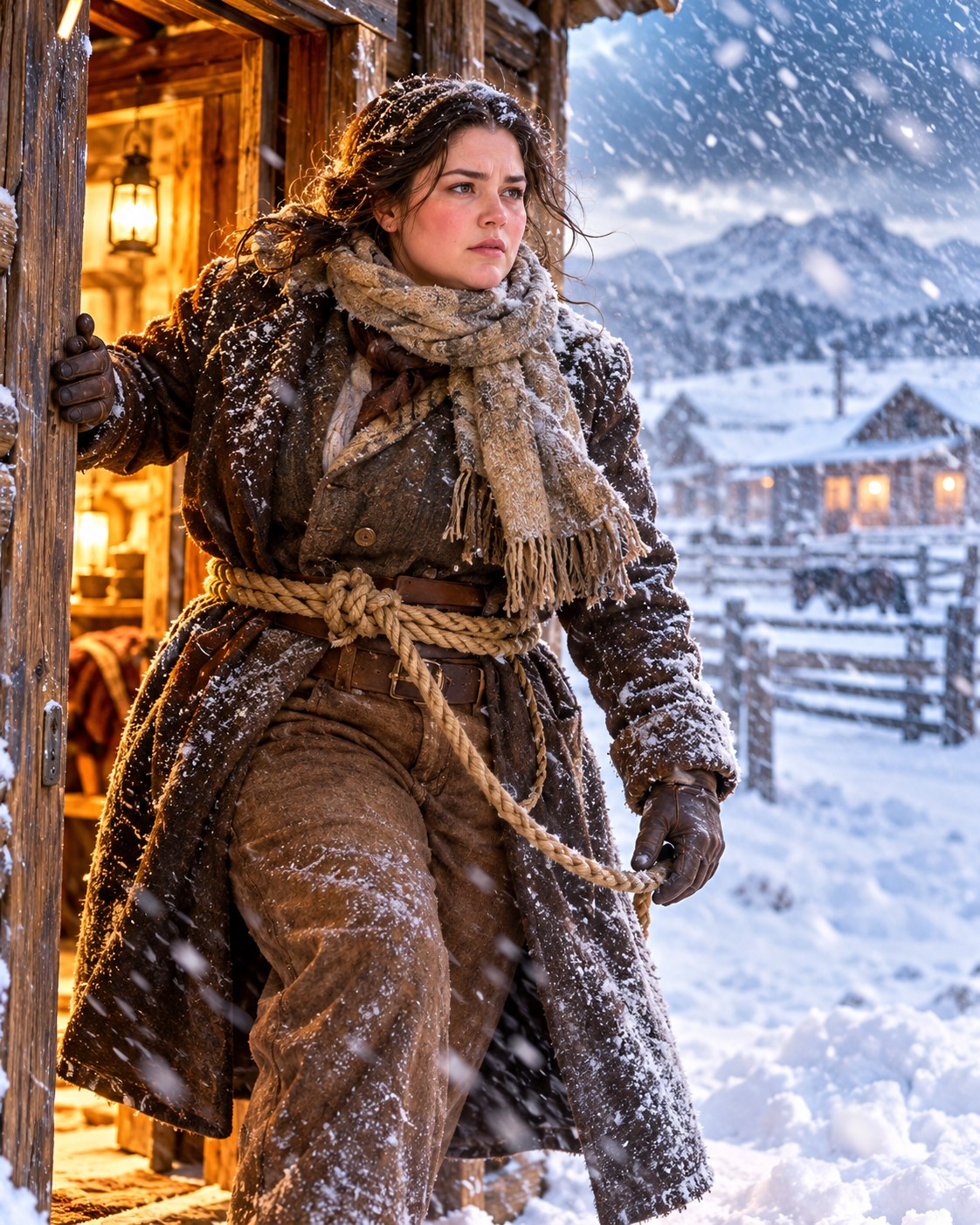
Henrietta Brooks had spent thirty-eight years believing her father possessed the power to decide what happened to her.
He had chosen her schools.
Her clothes.
Her friends.
He had decided which rooms she could enter when important guests visited and which conversations were too serious for a daughter who, in his opinion, would never have a proper place in society.
Then he had arranged her marriage to a stranger in Wyoming for five thousand dollars.
But standing inside the warm kitchen of Broken Spur Ranch, with her injured husband resting in the next room and her stepmother trembling beside the stove, Henrietta realized something extraordinary.
Arthur Whitcomb no longer frightened her.
Not even when he arrived with armed men.
Not even when he brought a man everyone believed had been murdered.
She looked toward the locked door.
"Nathaniel Price?" she called.
A pause followed.
Then the voice answered.
"Yes, Mrs. Brooks."
Henrietta glanced at Beatrice.
Her stepmother looked as though she might faint.
"That's impossible," Beatrice whispered.
Henrietta turned back toward the door.
"Deputy Reed!" she called.
From the rear hallway came the sound of hurried footsteps.
Thomas Reed appeared, his revolver drawn.
He had returned earlier that evening to examine the evidence and had been speaking with Sam in the back room.
"What is it?"
Henrietta pointed toward the entrance.
"My father is outside. He has armed men with him."
Reed's expression hardened.
"How many?"
"At least three."
"And Nathaniel Price?"
Henrietta swallowed.
"Apparently, he's alive."
The deputy stared.
Then he moved toward the door.
"Mr. Whitcomb!" he shouted. "This is Deputy Marshal Thomas Reed. Have your men put down their weapons."
Arthur's voice came through the wood.
"Deputy, this is a family matter."
"No, sir. Not anymore."
A long silence followed.
Then Arthur answered.
"Very well."
Reed looked at Henrietta.
"Stay behind me."
She nodded.
He lifted the wooden bar.
And opened the door.
Arthur Whitcomb stood beneath the porch lantern wearing an expensive black overcoat.
His silver hair was neatly combed.
His leather gloves looked untouched by the storm.
Behind him waited three men.
Two carried rifles.
The third stood between them, wrapped in a heavy wool coat, his face partly concealed by a scarf.
Arthur looked past the deputy.
His eyes found Henrietta.
"Well," he said. "You look dreadful."
Henrietta almost laughed.
Four miles through a blizzard.
A swollen knee.
Frost-injured fingers.
A husband who had nearly died in her arms.
And her father was concerned about her appearance.
"Good evening, Father."
Arthur frowned.
"Don't take that tone."
Henrietta held his gaze.
"Then don't insult me in my own home."
Something changed in his expression.
He had never heard her speak to him that way.
Reed stepped forward.
"Your men will leave their rifles on the porch."
Arthur hesitated.
Then nodded.
The men complied.
"Now," Reed said, "who is Nathaniel Price?"
The third man slowly lowered his scarf.
Henrietta stared.
His face was thin.
A pale scar crossed his jaw.
He looked exhausted.
But he was unmistakably alive.
"My name is Nathaniel Price," he said.
Deputy Reed went still.
"You're the man Calvin Brooks was accused of murdering."
Price nodded.
"Yes."
Henrietta gripped the doorframe.
"Then who was killed on October seventeenth?"
Price lowered his eyes.
"That," he said, "is what I've come to explain."
They gathered in the kitchen.
Arthur sat at the head of the table as though he owned the house.
Henrietta deliberately took the chair opposite him.
Deputy Reed remained standing.
Sam Pike sat near the stove, his wounded arm in a sling.
Beatrice stood beside the window.
Nathaniel Price removed his coat.
He looked at Henrietta.
"Your husband tried to save my life."
She stared.
"Then why did everyone believe you were dead?"
Price swallowed.
"Because someone else died in my place."
The room fell silent.
He explained that on October seventeenth, he had gone to meet Calvin near the old freight road.
He had carried original loan documents proving that Walter Hargrove had falsified accounts to force ranchers into foreclosure.
But Silas Vane had followed him.
"Vane fired at me," Price said. "The bullet struck my shoulder. I fell beside the road."
Henrietta remembered Calvin's account.
He had seen Price fall.
He had believed the shot was fatal.
Price continued.
"Vane struck Mr. Brooks with his revolver. While your husband was unconscious, I crawled into the drainage ditch."
Reed leaned forward.
"And the dead man?"
Price closed his eyes.
"Elias Turner's younger brother, Daniel."
Henrietta felt sick.
"The wagon driver's brother?"
Price nodded.
"Daniel had been helping me collect evidence. He arrived after the shooting. Vane caught him before he could reach me."
His voice broke.
"Vane killed him."
Nobody spoke.
Price looked down at his hands.
"They dressed Daniel in my spare coat and left his body near the freight road. His face had been badly injured. Hargrove arranged for the identification."
Reed's jaw tightened.
"And Elias Turner?"
"He was threatened. His brother was already dead. Vane told him that if he didn't testify against Calvin, the rest of his family would suffer."
Henrietta remembered the frightened wagon driver.
His changing story.
The stranger with the silver-handled walking stick.
At last, it made sense.
"Where have you been?" she asked.
"Hidden in a railroad workers' boardinghouse outside Laramie. I was afraid to come forward until I had enough proof."
Arthur cleared his throat.
"Price came to me because he knew I could arrange a safe return."
Henrietta turned toward him.
"Did he?"
Her father frowned.
"Of course."
She looked at Price.
"Did you come to my father voluntarily?"
Price hesitated.
Arthur's expression hardened.
"Answer her."
Henrietta leaned forward.
"Mr. Price, you are in a house with a deputy marshal. You can tell the truth."
Price looked at Reed.
Then quietly answered.
"No."
Arthur went still.
Price continued.
"Mr. Whitcomb's men found me two days ago. They brought me here because Arthur wanted me to sign a statement clearing him of any involvement."
Henrietta stared at her father.
Arthur's face reddened.
"That's a distortion."
"Is it?" Henrietta asked.
"Henrietta, you have no understanding of the complications involved."
She reached into her pocket.
Then placed his letter on the table.
If Brooks refuses, use the wife.
Arthur stared at it.
For the first time, he looked uncertain.
"Where did you get that?"
"Beatrice."
His eyes snapped toward his wife.
Beatrice lowered her head.
Arthur rose.
"You foolish woman."
Reed stepped between them.
"Sit down, Mr. Whitcomb."
Arthur glared at him.
"You have no authority to—"
"I have evidence of conspiracy, fraud, witness intimidation, and an attempted unlawful transfer of property."
Reed placed the forged deed beside the letter.
"And I have a seriously injured rancher who can identify the man who shot him."
Arthur stared.
Henrietta watched his face.
The confidence was disappearing.
For years, he had believed money could settle anything.
Now the papers were speaking louder than he could.
The investigation did not end that night.
It took weeks.
But for the first time, the truth was moving toward daylight instead of being buried beneath threats and forged signatures.
Deputy Reed placed Arthur Whitcomb under arrest on suspicion of conspiracy and fraud, pending formal charges. His armed escorts surrendered their weapons and were detained for questioning.
Nathaniel Price gave a sworn statement.
Beatrice provided copies of correspondence between Arthur, Hargrove, and Western Continental Development.
Sam identified Vane as the man who had shot him in the kitchen.
And when the weather finally cleared, Reed led a search party to the old line shack near the ravine.
Beneath a loose floorboard, exactly where Calvin said they would be, the deputies found the original loan documents.
The papers showed that Broken Spur had been charged for payments it had already made.
They showed unauthorized fees.
Duplicated interest.
Altered signatures.
And an agreement between Arthur Whitcomb and Walter Hargrove to acquire ranchland along the proposed railroad route.
Henrietta examined every page.
Her careful bookkeeping, once dismissed as an unnecessary hobby, became essential to the case.
She matched entries from Hargrove's private ledger to Calvin's receipts.
She identified the forged signatures.
She reconstructed the missing credits.
And she prepared a complete account for Edwin Mercer and the attorneys handling the prosecution.
When Mercer arrived from Cheyenne, he studied her calculations for nearly an hour.
Then he looked up.
"Mrs. Brooks, this is extraordinary work."
Henrietta smiled faintly.
"It's arithmetic, Mr. Mercer."
"No," he replied. "It's the difference between suspicion and proof."
For the first time in her life, Henrietta did not feel the need to minimize her abilities.
She simply nodded.
"Then let's make sure the proof is used."
Walter Hargrove was arrested three days later.
He had attempted to leave Wyoming under another name, carrying cash and a packet of securities.
But the railroad company's own records contradicted his statements, and several former employees agreed to testify after learning that Nathaniel Price was alive.
Silas Vane proved harder to find.
For a week, there was no sign of him.
Then a rancher reported a wounded stranger seeking shelter near the Colorado border.
Deputies followed the report.
Vane was captured in an abandoned freight shed, carrying the silver-handled walking stick Henrietta would never forget.
He tried to deny everything.
But Price identified him.
Calvin identified him.
Sam identified him.
And the recovered records tied him to payments made on the dates of both shootings.
The murder of Daniel Turner was finally acknowledged.
His brother Elias, no longer threatened into silence, gave the complete account of what Vane had forced him to say.
Calvin's murder charge was dismissed.
His name was cleared.
Arthur and Hargrove faced prosecution for their roles in the fraud and conspiracy, while Vane faced the murder and assault charges.
The criminal proceedings would take time, but the immediate danger to Broken Spur was over.
And the forged property transfer was declared invalid.
The ranch still belonged to Calvin Brooks.
Calvin's recovery was slower than either of them wanted.
The broken leg required weeks of rest.
The gunshot wound healed gradually.
His hands remained tender from the cold.
There were nights when pain kept him awake and mornings when he grew frustrated because he could not walk across his own bedroom without assistance.
Henrietta knew that frustration.
She had lived with painful joints for years.
So when Calvin cursed beneath his breath after struggling to stand, she did not scold him.
She simply handed him his cane.
He looked at it.
Then at her.
"Never thought I'd need one of these."
Henrietta raised an eyebrow.
"Neither did I."
He smiled.
"Does it get easier?"
"Some days."
"And the other days?"
"You learn to be patient."
Calvin sighed.
"That may be harder than the broken leg."
Henrietta laughed.
He watched her.
Then reached for her hand.
"Thank you."
She smiled.
"For the cane?"
"For everything."
She sat beside him.
"Calvin, you don't have to thank me every morning."
He looked serious.
"I spent too long not thanking you at all."
Henrietta's expression softened.
He continued.
"I don't want you to forget how much you mean to me."
She touched his cheek.
"Then show me."
Calvin smiled.
"I intend to."
And he did.
Not with grand speeches.
Not with expensive gifts.
But with the ordinary kindness he had once withheld.
He asked whether her knee hurt before suggesting a walk.
He brought her tea when she worked late over the accounts.
He listened when she spoke.
And when she disagreed with him, he did not treat it as a challenge to his authority.
He treated it as a conversation with his wife.
Sometimes they argued.
Calvin was still stubborn.
Henrietta was still determined.
But their disagreements no longer ended with silence and slammed doors.
They ended with explanations.
Apologies.
And, more often than either expected, laughter.
One afternoon in early spring, Henrietta found Calvin standing beside the kitchen window.
He was leaning on his cane.
Outside, the snow had begun to melt.
Water dripped from the barn roof.
The first patches of brown earth appeared along the fence.
Henrietta approached quietly.
"What are you thinking about?"
Calvin looked at her.
"My father."
She waited.
He turned toward the pasture.
"He died in a storm like that one."
"I know."
"For twenty years, I blamed myself."
Henrietta touched his arm.
"Why?"
"Because he went out looking for calves I'd failed to bring in."
His voice grew quiet.
"I thought if I'd been a better son, he would've stayed home."
Henrietta felt her heart ache.
"Calvin..."
He shook his head.
"Sam told me something yesterday."
She waited.
"He said my father didn't ride out because he was angry with me. He went because he loved the ranch and wanted to protect the animals."
Calvin looked at her.
"And Sam said my father told him to look after me."
Henrietta nodded.
"He told me that too."
Calvin swallowed.
"I spent twenty years thinking love meant losing someone."
He turned toward her.
"Then you walked into that storm."
Henrietta smiled faintly.
"Not my wisest decision."
"No."
He reached for her hand.
"But it was the bravest thing anyone has ever done for me."
Her eyes filled.
Calvin continued.
"You taught me something my father never could."
"What?"
"That loving someone doesn't mean pretending you don't need them."
Henrietta leaned against him.
He wrapped one arm around her shoulders.
For a long moment, they watched the snow melt.
Then Calvin kissed her hair.
"I love you, Henrietta."
She smiled.
"I love you too."
The money Arthur Whitcomb had paid to arrange their marriage remained a painful subject.
One evening, Calvin placed the original five-thousand-dollar agreement on the kitchen table.
Henrietta stared at it.
She remembered the courthouse.
Her father's cold expression.
Calvin's distant eyes.
The feeling that she had been handed from one man to another like an unwanted piece of furniture.
Calvin sat beside her.
"I've been thinking about this."
Henrietta looked at the paper.
"So have I."
He took a breath.
"I never should've agreed to it."
She turned toward him.
"Calvin, you were trying to save your ranch."
"I know."
He looked at her.
"But I let your father make me believe I was buying a solution to my problems."
Henrietta lowered her eyes.
"And I let him convince me no one would ever marry me for any other reason."
Calvin reached for her hand.
"Henrietta, look at me."
She did.
His expression was serious.
"I would marry you now if you had nothing."
Her eyes filled.
"No money."
He squeezed her hand.
"No railroad connections. No business arrangements. No promises from your father."
He smiled.
"Just you."
Henrietta swallowed.
"And my bad knee?"
"Especially your bad knee."
She laughed through her tears.
Calvin continued.
"And your stubbornness."
She raised an eyebrow.
"Careful."
"And your terrible habit of being right."
She laughed again.
He leaned closer.
"I would choose you, Henrietta Brooks, every day for the rest of my life."
She pressed her forehead against his.
"Then I choose you too."
Together, they tore the agreement into pieces.
Not because the past had disappeared.
But because it no longer controlled their future.
The financial settlement came several weeks later.
With the forged fees removed and the missing payments credited, the disputed Hargrove debt was substantially reduced. The remaining legitimate obligations were placed on manageable terms, and restitution recovered through the proceedings helped repair the damage caused by the fraudulent accounts.
Broken Spur was no longer facing immediate foreclosure.
Henrietta established a proper bookkeeping system for the ranch.
Calvin insisted she receive an equal voice in its financial decisions.
She refused to accept that merely as a favor.
So they met with Mercer and arranged the necessary documents to recognize her ownership interest.
When the attorney asked Calvin whether he understood what he was signing, Calvin smiled.
"Perfectly."
Mercer glanced at Henrietta.
"And you, Mrs. Brooks?"
She smiled back.
"Better than anyone."
The ranch became theirs in law as well as in life.
Sam Pike recovered from his wound and returned to overseeing the livestock.
He complained constantly about being told to rest.
Henrietta ignored the complaints.
Calvin laughed.
And for the first time in years, Broken Spur began to feel less like a place struggling to survive and more like a home preparing for the future.
Beatrice Whitcomb wrote twice.
Her first letter was full of apologies.
Her second was quieter.
She admitted the ways she had mistreated Henrietta and acknowledged that she had helped Arthur because she valued security and status more than honesty.
Henrietta read both letters.
Then she wrote back.
She did not pretend the past had been harmless.
She did not offer immediate forgiveness.
But she thanked Beatrice for finally telling the truth and made clear that any future relationship would require respect.
As for Arthur, Henrietta received word through Mercer that her father had been formally charged.
He requested a visit.
She declined.
Not out of revenge.
But because she no longer needed his approval.
For the first time, the decision belonged entirely to her.
And she was at peace with it.
By late spring, the hills around Broken Spur had turned green.
The cattle grazed beneath a clear blue sky.
Wildflowers appeared along the creek.
The barn had been repaired.
The accounts were balanced.
And Calvin Brooks had begun walking without his cane for short distances, though he still kept it nearby on difficult days.
One Sunday morning, Henrietta stood before the bedroom mirror fastening the pearl comb that had belonged to her mother.
She wore a simple ivory dress.
Not the expensive gown her father had chosen for the courthouse wedding.
This dress was hers.
She had selected the fabric.
She had sewn the sleeves.
And she had altered the waist herself.
When she turned, Calvin was standing in the doorway.
He wore a dark suit and a clean white shirt.
His hair had been carefully combed.
His expression softened when he saw her.
"Henrietta."
She smiled.
"Do I look all right?"
Calvin stared.
Then shook his head.
"No."
Her smile faltered.
He stepped closer.
"You look beautiful."
Henrietta laughed.
"You frightened me."
He smiled.
"Then I suppose I deserved that."
He reached for her hand.
She looked at him.
"Are you nervous?"
Calvin nodded.
"Terribly."
"Why?"
He swallowed.
"Because the first time I married you, I was too foolish to understand what I was being given."
Henrietta's eyes filled.
"And this time?"
He lifted her hand to his lips.
"This time, I know."
They gathered beneath the old cottonwood tree beside the ranch house.
There were no grand decorations.
No wealthy guests from Chicago.
No elaborate arrangements.
Only wildflowers.
Fresh ribbons.
A wooden table covered with white linen.
And the people who had stood beside them when everything seemed lost.
Sam Pike stood proudly near the front.
Deputy Reed attended in a clean suit.
Dr. Bell arrived with his wife.
Edwin Mercer had traveled from Cheyenne.
Several neighboring ranch families came carrying food, flowers, and warm wishes.
Henrietta had never imagined so many people would gather to celebrate her happiness.
For most of her life, she had been told she was someone to be tolerated.
Someone to be hidden.
Someone a man would marry only for money.
Now she stood beneath the spring sunlight, surrounded by people who wanted to see her loved.
Calvin waited beside the minister.
When Henrietta approached, his eyes filled.
She stopped in front of him.
He took both her hands.
The minister smiled.
"Calvin Brooks, you have asked to renew the vows you made to this woman."
Calvin nodded.
"Yes, sir."
"And do you have something you wish to say?"
Calvin looked at Henrietta.
His voice trembled.
"Henrietta, the first time we stood together before a minister, I thought marriage was a bargain."
A hush settled over the gathering.
He continued.
"I thought I could give you a roof, a name, and protection, and that would be enough."
Henrietta's eyes filled.
"But I was wrong."
He squeezed her hands.
"You gave me a home when I didn't know how to make one."
A tear slipped down her cheek.
"You gave me kindness when I didn't deserve it."
He swallowed.
"And when I was lost in the snow, you came for me."
Henrietta pressed her lips together.
Calvin's voice grew stronger.
"You walked through a storm that could have killed you because you believed my life was worth saving."
He looked directly into her eyes.
"I promise I will never again make you wonder whether you are wanted."
Henrietta began to cry.
Calvin smiled through his own tears.
"I promise to listen when you speak, to stand beside you when life is difficult, and to love you on the days when neither of us is at our best."
He paused.
Then said the words she had once believed she would never hear.
"Henrietta Brooks, you are not a bargain. You are not an obligation. You are not a woman I was forced to marry."
His voice broke.
"You are the woman I choose."
Henrietta squeezed his hands.
"Every day," he whispered. "For the rest of my life."
The minister turned toward her.
"Henrietta?"
She took a trembling breath.
"Calvin, when I first came to Broken Spur, I thought I was arriving at the end of my chances."
She smiled through tears.
"I believed I was too old, too awkward, too difficult, and too much trouble for anyone to love."
Calvin shook his head.
She continued.
"But somewhere between the arguments, the bookkeeping, the terrible suppers you pretended to enjoy, and the mornings when you left extra firewood beside the stove, I began to see the man beneath your fear."
A few guests laughed softly.
Henrietta looked into his eyes.
"I don't promise that life will always be easy."
Calvin smiled.
"Wouldn't believe you if you did."
She laughed.
"But I promise that when it is difficult, I will not turn away from you."
Her voice softened.
"And I promise to let you stand beside me, too."
Calvin's eyes filled.
Henrietta continued.
"I love you, Calvin Brooks. Not because you needed saving. Not because you own this ranch. And not because my father arranged our marriage."
She touched his cheek.
"I love you because I know who you are. And because you have chosen to become the man you always could have been."
The minister smiled.
"Then by the promises you have renewed today, may your marriage continue in love, honesty, and faithfulness."
Calvin leaned toward her.
Henrietta smiled.
And beneath the cottonwood tree, he kissed his bride.
The guests applauded.
Sam Pike wiped his eyes with a handkerchief and loudly insisted that the spring wind was responsible.
Henrietta laughed.
Calvin laughed with her.
And for once, neither of them felt the need to hide their happiness.
That evening, after the guests had gone and the last dishes had been washed, Henrietta stood on the porch.
The sun was setting behind the Wyoming hills.
The sky glowed gold and rose.
A gentle breeze moved through the grass.
Broken Spur lay quiet beneath the evening light.
Calvin stepped outside carrying two cups of tea.
He handed one to her.
"How's your knee?"
"A little sore."
"Want to sit?"
"In a moment."
He stood beside her.
For a while, they watched the sunset.
Then Calvin slipped his arm around her waist.
Henrietta leaned against him.
"Do you ever think about that night?" she asked.
"The blizzard?"
She nodded.
Calvin was quiet.
"Every day."
Henrietta looked up.
"Does it frighten you?"
"Sometimes."
He kissed her forehead.
"But mostly, it reminds me how lucky I am."
She smiled.
Calvin looked toward the pasture.
"I used to think this ranch was everything."
"And now?"
He turned toward her.
"Now I know it's only land."
Henrietta raised an eyebrow.
"Very expensive land."
Calvin laughed.
"Yes, ma'am."
He grew serious.
"But a ranch isn't a home because of the buildings or the fences."
He touched her cheek.
"It's a home because of the people waiting inside."
Henrietta's eyes filled.
She looked toward the kitchen window.
Warm lamplight glowed behind the glass.
The table was set for supper.
A fire burned in the stove.
And for the first time in her life, she knew she belonged exactly where she stood.
Calvin took her hand.
"Come inside, sweetheart."
She smiled.
"In a moment."
He waited.
Henrietta looked at the sunset one last time.
Then she turned toward him.
"Calvin?"
"Yes?"
"Do you regret marrying me?"
He stared at her.
Then gently lifted her hand to his lips.
"Only one thing."
Her smile faded.
"What?"
He looked into her eyes.
"That I wasted so much time before telling you I loved you."
Henrietta felt tears rise.
Calvin smiled.
"But I intend to make up for every day."
She laughed softly.
"That sounds like a very large promise."
"It is."
"Are you certain you can keep it?"
He stepped closer.
"Mrs. Brooks, I've survived a broken leg, a bullet, a blizzard, and your bookkeeping."
Henrietta burst out laughing.
"I believe I can manage loving you."
She wrapped her arms around him.
He held her carefully, mindful of her aching joints and his healing leg.
They stood together beneath the fading sunlight.
Two people who had once believed love was something other people received.
Two people who had been frightened, wounded, and terribly lonely.
Two people who had finally learned that a marriage could be more than a promise written on paper.
At last, Calvin kissed her forehead.
"Ready to go inside?"
Henrietta smiled.
"Yes."
He opened the door.
Warmth spilled across the porch.
She stepped into the house.
Then turned back toward him.
"Coming, Mr. Brooks?"
Calvin smiled.
"Right behind you, Mrs. Brooks."
He followed her inside.
And as he closed the door against the cool spring evening, he took her hand and said the words that would never again be withheld.
"Welcome home, my beautiful bride."






Comments 0