"Calvin Brooks, you are under arrest for the murder of Nathaniel Price."
Deputy Marshal Thomas Reed spoke the words clearly, without raising his voice.
Henrietta felt her fingers go numb around the paper she was holding.
Nathaniel Price.
She had seen that name only the previous evening, written in her father's unmistakable handwriting.
The letter had arrived from Chicago three days earlier, but she had been too frightened to examine its meaning until now.
Arthur Whitcomb had written only one sentence about the man.
If Nathaniel Price approaches your husband, do not allow Calvin to sign anything he brings.
Henrietta had assumed Price was another businessman.
Another creditor.
Another man interested in Broken Spur Ranch.
She had not imagined he would be dead.
And she certainly had not imagined her husband would be accused of killing him.
Calvin stood motionless in the yard.
His work shirt was dusty. His boots were muddy from the morning's chores. A faint bruise remained across his right knuckles from the day he struck Walter Hargrove.
But it was not his appearance that frightened Henrietta.
It was his expression.
For one brief second, Calvin looked genuinely shocked.
Then his face hardened.
"Price is dead?"
Deputy Reed watched him carefully.
"You knew him?"
Calvin hesitated.
"Yes."
"When did you last see him?"
"October seventeenth."
Henrietta's stomach dropped.
That was the night.
The night Calvin had returned home long after dark.
The night he had refused supper.
The night he had washed mud from his coat in the barn and told her not to ask questions.
Reed reached for the handcuffs hanging from his belt.
"Mr. Brooks, I need you to come with me."
Calvin looked at the restraints.
Then at Henrietta.
Something passed between them.
Not affection.
Not trust.
Something closer to warning.
"Go inside," he told her.
Henrietta stared at him.
"What?"
"Go back into the house."
"Calvin, they're accusing you of murder."
"I heard."
"Then tell them what happened."
His jaw tightened.
"Henrietta."
She recognized the tone.
The same cold authority he had used since their wedding.
The voice that told her where to stand, what not to touch, and which questions she was not permitted to ask.
But this time, she did not obey.
"No."
Calvin blinked.
The deputy looked between them.
Henrietta stepped forward, leaning heavily on her cane.
"My husband has not been convicted of anything. Surely he has the right to know what evidence has been presented against him."
Reed studied her.
"Mrs. Brooks, the warrant was issued by a magistrate in Cheyenne."
"On whose testimony?"
The deputy hesitated.
"Several witnesses."
"Names?"
"Ma'am—"
"Please."
Her voice remained steady.
"I understand you have a duty to perform. But my husband has been accused of taking a human life. I would like to know why."
Reed glanced toward the second man standing beside the carriage.
Then he answered.
"Walter Hargrove provided a statement placing your husband near the old freight road on the night of the killing."
Henrietta felt anger rise through her fear.
"Hargrove?"
"Yes."
"The same man my husband struck after he insulted me?"
Reed's expression changed.
"That's not how the incident was described."
"Then it was described incorrectly."
Calvin turned sharply.
"Henrietta, enough."
She looked at him.
"No."
The word came out louder than she intended.
Calvin stared.
She lowered her voice.
"You may not want me involved in your business, Mr. Brooks. But this is no longer a matter of bookkeeping."
For a moment, nobody spoke.
Then Reed cleared his throat.
"Mr. Brooks, turn around, please."
Calvin looked at Henrietta one final time.
She saw something in his eyes that she had never seen before.
Not fear for himself.
Fear for her.
"Stay away from Hargrove," he said quietly.
Then he turned.
The deputy fastened the handcuffs around his wrists.
Henrietta watched the metal close.
And something inside her changed.
Sam Pike came running from the barn when he saw Calvin being led toward the carriage.
"What in God's name is happening?"
"Stay with Henrietta," Calvin ordered.
Sam stopped.
"Mr. Brooks?"
"Do what I said."
The older man looked toward Henrietta.
She stood beside the porch, her face pale but composed.
"Sam," she said, "please saddle the gentlest horse and prepare the wagon."
Calvin turned.
"You're not coming."
Henrietta met his eyes.
"Yes, I am."
"The road to Cheyenne is rough."
"I've traveled it before."
"Your knee—"
"Will hurt whether I stay here or not."
The deputy opened the carriage door.
Calvin's expression hardened.
"This isn't your concern."
Henrietta felt the words strike her.
For weeks, he had told her the ranch was not her concern.
His finances were not her concern.
His past was not her concern.
Now, apparently, even his freedom was not her concern.
She lifted her chin.
"You married me, Calvin Brooks."
His eyes narrowed.
"Don't start."
"You gave me your name."
"Henrietta—"
"And whether you intended to or not, you made your troubles mine."
The deputy looked away.
Sam stood perfectly still.
Calvin stared at her.
She continued quietly.
"I will not stand here and watch an innocent man be taken away simply because he is too proud to accept help."
Calvin's face changed.
"You don't know I'm innocent."
The words stunned her.
For one terrible moment, she could not speak.
Then she asked the question she had been afraid to ask.
"Did you kill Nathaniel Price?"
Calvin looked directly into her eyes.
"No."
She nodded.
"Then I believe you."
He looked away first.
Reed guided him into the carriage.
The door closed.
Henrietta stood beside the porch as the horses began moving.
Calvin looked back through the small window.
She raised one hand.
He did not wave.
But he watched her until the carriage disappeared beyond the gate.
By the time Henrietta reached Cheyenne, her left knee was swollen so badly that she could barely climb down from the wagon.
Sam hurried around to help her.
"Easy, ma'am."
She accepted his arm.
"Thank you."
"You ought to rest."
"After we find Calvin."
They had traveled for hours over uneven ground.
Every rut in the road had sent pain through her hips and knees.
But Henrietta had refused to turn back.
Now the town stood before her, busy with wagons, horses, merchants, and people who had no idea that her husband might be facing the gallows.
Sam led her toward the sheriff's office.
Inside, a young clerk looked up from his desk.
"Can I help you?"
"I'm Mrs. Calvin Brooks."
The clerk's expression changed.
"Oh."
Henrietta noticed.
"My husband was brought here this morning."
"Yes, ma'am."
"I'd like to see him."
The clerk hesitated.
"Visiting hours are limited."
Henrietta placed her leather folder on the counter.
"Then I would like to speak to whoever has the authority to make an exception."
The young man stared at her.
Sam coughed to hide a smile.
A moment later, Deputy Reed emerged from the back room.
"Mrs. Brooks."
"Deputy."
"I wasn't expecting you."
"My husband wasn't expecting to be arrested for murder."
Reed sighed.
"Fair enough."
Henrietta stepped closer.
"May I see him?"
The deputy studied her face.
Then he nodded.
"Five minutes."
"Thank you."
He led her down a narrow hallway.
The air smelled of damp stone, old tobacco, and iron.
Henrietta gripped her cane more tightly.
At the end of the hall stood a row of cells.
Calvin sat on a wooden bench behind the bars.
He looked up when he heard footsteps.
His expression changed immediately.
"Henrietta?"
She stopped.
For the first time since their wedding, he sounded genuinely surprised to see her.
"You came."
"Of course."
He stood.
"You're supposed to be home."
She approached the bars.
"And you're supposed to be there with me."
Calvin looked at her cane.
Then at the way she shifted her weight to protect her injured knee.
"How bad is it?"
She frowned.
"What?"
"Your leg."
"Calvin, you're in jail."
"I can see that."
"Then perhaps we should discuss something more important than my knee."
He almost smiled.
Almost.
Then his expression grew serious.
"Go home, Henrietta."
"No."
"Hargrove is dangerous."
"I know."
"You don't understand what kind of man he is."
"I understand enough."
Calvin stepped closer to the bars.
"Listen to me. Whatever happens, don't let him convince you to sign anything."
Henrietta's heart quickened.
"Why would he ask me to sign something?"
Calvin hesitated.
She noticed immediately.
"What aren't you telling me?"
He looked away.
"Nothing."
"Calvin."
"Leave it alone."
She stared at him.
The old anger returned.
Even now.
Even behind bars.
He was still trying to shut her out.
Henrietta took a slow breath.
"Nathaniel Price."
Calvin looked back.
"What about him?"
"My father mentioned him in a letter."
His expression changed.
"When?"
"Three days ago."
"What did he say?"
"He warned me not to let you sign anything Price brought."
Calvin went completely still.
Henrietta watched him.
"Calvin?"
He gripped the bars.
"Where's that letter?"
"At the ranch."
"Did anyone else see it?"
"No."
His voice dropped.
"You need to hide it."
Henrietta felt cold.
"Why?"
"Because if Hargrove knows you have it—"
He stopped.
Footsteps sounded behind her.
Deputy Reed approached.
"Time's up."
Henrietta turned.
"Just one more minute."
"I'm sorry, ma'am."
Calvin stepped back.
"Go home."
She looked at him.
"I'll return tomorrow."
"Henrietta—"
"And I'll speak to an attorney."
"Don't waste your money."
She stared.
Then she said something that made him fall silent.
"It is my money, Calvin."
He looked at her.
She continued.
"And for once, I intend to spend it on something that matters to me."
His expression softened.
For one brief moment, she thought he might reach through the bars.
Instead, he lowered his hands.
"Be careful," he whispered.
Henrietta nodded.
Then she turned and walked away before he could see the tears gathering in her eyes.
Edwin Mercer was waiting in his office when Henrietta arrived.
The attorney rose immediately.
"Mrs. Brooks."
"Mr. Mercer."
He looked at her face.
"I heard about the arrest."
"Then you know why I'm here."
He gestured toward a chair.
"Please sit."
Henrietta lowered herself carefully.
Sam remained near the door.
Mercer opened a folder.
"The charge is serious."
"I understand."
"Nathaniel Price was found dead near the old freight road. His body was discovered in a shallow ditch."
Henrietta swallowed.
"How did he die?"
"Blunt-force injury to the head."
She closed her eyes briefly.
Mercer continued.
"A witness claims your husband argued with Price that evening."
"Who?"
"Walter Hargrove."
"Of course."
Mercer studied her.
"There's more."
Henrietta opened her eyes.
"What?"
"Price had been investigating land purchases connected to a proposed railroad expansion."
She leaned forward.
"My father?"
Mercer hesitated.
"Possibly."
Henrietta felt her stomach tighten.
"Mr. Mercer, I need you to tell me everything."
The attorney folded his hands.
"Arthur Whitcomb has been purchasing land rights throughout Wyoming through several business partnerships."
"Does he own Broken Spur?"
"No."
"Does he want it?"
Mercer did not answer immediately.
That silence frightened her more than any accusation.
Finally, he said, "There is reason to believe the proposed route could cross the northern portion of your husband's property."
Henrietta stared.
"Then why didn't my father simply purchase the land?"
"Because Calvin Brooks refused to sell."
She blinked.
"When?"
"Nearly a year ago."
Henrietta sat back.
Her father had known Calvin long before the marriage arrangement.
And Calvin had never mentioned it.
"Did Calvin know who made the offer?"
"I don't know."
Mercer opened another document.
"But Nathaniel Price appears to have been working for one of the companies involved."
Henrietta looked at the papers.
"Was he killed because of the railroad?"
"That remains to be established."
She drew a slow breath.
"Then we must establish it."
Mercer studied her.
"Mrs. Brooks, I can assist with the financial records, but a murder charge requires a criminal defense attorney."
"Can you recommend someone?"
"Yes."
"Then please contact him."
Mercer hesitated.
"Legal representation will be expensive."
Henrietta opened her personal account folder.
"How expensive?"
"Possibly several hundred dollars before the matter is resolved."
She thought of the fifteen hundred dollars her father had placed in her name.
The money intended to protect her from dependence.
She had guarded it carefully.
But now Calvin's life might depend on what she did with it.
"Use what is necessary," she said.
Mercer looked surprised.
"Mrs. Brooks—"
"My husband is innocent."
"You cannot know that with certainty."
Henrietta met his eyes.
"He told me he didn't kill Nathaniel Price."
Mercer was silent.
She continued.
"Calvin Brooks has been cruel to me. He has been proud, stubborn, and unkind. But he has never been a convincing liar."
The attorney studied her.
Then he nodded slowly.
"Very well."
Three days later, the first witness against Calvin changed his statement.
The man had originally claimed he saw Calvin arguing with Nathaniel Price near the freight road.
Now he insisted he had seen Calvin strike Price.
Henrietta learned of the change from Mercer.
She was sitting in his office when he placed the revised statement before her.
Her heart sank.
"Why would he change his story?"
Mercer looked grim.
"That's what I intend to discover."
She read the statement.
The witness was a wagon driver named Elias Turner.
He claimed to have been traveling toward Cheyenne shortly after sunset.
According to his new account, he had seen Calvin standing over Price beside the road.
Henrietta frowned.
"Something is wrong."
Mercer looked up.
"What?"
She pointed to the document.
"He says it was nearly dark."
"Yes."
"And he was fifty yards away."
"Approximately."
"Then how could he identify Calvin clearly?"
Mercer leaned closer.
Henrietta continued.
"Calvin was wearing a dark coat that evening. His hat was pulled low. The road has no lamps."
She looked at the attorney.
"How could Turner recognize his face from that distance?"
Mercer studied the statement again.
A slow expression of interest appeared.
"That's a fair question."
Henrietta turned another page.
"And why does he remember the exact time?"
Mercer frowned.
"What do you mean?"
"He says it was six forty-five."
"Yes."
"How did he know?"
The attorney looked at her.
Henrietta continued.
"A wagon driver traveling through open country after sunset would not necessarily have a clock in front of him. Yet he remembers the time to the minute."
Mercer leaned back.
"You're suggesting the statement was prepared for him."
"I'm suggesting someone told him what to say."
The attorney was silent for several seconds.
Then he picked up his pen.
"Mrs. Brooks, I believe we should speak to Mr. Turner."
They found Elias Turner at a boardinghouse near the freight depot.
He was a thin man in his forties with nervous eyes and tobacco-stained fingers.
When Mercer introduced himself, Turner's face tightened.
"I already told the law what I saw."
Henrietta stood beside the doorway.
"Mr. Turner, we only have a few questions."
He looked at her.
"You're Brooks's wife?"
"Yes."
His expression changed.
"Then I got nothing to say."
Mercer stepped forward.
"Mr. Turner, your revised statement contains several details that weren't included in your original account."
Turner looked away.
"I remembered more."
"Three days later?"
"That's right."
Henrietta watched his hands.
They were trembling.
She had seen frightened men before.
Her father's employees often looked that way when they had been instructed to lie.
She spoke gently.
"Mr. Turner, has someone threatened you?"
His head snapped toward her.
"No."
"Are you certain?"
"I said no."
Henrietta nodded.
"Then perhaps someone offered you money."
Turner went pale.
Mercer noticed.
"Mr. Turner?"
The man stepped backward.
"You need to leave."
Henrietta looked at him.
"Who paid you?"
"I don't know what you're talking about."
"Was it Walter Hargrove?"
Turner reached for the door.
"Get out."
Mercer placed one hand against the frame.
"Mr. Turner, knowingly giving false testimony in a murder investigation is a serious offense."
The man stared at him.
For one moment, Henrietta thought he might confess.
Then footsteps sounded in the hallway.
Turner's face changed.
He looked past them.
And whispered, "You shouldn't have come here."
A large man appeared at the end of the corridor.
He wore a dark coat and carried a heavy walking stick.
His eyes moved from Mercer to Henrietta.
Then he smiled.
"Mrs. Brooks."
Henrietta stiffened.
She had never seen him before.
"Do I know you?"
"No."
The man stepped closer.
"But I know your father."
Mercer moved slightly in front of her.
"Who are you?"
The stranger ignored him.
He looked directly at Henrietta.
"Arthur Whitcomb has been very generous to you, hasn't he?"
Henrietta tightened her grip on her cane.
"I don't believe that's your concern."
The man's smile widened.
"Then perhaps you should ask him why he was so eager to send you to Wyoming."
Mercer's voice hardened.
"Step aside."
The stranger did not move.
Instead, he looked at Turner.
"You've said enough."
Turner lowered his eyes.
Henrietta understood.
This man was not merely an acquaintance.
He was there to make certain Turner remained silent.
She looked at the stranger.
"Who sent you?"
His expression changed.
For the first time, the smile disappeared.
"Go home, Mrs. Brooks."
She held his gaze.
"No."
The man stepped closer.
"Your husband is in jail. Your ranch is nearly bankrupt. And you are a long way from Chicago."
Henrietta's heart hammered.
But her voice remained steady.
"Then I suppose you should be careful about threatening a woman who has very little left to lose."
Mercer turned sharply toward her.
The stranger stared.
Then he laughed.
"Your father never mentioned you had a backbone."
Henrietta lifted her chin.
"My father never noticed."
For a moment, nobody moved.
Then the stranger stepped aside.
"Enjoy your visit to Cheyenne, Mrs. Brooks."
Mercer guided her past him.
They did not speak until they reached the street.
Then the attorney stopped.
"That was dangerous."
Henrietta leaned against her cane.
"I know."
"You should have let me handle it."
"I know."
Mercer studied her.
"Are you frightened?"
She looked toward the boardinghouse.
"Terrified."
He seemed surprised.
She continued.
"But Calvin is sitting in a cell because someone wants him there. And I cannot help him by pretending not to see what's happening."
That evening, Henrietta returned to Broken Spur exhausted.
Sam helped her from the wagon.
Her knee was swollen.
Her back ached.
She could barely stand.
"Mrs. Brooks, you need to rest."
"I will."
"Promise?"
She smiled faintly.
"Yes, Sam."
Inside, the house felt painfully empty.
Calvin's chair stood beside the stove.
His coat hung near the door.
His work boots remained beneath the bench.
Henrietta looked at them.
For weeks, she had told herself she did not care whether Calvin spoke kindly to her.
She had convinced herself that his absence would make little difference.
Now the silence seemed unbearable.
She prepared supper for one.
Then sat at the table and stared at the empty chair opposite her.
She had married a man who refused to call her his bride.
A man who had told her not to expect affection.
A man who had accepted her father's money and treated her as an obligation.
Yet when he was taken away, something inside her had refused to let him go.
Henrietta lowered her head.
"Why do I care so much?" she whispered.
There was no answer.
Only the ticking clock.
And the sound of wind moving across the empty ranch.
Two days later, Mercer sent word that Calvin had been released pending further proceedings.
The evidence was not sufficient to justify holding him without another hearing.
The witness's inconsistent statements had raised serious questions.
Henrietta read the message three times.
Then she laughed.
A small, disbelieving sound.
Sam looked up from the stove.
"Good news?"
She nodded.
"Calvin's coming home."
The older man's face brightened.
"Well, praise the Lord."
Henrietta folded the message.
She wanted to prepare something special.
She wanted the house warm.
She wanted fresh bread on the table.
She wanted Calvin to walk through the door and see that someone had been waiting for him.
Then she stopped.
She remembered their wedding.
The courthouse.
The five thousand dollars.
The words that had followed her into every room of the house.
Don't expect me to call you my bride.
She lowered the message.
Perhaps she was being foolish again.
Perhaps Calvin would return and immediately resume treating her as a stranger.
Perhaps he would never understand what she had done.
But she could not stop herself from hoping.
Calvin arrived just before sunset.
Henrietta heard the wagon first.
Then Sam's voice.
Then footsteps on the porch.
She stood beside the kitchen table.
The door opened.
Calvin stepped inside.
He looked tired.
His face was unshaven.
His coat was dusty.
But he was home.
Henrietta felt tears rise.
She swallowed them.
"Good evening, Mr. Brooks."
Calvin stopped.
He looked at her.
For a moment, neither spoke.
Then he said quietly, "Henrietta."
She nodded toward the stove.
"There's supper."
He looked around the room.
The clean curtains.
The warm fire.
The bread on the table.
The familiar scent of stew.
Everything was exactly as he had left it.
Except now he understood how much work it took to make it that way.
He removed his coat.
"Sam told me what you did."
Henrietta looked down.
"I only helped where I could."
Calvin stepped closer.
"You hired an attorney."
"Yes."
"You paid him."
"Yes."
"You questioned witnesses."
She nodded.
"Yes."
He stared at her.
"Why?"
Henrietta looked up.
The question hurt more than she expected.
"Because you were innocent."
"That's not what I asked."
She swallowed.
Calvin's voice lowered.
"Why would you do all that for me?"
Henrietta looked at him for a long moment.
Then she answered.
"Because you are my husband."
The words settled between them.
Calvin looked away.
She continued softly.
"I know you didn't marry me for love. I know you never wanted me here. But I made a promise before the magistrate, Calvin."
Her voice trembled slightly.
"And I meant it."
Calvin's face changed.
For one brief moment, she saw something in his eyes that looked dangerously close to tenderness.
He stepped toward her.
Henrietta's heart quickened.
Then he stopped.
His jaw tightened.
"Don't misunderstand."
She froze.
Calvin looked down.
"I appreciate what you've done. But it doesn't change our arrangement."
The words struck like a slap.
Henrietta stood perfectly still.
He continued.
"I don't want you thinking this means something it doesn't."
She stared at him.
Then slowly nodded.
"Of course."
Calvin looked uncomfortable.
"Henrietta—"
"No, Mr. Brooks. I understand."
She turned toward the stove.
"The stew is warm. I'll leave it for you."
He watched her move away.
"Where are you going?"
"To my room."
"You haven't eaten."
"I'm not hungry."
She reached for her cane.
Calvin took a step forward.
"Henrietta."
She stopped.
He wanted to apologize.
He wanted to tell her that seeing her in the jail had shaken him.
That he had spent two nights wondering whether she was safe.
That he had never expected anyone to fight for him the way she had.
But the words frightened him.
Because saying them would mean admitting that his marriage was no longer merely a transaction.
And Calvin Brooks had spent years protecting himself from needing anyone.
So he said nothing.
Henrietta waited.
Then she nodded.
"Good night."
She climbed the stairs slowly.
Calvin watched her disappear.
Only when her bedroom door closed did he sit down.
The stew was still warm.
The bread was fresh.
And beside his plate lay a small folded note.
He opened it.
I am glad you are home safely.
Henrietta.
Calvin stared at the words.
Then he looked toward the staircase.
For the first time in his life, he understood that a man could be given something precious and still be foolish enough to push it away.
Three weeks passed.
The murder investigation continued, but the immediate danger to Calvin's freedom eased.
Mercer obtained further evidence that Elias Turner had been pressured to change his testimony.
The stranger from the boardinghouse disappeared from Cheyenne.
Walter Hargrove stopped visiting Broken Spur.
And Arthur Whitcomb never answered Henrietta's letter.
Life at the ranch slowly returned to its familiar rhythm.
Calvin worked.
Sam repaired fences.
Henrietta managed the household and accounts.
But something had changed.
Calvin began noticing her absence.
When she spent an afternoon resting upstairs, he found himself listening for her footsteps.
When she did not come to the table immediately, he glanced toward the kitchen.
When she laughed at something Sam said, he looked up without meaning to.
He noticed the way she favored her left leg on cold mornings.
The way she warmed her hands before handling the ledgers.
The way she always made certain his coffee was hot, even when she was exhausted.
And he noticed something else.
She no longer looked at him with hope.
She was polite.
Kind.
Helpful.
But the fragile expectation that had once lived in her eyes was gone.
Calvin told himself that was what he wanted.
A practical marriage.
No demands.
No complications.
Yet the distance between them troubled him more than he could explain.
One evening, he found her sitting beside the fireplace, reading.
He stood in the doorway.
"Henrietta."
She looked up.
"Yes?"
"Sam says the weather may turn."
She closed her book.
"Snow?"
"Possibly."
"It's only November."
"Storms don't care what month it is."
She smiled faintly.
"No, I suppose they don't."
Calvin hesitated.
"Your knee gets worse in the cold."
"Sometimes."
"I can bring more firewood inside."
"That would be helpful."
He nodded.
Then stood there awkwardly.
Henrietta waited.
Finally, he said, "Good night."
"Good night, Mr. Brooks."
He turned away.
Behind him, she reopened her book.
Calvin stopped in the hallway.
He had wanted to ask whether she was happy.
Whether she regretted coming to Wyoming.
Whether she would have married him if she had known what kind of man he was.
But he had been afraid of the answers.
So he kept walking.
The following morning was unusually warm.
Henrietta noticed it immediately.
The air felt wrong.
The sky was pale and strangely still.
The wind had shifted during the night.
And the distant mountains seemed to have disappeared behind a thin gray haze.
She stood on the porch, studying the horizon.
Sam approached carrying a bucket.
"Morning, Mrs. Brooks."
"Good morning."
He followed her gaze.
"Something troubling you?"
"The sky."
Sam looked up.
"Looks clear enough."
"That's what worries me."
The older man frowned.
Henrietta had spent her childhood listening to her mother's stories about severe winters in the Midwest.
Margaret Whitcomb had grown up on a farm before marrying Arthur.
She had taught Henrietta to notice the behavior of animals, the direction of the wind, and sudden changes in temperature.
Now Henrietta remembered something her mother had once said.
When the air feels too warm for the season and the birds disappear, pay attention.
She looked toward the barn.
The horses were restless.
One stamped repeatedly.
Another tossed its head.
Henrietta tightened her shawl.
"Where's Calvin?"
"Getting ready to ride."
Her heart quickened.
"How far?"
"North pasture, I reckon."
She looked toward the mountains again.
"Sam, would you ask him to stay close today?"
The older man studied her face.
"You expecting trouble?"
"I don't know."
She swallowed.
"But something feels wrong."
Sam nodded.
"I'll tell him."
Henrietta watched him walk toward the barn.
Then she turned back toward the horizon.
The gray haze had thickened.
And somewhere beyond the mountains, the wind was beginning to change.
Calvin emerged from the barn twenty minutes later.
He wore his heavy coat and riding gloves.
His horse was saddled.
Henrietta stepped down from the porch.
"Calvin."
He turned.
"What is it?"
"Please don't ride far today."
He frowned.
"Why?"
"The weather."
He glanced at the sky.
"It's warmer than it's been all week."
"Exactly."
He looked confused.
Henrietta continued.
"The air feels wrong. The horses are restless. And the mountains are disappearing behind that haze."
Calvin gave a short laugh.
"You're worried about a little cloud cover?"
"No."
"Henrietta, I've lived here my whole life."
"I know."
"I can read the weather."
"I'm sure you can."
He reached for the reins.
She stepped closer.
"Please."
Something in her voice made him stop.
He looked at her.
She was not trying to control him.
She was frightened.
Genuinely frightened.
For him.
Calvin felt an unexpected warmth in his chest.
Then he pushed it away.
"I've got cattle to check."
"Could Sam go with you?"
"Sam's repairing the south gate."
"Then perhaps you could wait until tomorrow."
Calvin sighed.
"Henrietta."
She lowered her eyes.
There was that tone again.
The one that reminded her she had no authority here.
He softened slightly.
"I'll be back before supper."
She looked up.
"Promise?"
The question surprised him.
For a moment, he almost reached for her hand.
Instead, he nodded.
"Promise."
Henrietta stepped aside.
Calvin mounted his horse.
As he turned toward the gate, she called after him.
"Calvin!"
He looked back.
She stood beside the porch, one hand resting on her cane.
Her copper-red hair moved gently in the warm breeze.
"Be careful."
He watched her for a moment.
Then he tipped his hat.
And rode away.
Henrietta remained standing until he disappeared beyond the ridge.
She did not know why her heart felt so heavy.
She only knew she wanted him home.
By noon, the temperature had begun to fall.
At first, Henrietta thought she was imagining it.
Then the windows started rattling.
The wind shifted sharply from the north.
A strange darkness spread across the horizon.
Sam came running from the barn.
"Mrs. Brooks!"
She opened the door.
"What is it?"
His face was pale.
"Storm's coming."
Henrietta looked past him.
The mountains had vanished.
A wall of gray-white cloud was rolling across the plains.
"How bad?"
Sam swallowed.
"Worse than I thought."
The wind struck the house.
The porch railing shook.
Henrietta gripped the doorframe.
"Calvin's still out there."
Sam looked toward the north pasture.
"I know."
She felt her stomach tighten.
"How far?"
"Four miles, maybe more."
Another gust hit the house.
Snow began falling.
At first, only a few flakes.
Then dozens.
Then hundreds.
Within minutes, the yard disappeared beneath a curtain of white.
Henrietta stared through the doorway.
"Sam, we have to go after him."
The older man shook his head.
"Not yet. We can't see the trail."
"But he's out there."
"I know, ma'am."
The wind screamed across the ranch.
Sam pulled the door closed.
"Mr. Brooks knows these hills. He'll find shelter."
Henrietta looked at him.
"Are you certain?"
Sam hesitated.
And that hesitation told her everything.
Four miles away, Calvin Brooks was riding along the edge of a narrow ravine when the first violent gust struck.
His horse stumbled.
Calvin tightened the reins.
"Easy, boy."
Snow blew across the trail.
The temperature had dropped so quickly that his breath froze against his scarf.
He looked toward the ridge.
The path was disappearing.
"Damn it."
He turned the horse toward home.
Then the ground shifted beneath them.
The animal lost its footing.
Calvin felt the saddle tilt.
He grabbed for the reins.
Too late.
The horse slipped.
Calvin was thrown sideways.
He struck the frozen ground with a sickening impact.
Pain exploded through his right leg.
For several seconds, he could not breathe.
The horse scrambled upright and bolted into the storm.
Calvin tried to rise.
His leg buckled.
He fell back.
A cry escaped his throat.
He looked down.
His boot was twisted at an unnatural angle.
Blood darkened the snow beneath his trousers.
He reached for his leg.
The pain nearly made him faint.
"No."
He tried again.
His body refused.
The wind howled.
Snow gathered across his coat.
Calvin looked toward the direction of home.
Four miles.
Only four miles.
But he could barely move four inches.
He thought of Sam.
Then of the ranch.
Then, unexpectedly, of Henrietta.
He remembered her standing beside the porch.
Please don't ride far today.
He had laughed.
He had dismissed her concern.
He had promised to return before supper.
Now the sky was disappearing.
And Calvin Brooks realized that the woman he had refused to call his bride might be the last person who ever waited for him to come home.
Back at Broken Spur, Henrietta stood beside the kitchen window.
The storm had become a white wall.
The barn was barely visible.
The fence had disappeared.
Snow struck the glass with such force that it sounded like handfuls of gravel.
Sam entered carrying more firewood.
"Mrs. Brooks, you need to stay away from the windows."
She did not move.
"Calvin should be home."
"I know."
"He promised."
Sam lowered the wood.
Henrietta turned.
"We have to find him."
The older man shook his head.
"Ma'am, nobody can survive out there without a clear trail."
"Then we make one."
"The wind will erase it."
She looked toward the door.
Sam followed her gaze.
"Mrs. Brooks."
Henrietta reached for her cane.
"Where's the ranch rope?"
Sam went still.
"What?"
"The long rope you use for securing loads."
He stared at her.
"Why?"
She looked directly at him.
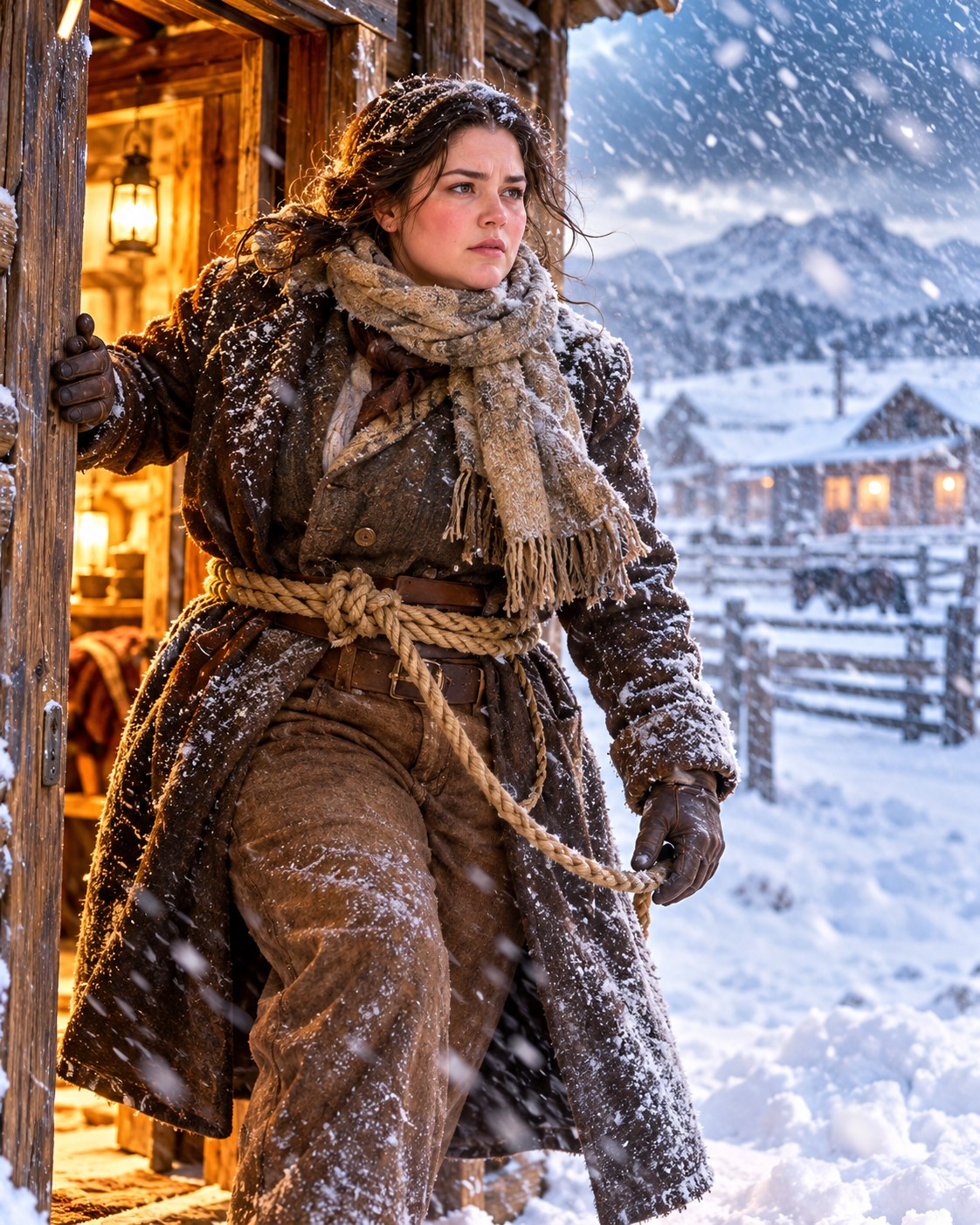
"Because I'm going after my husband."
Sam's face drained of color.
"No, ma'am."
"Sam—"
"You won't make it a hundred yards."
Henrietta swallowed.
She knew he was probably right.
Her knees were already aching.
Her hands had begun to stiffen.
The cold would make everything worse.
But Calvin was somewhere beyond that window.
Injured.
Alone.
Possibly dying.
And she could not bear the thought of sitting beside a warm fire while he froze.
Sam stepped in front of the door.
"Mrs. Brooks, please. You can't do this."
Henrietta looked at him.
Her voice was quiet.
"I have spent my entire life listening to people tell me what I cannot do."
The wind roared.
She tightened her grip on the cane.
"My father told me no man would ever want me. My husband told me I was nothing more than an obligation. And everyone who has ever looked at me has decided what my body makes impossible."
Sam's eyes filled with worry.
Henrietta continued.
"But Calvin is out there."
She looked toward the white landscape.
"And I am not going to let him die because someone decided I was too weak to save him."
Sam opened his mouth.
Then stopped.
Because outside, through the blinding snow, something moved.
A dark shape appeared near the fence.
At first, Henrietta thought it was a loose branch.
Then it moved again.
Sam stepped toward the window.
His face changed.
"Dear God."
Henrietta gripped the windowsill.
"What is it?"
The shape stumbled into the yard.
A horse.
Calvin's horse.
Alone.
Its saddle was twisted.
One stirrup hung loose.
And dark blood stained the leather.
Henrietta felt her heart stop.
Sam rushed toward the door.
But before he could open it, the horse staggered closer.
Something was caught beneath the saddle.
A strip of torn fabric.
Henrietta recognized the color.
It was from Calvin's coat.
Then she saw what was attached to it.
A small piece of paper.
Folded.
Tied tightly with a length of string.
Sam stared.
"Mrs. Brooks..."
Henrietta reached for the door handle.
The wind screamed outside.
She opened the door just enough to see the paper clearly.
And written across it, in handwriting she recognized, were three words.
DON'T TRUST SAM.






Comments 0