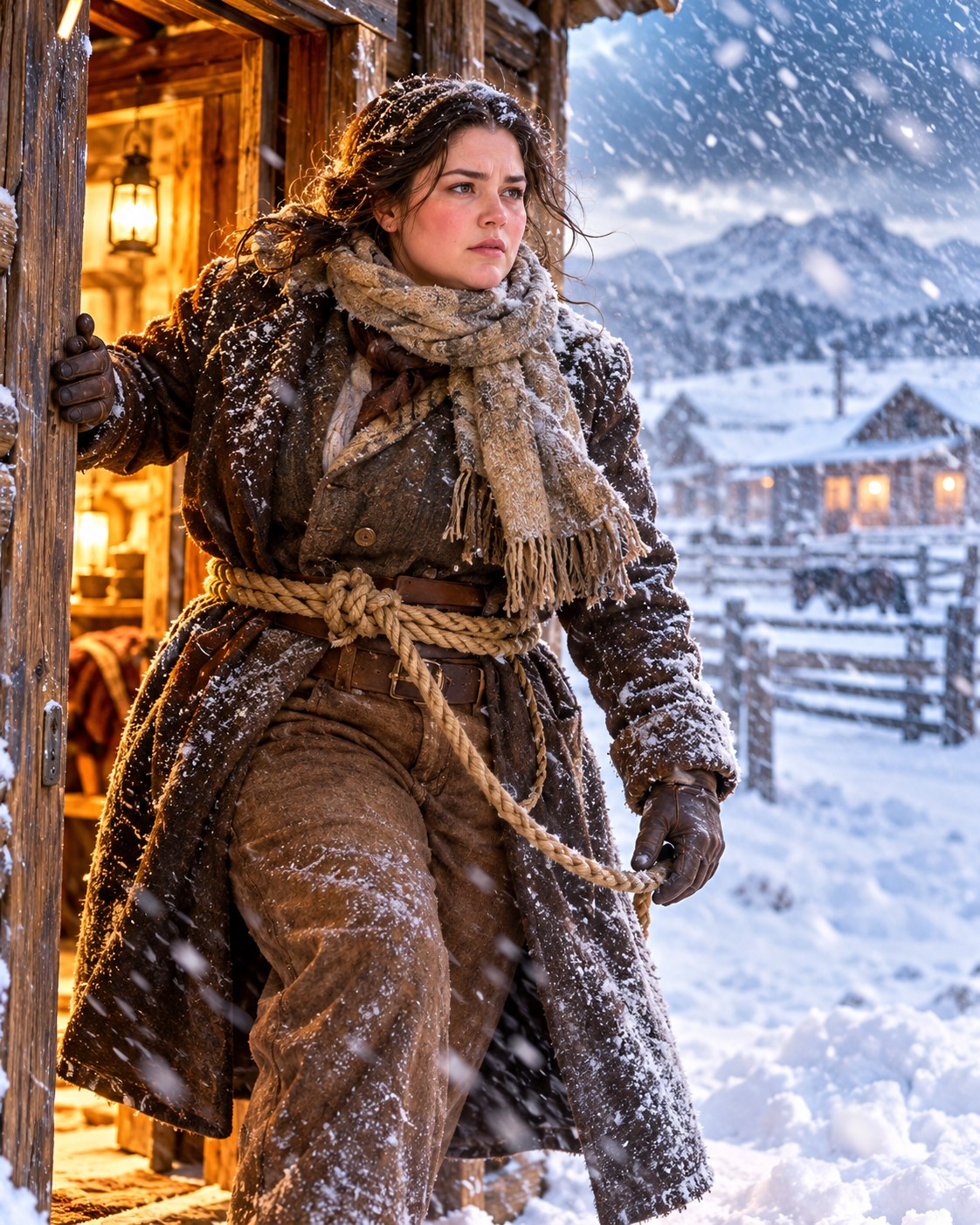
"Ask her why Arthur Whitcomb really sent her out here."
The banker's words hung in the cold evening air.
Calvin Brooks stood on the porch, staring at the man who had spent the last three years trying to take his family's land.
"What the hell is that supposed to mean?"
Walter Hargrove smiled.
He was a heavyset man in his late fifties, with thinning silver hair, expensive gloves, and the smug expression of someone who had never been forced to choose between paying a debt and buying food.
He owned the largest private lending office in Cheyenne.
He also held enough mortgages across Wyoming to make half the territory afraid of his name.
"Come now, Brooks. Surely you didn't think a Chicago railroad millionaire simply woke up one morning and decided to purchase his daughter a cowboy."
Calvin stepped closer.
"Watch your mouth."
Hargrove chuckled.
"Touchy, aren't we?"
Inside the house, Henrietta stood beside the dining table.
The open ranch ledger lay beneath her hand.
She could hear every word.
She wanted to close the book, walk into the kitchen, and pretend she had heard nothing.
Instead, she remained still.
Something in Hargrove's voice frightened her more than his words.
He sounded certain.
As though he possessed information that could destroy the fragile arrangement on which her entire future depended.
Calvin spoke again.
"If you've got something to say, say it."
Hargrove removed a folded paper from his coat.
"Your father-in-law has business interests in Wyoming. Railroad interests, specifically."
"I know what Whitcomb does for a living."
"Then perhaps you also know that a proposed freight route could eventually cross this valley."
Calvin frowned.
"There's no railroad coming through Broken Spur."
"Not today."
Hargrove smiled again.
"But land becomes very valuable when people begin drawing lines across maps."
Calvin's expression darkened.
"What does that have to do with Henrietta?"
"Perhaps nothing. Perhaps everything."
"Stop talking in circles."
Hargrove leaned closer.
"Whitcomb didn't choose you because he liked your character, Brooks. He chose you because you were desperate enough to sign anything."
Calvin felt his jaw tighten.
"And you know this how?"
"Because men like Whitcomb don't make charitable investments."
Inside, Henrietta looked down at the ledger.
Her father's name was not among the entries.
But the signature she had discovered belonged to Walter Hargrove.
She examined the figures again.
A payment had been recorded as received by Hargrove's office.
Another had been marked as an administrative expense.
A third had been deducted from the ranch's account without any corresponding invoice.
Henrietta's heart began beating faster.
The banker outside was accusing her father of manipulation.
Yet the records suggested Hargrove himself had been taking money from Broken Spur.
She reached for her pencil.
Outside, Calvin's voice rose.
"You came here to collect a debt. Not discuss my marriage."
"Your marriage is precisely why I'm here."
Hargrove tapped the folded paper against his palm.
"That five thousand dollars settled the original mortgage. But the separate obligation remains."
"What obligation?"
"Additional advances, penalties, and expenses."
"Expenses for what?"
"Keeping your ranch from being seized before Whitcomb's money arrived."
Calvin stared at him.
"You never mentioned any additional advances."
"You signed the documents."
"I signed a mortgage."
"And several related agreements."
Calvin took a step forward.
"Show me."
Hargrove's smile faded slightly.
"The records are at my office."
"Then bring them."
"Certainly. But until the balance is settled, Broken Spur remains exposed."
Calvin's hands curled into fists.
"How much?"
"Five thousand dollars."
The number struck him like a blow.
Another five thousand.
After everything he had sacrificed.
After marrying a woman he barely knew.
After enduring the humiliation of accepting money from a stranger.
He was still facing ruin.
Hargrove watched the realization spread across his face.
Then he delivered the final insult.
"Perhaps your wife has another wealthy relative willing to purchase a few more years of your pride."
Calvin grabbed the front of his coat.
"Get off my land."
Hargrove's smile vanished.
"Take your hands off me."
"Now."
For a moment, neither man moved.
Then Hargrove slowly pulled free.
He straightened his coat.
"You have thirty days, Brooks."
Calvin stared at him.
"Thirty days before what?"
"Before I begin proceedings against the remaining security."
"You can't take this ranch twice."
"No," Hargrove replied. "But I can pursue what your signature still guarantees."
He descended the porch steps.
Then he turned.
"And tell your wife I hope she's enjoying Wyoming. Her father certainly has interesting plans for it."
Calvin watched him climb into his carriage.
The horses moved away.
Only when the wheels disappeared beyond the fence did Calvin turn toward the house.
He opened the door.
And found Henrietta standing beside the dining table.
The ledger was open.
A pencil rested between her fingers.
For a moment, neither spoke.
Then Calvin looked at the book.
His expression changed.
"What are you doing?"
Henrietta swallowed.
"Looking at the ranch accounts."
His eyes narrowed.
"I told you not to go through my things."
"I know."
"Then why is that book open?"
"Because something is wrong."
Calvin gave a harsh laugh.
"Yes, Henrietta. Something is wrong. The banker just informed me that I owe another five thousand dollars."
"I heard."
"Then you understand why I'm not in the mood for explanations."
She looked down at the figures.
"Calvin, I believe some of these debts may not be legitimate."
He stared at her.
"What?"
"There are duplicate entries. Payments recorded twice. Charges without receipts. Several amounts don't agree with the bank statements."
Calvin looked at the ledger.
Then back at her.
"You've been here six days."
"Yes."
"And you think you've discovered something I've missed in six years?"
Henrietta felt the familiar sting of dismissal.
But she did not lower her eyes.
"I think the records deserve another look."
Calvin approached the table.
"Give me that."
She stepped aside.
He pulled the ledger toward him.
His eyes moved across the columns.
Henrietta pointed to one entry.
"Here. September twelfth. Two hundred and forty dollars for cattle feed."
"I remember buying feed."
"Yes. But the same invoice appears again on October third."
"Could've been another delivery."
"The invoice number is identical."
Calvin stopped.
Henrietta continued.
"And this payment of one hundred and eighty dollars was deducted twice, even though the receipt shows only one transaction."
He frowned.
She turned another page.
"These smaller charges add up."
Calvin studied the figures.
For several seconds, the only sound was the ticking clock.
Then he closed the book.
"You're making assumptions."
Henrietta stared at him.
"I'm reading what is written."
"You don't understand how ranch accounts work."
"I understand addition."
His face hardened.
"Don't get clever with me."
She drew a slow breath.
"I wasn't trying to."
Calvin pushed the ledger across the table.
"Leave my business alone."
Henrietta looked at the book.
Then at him.
"Very well."
She picked up her pencil.
Calvin expected an argument.
He expected her to insist she was right.
Instead, she gathered her papers and moved toward the kitchen.
He watched her go.
Something about her quiet obedience irritated him more than defiance would have.
"Henrietta."
She stopped.
"Yes?"
"Did your father tell you anything about a railroad?"
She turned slowly.
"No."
"Nothing about land in Wyoming?"
"No."
"Are you certain?"
Her expression changed.
"Are you asking whether I knew he might have business interests here?"
"I'm asking whether this marriage was part of some arrangement I wasn't told about."
Henrietta looked at him for a long moment.
Then she spoke quietly.
"Calvin, I learned about our marriage three months before it happened. My father told me you needed money and I needed a husband."
She paused.
"That was all."
He studied her face.
"Why would he choose this ranch?"
"I don't know."
"Why Wyoming?"
"I don't know."
"Why me?"
Her eyes filled with pain.
"Because you were willing."
The words struck harder than she intended.
Calvin looked away.
Henrietta waited.
When he said nothing, she continued toward the kitchen.
This time, he did not stop her.
The next morning, Henrietta woke with a decision.
She would not interfere with Calvin's business.
But she would not ignore what she had found.
There was a difference.
She had spent nearly twenty years helping manage her father's household expenses.
She knew how money disappeared.
Sometimes through carelessness.
Sometimes through waste.
And sometimes because someone believed no one was paying attention.
Walter Hargrove had made one mistake.
He had assumed Calvin Brooks would never examine the numbers closely enough to challenge him.
Henrietta intended to prove otherwise.
After breakfast, she waited until Calvin and Sam left for the north pasture.
Then she carried the ledgers to the kitchen table.
She placed her father's account papers beside them.
She found a clean notebook.
And she began.
Every transaction was copied by hand.
Every receipt was matched to an entry.
Every unexplained charge received a mark in the margin.
By noon, she had discovered eleven discrepancies.
By evening, seventeen.
Her fingers cramped from writing.
Her back ached from sitting.
She had to stop several times to stretch her legs.
But the more she worked, the clearer the pattern became.
The errors were not random.
They clustered around payments processed through Hargrove's office.
Henrietta found duplicate interest charges.
A late fee assessed before a payment was due.
A credit that had never been entered.
And a livestock sale whose proceeds appeared to have been reduced by an unexplained handling charge.
She calculated the total.
Four hundred and eighty-six dollars.
Henrietta stared at the number.
Nearly five hundred dollars.
Enough to repair fences.
Enough to buy feed.
Enough to keep two hired hands working through winter.
She checked her calculations again.
Then she examined the separate obligation Hargrove had mentioned.
The documents were incomplete.
But the figures she could see suggested something deeply troubling.
The supposed additional debt included charges that appeared to have already been paid.
Henrietta sat back.
She had no legal authority to declare the debt invalid.
But she knew enough to recognize that Calvin needed an independent examination before paying another cent.
She opened her personal account folder.
Fifteen hundred dollars.
Her father had told her not to use it for Calvin's debts.
She understood why.
A woman without money of her own could become trapped in a marriage she could not escape.
But she also understood that saving the ranch would mean more than handing Calvin cash.
It meant preventing anyone from stealing what little he had left.
She took out a fresh sheet of paper.
At the top, she wrote:
Broken Spur Ranch — Reconciliation of Accounts.
Then she began organizing the evidence.
Three days later, Sam Pike found Henrietta standing beside the woodshed, examining a broken fence rail.
She had wrapped herself in a heavy shawl.
Her cane sank slightly into the muddy ground.
"Mrs. Brooks?"
She turned.
"Good morning, Sam."
He looked at the rail.
"Something wrong?"
"I was wondering whether this wood could be repaired rather than replaced."
Sam scratched his beard.
"Depends on the damage."
Henrietta pointed to the joint.
"The wood itself seems sound."
He leaned closer.
"Well, I'll be."
"Could the damaged section be cut away?"
"Probably."
"And the remaining piece used somewhere else?"
Sam smiled.
"Yes, ma'am. That's what we used to do before Mr. Brooks started buying new lumber whenever something broke."
Henrietta looked toward the barn.
"How much lumber is stored there?"
"More than he realizes."
She nodded thoughtfully.
"Would you mind showing me?"
Sam hesitated.
"Mr. Brooks said you were to stay close to the house."
"The barn is close to the house."
"That's true."
"And I promise not to climb anything."
Sam chuckled.
"All right, Mrs. Brooks."
He walked beside her toward the barn.
Henrietta moved slowly.
The ground was uneven.
Twice, she had to stop.
Sam waited without comment.
She appreciated that more than he knew.
Inside the barn, she found stacks of unused boards, bent nails, old hinges, and several pieces of equipment that appeared repairable.
She asked questions.
Sam answered.
By the time they returned to the house, Henrietta had made another list.
Not of things the ranch needed to buy.
Of things it already owned.
That evening, she prepared beef stew and fresh bread.
Calvin returned late.
His boots were muddy.
His shoulders sagged with exhaustion.
He ate two bowls without speaking.
Henrietta waited until he finished.
Then she placed a sheet of paper beside his plate.
He looked at it.
"What's this?"
"A list of materials in the barn."
Calvin frowned.
"Why?"
"Because I believe several repairs can be completed without purchasing new supplies."
He looked at the list.
"Sam helped you?"
"Yes."
Calvin's expression darkened.
"I told you not to interfere."
"I'm not interfering."
"Then what do you call this?"
"Trying to help."
He pushed the paper away.
"I don't need you telling me how to run my ranch."
Henrietta looked at him.
"Then perhaps you could simply tell me which repairs are most urgent."
Calvin laughed bitterly.
"Do you think this is some Chicago household where you can make lists and everything gets fixed?"
"No."
"Out here, mistakes cost money. Sometimes they cost lives."
"I understand."
"No, you don't."
He stood.
"You've never had to make a living from land that might freeze, flood, or fail you. You've never had cattle die because there wasn't enough feed. You've never watched a bank officer measure your father's property like he's already planning where to put the auction signs."
Henrietta remained seated.
Calvin's voice grew harsher.
"You think because you can cook a decent supper and organize a cupboard, you understand what it takes to keep this place alive?"
She looked down.
"No."
"Then stop pretending."
The room went silent.
Calvin stood breathing heavily.
Henrietta slowly folded the paper.
"Very well, Mr. Brooks."
He looked at her.
Something in her voice made him feel suddenly ashamed.
But pride was a stubborn thing.
He turned and left the room.
Henrietta waited until she heard his footsteps upstairs.
Then she unfolded the list.
She looked at the careful handwriting.
The measurements.
The notes Sam had helped her make.
And she whispered, "I wasn't pretending."
The following Sunday, Sam arrived carrying a small wooden box.
Henrietta was kneading bread when he knocked.
"Morning, Mrs. Brooks."
"Good morning."
He placed the box on the table.
"Thought you might like these."
Inside were several old hinges, screws, and small tools.
Henrietta smiled.
"Where did you find them?"
"Back of the tack room. Been sitting there for years."
She picked up a hinge.
"This would fit the pantry door."
"Exactly."
She looked at him.
"Did Calvin ask you to bring these?"
Sam hesitated.
"No, ma'am."
"Then why?"
The older man shrugged.
"Because you're right about something."
"What?"
"Broken Spur has been throwing away things that could be fixed."
Henrietta felt warmth spread through her chest.
"Thank you, Sam."
He smiled.
"Don't thank me yet. That pantry door's stubborn."
They spent the next hour repairing it.
Henrietta held the tools and directed the work while Sam handled the heavier tasks.
When the door finally swung smoothly, she laughed.
A real laugh.
The first one she had allowed herself since arriving in Wyoming.
Sam grinned.
"There she is."
Henrietta looked at him.
"Who?"
"The woman who ought to be running this place."
She shook her head.
"Don't let Calvin hear you say that."
Sam's smile faded.
"Mr. Brooks is a good man in some ways."
Henrietta looked toward the window.
"I hope so."
"He just doesn't always know how to show it."
She returned to the bread dough.
"Kindness shouldn't be so difficult, Sam."
The older man had no answer.
By the end of the second week, Henrietta had saved Broken Spur nearly seventy dollars in household expenses.
She repaired clothing instead of replacing it.
She preserved vegetables that would otherwise have spoiled.
She organized the pantry so supplies were used before they went bad.
She found a buyer willing to pay a fair price for surplus wool stored in the barn.
And she persuaded Sam to repair two damaged gates using lumber already on the property.
Calvin noticed the improvements.
He noticed that the pantry stayed stocked longer.
That the kitchen fire consumed less wood.
That the repaired gates worked properly.
But whenever he asked how something had been accomplished, Henrietta simply answered, "Sam helped."
Calvin knew better.
Sam had worked at Broken Spur for decades.
The ranch had never looked like this before.
One evening, he found Henrietta asleep at the kitchen table.
A half-finished mending project lay beneath her hands.
Her head rested against the back of the chair.
Her cane leaned beside her.
Calvin stopped in the doorway.
The lamp burned low.
A pot of stew sat covered on the stove.
Beside it was a plate of fresh biscuits.
He looked at Henrietta.
Her face was pale with exhaustion.
One hand rested over her swollen knee.
For a long moment, he stood watching her.
Then he quietly removed his coat.
He approached the table.
There was a wool blanket folded over the nearby chair.
He picked it up.
Henrietta stirred.
Calvin froze.
Her eyes opened.
"Calvin?"
He lowered the blanket awkwardly.
"You fell asleep."
She straightened.
"I'm sorry."
"Why are you apologizing?"
"I meant to have supper ready."
He looked toward the stove.
"It is ready."
"Oh."
She rubbed her eyes.
"I suppose I was more tired than I realized."
Calvin looked at her knee.
"Does it hurt?"
Henrietta followed his gaze.
"A little."
"How much is a little?"
She smiled faintly.
"Enough to remind me I have one."
He almost smiled.
Almost.
Then he noticed the mending.
His work shirt.
The one with the torn sleeve.
She had repaired it.
He picked it up.
"You didn't have to do this."
"I know."
"Sam could've taken it to town."
"That would have cost money."
Calvin looked at the neat stitches.
"You're always thinking about money."
Henrietta's smile disappeared.
"I thought that was why I was here."
The words struck him.
He looked at her.
She looked away.
For a moment, Calvin wanted to tell her that he had not meant to make her feel like a purchase.
But he had.
He had said the words himself.
He had accepted the money.
And he had spent two weeks treating her as though the marriage certificate were nothing more than a receipt.
He placed the shirt on the table.
"Go to bed," he said quietly.
"I'll clean up first."
"I can manage the dishes."
Henrietta looked surprised.
"Are you certain?"
"Yes."
She rose slowly.
Her knee stiffened.
Calvin instinctively reached toward her.
She noticed.
For one brief second, their eyes met.
Then she steadied herself with the cane.
"Good night, Mr. Brooks."
He lowered his hand.
"Good night, Henrietta."
She walked toward the stairs.
Calvin watched until she disappeared.
Then he looked at the repaired shirt.
He ran his thumb over the stitches.
And for the first time, he wondered whether he had mistaken gentleness for weakness.
The next morning, Henrietta received a letter from Cheyenne.
It was addressed to her personally.
The handwriting belonged to Edwin Mercer.
She opened it at the kitchen table.
Inside was a brief note.
Mrs. Brooks,
I have reviewed the questions you raised concerning the financial records you sent.
Your calculations appear sound.
Several charges assessed against Broken Spur Ranch warrant further investigation.
I strongly recommend that no additional payment be made to Mr. Hargrove until the underlying agreements have been independently examined.
I will make inquiries discreetly.
Respectfully,
Edwin Mercer.
Henrietta read the letter twice.
She had mailed copies of the questionable entries three days earlier.
She had not expected such a quick response.
But Mercer had confirmed what she suspected.
The ranch was losing money because someone had been mishandling its accounts.
Possibly deliberately.
She folded the letter.
Then she took out her notebook.
At the bottom of the latest page, she wrote:
Disputed charges identified: $486.
Additional claims require verification.
She stared at the figures.
Four hundred and eighty-six dollars.
It was not enough to save Broken Spur by itself.
But it was enough to prove that the ranch's problems were not entirely Calvin's fault.
And if Hargrove had been dishonest about the smaller amounts, perhaps the larger debt was not what he claimed either.
Henrietta felt a cautious flicker of hope.
For the first time since arriving, she believed she might be able to help Calvin in a way he could not dismiss.
Not by giving him her father's money.
But by showing him where his own money had gone.
She heard footsteps outside.
Calvin was returning from the barn.
Henrietta gathered the papers.
She intended to tell him everything.
But before she could rise, the front door opened.
Calvin entered with Sam behind him.
Both men looked troubled.
"What happened?" Henrietta asked.
Calvin removed his hat.
"Nothing."
Sam glanced at him.
Henrietta noticed.
"Sam?"
The older man cleared his throat.
"Mrs. Brooks, the north fence gave way."
Henrietta's heart sank.
"Was anyone hurt?"
"No, ma'am. But six cattle got through."
Calvin threw his hat onto the table.
"And now we've got to spend money we don't have replacing half a mile of fencing."
Henrietta looked toward her notebook.
"Perhaps we don't."
Calvin turned.
"What?"
She stood slowly.
"I believe there may be enough usable lumber in the barn to repair the damaged sections."
"We've been through this."
"Yes. But Sam and I counted the boards."
Calvin looked at Sam.
The older man nodded.
"She's right, Mr. Brooks. There's more good lumber back there than we thought."
Calvin frowned.
"Enough?"
"Maybe not for everything. But enough to start."
Henrietta continued.
"And I found several charges in the accounts that appear to have been entered incorrectly."
Calvin's expression hardened.
"Henrietta—"
"Please."
The word was quiet.
But something in her voice stopped him.
She placed Mercer's letter on the table.
"I asked an attorney to examine the figures."
Calvin stared at her.
"You did what?"
"I sent copies of the questionable entries to Mr. Mercer."
"Without asking me?"
"Yes."
His face darkened.
"That's my business."
"And someone may be stealing from it."
The room fell silent.
Sam looked sharply at Henrietta.
Calvin stared.
"What did you say?"
She took a slow breath.
"I cannot prove theft. Not yet. But the records contain errors that have cost this ranch nearly five hundred dollars. And Mr. Mercer believes the additional debt should be examined before you pay anything more."
Calvin looked at the letter.
Then at the notebook.
He picked up the papers.
His eyes moved across the calculations.
For several minutes, no one spoke.
Henrietta stood beside the table.
Her knee ached.
Her hands trembled slightly.
But she waited.
Finally, Calvin looked up.
"You're telling me Hargrove may have been charging me money I didn't owe?"
"Yes."
"And you found this?"
"Yes."
He looked down again.
Sam stepped closer.
"Mr. Brooks, if she's right—"
"I can read, Sam."
The older man fell silent.
Calvin examined another page.
Then another.
His expression changed.
Not to gratitude.
Not yet.
To something more complicated.
Shock.
Anger.
And the painful realization that the woman he had dismissed as useless had discovered something he had overlooked for years.
He set down the notebook.
"Why didn't you tell me sooner?"
Henrietta looked at him.
"I tried."
Calvin said nothing.
She continued quietly.
"You told me to leave your business alone."
His face tightened.
Sam looked away.
For several seconds, Calvin stared at the papers.
Then he picked up his hat.
"I need to speak to Hargrove."
Henrietta stepped forward.
"Calvin, please don't confront him without the documents."
He stopped.
She continued.
"If he's made honest mistakes, he should be given the opportunity to correct them. But if he hasn't, you'll need evidence."
Calvin looked at her.
For once, he did not dismiss her advice.
He studied the notebook.
Then he slowly placed his hat back on the table.
"All right."
Henrietta blinked.
"All right?"
"We'll wait."
It was a small concession.
But to Henrietta, it felt enormous.
Sam smiled.
"Well, I'll be damned."
Calvin shot him a look.
"Go check the horses."
Sam hurried toward the door, still smiling.
Henrietta gathered her papers.
Calvin watched her.
He wanted to say thank you.
The words sat somewhere behind his teeth.
But he had spent so many years believing gratitude was a form of weakness that he could not force them out.
Instead, he said, "Don't send any more letters without telling me."
Henrietta's expression softened slightly.
"Very well."
He turned toward the door.
Then stopped.
"Henrietta."
"Yes?"
He hesitated.
"The figures. Are you certain?"
She met his eyes.
"Absolutely."
Calvin nodded.
Then he left.
Henrietta watched the door close.
She waited for the familiar disappointment.
But this time, something different remained.
He had listened.
Not warmly.
Not graciously.
But he had listened.
And for the first time, she believed Broken Spur might have a future.
Three weeks later, the ranch looked different.
The repaired north fence stood straight.
The barn had been reorganized.
The household expenses had fallen.
Several old debts had been questioned.
And Calvin had begun leaving the ledgers on the kitchen table instead of locking them away.
He never asked Henrietta to examine them.
But he no longer stopped her.
She understood the invitation.
Every evening, after supper, she reviewed the accounts.
Sometimes Calvin sat across from her.
Sometimes he asked questions.
Sometimes they argued over figures.
But slowly, a strange partnership began to form.
He understood cattle, land, weather, and the thousand unpredictable problems of ranch life.
She understood numbers, organization, and the quiet discipline of preventing waste.
Neither possessed everything the ranch needed.
Together, they were beginning to make a difference.
Yet Calvin still introduced her as Mrs. Brooks.
Never his bride.
Never his wife unless the law required it.
And he still slept in a separate room.
Henrietta told herself she had accepted those terms.
Most days, she believed it.
Then came the afternoon Walter Hargrove returned.
Henrietta was outside hanging freshly washed blankets on the clothesline.
The wind was cold.
Her joints ached.
She had wrapped a thick shawl around her shoulders.
Each blanket was heavy with water.
She lifted one carefully, using the line for support.
A carriage rolled into the yard.
Henrietta turned.
Walter Hargrove stepped down.
He looked at her.
Then at the blankets.
Then at the cane leaning against the fence.
A slow smile spread across his face.
"Well, well."
Henrietta straightened.
"Good afternoon, Mr. Hargrove."
He approached.
"So you're the famous Chicago bride."
She said nothing.
Hargrove looked her up and down.
His smile widened.
"I heard Brooks sold himself to a Chicago railroad man."
Henrietta tightened her grip on the wet blanket.
The banker laughed.
"Didn't realize they shipped the livestock with him."
Her face went still.
Hargrove stepped closer.
"For five thousand dollars, I'd have expected a woman who could fit through the front door without greasing the hinges."
Henrietta froze.
The blanket slipped slightly in her hands.
She had heard cruel remarks before.
At dinner parties.
In drawing rooms.
From men who believed money entitled them to humiliate anyone they considered beneath them.
But this was different.
This was her home.
The one place she had begun to believe she might belong.
Hargrove looked toward the barn.
"Where's your husband?"
Henrietta swallowed.
"Working."
"Of course he is."
The banker chuckled.
"Somebody has to earn a living."
She lowered her eyes.
"Mr. Hargrove, if you have business with Calvin, perhaps you should wait for him."
"Oh, I intend to."
He leaned closer.
"But first, I have a question for you."
Henrietta looked up.
His smile disappeared.
"How much did your father pay you to keep quiet about the railroad?"
She stared at him.
"I don't know what you mean."
Hargrove's eyes narrowed.
"Don't insult my intelligence."
"I'm not."
"Your father knows exactly what he's doing."
Henrietta gripped the clothesline.
"Then perhaps you should speak to him."
The banker laughed sharply.
"You're either a very good liar, Mrs. Brooks, or your father has made a fool of you too."
He stepped closer.
Henrietta instinctively shifted backward.
Her injured knee buckled slightly.
She caught herself against the fence.
Hargrove looked down at her cane.
Then smiled again.
"Careful. Wouldn't want Brooks's expensive purchase breaking before he's finished paying for it."
Henrietta's cheeks burned.
She opened her mouth.
But no words came.
Behind Hargrove, the barn door creaked.
Neither of them noticed.
The banker leaned closer.
"Tell me something, Mrs. Brooks. Did your father have to offer five thousand dollars because no man in Chicago would take you for free?"
Henrietta stared at him.
For a moment, she could not breathe.
Then she heard footsteps.
Heavy.
Fast.
Coming from the barn.
Hargrove turned.
Calvin Brooks was crossing the yard.
His face was pale with fury.
His hands were clenched.
And he had heard every word.
Hargrove opened his mouth.
"Now, Brooks, I was only—"
Calvin stopped directly in front of him.
"Say that again."
The banker laughed nervously.
"There's no need to get excited."
Calvin took one step closer.
"I said, say it again."
Hargrove glanced toward Henrietta.
Then back at Calvin.
And with a cruel little smile, he began to repeat the insult.






Comments 0