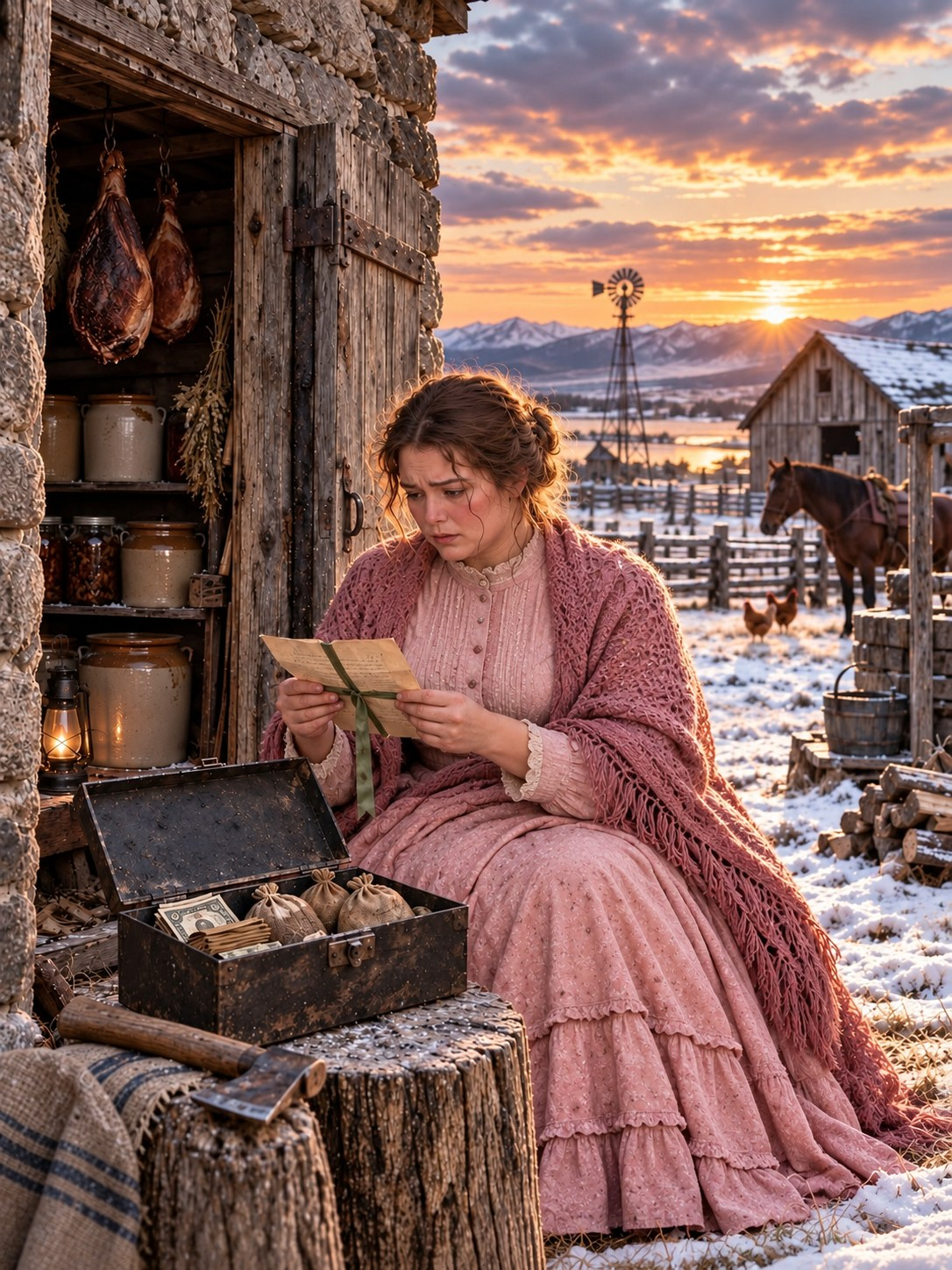
"Your father was murdered?" Deputy Thomas Reed demanded.
Martha Mercer stood beside the chopping block, gripping the yellowed letter so tightly that its edges bent beneath her fingers.
Charles Vane reached toward her.
"That document is private property."
Martha stepped backward.
"Then why does it have my name on it?"
Nobody answered.
Samuel Whitfield still held Vane by the wrist. Silas Pritchard stood near the county wagon, his face drained of color.
For several seconds, the only sound came from the horses shifting in the frozen yard.
Then Martha looked down at the letter again.
If you are reading this, Martha, then the man who murdered your father has finally come for the ranch.
Her father had died seven years earlier.
She had watched him die.
She remembered the doctor standing beside his bed, shaking his head. She remembered her mother's hands trembling as she folded the blanket over Nathaniel Mercer's chest. She remembered the terrible silence afterward.
The doctor had called it a failure of the heart.
There had been no investigation.
No accusation.
No suggestion that anyone had harmed him.
And now a dead woman named Hannah Whitfield was telling Martha that everything she believed about her father's death might be a lie.
"Let go of him," Deputy Reed ordered.
Samuel released Vane.
The lawyer stumbled backward, straightened his coat, and immediately reached for the letter.
Reed stepped between them.
"Nobody touches that paper."
Pritchard recovered his voice.
"Deputy, this is a county matter."
"Then it can wait until I understand why three grown men are fighting over a letter addressed to a young woman."
Vane's jaw tightened.
"You are exceeding your authority."
Reed turned toward him.
"Then I suggest you file a complaint."
Martha barely heard them.
She was staring at the handwriting.
Hannah Whitfield had written her name.
Not merely Mercer.
Martha.
The woman had known who she was.
Somehow, years before Martha claimed the ranch, Hannah had prepared a letter specifically for her.
Samuel approached carefully.
"Martha."
She looked up.
"Did you know?"
His expression was troubled.
"Know what?"
"That my father was murdered."
Samuel said nothing.
Martha felt something inside her harden.
"You told me Hannah knew my family. You showed me his name in the notebook. You knew there was an agreement."
"I knew there had been a dispute."
"Did you know my father died because of it?"
"No."
"Then why did you look frightened when you saw the letter?"
Samuel lowered his eyes.
"Because I knew Hannah had kept something from me."
Martha stared at him.
He looked older suddenly.
Not dishonest, exactly.
But burdened.
And she was beginning to understand that every person connected to this ranch seemed to be carrying a piece of the truth they were unwilling to surrender.
She unfolded the letter completely.
"Then I'm going to read it."
Pritchard took a step forward.
"You will do no such thing."
Deputy Reed turned.
"Mr. Pritchard, another word out of you and I'll ask you to wait by the wagon."
Pritchard's mouth opened.
Then closed.
Martha began reading.
Dear Martha,
I pray you never have reason to open this letter.
I have written it because there are truths that become more dangerous the longer good people remain silent.
Your father was an honorable man.
He made one terrible mistake.
He trusted Edwin Pritchard.
Martha stopped.
Edwin.
Silas Pritchard's father.
The same man who had tried to acquire the Whitfield ranch thirty years earlier.
She looked toward Silas.
He was staring at the letter as though he could burn it with his eyes.
Martha continued.
Many years ago, your father helped Amos and me prepare an agreement concerning the water beneath our north pasture. He was young then, but he understood the land better than most men twice his age.
Edwin Pritchard wanted that water.
He offered money.
Then he offered threats.
When neither worked, he arranged for a document to be signed under false pretenses.
Your father discovered the deception.
He tried to correct it.
That was when the trouble began.
Martha's fingers trembled.
She remembered her father sitting at their kitchen table, repairing a broken chair.
He had been a quiet man.
Patient.
Gentle.
The sort who apologized when he accidentally stepped on a dog's tail.
She could not imagine him involved in secret agreements, forged documents, or dangerous disputes.
But she remembered something else.
His habit of checking the windows after dark.
His refusal to let strangers inside.
The way he sometimes stopped speaking when a rider passed their house.
As a child, she had believed he was cautious.
Now she wondered whether he had been afraid.
She continued reading.
I cannot put every detail in this letter. The complete account is hidden where only someone familiar with Amos's work will know to look.
But you must understand this: your father did not die from an ordinary illness.
He was given something that weakened him slowly.
By the time anyone understood, it was too late.
Martha's knees nearly gave way.
She caught the edge of the chopping block.
Samuel reached toward her.
She shook her head.
"Don't."
He withdrew his hand.
Martha read the final lines.
I tried to warn him.
I failed.
If you have found this letter, the men who wanted our land may already be watching you.
Trust the original records, not the copies.
And remember that the money in the smokehouse was left for whoever had the courage to stay.
May you be treated more kindly than your father was.
Hannah Whitfield.
Martha lowered the paper.
The yard seemed impossibly quiet.
For seven years, she had believed her father died because his heart had failed.
Now she was holding a letter claiming someone had deliberately made him sick.
She wanted to scream.
She wanted to demand answers.
She wanted to ride into town and force every man who had ever spoken her father's name to tell her what he knew.
Instead, she folded the letter carefully.
Then she looked at Silas Pritchard.
"Did your father kill mine?"
Pritchard's expression twisted.
"That is an outrageous accusation."
"I asked you a question."
"My father was a respected businessman."
"That wasn't my question."
Vane stepped forward.
"Miss Mercer, you are clearly distressed. I suggest we postpone this conversation."
Martha turned toward him.
"Did you know about the letter?"
Vane hesitated.
Only for a moment.
But it was enough.
"You did," she whispered.
He adjusted his gloves.
"I knew there were disputed family papers."
"Then why did you try to take them?"
"Because their authenticity has not been established."
Martha looked at the county wagon.
At the deputy.
At Samuel.
Then back at the two men who had arrived intending to remove her from the ranch.
"You came here expecting me to be frightened into selling."
Pritchard's eyes narrowed.
"Be careful."
"You offered two hundred dollars for one hundred sixty acres."
"A fair offer considering the property's condition."
"And you threatened to arrest me when I refused."
"Your claim is under investigation."
Martha held up the letter.
"Then investigate this."
Deputy Reed took the paper from her.
He read it once.
Then again.
His expression grew increasingly serious.
"Mr. Pritchard," he said, "I'm suspending the search until this can be reviewed."
Pritchard stared.
"You cannot suspend a magistrate's order."
"I'm not canceling it. I'm refusing to carry it out while there is evidence of possible misconduct involving the parties requesting the search."
"That is absurd."
"Then take it up with the sheriff."
Vane stepped closer.
"Deputy, Western Prairie Holdings has substantial interests in this matter."
Reed folded the letter.
"That may be the problem."
Martha looked at him.
He was a broad-shouldered man in his early thirties, with tired eyes and a face weathered by years outdoors.
She had barely noticed him when the wagon arrived.
Now she wondered whether he was the only person in the county willing to listen.
Reed handed the letter back.
"Miss Mercer, keep this safe."
"I intend to."
"And don't leave the ranch alone until we understand what's happening."
Martha glanced at Samuel.
"I wasn't planning to."
Pritchard gave a sharp laugh.
"You're making a serious mistake, Deputy."
Reed turned.
"Then I'll answer for it."
The county official climbed into the wagon.
Vane gathered his scattered documents.
But before leaving, he looked at Martha.
His expression had lost every trace of politeness.
"You have no idea what you've involved yourself in."
Martha met his eyes.
"Then perhaps you should have left me alone."
For a moment, something dangerous flashed across his face.
Then he smiled.
"Your father said something very similar."
Martha went still.
Samuel stepped forward.
"What did you say?"
Vane's smile disappeared.
"Nothing."
But Martha had heard him.
And she knew Samuel had too.
The lawyer climbed into the wagon.
Pritchard snapped the reins.
The horses moved forward.
Deputy Reed remained behind.
He watched the wagon disappear down the road.
Then he turned to Martha.
"Miss Mercer, I need to ask you something."
"Yes?"
"Did anyone come onto this property last night?"
Martha's stomach tightened.
"Two men."
Reed's expression changed.
"What happened?"
"They searched the smokehouse. I heard them outside the farmhouse."
"Did you see their faces?"
"No."
"Did they take anything?"
"A wooden case. I don't know what was inside."
Samuel looked sharply toward the smokehouse.
"A wooden case?"
Martha nodded.
"Long and narrow."
Samuel swore under his breath.
Reed noticed.
"You know what it was?"
Samuel hesitated.
"Hannah kept a small cedar case containing copies of old land surveys."
Martha stared at him.
"You never mentioned that."
"I didn't know it was still here."
"Where did she keep it?"
"Behind a loose stone near the smokehouse chimney."
Martha remembered the scraped wall.
The disturbed crocks.
The broken wood near the threshold.
"They found it," she said.
Samuel looked toward the road.
"Then they're ahead of us."
Reed insisted on inspecting the smokehouse before leaving.
The three of them crossed the yard.
Inside, the air smelled of old smoke and damp stone.
The crocks had been moved from their shelves.
A loose stone lay on the floor near the chimney.
Behind it was a narrow cavity.
Empty.
Samuel crouched beside it.
"Hannah showed me this place when I was a boy."
"Why?" Martha asked.
"She said every home needed somewhere to keep what mattered."
Martha thought of the tin box.
The letter.
The money.
The hidden notebook.
Hannah had been preparing for danger long before Martha was born.
Reed examined the footprints near the doorway.
"Two men," he confirmed. "One heavy. One lighter."
Martha removed the brass button from her pocket.
"I found this."
Reed turned it over.
The engraved letter caught the light.
P.
He frowned.
"Where?"
"Near the chopping block."
Samuel leaned closer.
"That looks like the buttons on the county office coats."
Martha felt her stomach tighten.
Reed slipped the button into a small cloth pouch.
"I'll compare it."
"Will you tell Pritchard?" she asked.
"Not until I have a reason to."
Martha studied him.
"Can I trust you?"
Reed looked at her for a moment.
"Not because I'm wearing a badge."
The answer surprised her.
He continued.
"Trust me when I've done something to earn it."
Martha nodded.
It was the first sensible thing she had heard from a county official since arriving in Cotton Hollow.
Reed mounted his horse.
"I'll speak to the sheriff. If anyone returns, send word immediately."
"How?"
"Samuel knows where to find me."
Then he rode away.
Martha watched until he disappeared.
Only then did she turn toward Samuel.
"You knew more than you told me."
He did not deny it.
"Yes."
"How much more?"
Samuel looked toward the smokehouse.
"Enough to know Hannah was afraid."
"Of Pritchard?"
"Of what the Pritchards might do if the original agreement ever surfaced."
Martha folded her arms.
"Then tell me everything."
Samuel sighed.
"Come inside."
They sat at the kitchen table while the afternoon light faded.
Samuel opened Hannah's notebook to the page containing Nathaniel Mercer's name.
"Your father was not simply a witness," he began.
Martha waited.
"He helped Amos survey the northern boundary."
"Why?"
"Because the original county maps were wrong."
"Wrong how?"
"The creek was marked as the property boundary. But the underground water source extended farther north."
"Onto someone else's land?"
Samuel shook his head.
"Onto land Edwin Pritchard wanted to purchase."
Martha frowned.
"I don't understand."
"Amos discovered that the water beneath his pasture fed several springs farther east. Edwin wanted control of those springs because he intended to sell access to cattle companies."
"Couldn't he simply buy the surrounding land?"
"He tried. But without the original water rights, he couldn't guarantee the supply."
Martha considered this.
"So he needed Amos to sign them away."
"Exactly."
"And my father discovered the agreement was fraudulent."
Samuel nodded.
"He believed Edwin had altered the survey after Amos signed it."
"Did Amos know?"
"Not at first."
"What happened when he found out?"
"He confronted Edwin."
"And?"
Samuel looked down.
"Three weeks later, Amos became ill."
Martha felt cold.
"Did he die?"
"Not then. He recovered. But he never trusted Edwin again."
Martha thought of her father.
Seven years earlier.
A mysterious illness.
A doctor who could not explain why his strength disappeared so quickly.
"Was the same thing done to him?"
Samuel's expression darkened.
"I don't know."
"But Hannah believed it."
"Yes."
"Why didn't she go to the sheriff?"
"She did."
"What happened?"
"Nothing."
Martha stared.
"Nothing?"
"The sheriff at the time said there wasn't enough evidence."
"Was he connected to Pritchard?"
Samuel hesitated.
"He was Edwin's brother-in-law."
Martha closed her eyes.
Of course.
The more she learned, the smaller Cotton Hollow seemed.
Every road led back to the same family.
Every official record passed through the same hands.
And every attempt to uncover the truth had been buried beneath paperwork.
She opened her eyes.
"What happened to the original agreement?"
Samuel looked at Hannah's notebook.
"That's what we've been trying to find."
"Who's we?"
He hesitated.
Martha leaned forward.
"Samuel."
He sighed.
"Hannah and I. Years ago."
"Did you find it?"
"No."
"Then why do you think it's still here?"
"Because Hannah told me she would never destroy it."
Martha looked toward the window.
The north pasture stretched beyond the barn.
Somewhere beneath that frozen ground lay a well that might explain everything.
"She said the complete account was hidden where someone familiar with Amos's work would know to look."
Samuel nodded.
"That's what troubles me."
"Why?"
"Because Amos had several hiding places."
Martha stared.
"How many?"
"At least four."
She nearly laughed.
Not because anything was funny.
Because the situation had become absurd.
She had arrived hoping to repair a roof and plant potatoes.
Now she was searching for evidence of a thirty-year conspiracy involving water rights, forged documents, and her father's death.
And the only person who seemed to know where the evidence might be had been dead for years.
Samuel stood.
"We should search the north well tomorrow."
"Why not today?"
"Because the sun will be down before we reach it."
Martha looked at the money hidden beneath the floor.
Four hundred eighty-two dollars.
Enough to begin a new life.
But not enough to purchase safety.
"Then tomorrow," she said.
Samuel nodded.
"I'll stay nearby tonight."
"Where?"
"The barn."
"The roof leaks."
"I've slept in worse."
Martha studied him.
"You don't have to."
"I know."
"Then why are you?"
Samuel looked at Hannah's notebook.
"Because I failed her once."
Martha waited.
But he said nothing more.
That evening, Martha counted the money again.
Not because she doubted the amount.
Because she needed something solid.
Something that did not change when another person entered the room carrying a new secret.
Three cloth pouches.
A leather wallet.
Four hundred eighty-two dollars.
The number remained steady.
Her life did not.
She spread the coins across the table.
Some were worn smooth.
Others still carried sharp edges.
She imagined Hannah Whitfield saving them one at a time.
A few cents from eggs.
A dollar from cured meat.
A small payment for mending.
Years of work.
Years of loneliness.
Years of refusing to surrender.
Martha wondered whether Hannah had ever intended to spend the money herself.
Perhaps she had planned to repair the barn.
Perhaps she had dreamed of buying another horse.
Perhaps she had simply wanted enough to survive the next winter.
Then her heart began failing.
And instead of allowing the money to disappear into county accounts, she had hidden it for someone who might need it.
Martha touched the green ribbon.
The gift felt heavier now.
It was no longer merely money.
It was a responsibility.
She could leave.
Samuel had said so.
She could take the four hundred eighty-two dollars and begin again somewhere far from Cotton Hollow.
But if she left, Pritchard would get the ranch.
The water.
The records.
Perhaps the final proof of what happened to her father.
Martha gathered the coins.
Then she stopped.
One of the pouches felt different.
The smallest.
It had been tied with a double knot.
She had counted its contents twice without examining the fabric.
Now she noticed a narrow line of stitching along the bottom.
The thread was darker than the cloth.
She turned the pouch over.
A small shape pressed against the fabric.
Not a coin.
Something flat.
Martha reached for her father's folding knife.
She hesitated.
The pouch was old.
Hannah had tied it carefully.
Cutting it felt almost disrespectful.
Then she remembered the letter.
Trust the original records, not the copies.
She slipped the knife beneath one stitch.
Then another.
The seam opened.
A small folded paper slid into her palm.
Martha stared.
It was no larger than a postage stamp.
She unfolded it carefully.
Inside was a series of numbers.
17—4—9.
Beneath them were two words.
North stone.
Martha felt her pulse quicken.
The north well.
The covered water source.
Perhaps the numbers referred to a location.
A measurement.
A code.
She held the paper toward the lamp.
The ink was faded but legible.
Then she noticed a second line.
Written so faintly that she almost missed it.
Not the first.
Martha frowned.
Not the first what?
Stone?
Well?
Agreement?
She turned the paper over.
Nothing.
She examined the pouch again.
No other hidden compartments.
She looked toward the barn.
Samuel's lantern glowed faintly through a crack in the boards.
She could call him.
Show him the paper.
Ask what the numbers meant.
But something stopped her.
He had admitted withholding information.
He had known about the cedar case.
He had known about Hannah's hiding places.
And he had not told her everything.
Martha folded the paper and slipped it inside her Bible beside Hannah's letter.
For the first time, she decided to keep a secret of her own.
The next morning, Samuel arrived at the farmhouse carrying a shovel, a coil of rope, and a small iron pry bar.
Martha had already prepared breakfast.
Boiled oats.
Weak coffee.
Two pieces of bread.
Samuel looked surprised.
"You didn't have to feed me."
"You worked on my door."
"That hardly earns breakfast."
"It does here."
He sat.
They ate quietly.
Then Martha asked, "Did Hannah ever mention numbers?"
Samuel looked up.
"What kind?"
"Survey numbers."
"Of course."
"Did Amos use them to mark wells?"
"Sometimes."
"How?"
Samuel set down his cup.
"He measured from fixed stones. Large ones that wouldn't move during floods."
Martha nodded slowly.
"How many stones?"
"Depends on the survey."
"Did he mark them?"
"Usually with a chisel."
Martha thought of the folded paper.
17—4—9.
North stone.
Not the first.
Samuel watched her.
"Why?"
Martha kept her expression neutral.
"Just wondering."
He studied her for a moment.
Then nodded.
"Let's go."
They crossed the yard and followed the fence toward the north pasture.
The ground was hard with frost.
Dry grass bent beneath their boots.
The barn disappeared behind a low rise.
Ahead, the land sloped toward a shallow depression surrounded by scattered rocks.
Samuel stopped.
"This is it."
Martha looked around.
There was no visible well.
No wooden cover.
No stone ring.
Only frozen earth and prairie grass.
"Where?"
Samuel pointed toward a large flat stone.
"Under there."
They approached.
The stone was broad and heavy, partly buried beneath dirt.
Samuel knelt and brushed away the frost.
A faint mark appeared.
A chiseled cross.
Martha's heart quickened.
"Amos made that?"
Samuel nodded.
"He used marks like this."
Martha looked around.
Several other stones lay nearby.
Some large.
Some small.
She counted them.
One.
Two.
Three.
Four.
Then she noticed another farther north.
A narrow stone standing upright near a patch of dead grass.
She approached it.
Samuel called after her.
"That's not the well."
Martha crouched.
The stone bore a faint mark.
Not a cross.
A number.
Nine.
She brushed away more dirt.
Beneath the number was another mark.
Four.
Martha's breath caught.
17—4—9.
She looked toward the flat stone covering the well.
Then back at the upright marker.
Perhaps the numbers were directions.
Seventeen paces.
Four stones.
Nine inches.
Or something else entirely.
Samuel approached.
"What did you find?"
Martha moved slightly, blocking his view.
"Just an old survey mark."
He leaned closer.
Then stopped.
His expression changed.
"Where did you see that before?"
Martha looked up.
"What?"
"That mark."
She said nothing.
Samuel stared at the stone.
Then at her.
"Martha, did Hannah leave you something else?"
She considered lying.
But the question was too direct.
And she had never been good at dishonesty.
"A small paper."
"Where?"
"Inside one of the money pouches."
Samuel closed his eyes.
For a moment, he looked almost relieved.
Then frightened.
"What did it say?"
Martha hesitated.
"Numbers."
"What numbers?"
"Seventeen. Four. Nine."
Samuel stepped backward.
His face lost its color.
Martha stood.
"What?"
He looked toward the flat stone.
Then toward the distant farmhouse.
"Those aren't survey measurements."
"Then what are they?"
Samuel swallowed.
"They're page references."
Martha stared.
"To what?"
He looked at her.
"To the original county ledger."
The wind moved through the dry grass.
Martha felt the folded paper inside her Bible, far away in the farmhouse.
"How do you know?"
Samuel's expression was grim.
"Because Hannah used that system when she believed someone was altering official records."
Martha looked at the marked stone.
"Then why write 'North stone'?"
Samuel crouched beside it.
He examined the base.
Then pressed his fingers into the frozen dirt.
"Because this is where she kept the key."
Martha knelt beside him.
Together, they cleared the soil.
A small iron ring appeared.
Samuel gripped it.
Pulled.
Nothing happened.
He wedged the pry bar beneath the stone.
Martha helped.
The stone shifted.
A narrow opening appeared beneath it.
Inside was a rusted metal cylinder.
Samuel reached down.
Lifted it.
And placed it on the ground.
Martha stared.
The cylinder was sealed with wax.
Dark green wax.
The same color as Hannah's ribbon.
Samuel examined the lid.
Then he looked at Martha.
"Whatever is inside this, we open it together."
Martha nodded.
He broke the seal.
The lid turned slowly.
Inside lay a tightly rolled sheet of paper.
Samuel removed it.
Unrolled it.
And went completely still.
Martha leaned closer.
Across the top was an official county heading.
Below it were columns of names and dates.
But one entry had been circled in red.
Nathaniel Mercer.
Beside his name was a payment amount.
Five hundred dollars.
And in the final column, beneath the heading Purpose, someone had written a single word.
SILENCE.
Martha stared at the page.
Her father's name.
A payment.
A reason.
Then she noticed the date.
It was three days before he became ill.
She looked at Samuel.
His face was pale.
"Who paid him?" she whispered.
Samuel turned the paper toward the light.
At the bottom was a signature.
Not Edwin Pritchard's.
Not Silas Pritchard's.
A woman's name.
Martha read it once.
Then again.
And the world seemed to tilt beneath her feet.
The signature belonged to Ellery Booker.
The woman who had raised her.
The woman who had taught her everything.
The woman Martha had trusted more than anyone alive.
Samuel looked at her.
"Martha?"
She could barely speak.
"That's impossible."
But the signature was clear.
And beneath it, in smaller handwriting, was a final instruction.
Payment authorized. Witness to be removed before the next hearing.
Martha stepped backward.
The wind rose.
The paper trembled in Samuel's hands.
Then, from somewhere beyond the ridge, a rifle cracked.
Samuel dropped to the ground.
Martha turned toward the sound.
A second shot struck the stone beside her.
And from behind the abandoned barn, a man's voice shouted—
"Leave the papers, Martha! Your father should have listened the first time!"






Comments 0